Hidden Masterpieces
A painter and etcher whose works have found a permanent place in the leading American museums, EVERETT WARNER IS an authority on lighting and backgrounds, having acted as a visibility expert for the U.S. Nary during two world wars. It has long been his conviction that some of the finest works of art hare been victimized by the shadows or the wrongly tinted backgrounds which mar their mounting.
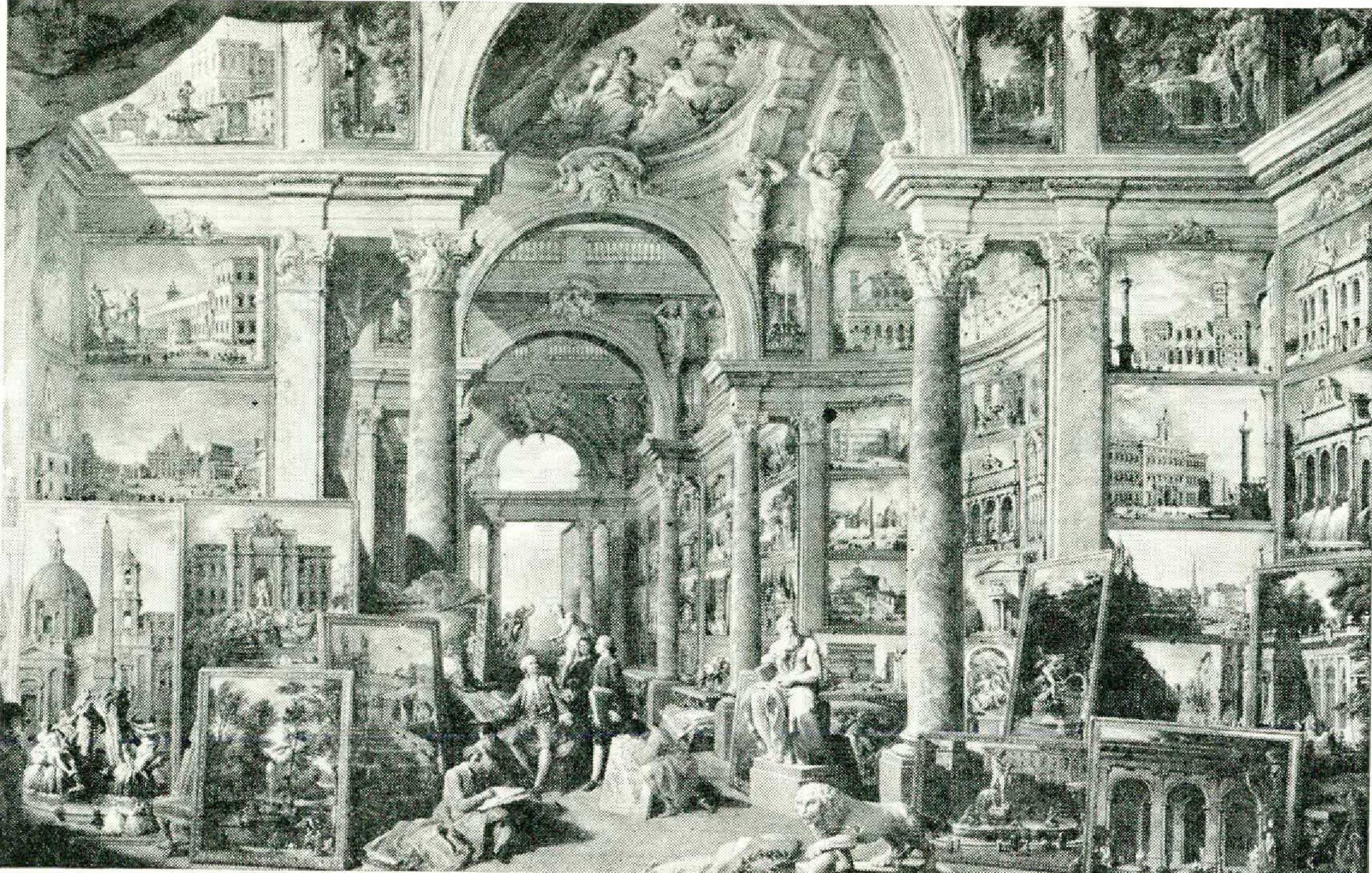
DURING the months which followed the theft of the Mona Lisa from the walls of the Louvre, the Paris papers were filled with ingenious conjectures about the manner of its disappearance. The most amusing one purported to be a confession on the part of two art students.
The two young men had been copying in the gallery, and, at closing time, a sudden impulse led them to carry off the Mona Lisa. They bore it out boldly under the nose of the guard and carried it to the Studio which one of the pair was occupying in the Quartier Montparnasse.
The enormity of the crime and the responsibility of concealment so weighed on the minds of the students that they set out, bearing the famous work, and they roamed the streets all night, trying to decide what to do with it.
As they were crossing the Pont Alexandre III in the early morning, they noticed signs of activity around the Grand Palais, and suddenly they realized that it was the day lor receiving entries for the Autumn Salon. It was the work of a moment to deposit the picture at the Grand Palais and to make out an entry form for a mythical artist named Henri Duval. They returned to their studios to find all Paris reverberating with the news of the sensational crime. The days passed without any suspicion falling on them, but they dreaded the time when the Salon would be thrown open to the public, It was with mingled fear and curiosity that they attended the vernissage, only to find that they need not have worried at all. They discovered the Mona Lisa with some difficulty—just an insignificant picture, hung way up on the fourth row and in a dark corner to boot.
The two students stayed in the gallery all afternoon while distinguished critics and opulent connoisseurs came and went without anything more than a careless glance at the Henri Duval—who had ever heard of him anyway? So it was with the days that followed. The Mona Lisa remained in full view before an entirely oblivious public, and when the Salon closed, the students presented their coupon at the Grand Palais and reclaimed the picture!
In our enjoyment of this wicked satire on the fallibility of expert opinion, there is danger that we may miss a very vital point: the important roles played by bad hanging and bad lighting. When a thief walks out of a museum carrying a masterpiece under his arm, it makes big headlines. Why are we never excited over the daily recurring losses constantly imposed on great pictures by poor light and unwise hanging? For many years Raphael’s Madonna Enthroned remained in a narrow gallery where the main panel was quite visible but the lunette above was largely blotted out by the reflection from the skylight. It took the upheaval caused by the reconstruction program of the Metropolitan Museum to get it out of this unfortunate location.
The plight of an even more celebrated painting, Gainsborough’s Blue Boy, had even less justification, because it could have been remedied in twenty minutes. When last seen in Huntington Gallery in San Marino, California, it had been hung between two larger pictures. A bronze had been placed in the center of the wall, and the Blue Boy hung above it, so that the lad’s feet were just on the level of the visitor’s eyes. The head could not be seen at close range owing to the obliterating reflection of the skylight, and the entire figure could be seen well only when you backed clear against the opposite wall of the gallery, a solution which few visitors discovered. The immediate remedy would be to discard the mediocre bronze and lower the Gainsborough to the picture rail; but, better still, since rails are an anachronism, they should be knocked out and all the pictures lowered.
No one would have been more irate over this high hanging than Gainsborough. In 1784 he had a full-length portrait to send to the Royal Academy, and he made a special request that it be hung as close to the floor as possible. When this request was ignored Gainsborough had the canvas brought back to his studio and never again sent anything to the Academy.
How much progress are we making in the hard task of getting pictures out oi darkness and into the light? Some answers to this question may be found by glancing at the major face-lilting programs which have been brought to substantial completion in the three greatest museums of the world — the Louvre, the Uffizi in Florence, and the Metropolitan Museum in New York. How has the Mona Lisa fared? Materially better than in the old light of the Salon Carré, because the Louvre wisely recognized the desirability of painting the gallery walls almost white, which, by reflection, has added greatly to the available daylight. Reinforcing daylight with an artificial illumination of fine quality will always prove a difficult problem on account of the murals and the decorative features of the ceilings.
Inevitably the renovation of such ancient galleries involves a mixture of tradition and pioneering. An example of the latter is the removal of the fine collection of Ingres portraits from the walls and their relocation on individual screens, set at the angle necessary to obviate blinding reflection from side windows. This same method has been followed in the rebuilt Palazzo Bianco in Genoa, and it seems to have won some favor in America.
In the Louvre the old order still holds sway in the Salle Rubens, furnished with crimson hangings and surrounded by little galleries or cubicles all in different colors, like a random bouquet of garden flowers. Most people will agree with Michel Seuphor, who described this décor as “an irritant to anyone interested more in the paintings than in their settings.” The Louvre collections have been long so closely linked with the national monument in which they are housed that the removal of any part of them to more suitable quarters is unthinkable to a Frenchman.
The Uffizi was more fortunate: it was bombed accidentally. Exterior reconstruction had to ftallow Vasari’s original plan, and it conforms to the spirit of medieval Florence and the repaired Ponte Vecchio nearby. Inside, the corridors are decorated in duplication of the old style, but the picture galleries are now finished mostly in the modern manner with light-colored walls, and there are some novel experiments in “indirect daylight.” In the room devoted entirely to Botticelli, there is a soft diffused glow under which Allegory of Spring and the Birth of Venus look beautiful indeed.
The improvements in the Uffizi are part ol a broad modernization movement which first took shape in the Palazzo Bianco and in Milan’s Palazzo di Brera and culminated in the very advanced reconstruction of the Capodimonte Museum near Naples. The Palazzo Bianco, which was reconstructed under the direction of architect Franklin Albini out of the rubble of wartime bombing, reveals several significant breaks with tradition in its internal planning, and though only a few hundred works of art are on view in the galleries, there are reportedly more than a thousand stored in the basement, hung on wire cables so that they can be slid out into view. Theoretically these are supposed to be accessible to the public, but unless your command of Italian is more persuasive than mine you will not get a peek at them. This is a preliminary step toward the visible storage which every really functional museum must provide eventually. The new Whitney Museum in New York has basement storage for eight hundred pictures, which hang on metal screens and can be slid out for examination, but these are not for the public either. We must still wait for some institution to provide specially constructed storage space, attendants, and adequate lighting, so that a serious student will feel that he has as much right to call for a stored picture as he now has to ask for a print.
With its ever-growing acquisitions, the typical museum of today is beginning to resemble an iceberg in that a large amount of its bulk never meets the eye. Instead of facing this situation by showing paintings in planned rotation, most institutions cling resolutely to the idea that all those judged to be the better works should be kept continuously on exhibit, and the remainder should be consigned to basement darkness and oblivion. This injects into the problem a large clement of personal preference. and it is useful to recall that many years ago, after the tenure of a British director of the Metropolitan had come to an end, the Italian primitives, which are now highly prized upstairs, were found down in the cellar. In too many cases a sentence to the basement becomes permanent, because a good picture appears to deserve its fate when seen under poor conditions.
WHEN the Metropolitan Museum was reopened to the public four years ago, after an extensive renovation which was reputed to have cost around ten million dollars, there were some of us who felt that hardly a fair share of that expenditure had been devoted to genuine improvement in the display of paintings. The impressive hall, filled with medieval art and bung with tapestries, was a significant achievement, but in the picture galleries we looked in vain for decisive forward steps in the lighting or in the handling of the walls. Under the current guiding hand of Director James Rorimer important progress has been made, the more noteworthy because he inherited gallery installations which had been given little real modernization.
The old museum had many dark, gloomy rooms in pronounced red and green colors, which were quite bad for the hanging of pictures, and instead of drastic changes they were given a beauty treatment, reappearing in more sumptuous form, hung with specially designed imitation brocades in red, blue, and yellow. But every good picture has a planned color harmony of its own. To convey its message well, a painting needs a surrounding zone of quiet color. An artist friend, visiting “Shorty” Lasar’s studio in Paris, was intrigued by a long line of gaily colored rags stretched across the room, and asked the painter the meaning of it.
“ That,” said Shorty, “is the Paris Salon. I am trying to paint my picture so that the other paintings won’t knock it out.”
Fortunately, the Metropolitan emerged from its reconstruction program with a few galleries in pale shades. You can make a comparison of appearance by studying a group of small Italian primitives of the Robert Lehman Collection hanging on a red brocade background, and then examining similar small paintings hung elsewhere on walls painted a very light neutral shade. The Lehman panels are not poorer works; they merely look inferior, owing to an unsuitable background which deprives them of some of their richness of color and of their individual significance. Before leaving this gallery, take a look at the El Greco to sec if you do not agree that there has been a very unhappy marriage between the red brocade wall and Saint Jerome’s red robe. There may be something in the terms of the bequest that requires all these pictures to be hung in the same gallery, but surely there is no stipulation requiring the wall to be red.
A wide divergence in the colors and reflectances employed for backgrounds makes evaluation of pictures difficult. Few would maintain that Guardi was as great a painter as Canaletto, yet when you find the latter’s Piazzetta muted down by its location on a wall the color of pistachio ice cream, you are likely to judge Guardi’s Venetian canvas, seen on a neutral background, to be the greater achievement. I have followed El Greco’s Cardinal de Guevara through many vicissitudes. I can remember how shocked I was when it was hung on a Pompeian red wall. What that wall did to the delicate rose of the cardinal’s gown was too cruel a thing to happen even to the churchman who was chief of the Spanish Inquisition. During the first stages of the Metropolitan renovation, this painting was shifted to a very light wall, which gave full resonance to its noble orchestration of color. It did not remain there long, however, and the next move was to a yellow brocade wall, where it did not have nearly the impact that it had before.
Van Gogh cut off his own ear with a razor, but it remained for the Metropolitan to cut off the top of his head, using for that purpose one of those lethal spotlights, which, blasting down from above, caused a very dark frame shadow over the upper part, concealing about one sixth of this very small self-portrait. The obliteration was the inevitable result of too vertical and too sharply directional illumination from spotlights or floodlights, used without the intervention of additional diffusing screens. This harsh, vertical lighting produces a network of minute highlights and tiny dark shadows over all but the most smoothly painted canvas, and since neither of these reflects much of the true color, the full vigor of the coloration is reduced.
IN A survey, Art Gallery Lighting, published in 1945, the Illuminating Engineering Society declared that natural lighting was obsolete and that “no satisfactory combination of natural and artificial lighting for art galleries is possible.” This publication was a well-documented study of the question, but it employed an exclusively scientific approach in dealing with what is equally an aesthetic problem. Since the whole purpose of gallery lighting is to provide the finest visual experience, why should not greater weight be given to the observation of pictures than to mathematical computations? A comparison is available in any museum equipped with both forms of lighting, and the Metropolitan will serve as well as any other for a field lest. Choose a winter day, because dusk comes then before the closing hour, and pay your visit in ample time to study a selected group under daylight. Return to each picture after the electricity has been turned on, and I believe you will agree that some pictures can be enjoyed no matter what the illumination, but others suffer serious loss under artificial light.
Washington can cross the Delaware just as well under one light as another, and a flashy work like Regnault’s Salome needs no special illumination, but the pictures which arc valued less for storytelling and more for pure art get the most benefit from daylight. The Prioress by Moroni is a good example, because you cannot possibly like it for its subject matter, and if you enjoy it at all, it will have to be for its art. It is a tough hurdle for beginners, but if you stay with it you may become aware of a delicate harmony of grays pervading the entire picture, and in future it will become a regular gallery stop — but not after dusk. The departing daylight takes with it just about all of that sensitive charm.
“All cats are black in a dark room.” A Chevreuil provided us with this arresting maxim to emphasize that our perception of color is wholly dependent on light and that a hue is revealed only under an illumination that contains rays of that same color. Since most pictures have been, and still are, painted in daylight, it is logical to expect that they would appear more as the artist intended if shown under that same illumination. The artificial illuminants now in use do not have exactly the same color pattern as natural light. Artists’ pigments may match under one but not under the other. For example, a blue sky painted during daylight with cobalt blue will turn gray under incandescent bulbs; on the other hand, an apparently similar sky painted with pthalo-cyanine blue, a recent addition to the palette, will change to a blue much more intense than before. When an artist has labored to create balanced color relationships, he is no more eager to have a pigment turn too brilliant than he is to have it become gray and lifeless.
A perfected system, employing both illuminants, long has seemed to be a reasonable goal of picture lighting. The project requires research in order to find a way to give artificial light more of that diffusion and fine color in which daylight excels and at the same time to devise some method of controlling those wide variations in intensity which make daylight’s performance so irregular. For some time the tool for taming daylight has been at hand: the photoelectric cell. It seemed feasible to focus electronic eyes on gallery walls, and through these eyes to actuate relays which would operate pivoted panels to screen down excess light from one wall while other electronic eyes were adjusting louvers to reflect light back on walls which were too dark. When daylight failed, even momentarily, to provide sufficient light, the system would bring in just enough artificial light to supply the deficiency. It was a real challenge, demanding imagination, ingenuity, and skill, and a small “pilot” gallery to test different methods, all of which required money. There was the rub. The only hope of financing such a project lay in a grant from some cultural foundation, which would be difficult to obtain since daylight had been declared officially dead by the engineers.
In the light of this attitude it was not surprising that the Museum of Modern Art blocked off all daylight entering its side windows, replacing it with a mediocre artificial illuminant. When the new Whitney Museum was built on the north side of the same lot, natural light was deliberately excluded by a solid roof and windowless walls, in order that the building might have a consistent artificial system from top to bottom. While the exclusion of daylight for even part-time use is regrettable, it is obvious that a mid-town museum must depend largely on artificial illumination. The lighting consultant, Thomas Smith Kelly, established a new standard of excellence in this field, using fluorescent tubes above a translucent ceiling to obtain very satisfactory diffusion.
Progress in daylight illumination was retarded but not halted by the Engineering Society’s verdict against it, and as time went on the potentialities of electronic eyes became increasingly familiar. The Sterling and Francine Clark Art Institute in Williamstown, Massachusetts, which was completed two years ago, used electronic eyes to open and shut skylight louvers. This was not in any sense complete automation, because the final control of light rested with museum personnel operating mechanical dimmers. It was, however, a step in the right direction; but the final goal was not reached until last year, when, if published accounts are accurate, the Capodimonte Museum, near Naples, put into use the complete automation, combining both natural and artificial illuminants.
In even the best museums an observant visitor will encounter mysterious oversights. Let us pick for an illustration the glass-topped case of American miniatures which has remained for a great many years in Gallery P 10 at the Boston Museum of Fine Arts, placed under, and at right angles to, a long narrow skylight, thus insuring a blinding reflection on the glass lids and making it almost impossible to get a good look at the miniatures. The remedy does not call for the services of an illuminating engineer; there is nothing to it beyond giving the cases a quarter turn to bring them parallel to the skylight overhead, in order to exchange its bright glare for the reflection of the dark cove of the ceiling. If, owing to insufficient slope of the glass lids, this should fail to remove all interference, the two cases could be separated and each moved a little closer to the side wall, thus producing perfect visibility for the works of art.
How can a thing involving so simple a correction escape attention for years on end? Has it been looked at many times but always with unseeing eyes? Possibly, but what seems more probable is that it has eluded diagnosis and that an easy remedy has not been indicated. It has not been identified clearly for what it is: a reflected image, and therefore controlled by that simple little law of elementary optics, “Light is reflected from a surface at the same angle as that at which it reaches that surface.” Ignoring this rule has caused more museum trouble than you may imagine. The full visibility of thousands of pictures is quite needlessly diminished because the pictures are hung too high to profit by this law, and as you attempt to get near to study these works a slight haze of light obscures the upper part of the canvas. The plight of the Blue Boy is repeated over and over again, and we cannot suppose that this would be tolerated if curators realized that dropping the picture lower on the wall would remove all interference.
No one has any difficulty in recognizing what the physicists call a specular image. Turning a hand mirror to the right angle to see your face is routine, but the equally simple solutions of altering the level of a painting or moving a glass-topped case to establish a new angle remain hidden mysteries. When the Gulbenkian Collection was placed on indefinite loan in the National Gallery, the owner stipulated that all the works must be shown under glass. Visitors discovered reflections of themselves on the glass, which was covering a dark painting. Naturally the museum officials were concerned over finding a method to meet this difficulty. Captain Charles Bittinger, a professional artist with a deep interest in optics, suggested that the Gulbenkian paintings be covered with what is called half-wave-length glass. This substantially reduced unwelcome reflections, though it did not eliminate them entirely.
A curious thing about all this concern of the National Gallery over these recognizable reflections is that less easily identified ones have for years been equally damaging to the appearance of certain pictures in the permanent collection, a direct result of the standard museum practice of elevating large, important pictures on built-up thrones to give them more honor than their fellows. Though at a considerable distance you can see all of Fra Filippo Lippi’s Annunciation, you will find upon moving closer that the heads are all blotted out by a bright image — the diffuse image of the skylight. More visibility would be a greater honor to pay any artist. When will we have the courage to tear out these foolish thrones everywhere, bringing the paintings down for clearer examination? Another high altar upon which it is common to offer paintings in sacrifice is the “Period Room,” where a picture much too good for such a poor location is shoved up over a mantelpiece or placed in a rectangular panel, bordered with an ornamental molding, which inevitably forces a full-length portrait up so high that the feet are at the observer’s eye level. The Marchesa di Balbi, by Van Dyck, cannot be seen from closer than twenty feet. At this point a diffuse reflection begins to mar the view of the Marchesa’s face, although in a functional gallery the canvas could be lowered several feet into a part of the wall which has good visibility. Period rooms belong in Museums of Decorative Art and are not suitable for the display of paintings of high quality.
We are living in an age of rapid change in museum construction, equipment, and management, and if we take stock of recent gains we find them impressive, though not in all directions. The overcrowding of walls is no longer considered quite respectable, and the pale neutral walls which provide both a sympathetic background and a secondary source of illumination are steadily replacing the dark or colored walls. Undoubtedly we have more light in the galleries today, but current fashions in artificial illumination are inclined to be too harsh and too highly directional to be the most suitable for pictures. Volume is not everything, and in the course of scientific advance that elusive thing, quality, is in danger of being neglected. As Andre Malraux has pointed out, “Humanity suffers from two ills — Tradition and Progress.”