Leaves of Gold
R. G. G. PRICE lives in Sussex and has contributed much light writing and literary criticism to PUNCH. He writes for the ATLANTIC on a variety of subjects.
When I was a boy I used to spend hours in secondhand bookstores, hoping to pick up a Shakespeare First Folio that had been overlooked during stocktaking. From time to time the proprietor of one of them would take pity on me as I searched so earnestly along his shelves, and try to introduce me to the World’s Great Literature, urging Marcus Aurelius or Epictetus on me in cheap editions; but I was not there for selfimprovement. I was there for loot.
As the years passed, I began to realize the narrowness of my aim. A prospector who wanted gold or nothing — spurning ferrous metals, kaolin, or sites for hotels — would be a man who wasted his chances, and, it struck me, a book hunter who hunted only First Folios was just as bad. As my literary sophistication increased, my hopes grew more versatile. By the time I was eighteen I should have been quite content with one of the minor Caxtons, preferably with hitherto unrecorded misprints. At twenty I was beginning to think that it would be quite pleasant to pick up a handful of the early Shelley pamphlets, association copies with marginal comments by, say, Byron.
Later I learned that there was money to be made out of the earliest work of contemporary authors. One did not need to strike it old to strike it rich. Comparatively few writers learn their job straight off and, in the strange world of the secondhand, this means that their misses are worth more than their hits. Nothing wins less kudos from the trade than a best seller. The ideal secondhand book is the slim, paperback volume of imitative verse that the tough-guy novelist has long hoped was forgotten; the blank-verse play that the great economist wrote when suffering from calf love; the guidebook that the famous poet produced under a pen name to pay his bills; the legends retold for the “kiddies” that the critical sophisticate has been trying to buy up ever since.
At one time I dreamed of buying new copies of the early works of future celebrities when they were first published. I soon found that to do this required a standard of talent spotting far beyond the highest flights I could soar to on wings of greed. The man who could foresee David Copper field in The Village Coquettes or even Hamlet in Henry VI, Part I was so different from me that I abandoned the fantasy of turning into him and sank into a happy eclecticism. I became ready to run my eye along a shelf, prepared to take anything that might turn up: a presentation copy of Paradise Lost, the corrected proof sheets of Huckleberry Finn, or Dale Carnegie juvenilia. I was no longer the kind of man who would throw back a Bay Psalm Book on the ground that he was trailing review copies of Françoise Sagan. I
must admit that as a trawler I was just as unsuccessful as I had been as an angler. It was just as well I never turned professional.
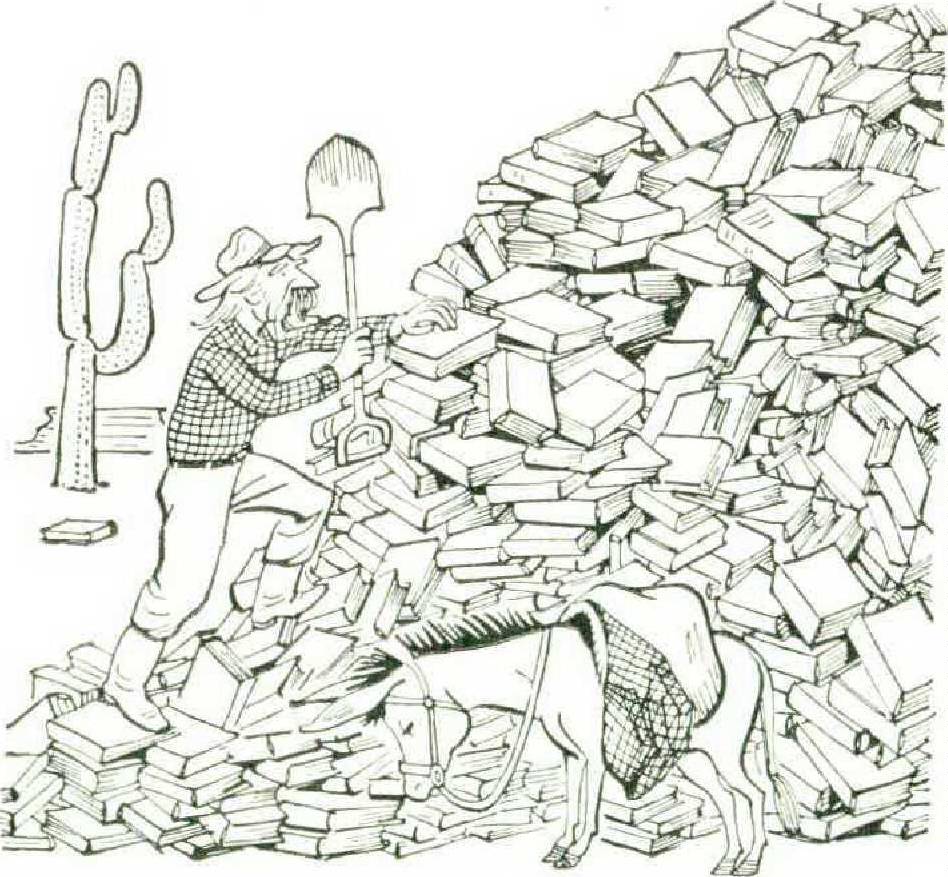
Present-day trends in this slaphappy trade puzzle me. I have been looking at the names of some of the books that have actually been making big money in the book auctions recently. Time after time these are books that no normal prowler would look at, except in the course of digging down to inspect what lay underneath, while books that we prowlers would consider sure-fire do not raise enough for a magazine subscription. The earliest known manuscript of some classical Latin poet written in a fine hand for a Renaissance cardinal and presented by him to a queen fetches a third of the price of Carrion Birds of the Zambezi Delta. The money now seems to be in the kind of unwieldy illustrated book about animals or places with which our forefathers yawned away the hours before the coming of the cinetravelogue. The cover may be off, the leaves stained with tea (not Scotch, tea), the illustrations folded and chewed. Still the bids pile up, whether it be for Desiccated Ferns of the Gobi Desert, 6 volumes, all oblong, or 32 folio volumes of Picturesque Detroit.
Things work out differently, however, in trying to sell books. After a frustrating afternoon in a bookstore, I have sometimes looked along my own shelves wondering whether perhaps the lode was not right here at home. Perhaps when I was a child I had a first edition of Alice in Wonderland and it is still about somewhere. Or perhaps the author of some novel picked up long ago has since rocketed into fame, selling two million of his latest book and ten of his first, of which I have one. If all else fails, I wonder about inscriptions and signatures. There are a few odd volumes bound in calf. Somebody must have owned them. No luck. Names on flyleaves like “P. Smith” may conceal the identity of the first man to Be or Do something: I cannot spend hours and hours with reference books just on the chance that they do.
Worst of all is what happens when I drag out of the bottom of a cupboard some dullish, battered, cumbersome book, apparently printed on lead, that I had to take as part of a lot when I was after another item. I struggle with it to the booksellers and they sneer at it, saying it is dullish, battered, cumbersome, and unsalable. “Who,” they ask, “would ever buy a book with a title like Fossils of New Amsterdam?” Then as I turn away, listing under the weight, they beam at another customer and say that at last they have managed to find him a complete set of The Dictionary of Commerce and Improved Ready-Reckoner, 1823-1834, 124 volumes, elephant folio.
The trouble is that this is not the kind of gambling you do best with a pin. You need an expert’s eye and memory and patience, and you are up against very hot competition. This, for me, turns book hunting into quite a different kind of hobby. My ideal bibliographic triumph would be five minutes in a shop and a lifetime on golden beaches, where in the blonde-besprinkled sunshine I should eat, drink, sleep — and read — which is more than I can see bidders for Views of Icebergs by A Gentleman, 17 volumes in 28, ever doing.