The Game
A native of South Africa who is now living in London, DAN JACOBSON graduated from the University of the Witwatersrand in Johannesburg. At the age of twenty nine he has three novels to his credit, his most recent, THE PRICE OE DIAMONDS, having been published by Knopf this spring.
ROGER MERRIT was the one who organized the expedition. At the age of seventeen Roger Merrit was a tall, blond fellow with a high-pitched voice and a gangling kind of stride that left his torso hanging just a little behind his legs when he walked. Roger was a contemporary and close friend of my elder brother, and the three of us made up the hunting party on my father’s farm.
My father’s farm was merely seventeen hundred morgen of veld, on which the only building was the mud-walled, corrugated-iron-roofed hut of the African herd boy. Across the seventeen hundred morgen there grazed a herd of cattle, some sheep, and a few horses, all of which were supposed to be fattening up for the summer, when they would be sold at the sales. My father never seemed to be quite happy unless he had somewhere within thirty or forty miles south of Lyndhurst a piece of veld he could drive to over the weekends, and where he could see his cattle, walk among them, and feed them with the sacks of bone meal and sulphur and other supplements that strained the springs of the car every weekend.
He thoroughly enjoyed his agricultural ventures, but they were never as profitable as he hoped they would be. And though he did not go into them with the expectation of making a fortune, he would begin to feel, after a year or two, that the damn farm should at least pay its way, and that if it couldn’t he should sell it — as a responsible man, a man of business. But his sense of responsibility tempered his enthusiasms only after he had taken each plunge; the particular farm I am talking of now he had bought after one of the wettest years we could remember in Lyndhurst. He had come to it at the end of summer, when the slopes of the veld were covered in grass that was knee-high, green at the stems, and beginning to go to a silvery blue seed at the tips, rising and sinking lightly as the breezes ran over them. Clouds moved across the sky, and the light, when it fell to the earth, seemed to be taken in by the grass and subdued there. The veld was wide and so gentle that it was hard to know why it should have been empty of people, why from only one point on the farm it was possible to see just one neighboring farmhouse, miles away.
But the afternoon we went hunting on the farm, eighteen months later, it was difficult to know why anyone — ourselves included —should have been there. The single barbed-wire fence along the side of the farm where we walked was something remarkable, a sign of lonely human endeavor — it seemed so strange that anyone should ever have bothered to survey this place, to mark off one section of it from another. The fence was like a monument. The whole sky seemed to glare down at us, and as we walked, our feet struck against ground that was hard and cracked, or sank into loose drifts of sand; from both the loose sand and the crust like earth, shoots of yellow grass started up here and there, as stiff as sticks. The few bushes, which a season before had merged gently into the grass around them, now stood out, the only dark things to be seen. The other colors were pale, the colors of drought, each one like something scraped across the eyeball: a scrape of yellow, a scrape of brown, a scrape of white, the dark scrape of the bushes. We walked with big hats on our heads, and took turns at carrying the rifle, and heard our feet cracking the grass beneath us.
Roger Merrit carried the rifle like a soldier, slung easily over his shoulder; my brother had it slung across his back, like a Boer on commando; and I carried it in both hands, in front of me. like a street fighter in the war films that we were at that time seeing so regularly. My brother and Roger Merrit were in their last year at school, and both of them were going to join the army at the end of the year — or so they said. I was only thirteen, and had no hope that the war would go on until I was old enough to join the army, so I took a vicarious pride in the intentions of my brother and his friend, who seemed already to be marching not across the peaceful desert of South Africa, but across the terrible deserts of North Africa. There in the north were places like Tobruk, El Alamein, Bardia, Mersa Matrûh, just beyond the horizon that encircled us in a whitish glare of heat. We walked, we took turns with the rifle; the soles of our shoes burned upwards with every step we took, and the rims of our hats cut into our brows, as if they had been made of steel.
“Where are those buck you’re talking about?” my brother asked Roger, complainingly.
Roger shook his loose shoulders. “It’s your farm, not mine.”
“I’d exchange all of it for a bottle of Coca-Cola, right now.”
I was a little ashamed of my brother. He seemed to lack the gravity of spirit for an outing of this sort.
“You said you saw some buck when you were riding here last time,” Roger said to me.
I had said this, and I had told the truth; that had been the germ of the expedition. Often when we came out with my father we would take one or two of the farm’s few horses and go riding aimlessly in any direction for miles, until the loneliness of the veld and its silence would begin to frighten us a little, and we would turn back. And more than once on these rides we had seen a few head of buck. Because my father did not allow any of the neighbors to shoot on the farm, the buck were more curious and less frightened of us than they should have been. They were pale brown, and swift when they ran, but they could halt in an instant and would stand with their heads turned, watching us, before fleeing again. I had mentioned this to Roger one day, and a week or two later he had told us that he had managed to get hold of a rifle and thought we should ask my father to let us go on just one afternoon’s hunt. My father was reluctant, but consented and gave us the car to drive to the farm.
“I have seen them,” I assured Roger. “Lots of times.”
“Perhaps they were sheep,” my brother suggested.
“Don’t be funny. You saw them too,” I said.
ROGER breathed whistlingly through his small nose when he was tired. My brother sweated freely; he said that any buck who couldn’t smell him coming deserved to gel a bullet through its head. My head was aching, and every footstep now was so much heat shaped like a foot sole. But I wanted us to see a buck, at least one, after what I had said.
Later my brother said, “I just don’t get the point of this.” We had halted on the crest of a rise, and from where we were the world seemed to go only downwards, beyond the farm boundary, beyond the boundary of the next farm, for miles and miles. It was not until the horizon that the veld lifted in the sudden blue humps of a few isolated koppies.
“You’ll get the point of it all right, when we sec something,” Roger said. Roger was in every way a more satisfactory hunting companion than my brother. Not only was he taller, not only did he carry the rifle in finer style, but he was serious, manly, and determined as well. He had not complained once about the heat or the distance we had walked, or the inhospitality and dullness of the veld. Constantly his eyes had scanned the veld in front of and behind him, whereas my brother had pulled his hat so low over his eyes that he looked like a clown and could not see more than ten yards in front of him.
And then to cap it all, my brother walked over to the shade of the nearest thorn tree and sat down on the ground. “You walk on,” he said. “When you come back, I’ll be waiting here for you.”
Roger looked angry; I felt ashamed.
“Come on,” I said, and gave my brother a gentle kick.
“No, man,” he said comfortably.
Roger stood a yard or two away, in the sun. My brother propped himself against the tree trunk and pushed his hat still lower over his eyes. Beyond, the veld burned yellow, burned brown, burned white, sloping down from us, for as many miles as we could see.
“Of all the damn — ” Roger said. “Honestly — ”
“You go on,” my brother said. “You don’t need me.”
I laughed and said to Roger, “Come on. If we go on, you’ll see he’ll follow.” But I said it with more certainty than I felt.
Roger and I began to walk on. The veld was quiet. When we looked back, my brother had sunk even lower against the narrow black trunk of the tree.
“Why did he come, if that was what he was going to do?” Roger asked me.
“I don’t know.”
“That’s sportsmanship!”
I said nothing. We walked on, but not for more than a few minutes. Then Roger hesitated, looked up at the sun, looked back at my brother, looked at the veld that lay ahead of us.
“Let’s go back,” Roger said. And we turned and went back without another word.
My brother watched us coming. “Did you get anything?” he shouted.
“Joke!” I shouted back.
But we had no sooner rejoined my brother — we were standing disgruntledly and accusingly over him — when we saw two head of buck emerge from a ragged line of bushes a few hundred yards away from us. They were low, not much higher than the grass, but a little darker in color; they moved cautiously, with their small triangular heads turned to us. In a moment Roger had raised the rifle and was taking aim; he fired, and a cloud of dust went up where the buck had been standing. I saw one buck running low, and Roger fired again at it; another cloud of dust went up, but from the place where we had first seen them. The one that was running kept moving, and I lost it in the grass. And then, from the same place as before, silently, a third cloud of dust rose from the ground to a height of perhaps three feet, and we saw the dust begin to drift over the pale grass.
We began running, all three of us. And when wc were about a hundred yards away we saw what was making the dust go up. The buck rose in the air, its small body twisting, arching in midair, almost fishlike. It was curved, brown, a dust brown; and we saw it fall, and the dust went up again.
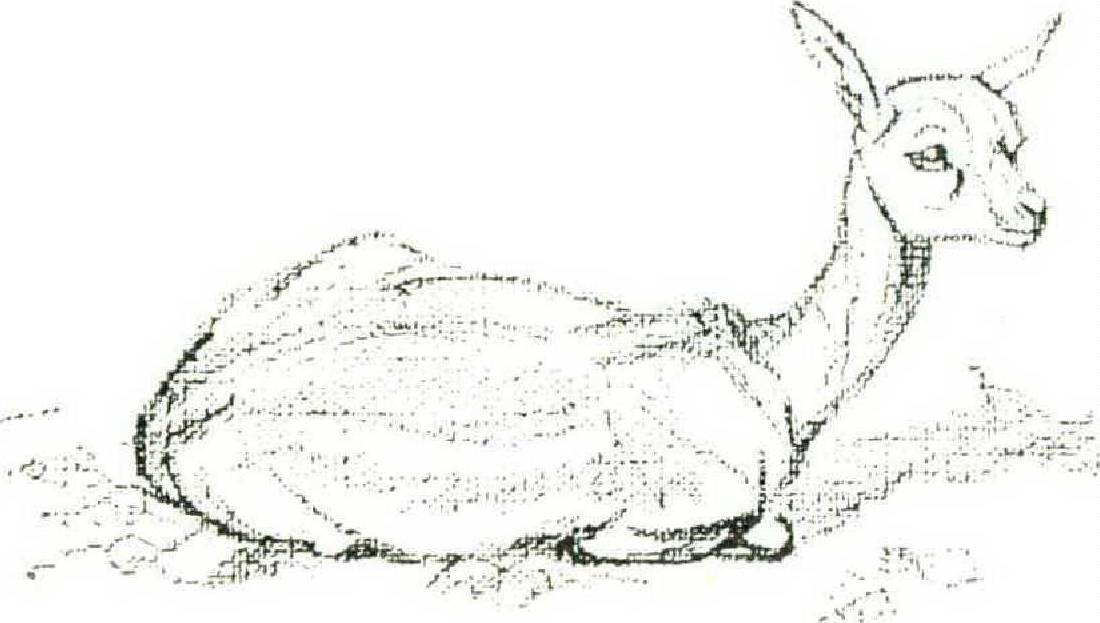
“Kill it,” my brother said as he ran. We dropped and waited, feeling under our hands and knees the hot sand and the sharpness of the grass, hearing our own panting. We waited for the buck, and at last we saw it rise, slowly this time, and stand. Roger took careful aim and fired, and the buck simply fell, with almost no dust going up. It was dead when we came to it, a little steinbok, in height not much taller than a fair-sized dog, but slender in the shoulders and haunches and muzzle, and most slender in the legs. One of the legs dangled by a ligament a few inches above the hoof. The first shot had snapped its leg; the second had gone through its chest. The leg was almost bloodless, but some dark blood was oozing out of the body.
And then Roger said, “There’s another,” and we looked up and saw a buck standing — perhaps the one we had seen before, perhaps another. But as we turned it began running.
“It’s your turn,” Roger shouted, thrusting the rifle at my brother. My brother lifted the rifle and fired.
“You missed,” Roger said, for the buck still ran. We watched it go; Roger took the rifle from my brother. And then, to our astonishment, we saw the buck stop, turn its head, stand clearly outlined against the darkness of a bush as it looked at us. Roger lifted the rifle; I was standing next to my brother, and I heard him muttering. I had been unnerved by the sight of the fine little buck leaping in agony, and now lying dead and ignominiously smeared in dust behind us; but I was more unnerved when I heard what my brother was saying. He did not know that I was listening; his attention was all on the buck, and he was talking to it. “Run!” he was saying. “Go on, run!” Roger fired, and the buck ran; its light brown body was lost in an instant on the pale veld.
Then we went back to our prize and had a longtalk about how we were to bring it to the car. “I’ll carry it,” Roger said boastfully and picked up the buck and slung it over his shoulders, as he had seen hunters do in the pictures. And we set out. But Roger was soon staggering. Small though it was, the buck was a considerable weight to carry over the rough surface of the veld under that sun. We took turns at carrying it, but even then we tired; eventually we put it under a thorn tree, and Roger and my brother went ahead to fetch the car.
I waited with the dead buck in the empty and silent veld, where nothing moved, not even a bird. I tried to remember the mood with which we had set out: I tried to think of El Alamein and Bardia, of Mersa Matrûh and Tobruk; but I could not put out of mind my brother’s rapt face, his lips moving, the hat over his eyes, as he prayed for the life of the buck. I was ashamed of him; yet I knew too that his feeling was my own. And I really did not know, then, whose cowardice was the greater: his in admitting his own feeling and giving it speech, or mine in trying to deny it.
When Roger and my brother returned we loaded the buck into the boot of the car.
Young as I was, I sensed a kind of covert logic in Roger Merrit’s sudden and shamefaced admission that afternoon, when we were driving home, that his father had refused to give him permission to join the army. There was no conscription in South Africa during the war, and without his father’s permission, Roger, at the age of seventeen, could not serve.
My brother said, “My father’s already given me his permission.”
“You’ll be in the army next year,” Roger said.
“Yes, I will,” my brother said. Then, “You’re the lucky one,” he broke out almost angrily.
Roger thought my brother was joking; but a little later Roger said, quietly, “Perhaps you’re right” — as if he too had realized that afternoon how little time they had to play at being men. On the main tarred road across the veld, the car rushed northwards.