The River Rat
A graduate of the University of Missouri, HOWARD DAVISstudied political science under Harold Laski at the London School of Economics before the war, and returned to England as a major in the Eighth Air Force, He was director of Dave Garroway’s TODAY for two years and is note teaching for the advertising Jinn of N. W. Ayer in its Philadelphia headquarters and writing fiction on the side.
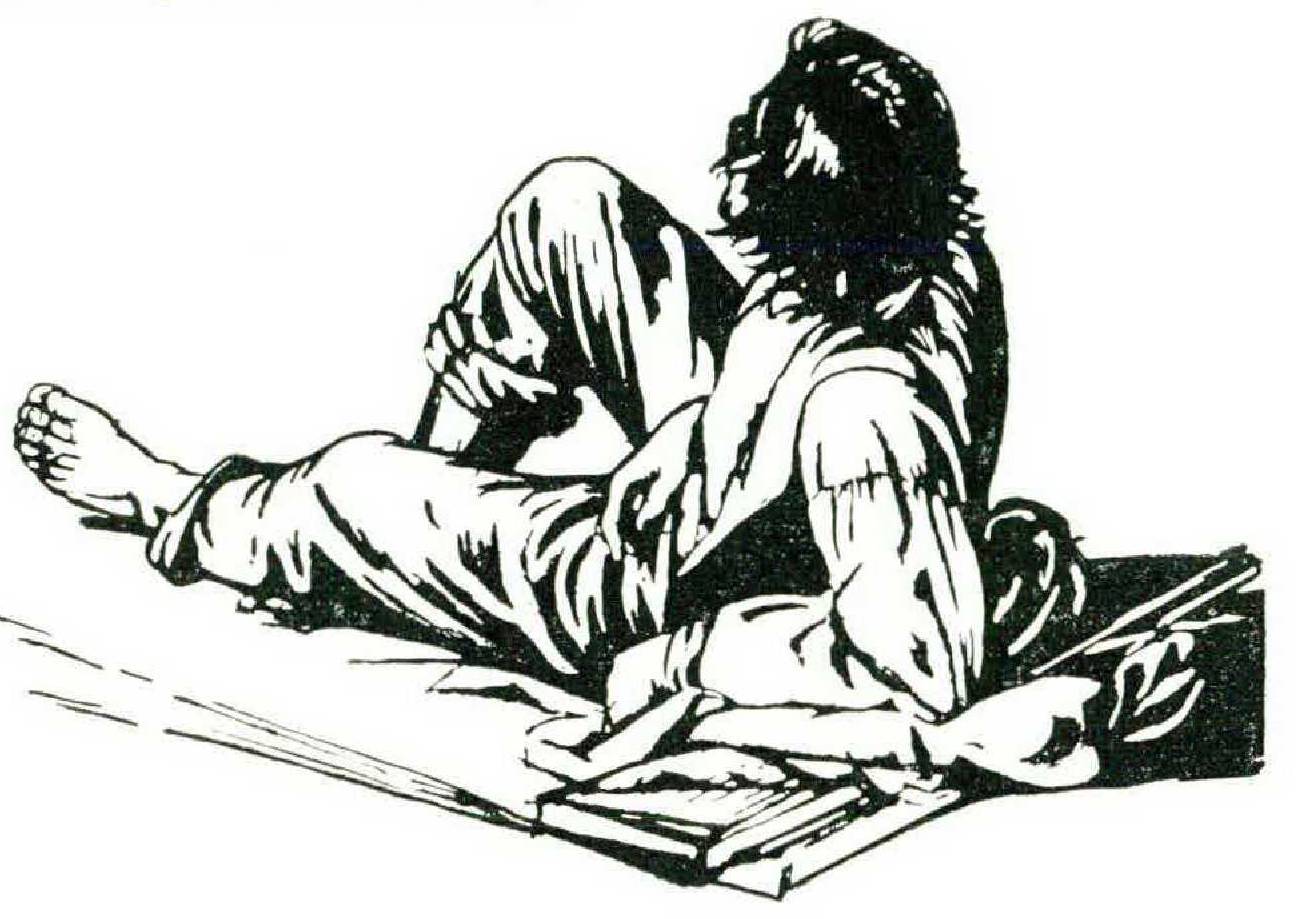
THE preacher walked with Richard through the oppressive June heat, down the main and only street of Defiance, toward Schlueter and Vogler’s General Store. The man was tall and lanky and carried himself erectly, and the boy was small but quite big enough to be eight years old. It was a sweet and good thing for a sixty-two-yearold man to have an eight-year-old son.
“When can we go to the river, Daddy?”
“Maybe next week.”
“Why so long off?”
“It’s too hot. You’d melt down into your Shoes.” Then the preacher and Richard both laughed, looking down at the boy’s dusty bare feet.
They met the River Rat coming out of the blacksmith shop. This was the closest Richard had been to the stranger. He looked bigger and darker and more fearsome than anyone Richard had ever seen before. Three weeks ago the man had walked out of the cottonwoods, coming from the river. Mr. Howell had seen him crossing the fields, but the man had shut the gates behind himself and had walked near the fence, not to tromp on the young corn. He seemed to know where he was going, looking neither to his right nor to his left. Maynard Niehoff had personally seen him in the store, where he bought things like flour and potatoes and tobacco, but no meat at all. A boy named Clyde Fulkerson, hunting rabbits in the cottonwood jungle, thought he saw a dirty tent pitched on the riverbank, but Clyde was timid about going too close.
The preacher said, “Good afternoon.” The stranger eyed them, mumbled, and walked on.
When he thought it was safe, Richard looked back. “What is a river rat, Daddy?” he asked.
“It’s a name people give to folks who live on the river, or near it. It’s not a very nice name. I wouldn’t use it if I were you.”
“Maynard says the River Rat cats raw catfish.”
“Don’t believe everything you hear, son.”
They reached the store. The preacher bought some bread and a can of Prince Albert, and asked as casually as he could feign it how the ball game was going. Mr. Schlueter, a fat, jolly man, told him that the Gas House Gang were trailing the Cubs four to two; why didn’t the preacher just sit down and listen to the rest of the game?
Richard did not care much for listening to baseball games. He was for the Cardinals just as he was for President Roosevelt and Billy Sunday, but what he really cared most about were the river and the bluffs. They were the only mysteries in Richard’s life, except death, and yet it was hard in Defiance to strike up a good conversation about them. People talked about the NRA, and about whether it was sinful the way Wallace wanted to kill the little pigs, and how nice or how awful it was that Prohibition had ended, and all the time less than a mile away the Missouri River flowed on toward the Mississippi, flowed unseen just this side of those bluffs which were the biggest and most magnificent bluffs that God had ever made, where few men in Defiance had ever set foot because the bluffs were on the other side of the river.
Of all Richard’s brothers and sisters, Terry had been the most helpful. Although he was ten years older and almost grown up, it was Terry who took down the book with the maps and said, “This is where we are, this is our river, and we’re on this side, you and I, Richard, right now; and on that side is St. Louis County, and there at the end of my fingernail is St. Louis, a great city no more than twenty-eight miles away if it weren’t for the wide bridgelcss river and the bluffs too steep to climb.”
Terry had succeeded in showing Richard where Defiance and the Darst Bottom stood in relation to St. Louis and the state of Missouri, and Maude Tyler, who had taught two generations at the one-room school, had already placed Missouri in a nation and that nation in the same world with China and Paris, France. But neither Terry nor Maude nor even Daddy had ever been clean across the quarter mile of river and climbed the bluff and looked back to see what Defiance looked like to the sun that rose out of the rocks.
It was awful hard even to get to see the river. Here is what you had to do. You had to get in the Model T with Terry and ride over the bouncy dusty bottom road until it petered out at the last farm, the Howells’. Then you had to have a corncob fight with Joyce Lee Howell, who was ten; you had to say, “We’re gonna walk down and see if the river’s still there,” and hear Mr. Howell ‘spect that it is. Then you had to cross sixty hundred fields and open thirty hundred wagon gates until the fields stopped and the cottonwoods started, and find the path that goes through, and walk and walk until finally you could stop, hook your thumbs in the bib of your overalls, and say, “Yep, it’s still there!”
You had to do all that even to see the river. Richard had not seen it since 1934, which was last September.
THE Redbirds lost four to two, and then the preacher had a call to make in the bottom. He and Richard walked back to the parsonage for the car at about three thirty. It was fearfully hot. Richard liked the breeze that the open car’s movement created.
“Who’re we gonna comfort?” Richard asked. Terry had said that once as a joke.
“Mrs. Hooper. She’s pretty sick,” said the preacher.
“What’ll I do?”
“I can drop you off at the Howells’ if you want to play with Joyce Lee.”
“And pick me up later?”
“In about an hour.”
Richard thought it over. Against it was Joyce Lee’s deadeye aim, but Mrs. Howell usually had cookies and Mr. Howell knew some river stories.
“Okay,” said Richard.
He stood watching by the mailbox as his father drove on. Strange that the Howells had not taken in their mail. Richard took it out carefully and walked up the path to the old frame house. He called “Joyce Lee” and then “Anybody home?” A tiger-striped cat rubbed against his leg. Nobody answered. The screen door opened easily, which was excuse enough to go in, so Richard deposited the mail on the parlor table. It was mysterious to be in somebody’s house when no one was home. You could open drawers if you wanted. Richard debated a moment with his conscience, then instead went to the kitchen and the cookie jar. Oatmeal cookies. Three are the most you can take without their being missed. He wandered out the kitchen door, munching. From the back porch the bluffs looked about twice as big as they did in Defiance. You could see that the blue parts were actually green and were probably trees growingin the canyons of the rocks. Even from here you could not see the river. Why, oh why, must the fields and the gates and the cottonwoods . . .
The thought no sooner struck than it was accepted. Pounced on. The first gate was easy, and the first field was actually the barnyard pasture. When you were alone you had to run through this one, for though all four animals looked like cows, one might be a bull. The second gate was heavy, so Richard climbed over it. A field of corn, to be skirted. Another gate. A field of oats, which turned into watermelons without a fence between, and the melons ran into weeds, and the weeds into cottonwood; the civilized world and its thirty hundred gates were behind.
The cottonwoods are skinny and very tall, about three times as tall as a young human being.
They cannot be walked through except by the path, because they grow so close together. It is very hot inside the cottonwood jungle because the breeze cannot get in. It is a good idea to take off your shirt. Richard left his by the path and put a dead branch across it to stumble over and make him remember the shirt on the way home. The ground was getting softer.
A rabbit jumped up from somewhere and bounced ahead down the path. Richard raised an imaginary shotgun and blasted away, but the rabbit was out of range. There were some mosquitoes now.
A movement in the weeds ahead. Richard stopped in his tracks, remembering the water moccasins. Terry would say that they are as scared of you as you are of them, but Terry was not here. Retreat can be honorable if the foe is so dread. A little garter snake wriggled out of hiding and away. Retreat is to be avoided at all costs.
There are still more things you have to do to reach the river. You have to think, even say aloud, “I’m gonna see the Missouri River soon,” and “The Missouri and Mississippi together form the longest river system in the world,” and “Missouri comes front Indian talk and means ‘Big Muddy.’ ” You have to stop and listen to find out if you can hear it yet, but you cannot. You have to be more careful not to lose the path, and swat a mosquito on your shoulder, and notice that you cannot see the bluffs because the jungle is so high and so thick. You have to feel the mud starting to slither between your bare toes, and then be aware that you can hear the river, way off and muffled, sort of. You have to rejoice in being eight, wish real hard for Terry to share it all, and take it back. Mud slither, mosquito bite, louder river, thinner jungle, faster heart. Thinner, louder, faster . . .
“Yippee!” Out loud.
One second, nothing ahead but jungle; the next, brown water, eddying close by, rushing farther out, roaring, roaring now there’s no more cottonwoods to deaden the sound. The bluffs tower ahead and over, endless Gibraltars, chalky rock and green canyons and on top real trees and a house and barn as close as the Howells’, though in another world. Heart pounding, pleasure swimming so in your head you could like to die!
WHATCHA doin’, boy?”
The long shadow moved, and the boy, terroreyed, wheeled to face it. Dark, gigantic, stark naked, stood the River Rat.
“I said whatcha doin’? Cat got your tongue?”
Richard knew he must speak. If naked, crazy river rats are anything like cows or snarling dogs, you’ve got to try not to look scared, no matter how much you are.
“I seen you in town,” said the River Rat. His voice was not quite as gruff as Richard had imagined it. He seemed to want a reply, but Richard’s throat was not ready.
“Was that your grandpa you was with?”
“My daddy.” Faintly.
“He spoke real friendly.”
“He’s the preacher,” Richard said.
“He don’t seem as stuck-up as most,” said the River Rat.
“He’s a Methodist.”
The giant laughed so heartily that Richard decided he had said something very clever. He tried to laugh himself, but it did not work. The naked man’s laugh was all the way down in his hairy belly, which flexed like arm muscles with the laughter. The belly was white; only from the neck up was the giant so dark.
“Methodist, huh? My family was full of Methodists! John Wesley-this and John Wesley-that! All sprinklin’, no dunkin’.” He laughed as though the memory were very funny. Then Richard realized that he was still not looking at the man’s face. There were things about the River Rat’s nakedness that Richard had never even imagined.
“Are you a Methodist too?” Richard asked, politely. Now the sound seemed to come from himself, and he was looking at the bearded darkgray face.
“Me? Hell, no! I ain’t nothin’. I ain’t a Mason, Odd Fellow, Baptist or Methodist or hypocrite!” He laughed again, at his own cleverness now, Richard guessed.
“You’re a river rat, aren’t you?” He did not know what made him say it. He looked around to see if there was anything he would stumble over if he could manage to run.
“Is that what they say?” Curiously.
“Yes, sir.”
“Well, I guess I am, if they say so.”
“Do you only wear clothes to town?”
“What? Oh, you mean why am I bare-ass naked? Look here.” For the first time Richard noticed the broken fishline. “Trotline got snarled on somethin’ in the river. Had to wade in to pull ‘er free.”
It was a relief to know he did not go around naked, Richard thought. All of a sudden he was conscious of being no longer frightened.
“Where’s your tent?”
“What tent?”
“They say you live in a tent somewhere.”
“Well, tell ‘em I don’t live in no tent. Tell ‘em to mind their own damn business!” He was gruff again.
“Yes, sir. I will.” Some of the fear came back.
“You want to see where I live?”
“Yes, sir.”
“C’mon. I oughta git some clothes on. Might corrupt ya.”
There was a small jutting out of the shore about a hundred yards downstream. Richard followed the naked man, neither one speaking. Beyond the jutting out Richard saw the boat in the stagnant slough. It was bigger than any other boat Richard had seen, a sort of houseboat with a smaller house on top where the wheel was, and a flat deck not far above the water line. It was painted gray all over and had numbers on it at various places. A plank ran from the deck to the oozy shore. Heavy ropes were tied to stakes that had been driven deep in the soil.
“How d’ya like it?” the River Rat asked, proudly.
“Gosh, it’s big! Is it yours?”
“Nope. I take keer of it.”
“You live on it?”
“Sure. You wanta see? You don’t believe it?”
Richard followed him over the plank. The man stooped as they entered the small cabin. Inside were four bunks and a table and a bottledgas cooking stove.
“You really live here? No kidding?”
“You like it, huh?” The man started to pull on his overalls.
“Whose is it?”
“B’longs to the gover’ment. Now you know my secret, huh?”
“Sure I do!” Richard said proudly. Then, “What is your secret?”
“I’m a civil servant! See? I ain’t no river rat. This here’s a broke Army boat. It looks all right, but the engine’s shot to hell. Broke down right out there. It’s thirty-two years old, thereabouts. They say they’re gonna put a new engine in it someday. I dunno. The Army don’t know their—•” He looked at the boy and checked himself. “Anyways, they’s a gover’ment regulation ‘gainst leavin’ anything unguarded. So this Captain Abernathy sends me down here four weeks ago. I was workin’ in a yard where they store pilings down by Washington, Missouri. Captain Abernathy says, ‘Pete, of all the civilian employees the U.S. Army ever had I ‘spect you like folks lesser than anybody I ever seen. You want a nice lonely job where you can fish and not see nobody, even civilian employees like yourself?’ I says ‘sure,’ and here I am. Not bad, huh?”
“Gosh! You’re really a civilian?” Richard did not know what the word meant, but it sounded impressive.
“Name’s Pete Harmon. What’s yours?”
“Richard. How many fish do you catch?”
“Not many this side. The channel cats like the current. It runs nigh to the other side. Got three trotlines out, the other side. Wanta see my skiff?”
The man led the way back to the deck and pointed. There on the downstream side, tied to the larger boat, was a rowboat, its stern riding low from the weight of an outboard motor.
“See? It ain’t the Army’s, neither. It’s mine. Brought it down from Washington, Missouri, when they dropped me off here. It’s real nice to have. I run over twice a day to the trotlines, and usually they’s a small channel cat or a carp or two, and I save most of the dough they give me fer food, so’s I kin drink bottle-in-bond ‘stead of bootleg rotgut and send a little to my old lady, who lives in Sikeston. Now if you’re rowin’ a boat, you gotta aim upstream and crablike if you wanta go straight across, and it’s mighty hard in the current, I’m tollin’ you, but the motor don’t care none, and I lift the gas off’n the Army. Wanta go across with me to check the trots? Don’t take long.”
Richard had not listened too carefully until “go with me.” Now he closed his eyes and prayed silently. “Let it be true that he said that! Give me the words to make him see how much I want what I believe he is offering.”
He spoke carefully. “I don’t care,” he said.
Here’s the kind of prayer you pray while crossing a river. Thank you, Almighty God, Master of boys and bluffs, Maker of outboard motors, Sender of civilians. Thank you that the River Rat’s own skiff is parting the thick brown water taking me closer and closer. Thank you that the current doesn’t frighten me, that the Howells weren’t at home. Forgive the cookies and wishing all the time that Terry would come back, and thank you again for the naked man with clothes on now who sits by the motor with his big hand on that rod steering us. ‘Thank you, Lord Jesus!
As THE bluffs came closer, the green canyons were individual trees and bushes, the sheer stone outcroppings revealed veins and layers, and an outhouse was added to the farmhouse and barn. Finally the bluffs could not come any closer because the river was all behind. The motor idled and coughed to silence as Pete came forward and grabbed a small tree on shore, pulling the boat in close.
“Jump ashore, boy!”
Richard jumped to the soil of St. Louis County. He kept looking up as Pete pulled in his first trotline, empty. A cloud passing overhead made the bluff sway and lean until Richard almost cried out in alarm. Then he saw the steps. They were wooden and ran zigzag up one of the green canyons.
“What’s that, Pete?” he cried. “Where do the steps go?”
“Steps? Oh, them steps. They run up to that farmhouse. I ‘spect them folks steal from my trotlines. I’d like to catch ‘em!”
“You mean they go all the way up the bluff?”
“Why not? You don’t think that’s a big bluff, do you? That’s nothin’ like the ones up by Pacific or down by Jeff City. That’s a puny bluff, son. Not more’n a hunderd fifty feet.”
Richard started for the steps.
“Wait a minute, boy! If yer gonna climb ‘em I’d best tag along.”
After about forty million steps Richard looked down. Pete, foreshortened below him, grinned in encouragement. The river swirled below Pete, far, far below. Richard grasped the rail more tightly and did not look down again until he had reached the top. They had come out near the barn, but the zigzag pattern of the steps had taken them away from the bluff so that Richard could not immediately find the river. Pete showed him the way.
Now this is what it is like to stand on a bluff. You are very high up, but the clouds still look a long way off. Behind you the land is flat. The bluff is a bluff only on one side. If you stand on it you do not exactly see it. You see a river far below and you feel a little dizzy and you take Pete’s hand, thinking for a minute it’s Terry’s. It’s a bigger, rougher hand, but you’re not too sorry.
The river looks different from the way it docs on the other side. Because you’re so high up it doesn’t flatten out and look like fuzzy white air far out, but is now a big brown stream, moving lazy and slow and grand. You sec the cottonwoods from the top, and beyond them the watermelon field that turns into oats instead of the other way around. You see a hundred more fields, upstream and downstream, each field beyond smaller and bluer, until you finally see Defiance and realize for the first time how little it is in the scheme of things; it is blue instead of green, unlike the bluffs which turned out to be green instead of blue. The Pleasant Hill (Methodist, Old Stock) Church is on the small hill to the right of town, and the Emmaus (Evangelical, German) Church is on the small hill to the left of town, and you can’t see Schlueter and Vogler’s because of the grain elevator by the tracks. One thing you can see is the parsonage, plain as day but small as a dollhouse and no mother and father, no brothers or sisters in view. You see beyond Defiance too, blue rolling hills and winding roads and farm buildings big enough for ants. And you feel surprised that the world you live in every day is beautiful to people on the bluff in St. Louis County.
Richard squinted his eyes and looked again real hard at the Pleasant Hill Church, but the gravestones were too small to see. The graveyard itself was plain enough, and in the middle of it there was an old elm which, in all that vast panorama, gave Terry a tiny identifiable location of his own, for Richard remembered that at the funeral in December some of the frozen earth from the grave had been banked against the tree, and just last week, when he took his brother the daisies, he had been glad that there was shade so that they would not wilt for an hour or so.
The boy arrived home an hour after supper. His scolding was rather severe and very well deserved. He tried hard to look and feel repentant. His story would not hold water, that was sure. Maybe the stranger, maybe the Army boat. Not the nakedness, not crossing the river and climbing the bluff.
An hour after the boy had been sent to bed, the preacher sat on the porch smoking his pipe. His wife was troubled.
“Father,” she said, “he wouldn’t have just made up the muscles in the man’s . . . stomach.”
“No,” said the preacher, and thought about it for a while. “If you stood on that bluff the store would be hidden by the grain elevator,” he said finally.
“You’d better see if he’s awake.”
The preacher went to Richard’s room. The child was awake, uncovered in the hot night.
“Son, tell me if you really climbed that bluff.”
“Yes, sir. I did. I really did.”
“I’m sorry. I’m sorry we didn’t believe you.”
“That’s all right.” Pause. “Daddy, will you tell me about the Mississippi?”
“Well, you know. We lived forty miles above Memphis, Tennessee —”
“What was across the river?”
“Arkansas.”
“Was there a bridge?”
“No closer than Memphis in those days.”
“Do you remember when you first crossed the river?”
Fifty-six years. The river was still alive then. Eighteen-seventy-nine. Gingerbread steamboats, trains of barges a half mile long, sweating Negroes lifting superhuman weights at the landing, a small boy, too shy to go close, who believed that the West commenced in Arkansas. Finally the uncle who had been a Confederate soldier, and the leaky rowboat, and the first step on the soil of the West, and looking back. Fearing forgetting.
“I remember it, son. Don’t worry, you won’t forget.” Then from the doorway, “You won’t lose this day, Richard. You won’t lose it ever.”