Beauty Contests
FRANCIS W. DAHL, is wudely known for his books of cartoons and his daily drawing an the editorial page of the Boston
I do not like to judge beauty contests. I just don’t care for the work, that’s all. The first time I admitted this openly, the reaction was, “How’s that again?" and one perturbed friend said, “You don’t like girls?" Well, I used to. or rather I used to like judging beauty contests, and as a newspaper cartoonist l enjoyed the privilege of visiting college campuses to pick a queen or two from among the boys’ dates at carnivals.
I considered such an affair a stunt rather than a contest, a spoof on the big publicized pageants, and certainly a much more festive and charming spectacle than the commercial tub thumpings.
It was not until one gala evening when the judges had reached their decision and our chief justice, the dapper head of a New York model agency, was placing the crown on the curls of the winner that I looked around and saw most of the other gills twisting their handkerchiefs and looking as though their hearts would break. End of spoof.
When I discovered that there might be coeds who did not expect to disappoint themselves and their young men by not being crowned Queen of the May, I withdrew from the bench, letting it be known that I was just a big softie who couldn’t bear to frustrate so many lovely young hopefuls.
Perhaps this was not strictly honest. It might be that I am no softer than the Atlantic City Board of Trade. Those hotel operators are still judging beauty contests, but if you will scan the requirements of a Miss America today, you will see that although the judges are not yet in full llight, they are looking for the nearest exit.
Today’s Miss America is chosen for her talent, poise, intelligence, stamina, good breeding, imperturbability, and beauty, They got it in there, that beauty but Miss A. also has to answer a quiz and be able to speak to groups. Here we have all the qualifications of a corresponding secretary for the League of Women Something-or-other: and it isobviout that the poor, miserable Bonifaces arc trying to sav, “Girls, if you don’t win our contest it is because you are too hopelessly beautiful.”
judging from my own experience, I would say it is the Atlantic City beauty judges who need poise, stamina, and imperturbability, and they have not got them. As for intelligence and judgment, if they possessed any they would not try to mollify the losers of a beauty contest with any falderal about academic requirements.
My fellow judges in the Ivy League were frequently college presidents; but if we did not always see eye to eye the proxy’s eye was just as reliable as mine in such matters and perhaps more so. Never did I hear one of these educators ask a girl to recite a quiz before handing her the palm. One college president said he thought we ought to pick a wholesome type of girl with character, but he gladly went along when the rest of us chose the one with the giggle.
Let us contrast this with the big international contest at Long Beach in which the tempestuous Miss Chile, an also-ran, berated the judges in proper Latin fashion. She pointed out that an American had won first place as usual; that the second choice, Miss Germany, was top-heavy; and that Miss Sweden, third place, could not recite or speak in public!
if Miss Chile’s criticism is accepted. and I hasten to say that I would not care to differ with Miss Chile for one moment, then the highminded judges of the international beauty contest are after all just a bunch of ordinary chauvinists who like a big dame who doesn’t talk too much.
I know how it is, fellows. You get a long line of terrific gals swinging past, smiling their prettiest and pausing on the turn to look you right in the eye, and that stuff about talent, humility, and public speaking fades. But don’t forget about Miss Chile, fellows. Miss Chile is judging you.
You have seen those page-wide panoramas of all the Miss America or Miss Universe contestants holding the official pose: shoulders hack, chests out, smiling. You have seen similar shots of West Point cadets standing at attention: shoulders back, chests out, not smiling. As a youngster I visited the West Point parade ground to see the latter spectacle and was annoyed when one of the lads keeled over. It certainly spoiled the newsreel effect. On the other hand, I recall that two loyal comrades fell out immediately, seized
him between them, and hustled him off, presumably to the infirmary, a third brother trotting behind with the unfortunate’s kepi and rifle.
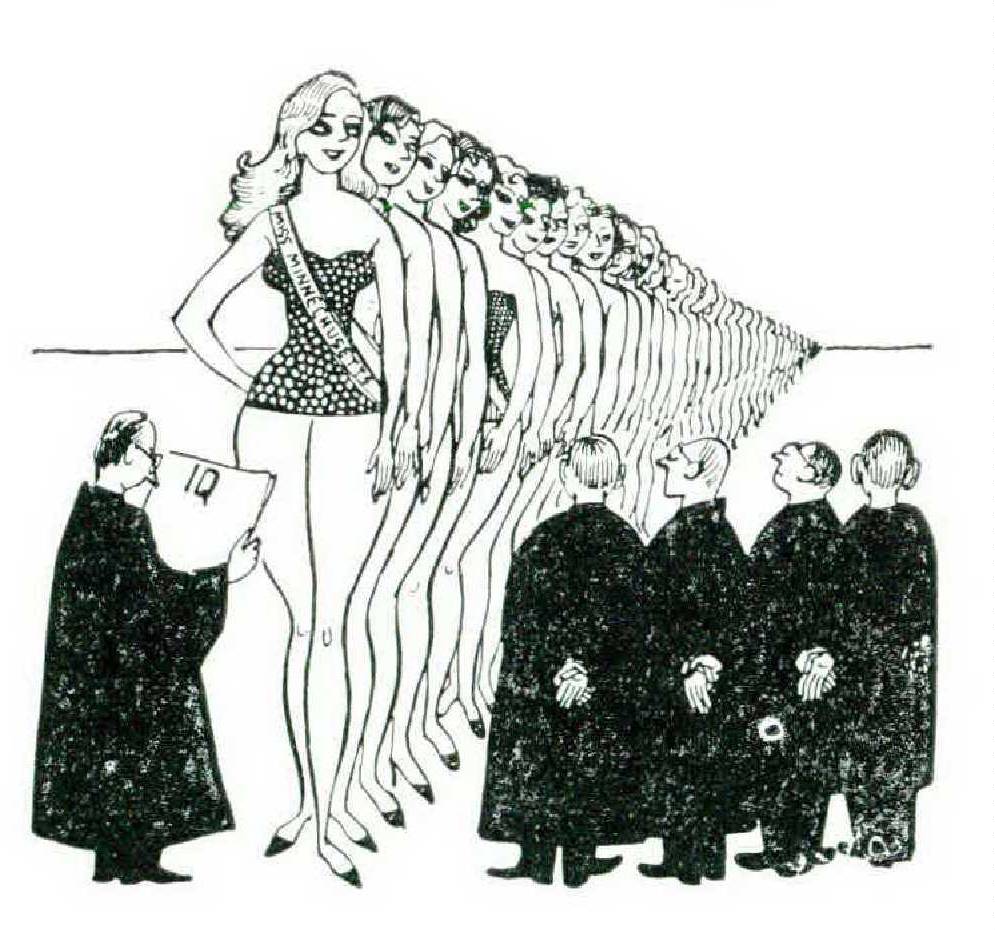
A few years ago when the national, or perhaps it was the international, beauties lined up for the big official picture taking, one of the girls in the front row keeled over. She lay there on her face, passed out cold, while the other beauties held the three-quarter stance and smiled and smiled and smiled.
West Pointers may lead a Spartan existence, but does it compare with what takes place at Atlantic City:’ I think not.