Gertrude Stein in Paris
Poet, teacher, editor, and literary critic, JOHN MALCOLM BRLNNIN was born in Halifax, Nova Scotia, and educated at the University of Michigan and at Harvard. His most recent book, DYLAN THOMAS IN AMERICA, was published under the Atlantic-Little, Brown imprint in 1955. This is the first of two excerpts from his new book, THE THIRD ROSE, a full-scale biography of Gertrude Stein, her life, her writings, her associates, and the cultural movements of which she was a part.
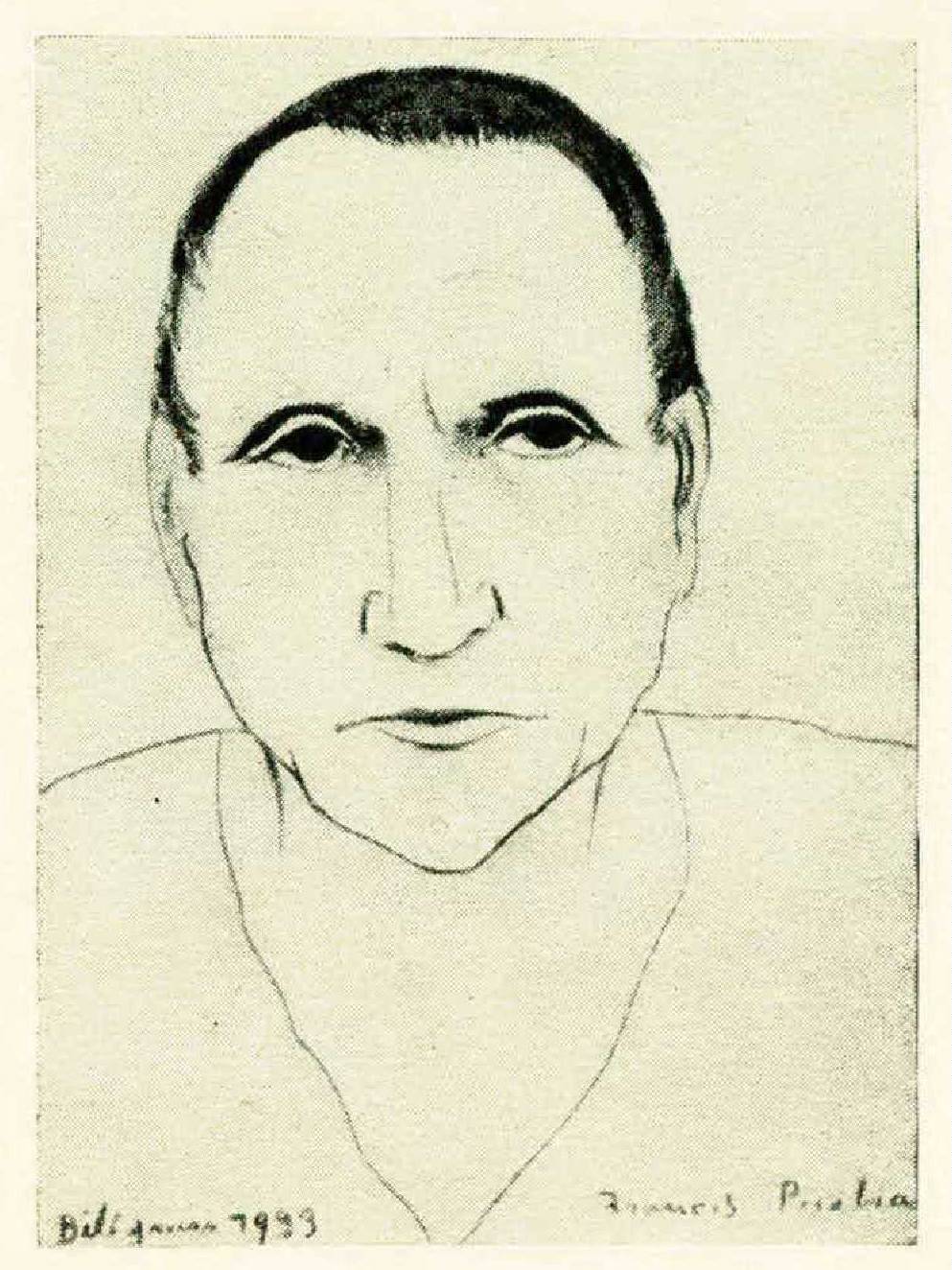
BY JOHN MALCOLM BRINNIN
THE great disparity between the fame of Gertrude Stein as one of the giants of modern literature and the inconsequential number of her published works made up a paradox that outraged her sense of justice and subdued her hopes for lasting consideration through all of the early and middle years of her professional life. Popular reviewers kept her name prominent in the columns of American newspapers, and sometimes even spoke of her with respect instead of quoting her sentences for easy laughs. She was talked about, listened to, made into a legend. But for many reasons she was not read, and the most important of these was simply that she was not published. Her despair at this neglect brought her at times to a poignancy of expression which normally would be the last thing one might expect from her. “Sometimes I think it would be nice,” she said, “to sell typewritten copies of me in a store but I don’t know of a store.”
While her manuscripts were always readily available, the “adventurous publisher” for whom she had long waited failed to show. Carefully bound, the completed works of more than twenty creative years stood in proud isolation upon the shelves of a Spanish armoire. Meantime, Gertrude and her friends made plans, cooked up schemes, and tried angles, enlisting aid from any quarter that might lead to the ransom and rescue of the well-dusted but long-neglected manuscripts.
In 1920, John Lane had reprinted Three Lives in England, and its modest second-round success had whetted Gertrude’s appetite for more. From New York a friend sent advice that echoed the feelings of a hard core of devotees and a few critics: “Last spring I dined with Walter Arensberg & Duchamp and we talked of a new book of your things and the best way to put it over etc. My opinion was that you ought to print it privately at your own expense and once a thousand volumes were printed they could be sold somehow. I think in the end it would pay for itself. You see you are handicapped by writing in a language that is behind in the arts. There is a public for you but no publisher.”
When Robert McAlmon, the young director of Contact Editions and husband of the wealthy English writer Bryher, came within striking distance, Gertrude issued an invitation to tea. But the occasion was only partly social; Gertrude had business in mind. During the course of talk she suggested that McAlmon publish The Making of Americans in a series of four to six volumes over a period of two years. He responded to the notion that her book might be suitable on the list of his Contact Editions but felt that since the work was all of a piece and offered no obvious divisions for serial presentation, it had better be published as a single volume. Gertrude quickly sanctioned this improvement on her own scheme and promised McAlmon that she would see to it that at least fifty friends bought advance copies. The manuscript was shortly on its way to the press of Maurice Darantière in Dijon, a firm which had already served the cause of modernism by printing James Joyce’s Ulysses.
The printing job, as might be expected, was a nightmare for the French compositors. Countless repetitions, minute inversions, infinitesimal variations, all the characteristic tricks and turns of the early Stein were quite beyond them. When proofs came back, Gertrude and her companion, Alice Toklas, were faced with a job that brought them to the edge of despair and blindness.
Rereading the book for the first time since she had written it, Gertrude found the experience a mixed pleasure. She was greatly worried that people might think some of the book’s unorthodox use of tenses, persons, adjectives, and divisions was not to be taken as written but that they would be ascribed to the whimseys of typesetters. “Though it does seem a bit profound to my twenty year older eyes,” she admitted, she was on the whole eminently satisfied with the literary merit of the manuscript as it stood. She toyed with the idea of making certain minor revisions but always found herself reverting to the original way of putting things. In her personal judgment, the long-buried work had assumed the solidity of a classic. “There are some pretty wonderful sentences in it,” she wrote to Sherwood Anderson, “and we know how fond we both are of sentences.”
The Making of Americans, more than nine hundred literally transparent and almost unreadable pages, paper-bound, was published finally in September, 1925, but not before Gertrude’s forwardness had cost her the friendship of the man who published it. In McAlmon’s absence from France she had taken it upon herself, against his instructions, to order delivery of the printed volumes from M. Darantiere for immediate shipment to New York. When McAlmon discovered this unwarranted intervention, he was angry — not without reason, Gertrude conceded — and wrote to her detailing other matters he regarded as breaches of their understanding. He felt that Gertrude had done nothing herself to promote distribution of the book, noting that “no evidence of any order [has] come in through your offices except from your immediate family.” He concluded his letter with accusations and a threat: “ Incidentally, you have never been financially incapable of putting your book before the public if your art is of prime importance for you. If you wish the books retained, you may bid for them. Otherwise, by September — one year after publication — I shall simply rid myself of them en-masse, by the pulping proposition.”
McAlmon’s threat was never carried out, but his personal relations with her had come to an end. Friendship or no, The Making of Americans, the cornerstone in a career dedicated to unorthodoxy on the largest scale ever entertained by a serious writer, was at last available to anyone who eared to buy.
In the wide net of literary, romantic, or barstool relationships that self-exiled Americans and Englishmen had cast over artist-quarter Paris and its Spanish, Italian, and Riviera suburbs, Robert McAlmon was a ubiquitous figure. His own work as a writer came to nothing much, but his services as the publisher of Contact Editions and the Three Mountains Press were of enormous value. Besides Gertrude Stein, authors whose work he brought out in editions which for the most part are rare items today included Ernest Hemingway, Ezra Pound, William Carlos Williams, H.D., Djuna Barnes, and the painter Marsden Hartley, whose Twenty-five Poems appeared in 1923. Although the expatriate period tends, today, to be notable mainly for the great fame of a very few writers and painters, it was a period that beautifully accommodated scores of marginal artists like McAlmon and hundreds of brilliant failures whose ambitions could be kept alive in vicarious enjoyment of the success of those who had come through.
ALTHOUGH Gertrude’s literary success was still but thinly substantiated by published works, her social success as a leading figure in the expatriate world was radiant and beyond question. “On sunny mornings,” recalled the social-historian Lloyd Morris, “when the streets of the Right Bank were full of people, a hallucination would sometimes overtake you. From around a corner there appeared the vision of a great Buddha on wheels, erratically charging down the thoroughfare, divinely indifferent to the fate of mortal traffic, heedless of laughter or imprecations. The sudden vision was all too real; it was merely Miss Gertrude Stein single-mindedly bound upon some practical errand in her model-T Ford. . . . Miss Stein was massive, monumental, majestic; she had the grandeur of a major scenic phenomenon. . . . A summons to her home was an invitation to present oneself to Mont Blanc.”
Through the early and middle twenties, No. 27 Rue de Fleurus had assumed the aspect of something between a court and a shrine. Proximity to the throne, where Gertrude sat with legs crossed, one sandal dangling from her big toe, was much to be desired by the young men who curried royal favor. There was, in the course of time, always one among them who, unofficially yet with authority, served as major-domo to the royal establishment, while all about him jockeyings for position went on. In the background, over the noise of the teacups, one could hear the sound of rolling heads, the rumble of dead reputations being carted away.
Not the least noticeable thing about the salon was the way its dramatis personae changed from month to month, week to week. Both Gertrude and Alice preferred variety in their relationships, and Alice often blithely quoted the jingle, “Give me new faces, new faces, new faces. I have seen the old ones.” Gertrude had said for years that she liked to see people come but, just as much, she liked to see them go. As a shrine, the atelier was already historical and impressively decked with propitiatory gifts. A patina of fame had settled on the paintings, and the brushings of thousands of pilgrims had mellowed and polished the heavy furniture. Those who did not know and perhaps would not have cared about the nice hierarchical divisions in Gertrude’s retinue came to her door as sober and interested as they would come to Sainte Chapelle or Les Invalides. In search of “all that Paris had to offer,” they regarded a visit to “27” as a visit to an academy where examples of almost every phase of modern painting could be studied at leisure and discussed with one who had been among its earliest champions.
Whatever the social climate, the paintings remained the focal point of interest around which the deeper life of the salon revolved. Gertrude was continually rearranging the works, featuring new ones, or attempting to revive interest in an old one by placing it in a position of prominence. She also had her own salon des refusés, a small room into which were dispatched paintings she had acquired as white-elephant gifts, or had bought by mistake, or in which she had finally lost interest. “I never know when or why a picture suddenly becomes beautiful and loses its quality of irritation,” she said. “There was a time when I had to cover that Cézanne portrait with a glass for no one would believe that it was finished; it irritated everyone and even angered some. Without liking it, I had recognized its quality, and then one day — as one turns over in sleep — it became beautiful and I could not see it in the way I had seen it before.” Because of this lively changing attitude, there was always some new point of interest in the salon, which so easily might have taken on the dead air of a museum.
While her great collection of paintings gave Gertrude’s salon a specific luster, a number of people, painters among them, felt that she actually knew little about painting and that her taste was, at best, whimsical. Even an intimate like the painter Harry Phelan Gibb, her closest English friend, was disturbed on one occasion by a most unexpected reaction from Gertrude. Gibb had sent her one of his works, on the back of which was a sketch of the sort he turned out for calendars and greeting cards as a way of making a living. To his astonishment, Gertrude altogether dismissed the gift painting but said she thought the sketch was very fine. Gibb wrote: “I don’t know what to make of it. The sketch you give praise to was one of my worst pot-boilers too bad to sell at any price. I therefore used the back and painted the other one. I thought it had something in it though I knew it did not hold together yet I thought I had got just that something out of the commonplace. Then I thought it might amuse you. It never occurred to me you would look at the one on the back. However you have looked at it. You have said what you think and I am left perplexed.”
Since both she and her brother had made so much of their pictures — he in his salon lectures and later in his writings, she in her literary transcriptions of cubism — many observers came to regard them mainly as theorists, lacking in any real feeling for visual art, whose pictures were merely pegs on which they could hang hypotheses. Their critics, granting that the Steins had taken up Picasso and Matisse in the very earliest days of their collection, pointed to their later divergent interests, which led Leo away from nearly all contact with modern art and led Gertrude to give support to artists whose lack of talent was an open scandal. In this view, their connection with Picasso and Matisse seemed a matter of chance; except for the useful notoriety it brought, almost any other association might have served as well.
Many people felt that, even as she sat as proprietor in the midst of her collection, Gertrude could not wholly disguise the fact that she was more interested in the individuals who had contributed works to it than she was in the paintings themselves. Her concern, they believed, was with personalities and public success rather than with actual achievement. They noticed often that she tended to rate a new painter’s promise in terms of his resistance to her. An indifferent newcomer was met with indifference, and when he was shown to the door his work was banished with him.
Throughout her life, Gertrude showed very little interest in the work of artists she did not know, unless they were dead and comfortably separated from her by at least a generation. There was no distant idol in her life at any time, no one beyond her immediate circle toward whom she looked with respect and admiration, unless it were someone as remote from the world of art and as thoroughly dead as Ulysses S. Grant. She had come to be satisfied with self-adulation, knowing, as she said, that in her time she was the only one. Her affection for others was reserved for those whom she could appropriate. Whether or not the world agreed, Picasso was the only painter, Sherwood Anderson was the great American writer, and Virgil Thomson was the greatest living master of prosody.
Yet Gertrude’s prestige as an arbiter of painting was not to be dismissed. Her early identification with the career of Picasso had given her the aura of a prophetess, which, in a business way, some dealers were eager to exploit, and her appearance at the opening of a new exhibition was considered the first augury of its success. Her entrance was awaited always, and was unfailingly dramatic; she kept up a running stream of chatter as she moved at will through the gallery and was never without an audience. Holding forth in the center of a hundred paintings, she blessed this work with her popish hands and damned that with a glance of indifference. When the editors of a magazine sent her a questionnaire in which was the question, “What is your attitude toward art today?” Gertrude dismissed all pretension. “I like to look at it” was her whole answer.
IN HER own preserve, perpetually attended by her dark guardian angel with the long earrings, her apparent remoteness caused many people to feel that they might at any moment catch fire from the sacred flame. Something timeless about her was alternately repellent and attractive. Most of the visitors succumbed to her charm, and many who remained inarticulate about her work easily found words to describe her fascination.
When William Carlos Williams, the American poet and physician, came with Robert McAlmon to see her, she gave him tea, then one by one showed him her great collection of unpublished works and asked him what he would do if he were in a similar position. “It must have been that I was in one of my more candid moods,” Dr. Williams wrote in his Autobiography, “or that the cynical opinion of Pound and others of my friends about Miss Stein’s work was uppermost in my mind, for my reply was, ‘If they were mine, having so many, I would probably select what I thought were the best and throw the rest into the fire.’ ”
There was a shocked silence. Then, as McAlmon recalled, Gertrude became vehement. “No, oh no, no, no,” she said, “that isn’t possible. You would not find a painter destroying any of his sketches. A writer’s writing is too much of the writer’s being; his flesh child. You may, but of course, writing is not your metier, Doctor.”
“But Doctor Stein,” said Williams, “are you sure that writing is your metier? I solve the economies of life through the profession of doctoring, but from the first my will was toward writing. I hope it pleases you, but things that children write have seemed to me so Gertrude Steinish in their repetitions. Your quality is that of being slowly and innocently first recognizing sensations and experience.”
This was too much; the door of the atelier had already closed silently on William Carlos Williams. “I could not see him after that,” Gertrude said. “I told the maid I was not in if he came again. There is too much bombast in him.”
But the contretemps did not change Dr. Williams’ deep appreciation of what Gertrude Stein was doing in the way of pioneering new American paths into the overgrown forests of a literature moldy with imitative leaves from the pages of Spenser and Wordsworth and Tennyson. “ Having taken the words of her choice,” he wrote, “ to emphasize further what she has in mind she has completely unlinked them from their former relationships to the sentence. This was absolutely essential and inescapable. Each under the new arrangement has a quality of its own, but not conjoined to carry the burden of science, philosophy, and every higgledy-piggledy figment law and order have been laying upon them in the past. They are like a crowd at Coney Island, let us say, seen from an airplane. . . . She has placed writing on a plane where it may deal unhampered with its own affairs, unburdened with scientific and philosophic lumber.”
In her own mind, Gertrude was both the Parisian figure and the foursquare American that she wanted to be. “For one thing, for all of the time I’ve been in France,” she said, “I have never been called an expatriate and that is the tiling I am proud of. I proved you could be a good American anywhere in the world.”
Subterranean currents might be coursing through an evening’s assemblage of personalities, but the overall tone of the salon was one of a strict and formal politeness. Gertrude would seldom tolerate eccentric behavior in anyone but herself and was quick to cut those whose manner was odd, or presumptuous, or snide. But boorishness was never the only reason for a snub. Dullness and conventionality were just as vulnerable. She preferred, by all odds, the interesting fake to the distinguished “good” character, and the regulars at “27” included figures of every conceivable artistic type and temperamental persuasion except plodding earnestness.
KATHERINE ANNE PORTER, then living in Paris, was harsh in assessing the pretensions of the salon and its fledglings. “ Miss Stein herself sat there in full possession of herself, the scene, the spectators,” wrote Miss Porter in The Days Before, “. . . wearing thick no-colored shapeless woolen clothes and honest woolen stockings knitted for her by Miss Toklas, looking extremely like a handsome old Jewish patriarch who had backslid and shaved off his beard.” Among the late-comers trying to elbow their way into the lost generation were some who, according to Miss Porter, “announced that they wished their writings to be as free from literature as if they had never read a book, as indeed too many of them had not up to the time. . . . A few of them were really lost, and disappeared, but others had just painted themselves into a very crowded corner.”
Those who were already enjoying Gertrude’s favor were apt to view her coterie attachments in quite a different light. “She was supposed to exert a deleterious influence on the young,” wrote Harold Acton, “but as far as I could see she solved their problems with rare sympathy and common sense. I considered her an excellent critic. To me she gave sound advice, though I was neither a disciple or an imitator. I showed her my latest poems and ... a fable in prose which I had just finished, and she saw in them what she was looking for: the rhythmical connexion between my writings and my personality.”
The regulars cherished their sense of coterie, yet the group was continually riddled with dissension. To have paid respects to Gertrude and to have sat with Alice were to have been admitted into the charmed circle of those whose pretenses, at least, were interesting and fashionable and to have received the benediction which, a short time past, had been famously granted to Picasso and Matisse, to Anderson and Hemingway. Virgil Thomson was perhaps the most genuinely distinguished among them. He did not at once get along very well with Alice, but he found himself in Gertrude’s good grace simply for having chosen to put certain of her works to music. Thomson had for years been one of her admirers, and his understanding of what she was up to was based on firsthand knowledge of her writing. But he was no sycophant, and his objective sense of Gertrude’s personality was as clear as the affection in which he held her for many years. “She expected to be granted the freedom of a man,” he observed, “without allowing anyone to sacrifice the respect due her as a woman.” Whereas there was nearly always some elusive note of patronizing in Gertrude’s clucking attendance upon her mixed brood, this did not extend to Virgil Thomson. She seemed to have recognized his brilliance as a critic and his self-assurance as a composer from the very beginning of their relationship and to have accepted him as an equal.
While T. S. Eliot had attained in these years a solid but somewhat austere and limited reputation, his stature was already outlined clearly enough to indicate the great range of his ultimate influence. Within the walls of “27,” his name had first been mentioned by Ezra Pound. Through a mutual friend of Gertrude’s and Eliot’s, Lady Rothermere, who was financing the publication of the Criterion, which was edited by the poet, an evening was arranged at which Miss Stein and Mr. Eliot were to become acquainted. Gertrude professed to be but halfhearted in the prospect, but Alice and others told her that this was one young man she should not miss knowing. Alice was putting finishing touches on a new evening dress that Gertrude was going to wear for the occasion when, unexpectedly, Lady Rothermere and Eliot, along with Jane Heap, the editor of the Little Review, arrived at the Rue de Fleurus.
Alice remembered Eliot as “a sober, almost solemn, not so young man who, refusing to give up his umbrella, sat clasping its handle while his eyes burned brightly in a non-committal face.” With Gertrude he had a sober conversation about split infinitives and other grammatical solecisms, and her knack of bringing them into her work. Eliot suggested that he would be pleased to have her give him something for publication in an early issue of the Criterion. But, he insisted, what he wanted was her very latest thing. As soon as he and his companions had departed, Gertrude sat down and wrote a portrait of Eliot which, since his visit had been made on November 15, she entitled “The Fifteenth of November.” Eliot accepted this piece but, in spite of his insistence on the freshness of what he might publish, its appearance was repeatedly delayed for nearly two years.
The Eliot portrait was merely one in a series of such works in a now familiar method. However, since it was published in an organ as highly regarded as the Criterion, the portrait served to buttress Gertrude’s rapidly solidifying reputation as underminer of traditions and menace to the academies, The pen of Henry Seidel Canby registered tremors that were beginning to shake the world of established literature, in the center of which, like an ivy-covered Kremlin, stood Harvard University. “If this is literature,” wrote Canby, “or anything other than stupidity worse than madness, then has all criticism since the beginning of letters been mere idle theorizing. If it is literature, then alas! for literature. Thank Heaven, that there are still Professor Lowes and Harvards to conserve tradition and guide taste, and to make the world unsafe for eccentricity. To raise the grotesque and the absurd to the plane of the serious is to render a disservice to literature. More, it is to render an insult to intelligence and evoke a curse on criticism.”
Gertrude professed to be pleased when, some time later, she heard that Eliot had said in a lecture at Cambridge that her work was “very fine but not for us.” What Eliot actually said was “it is not improving, it is not amusing, it is not interesting, it is not good for one’s mind. But its rhythms have a peculiar hypnotic power not met with before. It has a kinship with the saxophone. If this is the future, then the future is, as it very likely is, of the barbarians. But this is the future in which we ought not to be interested.” While deploring her influence, Eliot nevertheless granted the effectiveness of some of her methods and admitted in a letter to her that he was “immensely interested” in everything she wrote.
According to Bravig Imbs, a young novelist fresh from Dartmouth College who served a short term as major-domo, “we were a coterie and most of us young enough to think it very important. We were all going to be great artists and we had all sat with Alice and we had all given our homage to Gertrude.” With so many personalities, Gertrude’s favorite sport, so Imbs said, was the deliberate framing of contretemps, which were apt to result in emotional fireworks. This Machiavellian game took place while she sat “majestically like a Roman emperor, taking a deep malicious pleasure in the all but mortal combat she had encouraged among her guests. She was not only extremely versed in the French art of brouille but had this extra accomplishment of stirring up quarrels between people without ever once stepping into the shadow of blame herself. . . . Alice would always reprove Gertrude for letting herself fall into such temptations, and Gertrude would answer with Juan Gris’ favorite proverb: One must always yield to temptation.”
THE friendship of Gertrude Stein and Edith Sitwell, which in time became a firm one, began inauspiciously. In 1923, Miss Sitwell had published in the Nation and Athenaeum a review of Geography and Plays, in which she said: “To sum up the book as far as possible, I find in it an almost insuperable amount of silliness, an irritating ceaseless rattle like that of American sightseers talking in a boarding-house (this being, I imagine, a deliberate effect), great bravery, a certain real originality, and a few flashes of exquisite beauty. . . . She is, however, doing valuable pioneer work.” Gertrude felt that the review was condescending and dismissed it as but another report from the alien world. A year later, the London Vogue published an article by Miss Sitwell in which she stated that she had spent the year reading almost nothing but Geography and Plays and that she considered it an important and beautiful book. Gertrude forgave and forgot. When Edith Sitwell next came to Paris, a meeting was arranged, and one of Gertrude’s few friendships with anyone she might have considered a peer was affectionately joined.
In later years, Edith Sitwell and her brother Osbert remembered Gertrude mainly for her incorrigible tendency to misinterpret every human relationship with which she came into contact. When Gertrude said that So-and-so was in love with So-and-so but that the emotion was unrequited, or that Mme. X was about to sue M. Y for slander in a matter involving Mile. Z, the Sitwells came to the conclusion that they would approach the truth only by assuming just the opposite of Gertrude’s assertions. But their fondness for her as a person and respect for her as a writer were constant and long-standing. “She is the last writer in the world whom any other writer should take as a model,” Dame Edith wrote, “but her work, for the most part, is very valuable because of its revivifying qualities, and it contains, to my mind, considerable beauty.” Reporting one of their early conversations, she recalled that Gertrude had said, “The difference between Picasso and inferior painters is that inferior painters put in all the leaves on a tree, with the result that you see neither tree nor leaves. Picasso paints one leaf upon a tree, and you see the life of the tree.”In a similar sense, commented Dame Edith, “She throws a word into the air, and when it returns to the ground it bears within it the original meaning it bore before custom and misuse had blurred it.”
When Miss Sitwell returned to England, it was upon her urging that Gertrude consented to lecture at Cambridge. When the president of the literary society there had written to Gertrude to speak in the early spring of 1926, the idea terrified her. She wrote a quick and definite refusal. Hearing of this rejection, Edith Sitwell wrote immediately to say that it was of the first importance that she change her mind, that Gertrude’s “actual presence in England would help the cause” since “it is quite undoubted that a personality does help to convince half-intelligent people.” Contingent upon Gertrude’s acceptance of the Cambridge invitation, Miss Sitwell prodded, Oxford was also about to ask her to lecture. Gertrude did change her mind, but the prospect of a public appearance sent her into an extended period of anxiety.
She brooded for days, decided to take elocution lessons from a professor at the Sorbonne, then decided not to. She could make no beginning on what she was going to say until one afternoon in Montrouge when, waiting for a mechanic to finish repairs on her car, she sat on the fender of another car in the garage and began to write. By the time her Ford was repaired, she had completed all of Composition as Explanation. To make sure that she would be stylishly caparisoned, her friend Yvonne Davidson provided her with a stately robe of blue Chinese brocade. The next step was to get the reaction of anyone who might be willing to listen to a preview performance of her lecture. Everyone had ideas — not so much on the content of the lecture, since no one ever argued with Gertrude about the validity of her thoughts — but on the manner of delivery. After much confusing advice, and with no belief that she had learned anything, she arrived in London in the grip of a fearful case of stage fright. Osbert Sitwell, who, she felt, looked like “the uncle of a king,” came to her hotel, extended his sympathy, and tried to help. “He so thoroughly understood every possible way in which one could be nervous,” said Gertrude, that she was “quite soothed.”
THE evening at Cambridge was a resonant success, and when, at Oxford a few days later, Gertrude again took the platform in her robe of Chinese blue, she had begun to feel like a prima donna. Harold Acton, who had invited her to address the members and friends of the Ordinary, a literary society, recalls the event in his Memoirs of an Aesthete: “Edith, Osbert and Sacheverell Sitwell accompanied Gertrude as well as Miss Alice Toklas, her inseparable companion, who looked like a Spanish gipsy and talked like a Bostonian. Gertrude had left all her nervousness at Cambridge; it was a fine summer day and she was ready to enjoy herself. Her audience was even larger than I had anticipated and many had to stand. Owing to the critics, the popular conception of Gertrude Stein was of an eccentric visionary, a literary Madame Blavatsky in fabulous clothes, the triumph of the dream and escape from life personified, with bells on her fingers as well as on her toes, or a mermaid swathed in tinsel, smoking drugged cigarettes through an exaggerated cigarette holder, or a Gioconda who had had her face lifted so often that it was fixed in a smile beyond the nightmares of Leonardo da Vinci. One was aware of the rapid deflation of these conceptions, as Gertrude surpassed them by her appearance, a squat Aztec figure in obsidian, growing more monumental as soon as she sat down. With her tall bodyguard of Sitwells and the gipsy acolyte, she made a memorable entry.
“Nobody was prepared for what followed, a placid reading of Composition as Explanation and several word portraits, including one of Edith Sitwell, who sat so near that the portrait could be compared with the original. . . . Though we had heard dozens of lectures, nobody had heard anything like this before. There was no nonsense about her manner, which was in deep American earnest, as natural as could be. . . . While she read Edith Sitwell’s portrait I glanced at the model. No, I could not see the likeness, nor, apparently, could Edith, for she was trying not to look as embarrassed as she felt. Sachie looked as if he were swallowing a plum and Osbert shifted on his insufficient chair with a vague nervousness in his eyes. The audience sat attentively; some were taking notes. Gertrude Stein was casting a spell with her litany which might go on for ever and ever amen.”
Discussion after her talk lasted for an hour. When someone asked her why she thought she was on the right track with her unique sort of work, she replied that it was not a question of what she thought or of what anyone thought. She had been going her own way for twenty years, and now at both Oxford and Cambridge they wanted to hear her lecture. The climax of the evening came with a touch of Gertrude’s wit that left nothing more to be said. In his memoirs, Osbert Sitwell recalls the moment: “I remember ... a certain commotion arising and some accompanying laughter when . . . she remarked ‘Everything is the same and everything is different.’
“Many undergraduates had come to the hall to amuse themselves after the lecture at the expense of a writer widely and angrily derided, her work dismissed as the ‘stutterings of a lunatic.’ But in the presence of this obviously distinguished woman, the wiser of them recognized that there was not much to be done in this line. At the end, two young gentlemen, not so easily discouraged, shot up to heckle her from different parts of the audience: but they asked an identical question: ‘Miss Stein, if everything is the same, how can everything be different?’ In a most genial, comforting manner, Miss Stein replied: ‘Well, just look at you two dear boys!’ ”
(To be concluded)