"My Wife Works..."
MARGARET WATERMAN teaches writing courses at Western Reserve University. This is her first appearance in the ATLANTIC.
Within five minutes I knew I was in a different world. I have studied languages before: the standard Latin, French, and German back in the 1930s. But this Russian class is different.
“Good morning. How are you today?” the instructor asked us in Russian. I hadn’t a single doubt. We had always been irès bien, merci when a French teacher asked how we carried ourselves. In German we had been sehr gut. But in Russian the answer was not “very fine, thank you.” We were only fairly well, quite well, so-so. The comrade to my right informed me of his limited good health, and I informed the comrade to my left of my limited good health. And we were off on the cheerless path of beginning Russian.
Somehow life was gayer in my days of limited vocabulary in French and German. Or, if not exactly gay, at least cheerful. We talked about our families. (“Your father, is he a big man or a little man?”) Or our clothes. (“Today I wear a red dress. At home I have also a blue dress.”) In German we were inspired to conversation by an enormous colored picture. Though our vocabularies were not up to mentioning it in class, we strongly suspected the family in the picture of having only one heated room, for three generations of the von Niemand family, several animals and birds, and all manner of furniture and extra food and clothing were crowded into that little room.
“What does the grandmother?” “She knits a stocking.” “Hans sits on the floor. He plays with the dog. Herr von Niemand plays the violin. Maria eats an apple.” And as long as our vocabulary held up, we went on discussing the contented Niemands in the cramped little parlor.
Through our French books, we came to know two devoted friends who spent a great deal of time and postage sending letters across the Atlantic. The visitor to Paris must have spent half his waking hours penning letters — even more if he wrote French no faster than we did. Sometimes we pretended to be writing home from Paris; sometimes we just talked about the cultural joys of Paris.
“I have just seen the Champs Élysées. It is a street very pretty. Today I have visited the Louvre, where one finds many works of art. In the evening I amuse myself at the theater. Tomorrow I shall go to the country.” Jacques, as I recall, always went it alone in Paris. But my French teacher believed in togetherness, and plurals, so we moved in groups. Once we visited the Eiffel Tower in a group of ladies only and practiced our feminine plurals.
But in Russia there is no such gadding about. No one plays the violin. No one eats apples or lolls on the floor with a dog. “Who you?” “ I student.” That much we learned the very first day. And after getting our mouths around that, we were easily coaxed into figuratively patting the Russians on the back for having done away with such frivolities as the article and the verb “to be.”
Now, after a month, we converse daily. We are never cozy in Moscow, though, as we used to be in Herr von Niemand’s stuffy parlor. We are not wide-eyed, as we used to be seeking out cafés and theaters and shops with Jacques. With heavy feet (I always fancy mine in enormous Russian boots) we tramp about Moscow looking for other moderately well comrades to talk to. We meet Ivan Ivanovich and Pavel Petrov and citizeness Alekseeva. And we talk. We talk and talk. And we talk always about work.
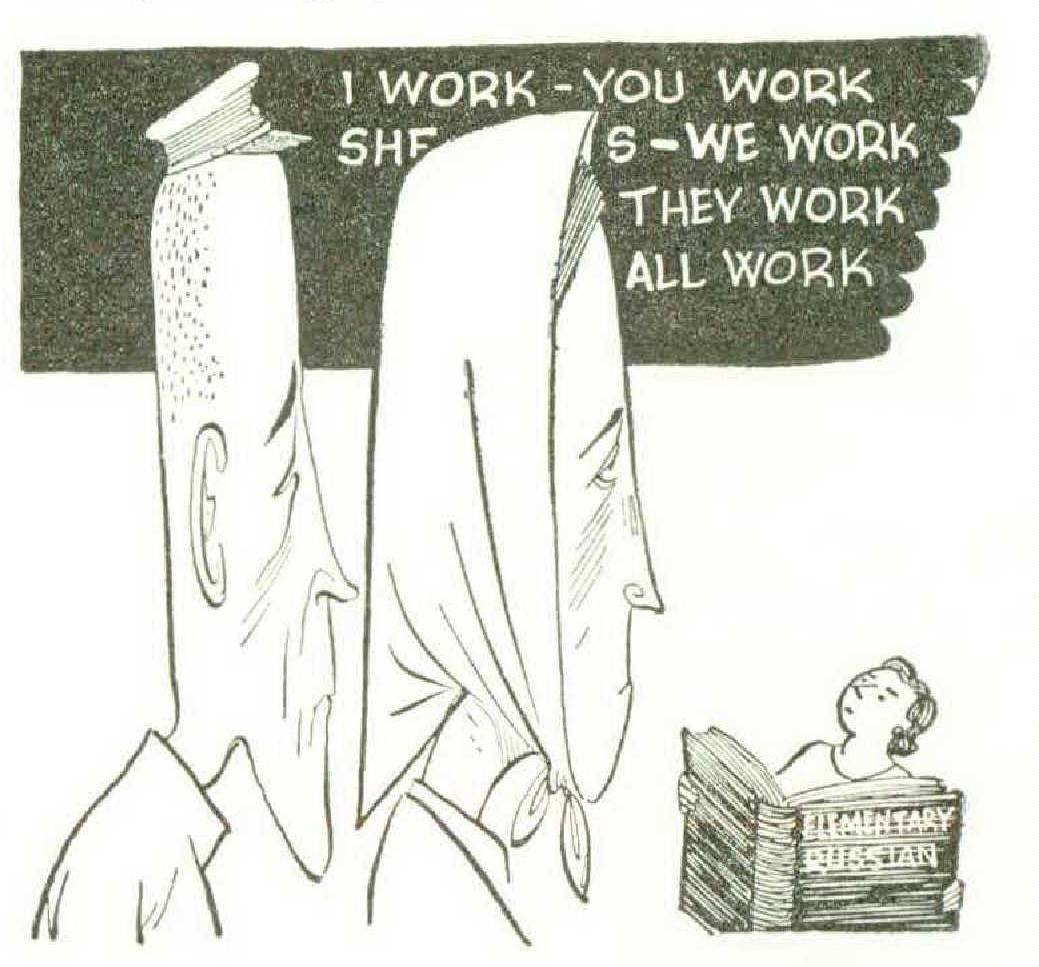
“What you?” “I mechanic.” “What your friend Peter?” “He doctor.” “He engineer?” “He doctor and engineer. He genius.” Sometimes we talk with a comrade about his wife. So far we are acquainted with no citizens who have offspring. “Your wife at home?” “No, she works at factory. She works day and night. She works very quickly. She works a great deal.” Students work in schools. Wives work in kitchens, when not working day and night elsewhere. Doctors work in hospitals. Engineers work in factories.
I work at learning Russian. Today in a melancholy moment I sneaked ahead a few lessons to find out whether things were going to look up or whether the whole semester would feel like the last act of The Cherry Orchard. But there it was again. I read the sentences under “Translate into Russian" — the only thing I could read later in the book. “We work all day at the plant without a rest. Only late in the evening do we go-by-foot back home. For breakfast we eat black bread. I work so much that I read nothing.”
For a moment I thought I saw a ray of hope. We were adding “streetcar" and “automobile" and “go-byvehicle” to our vocabularies. Now we would rest our feet. Now we would cease this pedestrian pursuit of comrades. “Do you own a car?" “No, I can live very well without a car. I go to work by subway.”“Who has a car?” “The engineer Pavlov owns a car.”
In the next sentence Engineer Pavlov is driving downtown. (On his way to the plant, of course.) Ignorant American that I am, I expect him to offer us a ride. But he doesn’t; he goes-by-vehicle straight by. (He is intent upon getting to the plant, where he will work very hard.)
So far we have not had “must” and “should" and “ought.” But we are braced for them when they come. “We should all work. We must work day and night. We ought to work a great deal. We must all become engineers.”
It may be next semester before we get to those verbs. But perhaps there will be no beginning Russian class, for by that time even the dullest of us will have grasped the one great lesson our Russian grammar has to teach. We shall be studying to become engineers. We shall be working a great deal. We shall be working day and night every comrade among us — in spite of health that is only so-so.