Something on a Dirt Road
NEWTON F. TOLMAN is a writer on country subjects who claims the odd distinction not only of having hern horn in New Hampshire, tad of haring tired there practically ever since.
NEWTON F. TOLMAN
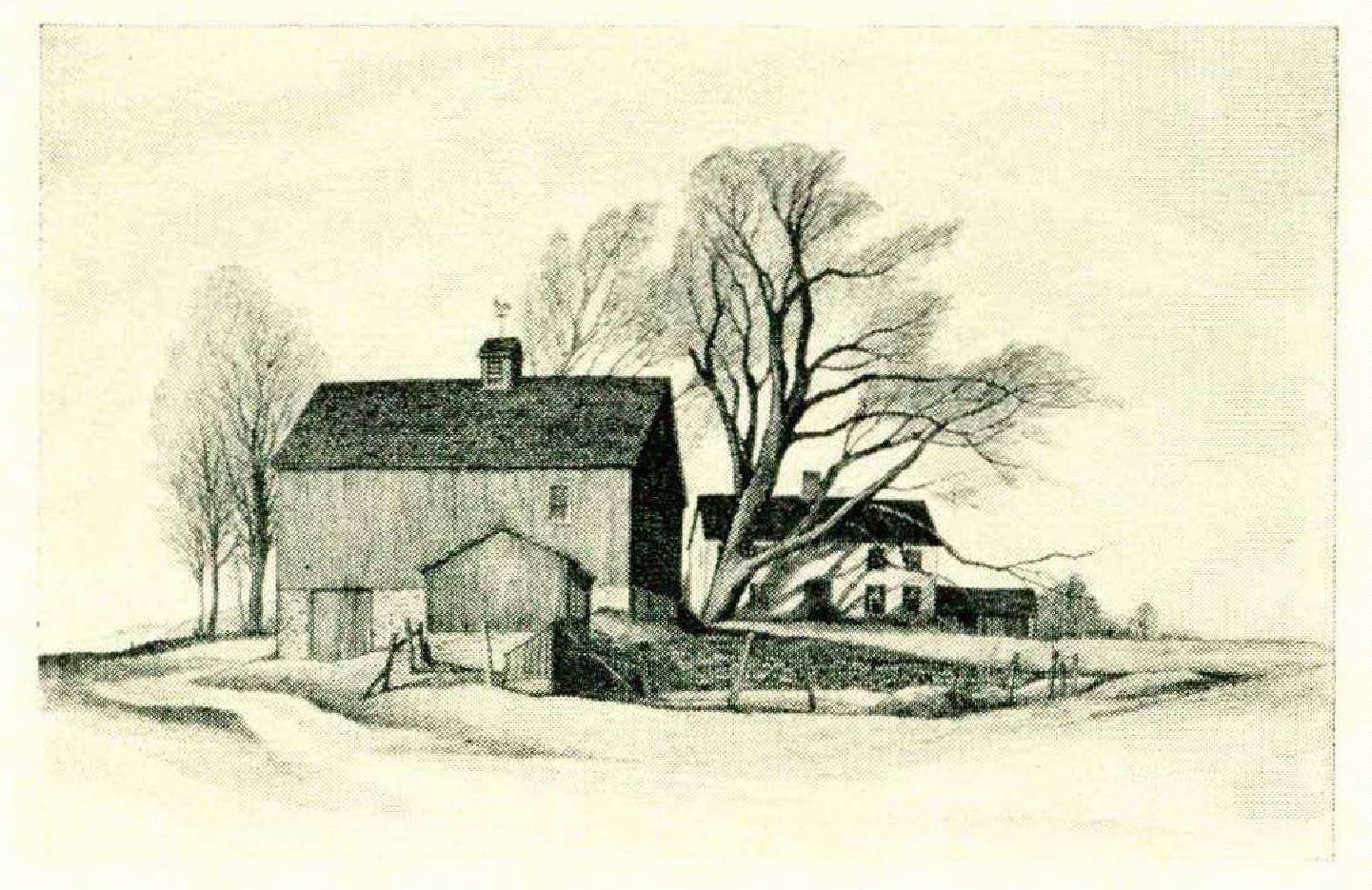
AMERICA, lecturers from abroad always explain to us, is a land of varied and violent fads. Admittedly, we have gone in for an odd custom now and again; and one of the strangest began around the turn of the century. Families of means were suddenly seized with an urge to return, voluntarily, to New England - back to a rigorous clime from which they had long been escaping in droves — bent on rehabilitating and occupying old farmhouses.
Heretofore no outsiders had ever come up to our country except in the heat of July or August. Their summer homes ranged from flimsy cottages encased in green latticework to the huge Italian villas, Spanish haciendas, and English manor houses of Bar Harbor and Dublin Lake. Now tlie avant-garde of the summer folk started moving into the farmhouses.
The new farmhouse aristocrats were ranked in order of age of dwelling; climbers soon learned to forge “1760” over doorways of newly acquired old homesteads. One very rich Dublin summer resident, determined to corner the market, bought up twelve old farms, extensively adding to the buildings, and installed a resident farmer in each, kite amount of money that this amphictyony managed to lose was too much even for a multimillionaire, and the places were soon sold oil.
Some of the wealthier recruits to the cult found adjustment to farmhouse living difficult. An industrialist who bought an old house on a hilltop to the south of us remodeled it so extensively that the original house was lost to view somewhere inside. He moved up whole chunks of the rococo family mansion from Worcester and grafted them on all around. There were three-story bay windows, a variety of dormers with stained glass, and, towering over all, two red water tanks large enough to supply the Hotel Wentworth. When the place was finished, the owner ended up a speech at Town Picnic, “and I hope the day is not far off. my friends, when every hilltop in New Hampshire will be crowned by a home as beautiful as my own.”
Now, fifty years later, there are still quite a few uncrowned hills left, but the search for old houses is hotter than ever. In the beginning we shrewd, dour natives figured the thing must surely be a passing fashion. It is a notion we have clung to over the years, thus losing countless chances to make a fortune in real estate. As a result we arc dourer than ever.
What has happened to “the country,” meaning a background for living as distinguished from that of city or suburb? Even here in the hills it is as extinct as The Country Gentleman, that weekly thriller we used to fight for by the light of the softly hissing mantle lamp. Lately, the only real farmers’ magazine we’ve seen is a quarterly, slicker and more sophisticated than Esquire, called The Farm.
Our native-born Ethan Frome types are about all dead now, their mores and tenets — their very accent — all but forgotten. Nor are their ways especially mourned by the handful of us, their descendants, who still live on the Old Place. It is the newcomers from Boston and New York and Indianapolis who keep their memory green. And these people are always insisting they see in us all the homely and quaint traits of our forebears. “Real characters, these neighbors of ours — lived right on the same spot for generations . . .”
Our upland township is one of the more sparsely inhabited in the state, yet it now depends on a suburban routine for its existence. Only two or three men still make a living in the vicinity of their homes. The rest, and some of the women too, commute to town jobs anywhere from ten to forty miles distant. School buses must navigate the most obscure cowpath to its end, ensuring that our “country” children, if they ever get any exercise, must get it some other way than walking.
A few of us, far out in one end of the township, still put up a fight every year to stop the spreading tar roads from creeping our way. Not for purely aesthetic reasons, but to protect our hunting and fishing from the increasing tide of beer-bottle heavers. But more and more of our neighbors are coming to the conclusion that we are insane — fanatics throwing ourselves across the asphalt path of progress.
This matter of roads is becoming ever more important to immigrants landing in our region from points south. We know a man who, though he has lived in New Hampshire only two or three years, is urging us to find him a place just like ours. At first we couldn’t believe he was serious. “Why, your house is one of the show places of the state, Bill,” I said to him. “It must have had over a hundred and fifty thousand sunk on it at one time or another. Why on earth would you want to move?”
“The damn road,” he replied. “Black top. Tourists, deer hunters, riffraff! Cans and bottles all along the edge. Driving us crazy. We’ve just got to find something on a dirt road.”
What he meant was a gravel road. Most of our country roads today that are not metaled (as they would say in England) are heavily surfaced with gravel. At least they are supposed to be, and that is why at Town Meeting there is always a great deal of talking, one might even say fighting, about Class 5 roads. The best of these roads are good the year round. But too often the gravel is only fine sand, or it has washed away, or there is not enough calcium chloride added to lay the dust. The result is a washboard guaranteed to shake loose from your chassis every bolt not firmly welded in place.
The drive leading to our house is really an old dirt road. Experts say it is one of the finest examples extant. Part of it was used by my ancestors (circa 1770); the remainder was built only fifty years ago. (As was our house, the family farm being a mile away.) The more recent part of the road is a fine reproduction, hardly distinguishable from the original. Nowhere has a shovelful of gravel ever been added to the authentic dirt.
In summer a dirt road has a soft, moist center with patches of grass, dandelions, and daisies. The wheel tracks are glassy smooth and have a pleasantly cool texture. For walking barefoot there is no surface as good.
All winter long the dirt resembles nice, smooth concrete. But in spring when it unfreezes it becomes liquid. While this lasts, we either mount the farm tractor or walk. The six-foot rear wheels of the tractor disappear at times, but they can usually keep on slogging forward. Every day we go out and dig little canals here and there to drain off the excess soup and argue endlessly about how many weeks it will be before we can try it with the jeep.
We are taxed a bit higher for owning such a lovely dirt road than would be the case if we lived on a gravel or asphalt highway, but it is well worth it. Nowhere else in the world could we be so sure of a whole month of peaceful solitude every year.
Suburban though we have so largely become, our once silent skies roaring day and night with jets, ‘copters, and quaint old props, there is a curious half-world all around us peopled with characters out of the last century. This illusory world-within-a-world began when I was a boy, long before Alexander Woollcott bought his old Vermont farm and called it Bellyacres.
It is the country as the city dweller sees it. It is the country of conservatively romantic novels, plays, and movies — and endless nonfiction accounts of how “we got tired of the tensions and struggle of city life, the daily hours wasted on commuter trains, the sham and glitter, the false standards, high taxes . . .”(My real-estate tax last year came to $840.67.)
THE man who moves to the country, unlike the proverbial Englishman who always dresses for dinner in the remote jungle, feels impelled to go in for clothes that reflect his altered way of life. The only jacket-and-tie men in rural New Hampshire are native-born farmers or lumbermen.
All this is fortunate for the photographers from the national picture weeklies who every year do the features on Town Meeting, “Where Democracy Really Functions.” In the front of the hall sits a broad-shouldered, jolly-looking fellow in the obvious garb of the woodsman. His round face, fresh in from the cutting March wind, is browned as though from the hot sun of the West Indies.
And indeed, he and his wife have just returned from there. Originally from New York, they moved up here some ten years ago. Usually they take a southern cruise to relieve the tedium of our winter chores — the shoveling out of paths, over and over, the daily mixing of Martinis.
Many of our rural customs, neglected for two or three generations, have been brought back to life by the professional country dwellers. They have introduced us to every beverage known to history, including champagne cider, dandelion wine, elderberry cordial, maple-sap beer, and blackberry grub (or is it shrub?).
We were also introduced to something that almost killed us. It was an afternoon in the dead of winter, and the roads were so drifted that no car could move. A neighbor phoned, in some excitement, to tell us we had better come down right away to see what he had discovered. He would say no more.
We got down there as fast as the tractor would go and were ushered into the kitchen to face an amazing spectacle: about forty full liquor bottles lined up on the kitchen table. After generously sampling several we found out the story. Our host had ordered some wooden barrels from a wholesale liquor firm in which to age his cider. On arrival, the barrels were found each to contain some dregs from their former service, amounting to several gallons of cloudy, powerful, uncut whisky. He had strained it off through a dish towel and filled all the old bottles he could find.
When we regained consciousness, it was fortyeight hours later and we were safe in our own home. We never knew how we had got there, but our faithful tractor was standing in the barn.
Some time ago we drove across the river to visit Ruth Smith, who has written some good things, among them an inspired book called White Man’s Burden. Ruth is a real old Vermonter, having moved there from Kansas twelve years ago, and we were talking about the numbers of writers who had settled in the Green Mountain country since Kipling’s ill-starred sojourn near Brattleboro in 1896—1898. We concluded that about half of what we had read lately must have been written in Vermont.
Even Ruth could not tell us why so many colleges have been springing up in Vermont, one to almost every village. It may be that in trying to elude mass-production education, the famed individualism of the region seems like the right environment.
In earliest days, the more adventurous and footloose of our hill-country farm youths used to run away to sea. In my time we also ran away, but we headed instead for Greenwich Village. When it came to glamour, with a high flavor of Bohemianism, even Paris could not compete with the Village. Only there could Max Bodenheim have written his classic, Naked on Roller Skates, and the area from MacDougal Alley to Tenth Street, lined with sculpture and painting studios, was the undisputed capital of the art world.
Today the painter or musician or writer who has arrived immediately buys an old farm in New England. (Those who haven’t try to land a free summer at the MacDowell Colony, one building of which was the old farm of composer Edward MacDowell, who died there in 1908. His half-smoked cigar lies in the ash tray on the piano exactly as he left it; at least it was there the last time I was over that way.) One of our neighbors is a woman who has recently scored a resounding success as a painter. She now has a winter studio in New York, but it is in the East Seventies, and she remarked the other day that she had never set foot in Greenwich Village.
Another neighbor, for a time, was a poet. He later went to England, where he soon became a great favorite of the Oxford crowd. Before he left, in exchange for a few cords of wood I chopped for him, he gave me the MS. of this verse written in his own angular scrawl:
EARLY SPRING LANDSCAPE
Spring had been long in coming; almost too long,
So it seemed, for their old frames had been unequal
To the task of keeping things dug out from blizzard
After blizzard. But when at last the final thaw began,
Cutting down the wind-carved hills of white
That had for months near buried the weathered homestead,
Old Eph took hope, and to his wife be said,
“Sarah-Jane, come to the south window with me here,
And look out toward the road — under the apple tree,
There, see? That’s the cab of the old Reo;
Clutch went out in nineteen-seventeen, remember?
And just beyond, the Franklin, and the Dodge sedan.
For years I aimed to get a new transmission for that Dodge.
But when the tires rotted I figured, what’s the use?
Can’t see much of the Overland yet, guess the top collapsed
With all the snow we had . . . looks kind o’ spring-like,
Don’t it, though, to see them all again!”