Homer's Winks and Nods
Poet, novelist, and classical scholar, ROBERT GRAVES resides in Majorca but makes his intellectual home in antiquity. The following essay is drawn from his introduction to a new translation of the ILIAD, which will be published by Doubleday later this month.
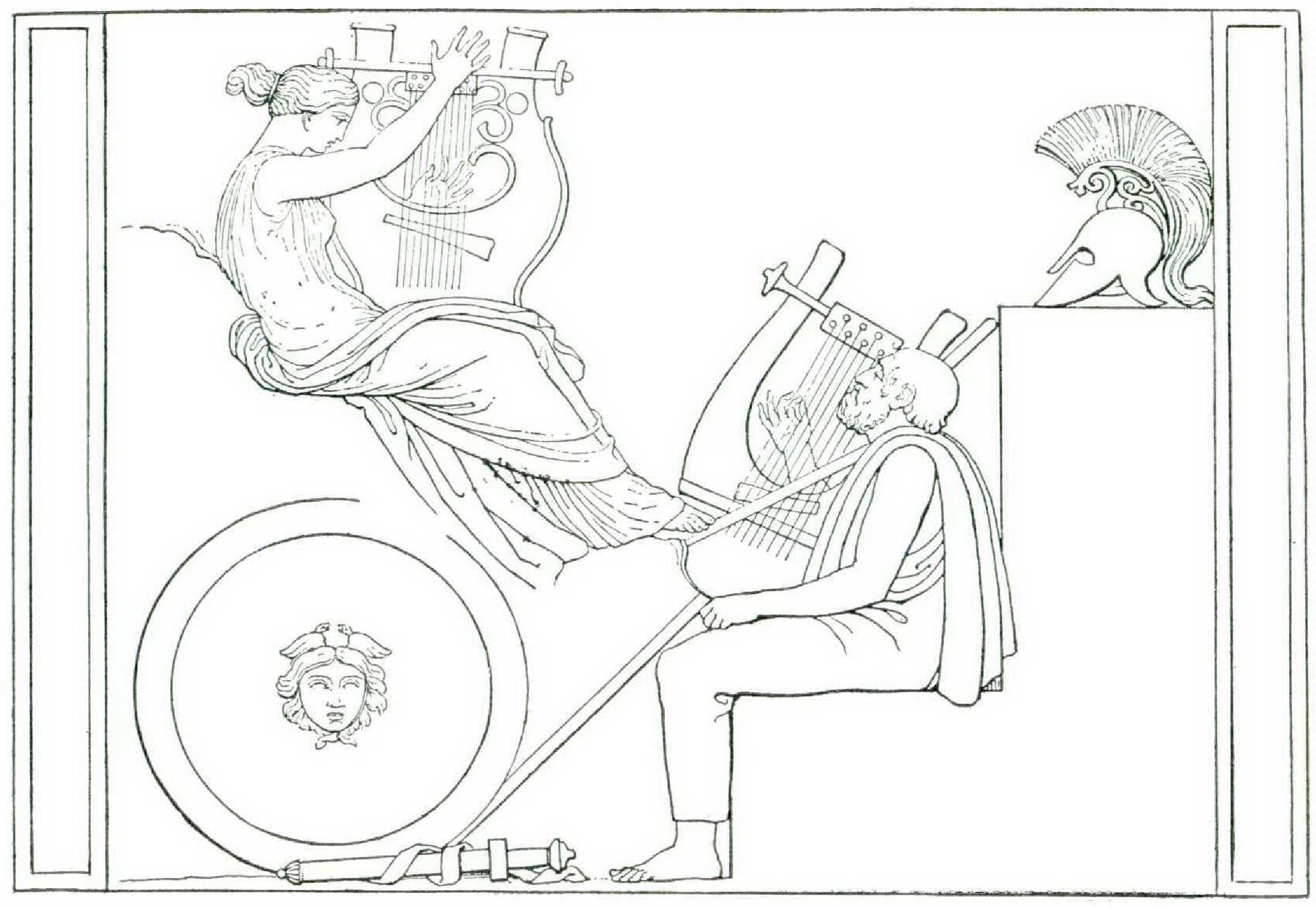
THE Homeridae — “Sons of Homer” — a family guild of Ionian bards based on Chios, enlarged their ancestor’s first short draft of the Iliad to twenty-four books and became collectively known as “ Homer.” They earned their livelihood by providing good popular entertainment for such festivals as the all-Ionian at Mount Mycale in Lydia, the all-Athenian at Athens, and the four-yearly homage to their patron, Apollo, at Delos; also, it seems, by going on circuit to various small royal courts where Greek was spoken from Asia Minor to Sicily, and perhaps even visiting Spain and western Morocco.
If modern scholars overlook the entertainment motive, dominant in the Iliad, and treat Homer as a Virgil, Dante, or Milton rather than as a Shakespeare or Cervantes, they are doing him a great disservice. The Iliad, Don Quixote, and Shakespeare’s later plays are life — tragedy salted with humor; the Aeneid, the Inferno, and Paradise Lost are literary works of almost superhuman eloquence, written for fame, not profit, and seldom read except as a solemn intellectual task. The Iliad and its later companion piece, the Odyssey, deserve to be rescued from the classroom curse which has lain heavily on them throughout the past twenty-six centuries and become entertainment once more. How this curse fell on them can be simply explained.
Other professional storytellers must have been active in Homer’s day, but since not a line of their original work nor any tradition of it has survived, we are justified in assuming that, like their ancient Irish, Welsh, and Gaelic counterparts, they used prose, reserving verse for incidental passages of religious or dramatic importance only, when they took up their lyres and sang what are still called lyrics. It is probable, however, that court poems had been recited in the glorious Mycenaean civilization of Greece, destroyed by the Dorian invasion not long after the fall of Troy, but that, on the destruction of the Greek royal courts at Mycenae, Pylus, Thebes, and elsewhere, prose versions of the tales, adorned with numerous poetic tags, passed into the hands of popular storytellers.
When a renascence of civilization among the Ionic settlers on the coast of Asia Minor finally closed the Dark Ages, which had lasted from about 1050 B.C. to about 750 B.C., Homer put one of these traditional tales back into verse. What is more, he used the new alphabetic script, borrowed from the Phoenicians, to record it in writing. Verse made The Anger of Achilles so easily learned by heart, and also exercised so compulsive a charm on Homer’s audience, relaxing with wine at their elbows in some royal courtyard, that it became a valuable legacy to his storytelling sons. Their additions are nearly all composed in the spirit of their father, though certain stylistic differences tempt experts to date the various books, or parts of books, from internal evidence.
The Iliad presupposes an earlier story cycle about the events leading up to The Anger of Achilles. These were the birth of Helen from Leda’s famous swan egg; the wedding of Peleus and Thetis; the Apple of Discord, thrown by the Goddess of Strife, which provoked the Trojan War by leading to the Judgment of Paris and his elopement with Helen; the unsuccessful Greek embassy sent to Troy demanding the surrender of Helen and her treasures — we gather from Herodotus that King Priam refused, on the ground that his aunt, Hesione, carried off by Heracles from an earlier sack of Troy, was still a captive in Greece — the recruitment of heroes for the punitive expedition, their landing at Troy, and the first nine years of desultory warfare. The cycle was versified by Stasinus of Cyprus (whom tradition makes Homer’s son-in-law) in the nine books of his Cypria, composed soon after the Iliad. But the Iliad assumes popular knowledge of these legends, as also of The Seven Against Thebes, The Labors of Heracles, and other cycles unconnected with the Trojan War.
Later poets continued the Trojan story, using the same Homeric hexameters; the traditional corpus of prose tales meanwhile remained in being. Though an authorized edition of the Iliad and Odyssey, published by leading Homeric bards under the patronage of Pisistratus, tyrant of Athens (mid-sixth century B.C.), had given the Homeridae immense prestige, their version of a dramatic event was often rejected by later mythographers in favor of a more popular and usually more archaic one. Pisistratus, whose chief adviser, Solon, traveled widely through the Middle East, saw the advantage of giving his official welcome to a reconstituted Mycenaean epic which recorded a strong Greek confederacy and could be treated as a holy scripture of the Oriental sort. Since Homer claimed to have been inspired by the Muse, since he glorified Nestor, Pisistratus’ ancestor, and since the Homeridae ranked as honorary Athenians — Homer reputedly having been born at Smyrna, a colony of Athens — these revised texts of the Iliad and Odyssey would serve Pisistratus’ purpose well enough.
The authors of the original Mycenaean court epics had been endowed temple priests who set themselves to exalt their gods and praise their rulers and did not need to think in terms of popular entertainment. Homer, on the other hand, instead of praising his rulers satirized Agamemnon, High King of Greece and Commander in Chief of the Allied Forces before Troy, as a weak, truculent, greedy, lying, murderous, boastful, irresolute busybody who almost always did the wrong thing.
Now, the original High King of the Achaeans was a living god, his palace a temple, his courtyards holy ground. He corresponded on equal terms with the High King of the Hittites, a fellow god. But by Homer’s time this religious high kingship had perished, all the great cities had fallen, and the semibarbarous princelings who camped on their ruins were ennobled by no spark of divinity. It is clearly these Iron Age princes, descendants of the Dorian invaders who drove his own ancestors overseas, whom Homer satirizes in Mycenaean disguise as Agamemnon, Nestor, Achilles, and Odysseus and of whom Hesiod, a late contemporary of Homer’s, was thinking when he wrote, in lugubrious vein, that the divine race of men had been destroyed in ancient Thebes and Troy.
The Homeridae, being sacrosanct servants of Apollo, could risk satire so long as they remained serene and unsmiling throughout their performances, pointed no finger, cocked no eye, tipped no wink. Homer’s wit is at its most merciless in Book Two, when Agamemnon calls a popular assembly and tests his troops’ morale by offering to abandon the siege of Troy. Members of the privy council have been warned to shout protests and demand a vigorous assault, but Agamemnon so overacts his defeatist part that he convinces even himself, and the war-weary soldiers at once rush cheering down to the ships. A fiasco! The goddess Athene is obliged to intervene. Homer makes Agamemnon superbly ridiculous again in Book Four, when the armistice has been broken and he addresses his wounded brother, Mcnelaus, taking him by the hand:
Alas, my poor brother! I fear that the oath which pledged you to single combat in no-man’s-land has proved your ruin: the Trojans have broken the armistice and transfixed you with an arrow. ... I am more than ever assured that Troy’s doom is scaled, also that of King Priam the Spearman and his subjects. Zeus, Son of Cronus, indignant at this outrage, will shake his shield threateningly at them from the Olympian throne; thus the armistice will not have been concluded in vain. Nevertheless, I should be most unhappy, brother, if you succumbed to your wound.
Agamemnon does not send for a surgeon at this point but continues self-pityingly and once more in a defeatist strain:
Your death, by removing the cause of war, might set my men clamouring for home — how ashamed I should be to find myself back on the thirsty plains of Argos, having allowed Priam’s people to make good their old boast of keeping Helen. Your bones would rot in Trojan soil, and the proud Trojans capering on your tomb would scoff: “I pray the gods that illtempered Agamemnon will have no greater success in his other ventures than in this! He has sailed away empty-handed, and noble Menelaus lies here beneath our feet, his mission unaccomplished.” Rather let the earth swallow me alive than that they should say such things!
Menelaus has, however, only been scratched. Battle is resumed, and Agamemnon stalks from contingent to contingent of his army, encouraging the commanders, but merely succeeds in setting their backs up by his ill-chosen phrases. Idomeneus is barely civil, Diomedes preserves a resentful silence, Odysseus and Sthenelus are downright rude to their High King.
In Book Nine, Agamemnon’s flood of tears and thunderous groans, after a severe defeat due to his own stupidity, introduce further comic scenes. He wakes Nestor with the odd excuse that he must no doubt be suffering from insomnia. Nestor, courteous though sarcastic, revenges himself by waking everyone else of importance. But for what? He has no idea. Nor has Agamemnon. They solemnly call a council and decide to send out a small patrol. Diomedes leads this, and when asked to choose a partner, picks Odysseus as the bravest present; yet he remembers Odysseus’ cowardly desertion of him in battle, and Odysseus knows that unless he redeems his good name a spear will be driven between his shoulders. He offers Diomedes a half apology.
Homer is utterly cynical about the Olympian gods. Zeus rules them by fear and cunning, not love, and must keep on constant guard against a palace revolution. In most mythmaking societies, what is alleged to happen in the courts of Heaven reflects what happens in the royal palace below, but Homer lets his gods behave far worse than the one royal family to whom he introduces us, namely, the Trojan. Priam, in Book Twenty-four, may rage at his surviving nine sons as malingerers and playboys who have dared outlive their forty-one heroic brothers, but his curses are doubtless intended to avert Nemesis and so protect them. On all other occasions the domestic atmosphere in the Trojan palace is irreproachable, despite the presence of Helen, prime cause of the family’s continued sufferings.
Zeus, on the other hand, hurls horrible threats at his wife, Hera, and the rest of the Olympian family, too well aware of their jealousies, grudges, deceptions, lies, outrages, and adulteries. Hera is a termagant, so cruel and sly that she manages to convert marital chastity and an avoidance of direct lies, which are her only virtues, into defects. She would like to eat the Trojans raw, and all because, long ago, Paris rejected the bribe she offered for a verdict in her favor and instead gave Aphrodite the prize of beauty. We are left wishing that Hera would commit adultery with some river god or Titan, be taken in the act, and thus compel Zeus to chain her down forever in the pit of Hell.
Zeus’s spoiled daughter, Athene, shares Hera’s grudge against Paris — she also entered for the beauty prize — and Homer does not ask us to approve of her mean behavior when the lovable Hector at last faces Achilles, a far stronger champion than himself, and she robs Hector of his advantage. Athene shines in comparison only with the foolish and brutal Ares. Of the three Olympians who come out of the tale fairly well, Apollo the Archer was the Homeridae’s patron, Hephaestus the Smith ruled Lemnos, one of the Ionian Islands, and Hermes the Helper had invented the lyre and protected travelers. Then there is Poseidon, whom Homer clearly despises for not standing up to Zeus and for being so touchy about his reputation as a master mason, but he abstains from ridiculing him because the PanIonian Festival falls under his patronage.
Homer’s audiences burned sacrifices to the gods and celebrated annual festivals, yet they felt, it seems, no more and no less religiously sincere than most cradle Catholics and cradle Protestants do today.
Libations and sacrifices, the Ionians agreed, might be useful means of placating angry gods — a splash of wine and the thighbones of the victims on which one feasted cost little — and in the interests of law and order one should never swear false oaths nor break the sacred bonds of hospitality. But they appear to have lacked any spiritual sense, except such few of them as had been admitted to the Eleusinian, Samothracian, Orphic, or other soul-stirring Mysteries. That Demeter and Persephone and Iacchus, the main figures in these Mysteries, are kept out of Homer’s divine harlequinade suggests that he and his sons after him were adepts — hence their poor view of official religion.
PERHAPS it was the very cynicism of the Iliad and Odyssey that made them acceptable holy writ in Pisistratus’ day, when the Greeks were already practicing free philosophic speculation. Homer soon became the basis of all classical Greek culture and, when Rome conquered Greece, of all Roman culture too. Nobody could be thought educated who had not studied him under a grammarian, and many bright youths knew both his epics by heart. The grammarians (professors of language and literature) discussed Homeric texts with as much zest and minuteness as the third-century rabbis devoted to commentaries on the Pentateuch. Homer was quoted in season and out; an apt reference, however irrelevant to the context, might win a doubtful case at law — where again the rabbinical parallel is tempting. Pisistratus, who claimed prime historical importance for the Iliad, managed to interpolate a line in the catalogue of ships by which Great Ajax the Salaminian was credited with beaching his small flotilla at Troy next to the larger Athenian one. This he offered as evidence in a court action against Megara. Athens was laying claim to the island of Salamis and managed to fool the Spartan judges.
The Iliad, though popular throughout Greater Greece in the sixth century, as vase paintings and other works of art prove, earned little reverence until jurists and grammarians treated it as a bible: for instance, Xenophanes of Colophon (about 500 B.C.) complained of Homer’s “imputing to the gods all that among men is shameful and blameworthy.” But Thucydides, writing about 420 B.C., already discusses Homer as a reputable theologian, if sometimes inclined to figurative language; and it is odd to find the later grammarians of Rhodes, Athens, and Alexandria commenting ponderously on passages which were no less satirical, in their tragic way, than Mark Twain’s Huckleberry Finn.
When I did Book Twenty-three at school, the ancient classroom curse forbade me to catch any of the concealed comedy in the account of Patroclus’ funeral games, which distinguishes them from Anchises’ tedious funeral games in Virgil’s Aenetd. Thus, Nestor, too old to compete in the chariot race, gives his son, Antilochus, advice before he drives the Pylian team, confessing that the horses are slow and hinting that the race can be won by gamesmanship alone. Antilochus dutifully spurts to overtake Menelaus in a bad part of the track, which, as they both know, will soon become a bottleneck, and declines to slacken his pace. Menelaus, rather than be involved in a crash, lets Antilochus drive ahead and cannot afterwards retrieve the lost ground.
When Menelaus complains of a deliberate foul, Antilochus voluntarily forfeits his prize, though he has recently saved Menelaus’ life in battle. Achilles, as president of the games, thereupon awards Nestor a consolation prize. Nestor, in a gracious speech of acceptance, tells a long story of how, when young, he won all the events at King Oedipus’ funeral games — or all except the chariot race, in which Actor’s sons scandalously jockeyed him. Homer leaves his audience to grasp that Achilles sympathizes with Antilochus and that Nestor means, “Yes, we cannot blame my son for boldly putting Menelaus to a test of nerves, it was a different matter at Thebes, long ago, when a rival chariot deliberately crossed my lane and headed me off. Yet my rivals were the Moliones, who, though putative sons of Actor, claimed Poseidon, God of Charioteers, as their real father; so, of course, I could make no protest.”
In the subsequent foot race, Antilochus, the fastest runner of his age group — the early twenties — is outdistanced by Odysseus, a man old enough to be his father, but makes a polite comment on the athletic pre-eminence of veterans. In fact, Antilochus purposely lost, to rehabilitate himself as a true sportsman, and this becomes clearer when Achilles shows gratitude by doubling the value of his third prize. Agamemnon then sees an opportunity of winning a prize himself; he enters for the javelin throw, confident that Meriones, his sole opponent, will have the politeness to scratch. Achilles does not even give Meriones the chance but sarcastically announces that Agamemnon, the best warrior in the world, may as well take both first and second prize: a contest would be sheer waste of time!
Nestor, Homer’s favorite butt after Agamemnon, can never refrain from boasting of his youthful prowess and. though rated the sagest councilor among the Greeks — as Polydamas is among the Trojans — consistently gives bad advice, which Agamemnon always adopts; whereas Polydamas consistently gives good advice, which Hector always rejects. Thus, the Greeks would never have suffered such a heavy defeat on the plain if Nestor, instead of encouraging Agamemnon to act upon the false dream sent by Zeus, had done as Priam later did — tested its truth by demanding a sure augury.
When a Trojan arrow wounds Machaon and Nestor agrees to drive him out of danger, Homer’s humor is at its driest. Once back at the Greek camp, they settle down to a refreshing beverage of onion juice, honey, and barley water in a great golden tureen, to which the slave girls add wine flavored with cheese, and Nestor embarks on a long story of his own youthful adventures at Pylus. He makes no attempt to remove the arrow still protruding from Machaon’s shoulder, though after fifty years of warfare he can hardly have avoided picking up a little simple surgery; nor does he send for Patroclus, a competent surgeon who, we know, was not busy at the time; nor does he even return to the battlefield and encourage his hard-pressed troops. He is still droning on when the Trojans swarm over the rampart. Then he hurriedly excuses himself: “ Pray continue drinking, and one of my slave girls will wash the blood from your shoulder.”Nestor later dishonestly explains his absence from the field as due to a wound, and the Iliad ends with no further mention of Machaon, who, for all Nestor cared, may have succumbed.
Homer treats Achilles with irony rather than humor. Though we are enlisted at the start as this ill-used hero’s partisans, Achilles is soon discovered to be the real villain of the piece, who heartlessly watches the massacre of his comrades, just to spite Agamemnon. We believed his assurance to the assembly that whenever he sacks cities and adds their treasures to the common stock, Agamemnon awards him only a trifle and takes the lion’s share himself; later, we find Achilles’ hut chock-full of loot — he has been selling captured prisoners as a side line and pocketing the proceeds. We also believed his assurance to the assembly that he was sincerely enamored of Briseis, but when Agamemnon at last repents and offers to surrender her, untouched, together with an enormous compensation for his insults, Achilles tells the envoys that he does not really want the girl, she means nothing to him, and that he despises treasure.
HOMER the satirist is walking on a razor’s edge and must constantly affirm his adherence both to the ruling aristocracy, however stupid, cruel, or hysterical, and his belief in auguries and other supernatural signs. The most sensible and telling speech at Agamemnon’s assembly, in Book Three, is made by the antimonarchical commoner, Thersites, whom Odysseus thereupon flogs. To dissociate himself from Thersites’ sentiments, Homer presents him as bowlegged, bald, humpbacked, horrible-looking, and a general nuisance, but the speech and Odysseus’ brutal action stay on record. And Homer’s real feelings on the subject of auguries are put into Achilles’ mouth — he thinks birds are simply birds, and fly about on their own lawful business without divine instruction — for Achilles is angry and despairing and can therefore be pardoned.
An inveterate hatred of war appears throughout the Iliad, and Homer smuggles into Book Twentythree a bitter comment on the monstrous slavery it entails by awarding the winner of the wrestling match a copper caldron worth twelve oxen and the loser a captive Trojan noblewoman, valued as highly as four because she is skilled at the loom.
We never get a clear battle picture in the Iliad. To earn his slices of fat roast mutton and his cup of honey-sweet wine at court, Homer often had to strain his imagination in describing novel varieties of manslaughter, which he credited to the ancestors of his hosts. Even Agamemnon, from whom the aristocracy of Lesbos claimed descent, was allowed his day of glory (Book Eleven), though he made as much fuss about a slight wound “as though he had been overtaken by the pangs of childbirth.” These passages are perfunctory in the main, and, except for the pleasant similes that embellish them, can be skipped without offense to Homer. He is so careless, too, about the names of Trojans killed — Greek sword fodder — that Erymas, Acamas, and Chromius get dispatched twice and Chromius lives to tell the tale. Books Sixteen and Seventeen are a sad muddle as regards time and weather continuity: first sunset, then bright sun and no cloud, then a rainbow, then a thunderstorm, then a long spell of fighting, then night falls. Hence the Latin tag, “our good Homer himself occasionally nods.” Yet some of the major discrepancies are inherent in the prose tradition; thus, the Apple of Discord was flung at the marriage of Peleus and Thetis just before the Trojan War, which Achilles nevertheless joined, mysteriously grown to sudden manhood.
Two main reasons prevented Homer from making his battles realistic. One was that the feats or fates of common soldiers did not interest his patrons, who cared to hear only of duels between noblemen. The second reason was that, while light-chariot races were still in vogue, the heavychariot fighting described in the story cycle had gone out altogether by Homer’s day. So, though chariot combats occur frequently in the Iliad, the relation of chariotry to infantry remains obscure.
Homer feels most at ease when his heroes forget their chariots and fight shield to shield in an unbroken line, so close that their spears almost get entangled. This unbroken line is a postMycenaean development of Greek infantry tactics and implies a changed social organization. The chariot-riding Mycenaean prince — unless he happened to be a Pandarus or Teucrus and fancied himself as a bowman — used a long thrusting lance, a towerlike figure-of-eight body shield, and a heavy bronze broadsword. Thus prepared, he challenged enemy nobles to single combat, and his crowd of leather-jerkined pikemen, standing in the background, moved forward only if he fell wounded. (Little Ajax and Amphius wore linen corselets not from sheer foolhardiness but because they carried body shields.) The free citizens of Homer’s day, however, fought in a close line like the Roman legionaries, and their weapons were a couple of throwing spears, an iron stabbing sword, and a small, round targe with a pointed boss. Archers, slingers, and cavalry supported them. Homer omits cavalry, but, though Ajax fights in true Mycenaean style and so at times do Hector and Achilles, he feels obliged to modernize most of the fighting in order to hold his audience.
The Mycenaeans buried their noble dead without burning their corpses or their funeral offerings; Homer makes both Greeks and Trojans practice the modern total cremation. The forging of Achilles’ bronze shield is described in a way that shows Homer’s total ignorance of Mycenaean metallurgy: Hephaestus goes to work as though he were a blacksmith. And simple woodmen wield iron axes, though no iron but the rare and immensely valuable meteoric sort, containing a high proportion of nickel, was known at Mycenae; ore smelting came in later.
Troy itself is no fiction, nor is the burning of the city (which archaeologists call “ Troy VIIA”) by an expeditionary force of Greeks in the thirteenth century B.C. — 1230, not 1287, is the date now favored. But, though the occasion of the war was perhaps a Trojan raid on the Peloponnese, the cause would rather have been a decision reached by the Aeacids and their allies to reopen the trade route through the Hellespont from which the Trojans had lately debarred them. Achilles was a leading Aeacid, and the Cretan followers of Prince Scamander are named by Strabo as among the founders of Troy, which would explain their descendants’ participation in the war under Idomeneus.
A tradition quoted by Hesiod makes Helen’s numerous suitors sacrifice a horse at Sparta, stand on its bloody joints, and swear that they will defend the chosen husband against anyone who resents his good fortune. Thus, Hesiod says, Helen’s rejected suitors organized the expedition against Troy when Menelaus was wronged by Paris. Yet it has been convincingly shown by Professor T. B. L. Webster, in his admirably up-todate From Mycenae to Homer, that Helen’s abduction formed no part of the original Trojan legend; Homer borrowed the tale from some source dependent on the early Ugaritic epic, Keret. In the opening lines, Prince Keret mourns that “his lawful wife surely went away; his rightful spouse, whom he had won with a bride gift, indeed did depart.” Thereupon the god El tells him to besiege Udm and demand the King’s daughter, Huray — apparently this same lawful wife. Keret does so, and in the end the King of Udm surrenders her, after an attempt to buy him off. In the Iliad, Paris likewise offers to restore with interest the treasures which he has carried off if he may keep Helen, but this does not satisfy Menelaus.
Professor Webster’s discovery of an external source for the Helen-Paris relationship strengthens the contention I made in my Greek Myths:
This is to suggest that the mnēstēres tēs Helenēs, “suitors of Helen,” were really mnēstēres tou hellēspontou, “those who were mindful of the Hellespont,” and that the solemn oath which these kings took on the bloody joints of the horse sacred to Poseidon, the chief patron of the expedition, was to support the rights of any member of the confederacy to navigate the Hellespont, despite the Trojans and their Asiatic allies. After all, the Hellespont bore the name of their own goddess Helle.
In the first nine years of war, the Greeks seem to have blockaded but not besieged Troy, limiting themselves to punitive raids on the Trojan allies all along the Asian coast and doubtless sailing home every autumn. The unbroken ten-year siege is a dramatic fiction often contradicted by internal evidence; thus, Sarpedon the Lycian still has an infant son at home, though he came to Troy with the first allied contingent. And, in Book Eleven, Othryoneus from Cabesus has just heard of the Greek landing. The mythographer Hyginus records an earlier legend, that King Priam’s allies arrived in the tenth year. Also, excavation proves that Troy VIIA could house no more than two or three thousand men, as opposed to the many thousands mentioned in the Iliad as having spent the entire war there.
Now we come to the question of how Homer understood divine intervention in human battle. It is one thing to ascribe natural catastrophes such as earthquakes, pestilence, deaths in childbirth, men or houses struck by lightning to respectively Poseidon, Apollo, Artemis, and Zeus, or to regard birds as messengers of the gods. It is quite another when these gods adopt human guise, as when Apollo pretends to be Hector’s brother, Helenus, and gives him tactical advice or when Hermes disguises himself as Achilles’ squire and guides Priam safely into the Greek camp. This is a graphic way of saying that the human being was inspired, though keeping his familiar appearance; the divine Kings of Mycenae and the Middle East were constantly represented by epic writers and on monuments as being so favored by their deities. When, however, a god stands at the side of a chosen champion other than a divine King and helps him to victory — as Athene did for Diomedes and Ajax or as Apollo did for Paris when he killed Achilles (a deed, by the way, only prophesied, not performed, in the Iliad) — this seems more like divine possession than divine inspiration. Though by Homer’s time such a possession had evidently ceased to be a common phenomenon, he has preserved occasional details which make it recognizable.
The personalities of the Olympians were established by ancient Greek myth, so that, if a hero were possessed, it would be at once apparent which deity was riding him. Ares, the War God, a great, tough, swaggering warrior, relied on main force, heavy spear thrusts, and crushing sword swings; perhaps heroes mentioned in the Iliad as “Ares’ favourites” or “descendants of Ares” were susceptible to his possession. Diomedes, in Book Five, fears to face Hector because Ares is with him; but on another occasion, Diomedes has been himself possessed by the goddess Athene, and Hector prudently avoids an encounter.
Among the ancient Greeks, as among the pagan West Africans and loa-worshiping Haitians, a man could be possessed by a goddess or a woman by a god. The Pythoness at Delphi or the Sybil at Cumae, who were possessed, not merely inspired, by the god Apollo, assumed his voice and demeanor. Athene, the Amazonian goddess, evidently had a more deadly battle technique than Ares, because whenever two warriors met, one inspired by Athene, one by Ares, Athene always won; two combats between these deities — or their chosen incarnations — are given in the Iliad. Hector remarks that fighters have their off days or their days of triumph, according as Heaven wills. Thus Aeneas, possessed by Aphrodite, is easily defeated by Athene’s incarnation, Diomedes, by suffering the hand wound which Homer attributes to Aphrodite; but Aeneas makes good his escape. Later, the strong god Apollo possesses him and he lops down his opponents like pines. But the Greek gods never became bisexual, as their West African counterparts did.
The most interesting case of possession in the Iliad is that of Paris, Aphrodite’s favorite. When he fights Menelaus, then aided by Athene, he just manages to extricate himself with Aphrodite’s adroit help and to escape to Troy. Afterwards, Hector visits him at his house and calls him back to fight, saying sarcastically: “ I cannot regard your grudge against Troy as a very decent one; it is for you alone that our people are dying to defend these walls.” Paris, still under Aphrodite’s influence, gives a characteristic answer: “Sharp words, but not unreasonably so. Allow me to explain that I bear no particular grudge against Troy, but feeling a little sad. I wanted to enjoy a good cry on the chair in this bedroom. My wife has just suggested that I should fight again, and I am taking her advice; because one never knows who will win the next round, does one?” That same day, Paris saves the situation, not by some tremendous lunge with a spear or cast with a boulder but by an unsporting arrow shot, from behind cover, that pins Diomedes’ foot to the ground and disables him for the rest of the battle, Paris’ laugh is the merry laugh of Aphrodite, and Diomedes’ answer carries all the venom proper to Athene.
Homer clearly disbelieves the legends of gods’ taking part in human affairs but is always ready to extemporize divine machinery. Since a “tomb of Sarpedon” was shown in Lycia, whereas the Trojan cycle made Sarpedon fall in battle, Homer obligingly arranges an aerial transfer of the corpse back to Lycia, at Zeus’s orders. It is reasonable to suppose that he has also altered the ancient account of how Paris killed Achilles. Aphrodite, rather than Apollo, will have guided the arrow that pierced the famous heel, since, according to most mythographers, Achilles fell not at the Scaean Gate but in Apollo’s temple, where Deiphobus had lured him after posting Paris behind a pillar. Apollo would hardly have so defiled his own shrine. Aphrodite seems to have been a far more important character in the original story cycle than in the Iliad. The Homeric Returns of the Heroes, clearly based on Mycenaean tradition, makes every Greek leader of note either return home to find his wife unfaithful or be shipwrecked. Before Poseidon, fairly late in religious history, converted his thunderbolt into a trident and exchanged sweet waters for salt, Aphrodite ruled the sea as well as human passions, and her alternate forms of revenge for the destruction of Troy yield far better sense than Poseidon’s idle spite, to which, though he championed the Greek cause at Troy, these disasters are implausibly ascribed.