The Saving Grace
In the foreword to JAMES THURBER’S first, slim volume of drawings, Dorothy Parker recounted how hecklers had found the Thurber women to have no sex appeal, to which the artist replied, “ They have for my men.” This certainly applies to the heroine of his new cocktail party, Mrs. Groper. Readers wanting more of Thurber are advised to consult his most recent and popular book, THE YEARS WITH ROSS.
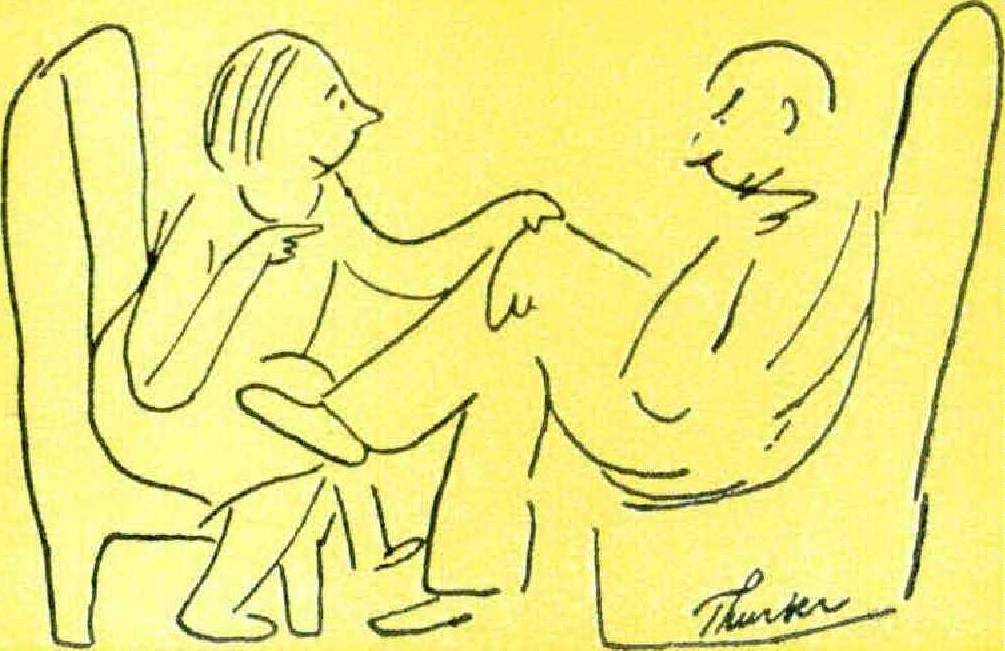
I HAVE wanted to argue with you since 1951,” said a woman who sat down next to me, around midnight, at a recent party in Connecticut.
“You have shown remarkable restraint for your impatient sex,” I said. “Here it is 1959. What is it you want to be wrong about?”
“In 1951, in an interview, you said that humor would be dead within five years. Well, it wasn’t,” she said firmly.
“ I said it would either be dead or off its rocker,” I told her. “ Perhaps it is both. You may have seen its gibbering ghost.”
“ Do you think ghosts are crazy?” she demanded.
“Well,” I said, “anyone who rejoins our species, after once being quit of it, can scarcely be called bright, can she?”
Here she proved too quick for me. “It was Banquo who made that awful scene in the dining room, not Lady Banquo,” she pointed out. I could have observed that Lady Banquo was not dead, but it would have been too easy.
“Lady Banquo sent him there,” I said. “You know how women ghosts are,”
“ I don’t want to get into the First Folio, or anything like that,” she said with a touch of irritation. “What did you think was the matter with humor in 1951?”
“ It was suffering from acute hysteria, pernicious fission, recurring nightmare, loose talk, false witness, undulant panic, ingrown suspicion, and occlusion of perception — quite a syndrome,” I said. “When reason totters and imagination reels, humor loses its balance, too.”
“It is called the saving grace,” she said, making a sharp left jab of the truism. I wasn’t off guard, though.
“Grace can’t save us unless we save it,” I said.
“It is saved,” she insisted. “It’s on all sides of us. You just don’t want to see it. What else do you think has happened to humor?”
“ It suffers from chronic crippling statistics,” I told her. “Humor flourishes only as a free single entity. Humor makes its own balances and patterns out of the disorganization of life around it, but disorganization has been wiped out by organization, statistics, surveys, group action, program, platform, imperatives, and the like. These are good for satire, but they put a strait jacket on humor.”
A man with a highball glass in his hand wavered over to us and said to me, “You guys give me a pain in the neck. On the other hand, the pain in Twain stays mainly in the brain.”
For such crude intruders I always carry a piece of complicated academic drollery, and I gave it to him: “If you prefer ‘I think, therefore I am’ to ‘Non sum qualis eram,' you are putting Descartes before Horace.”
He hesitated, jiggling the ice in his glass. “Nuts,” he said, and wove away.
“ Who was that feeble-minded son of bombast and confusion?” I asked my companion.
“My husband,” she said. “My name is Mrs. Groper. Alice Groper. Tell me some more about statistics, but not too much.”
“On Monday, July 6,” I said, “I heard three news broadcasters say, ‘Only two hundred and sixty-two people were killed in automobile accidents in the past two days,’ and one of them added that nearly a hundred people — eighty-eight, to be exact — were alive that might have been dead. He was basing his statistics on an estimated three hundred and fifty dead, confidently predicted by the Safety Council. In the place of humor, you see, we have grim, or negative, cheerfulness. One statistician not long ago tried to cheer us all with his estimate that only eighteen million people, not fifty million, would be killed here in a nuclear war. This kind of horrifying reassurance is now our main substitute for laughter.”
“I don’t want to talk about horrifying reassurance,” said Mrs. Groper.
“Take teeth, then,” I told her. “Last year, in London, somebody asked me why Americans thought teeth were so funny. I explained that it is not teeth, but the absence of teeth, that we regard as funny, and also the absence of hair.”
“But we laugh at paunches, too,” she cut in quickly, “and that’s the presence of something.”
“Not at all,” I told her. “What we laugh at is the absence of the once flat abdomen. If I am splitting hairs, they are the hairs just above the male ears, as all the others are so hilariously gone.”
“Let’s not go into philosophy or definition,” said Mrs. Groper. “They never get you anywhere.”
“They have got us where we are, or, anyway, they have left us there,” I said. “Now, disorganization must not be confused with disintegration. If the failing apart of the human body is funny, then death should be the biggest laugh of all. I think I saw this concept forming when the edentulous mouth was first deemed to be uproarious. That was a long time ago, and I hoped that the comedy of dentures would disappear along with the jokes about the activities of Mrs. Eleanor Roosevelt, but I was wrong. Mike Nichols and Elaine May, and even the English playwright, Graham Greene, regard teeth as highly amusing. The usually very humorous Nichols and May have a protracted, or perhaps I should say extracted, skit about a dentist who falls in love with the decayed molar of a young woman patient, and then with the rest of her. (They call her Reba, but I would prefer Sesame.) Mr. Greene’s current comedy success on the London stage concerns a love triangle involving a dentist, a bookseller, and the dentist’s wife. In this play the dentist occasionally flashes his electric torch into his rival’s mouth and warns him about a certain tooth. The play is a huge success, and I expect any day now to encounter a burlesque called The Bridgework on the River Kwai. I happen to consider the oral cavity to be about as humorous as a certain canal. Ask me, what canal?”
“What canal?” asked Mrs. Groper.
“Alimentary, my dear Watson,” I said. “Why don’t you giggle?”
“Because my name is not Watson, and I don’t know what you’re talking about,” she said.
“ I am talking about the fragmentation of the human organism as the source and subject of dubious fun,” I said. “Last August a weekly magazine I sometimes write for became avantgarde in this field of humor and came up with a comic drawing about the virus called Staphylococcus aureus. There were no funny drawings in the magazine about people, only about other creatures. The idea that persons, as such, in their entirety may be passing from the American comic scene keeps me awake at night. One dawn I woke up singing, ‘When you were the fly in the ointment and I was the cat in the bag.’ Then I worked out the caption for the drawing of a bug in a rug. It is saying to another bug, ‘ I can’t get comfortable.’ ”
“But you have done a hundred fables about talking animals and birds,” she reminded me. Having determined not to drink anything that night, I sipped my second highball slowly.
“You have mislaid your discriminator,” I told her brusquely. “The fable form has immemorially identified the behavior of animals and birds with that of people, to emphasize the foibles and follies of the human race. But talking animals in cartoons are now tending to denigrate man by assuming attitudes of superiority. For example, you find two giraffes staring at a human being, and one of them is saying, ‘There ain’t any such animal.’ Or a cartoon will show half a dozen persons on all fours with their heads buried in the sand, and one ostrich is saying to another, ‘ My God, look who’s fallen for that old myth.’ ”
DIDN’T anything funny at all, in the old-fashioned sense, happen to you while you were in Europe last year?” Mrs. Groper wanted to know. “I think you’re just in a depressed mood. You’ve had too little to drink. I’ll get you another highball,” and she did.
“Well, there were the Hugginses,” I said when she came back with the drink.
“Now, that’s funny.” She laughed merrily.
“Not frightfully,” I said, “and yet it was frightful, too — what happened to them on the ship coming home, I mean.”
“Did they fall overboard?” she asked.
“No, but they went off the deep end,” I said. “Here’s what happened. Mrs. Huggins had bought a new dress in Paris, at the most expensive shop — I’ll call it Violetta’s. While her husband was out on deck one day, staring at the sea and trying to remember how many people had gone down on the Titanic, not how many had been saved, she removed the label from the dress and sewed in the label of what you women call a reasonable shop, a small shop in New York. But it preyed on her mind, and so she later ripped out the label and put the Violetta one back in.”
“That’s not so funny,” my companion said. “ We all do things like that. We’re all afraid of the customs inspectors.”
“Anyway,” I said, “my wife and I met the Hugginses for drinks one night after dinner on the ship. They had already had a lot of cocktails and wine, and they were both on the edge of their chairs. She was also on the edge of colitis, and he was threatened with a new ulcer.”
“ I don’t see why, if she had sewed the real label back in,” said my companion.
“It was this way,” I said. “Huggins told his wife that any customs inspector would be able to tell that the Violetta label had been sewed into the dress by a nervous and amateur hand — that is, a guilty hand.”
“So what?” demanded Mrs. Groper. “It belonged there.”
“Belonging is a matter of congruity, not of simple fact,” I explained. “The human mind, or mental state, being what it now is, the inspector would be sure to say,‘Madam, this is clearly not a Violetta dress. You have sewed the label of an expensive Paris shop into an inexpensive American-made dress that you obviously took to Europe with you.’ ”
“But why would Mrs. Huggins conspire with herself to pay duty on an imported dress when she didn’t have to, if it wasn’t really imported, even though it actually was?” Mrs. Groper asked.
“ You’re oversimplifying,” I told her sharply. “The assumption would be that Mrs. Huggins was trying to get away with something. I mean, that she was willing to pay a hundred dollars in duty just to prove to her friends that her husband could afford a Violetta dress for her.”
“ What finally happened?” asked Mrs. Groper.
“ Huggins wanted to throw the dress overboard,”I said. “To save money, you see.”
“ Do I?” she asked.
“Certainly,” I said. “ If the case got to the courts as the result of Mrs. Huggins’ determination to prove that the Violetta dress was in fact a Violetta dress, Violetta herself might have to be flown to New York to testify. Lawyers’ fees, court costs, and so on would run into a pretty figure. Well, anyway, over our drinks that night, Mrs. Huggins burst into tears. My own wife, returning from the ladies’ room at that moment, accused me of having hurt her feelings. That made me mad. Then suddenly Huggins smote the table with his right fist, breaking his glasses, which he had forgotten were there. His wife reached over impulsively and cut her right index finger on a fragment of broken lens.”
“I think you’re losing me now,” my companion said.
“We’re all lost,” I said irritably. “When Mrs. Huggins’ finger began bleeding, I yelled at her, ‘ Why in the name of God do you have to cut yourself every time your husband breaks his glasses?’ You see, I was mad at her now because she had not denied that I had hurt her feelings. Humor had folded its tents like the Arabs and noisily stolen away from a situation that demanded its presence. England’s Lord Boothby recently said that humor is the only solvent of terror and tension. He might have added that it is also good for incipient colitis and ulcer, broken glasses, bleeding index fingers, raised voices, and lowered spirits.”
“ Goatblather,” said Mr. Groper as he passed my chair, jiggling ice cubes in a fresh highball.
YOUR husband has all the charm of a gentleman I shall now tell you about,” I said. “The story points up the decline of humor in our time and in our species. Recently two couples, entirely unknown to each other, were leaving a Broadway theater at the end of the play. They were moving slowly and with difficulty up the crowded aisle, when the observant wife of one man whispered in his ear, ‘ You’re unzipped!’ He hastily zipped and, in so doing, caught in the zipper the fringe of the other woman’s stole. The embarrassing predicament soon became uncomfortably obvious to all four. They were huddled together as they reached the curb, where the husband of the woman with the trapped stole said grimly, ‘Let us not make a social occasion of this. We shall all get in the same cab and drive to whichever apartment is the nearer.’ And they did just that, in gloomy silence.”
“But,” said Mrs. Groper, “they could have taken separate cabs, and the stole could have been returned next day.”
“The husband of the stole,” I explained, “made it clear that he did not want to exchange names with the other couple. When they got to the nearer apartment, the two gentlemen retired to another room, where they finally managed to extricate the stole. Then the two couples separated without so much as a good night.”
“But if they had had a nightcap together, they all would have laughed about it,” said Mrs. Groper. “You just can’t be dignified in a situation like that. You need another drink.” And she left to get me one.
“ Keep it clean, Mac,” said the peripatetic Groper, passing my chair again.
“Don’t you ever sit down, for God’s sake?” I yelled after him. His wife brought me the fresh drink, and I added a moral to the tale: “When dignity does not give, humor cannot live.”
At this point my wife joined Mrs. Groper and me and said, “Why are you shouting?” I started to explain, realized that it couldn’t be done, and sulked instead.
“Did Mr. Huggins finally throw the dress overboard?” Mrs. Groper asked my wife.
“Oh, that,” my wife said. “Of course not. They were lucky. The customs inspector didn’t even look at the dress.”
The party was growing noisy now, and we could hardly hear one another. Someone had put a record on the phonograph, and several couples were dancing.
“If that’s all there is to it,” said Mrs. Groper, “it isn’t really frightful unless Mrs. Huggins got blood poisoning and died.”
“Oh, my God, I didn’t know that!” my wife cried.
“We all have to go sometime,” I yelled.
“I was ready to go an hour ago,” my wife said, “but you were taking something apart, as usual.”
“A woman always assumes that a man is taking something apart when he’s trying to put it together,” I said.
“We must go,” my wife insisted.
“Not until I save Mrs. Huggins’ life,” I said. “It’s the least I can do.” But Alice Groper was no longer interested in the plight of the Hugginses.
“Your husband has been officiating at the burial of humor,” she said.
“Oh, he has, has he?” said my wife. “Then there’s something you should read aloud to him, to refresh his memory on the vital statistics of humor. I think our hostess has a copy of it. I’ll see.” She went away and came back with a pamphlet, which she handed to Mrs. Groper, saying, “He wrote this in 1953. It’s about the deathless tradition of humor in the United States of America.” She pointed to a certain paragraph, and Mrs. Groper read it aloud. “ ‘ Humor came over in the Mayflower. It weathered hard winters, Indian attacks, witch hunts and Puritanism. Later it flourished in the free American soil, it was carried westward in covered wagons, it was borne upon our battlefields as bright and inspiring as regimental colors. It has been seasick, wagonweary, and shot full of holes, but it has always managed to keep on going.’ ”
“Now you’re making sense,” said Mr. Groper, holding out his hand. I thought for a moment of biting it, but shook it instead. “How’s about a little old toast to humor?” he asked. The music had stopped and the others in the room gathered around us.
“You do the honors,” Mrs. Groper said to me. I stood up, without too much difficulty, and held my glass high.
“Here’s to the Queen,” I said. “The Queen of the graces.” As we were drinking to the hardy survivor of centuries of American life, our hostess, a lady of great charm but small regard for syntax, cried, “ Do not for the God’s sake break the glasses! Too many glasses are broken already without toasting Queens, so it is enough, and not funny.” Everybody thought it was funny, though, and everybody began laughing. My wife and I were leaving the jolly house, good humor all intact, the sound of merriment in our ears, when Groper came up and extended that damned right hand of his. I took it. “I’m sorry I mentioned your goatblather,” he said. I wanted to throw him over my shoulder, but I am thirty years too old for that gesture in conclusion. “It is nannyblibberers like you that are full of goatblather,” I told him.
“Come on!” my wife said, pulling me toward our car as if I were six years old, which, like all American adult males, I sometimes am.
When we were back in our living room she said, “ Grief-stricken as you are by the death of humor, maybe a nightcap would put you in a better mood.” I nodded, having never rejected a nightcap since 1915.
“ I am, au fond, a mellow foxy grandpa-type philosopher,” I told her. “ While we finish the nightcap, I shall count your lucky blessings, name them one by one.”
“Then,” she said, “we’ll only need a short drink.” And she made us both a short one.