Accent on Living
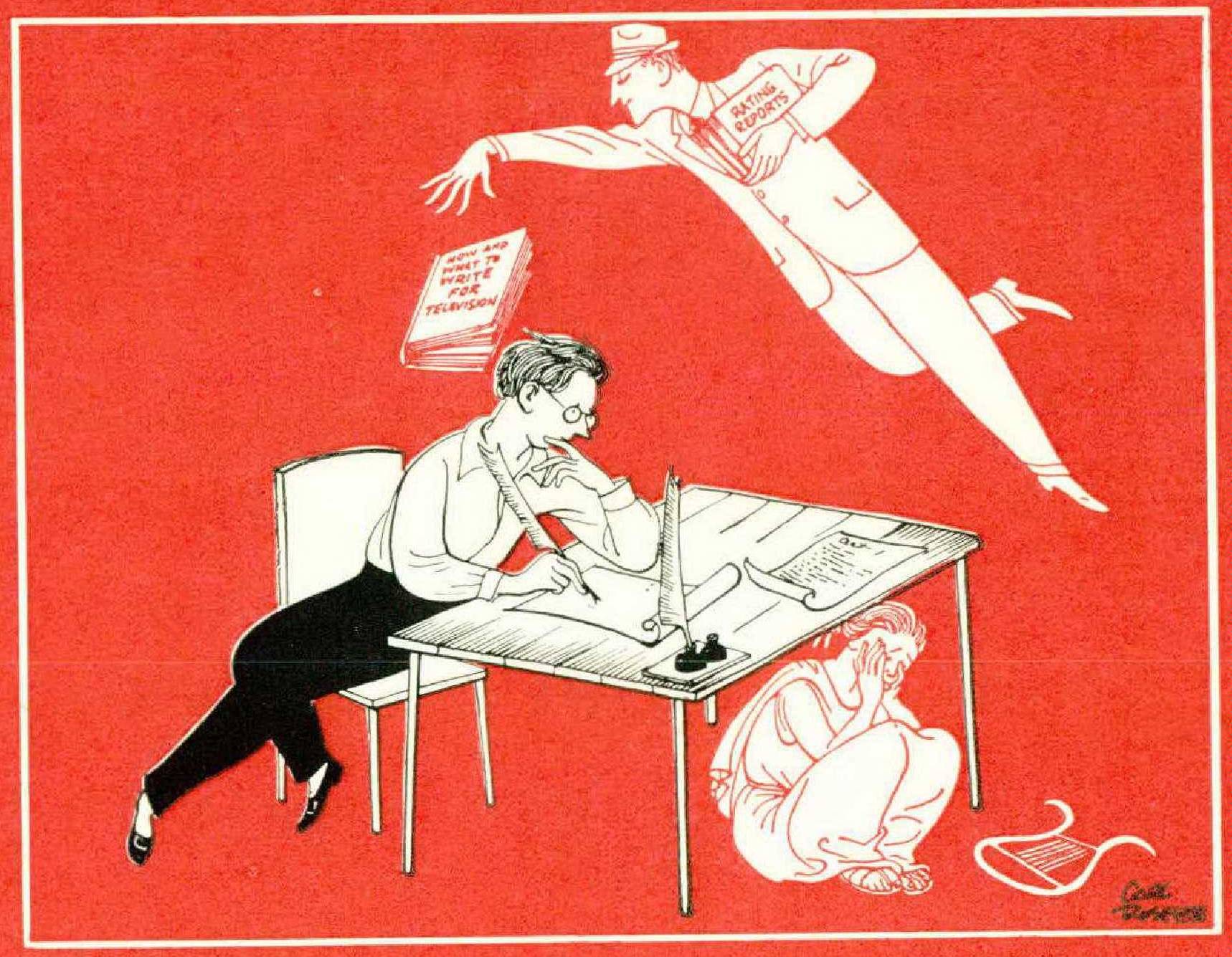
THE clearest picture yet of Madison Ave.’s tv programming taboos . . . has been filed with FCC examiners during the Coast phase of their video probe.” So begins a recent story in the indispensable weekly, Variety.
The story came from Hollywood, where a television producer testified at a hearing before the Federal Communications Commission. Commercial sponsors, he testified, hand down through their advertising agencies written directives on all matters concerning “taste and policy,” and excerpts from two of these throw some light on why television is the way it is.
Here is what Variety’s story described as the “do’s and don’t’s” laid down by Liggett & Myers for its Chesterfield show:
“No portrayal of pipe or cigar smoking or chewing. Avoid shots of messy ashtrays crammed with cigaret butts. Use Kingsize Chesterfields only. Take cellophane off pack.
“While we do not want to create an impression of one continual, smoke-filled room, from time to time in the shows we feel ‘natural’ smoking action is a requisite by the cast. It should never be forced.
“There are many incidental ways the show can help. For instance, background shot of cigaret machine in restaurant, train or bus station — a poster or display piece in drug store — the end of a carton sticking out of a shopping bag.”
Variety thought L&M’s ideas on the age of its TV smokers were worth a subhead, “L&M on Kid Smokes,” and the directive continued: “Smoking Age. This is a problem of ‘looks’ rather than actual age. Obviously, a 12-year-old should not be shown smoking. College age men and women can be pictured smoking without any fear of criticism. . . . We don’t want public criticism in encouraging the too young or ‘too young looking’ to smoke. On the other hand, the high school and college market is extremely important to Liggett & Myers as future longtime customers.”
The requirements of General Mills were reported to contain no less than twenty-two “policy points” with restrictions that Variety found “prohibit virtually everything but sheer heroism and abstract villainy.” The story goes on:
“Statement warms with a cryptic point on morals: ‘In general, the moral code of the characters in our dramas will be more or less synonymous with the moral code of the bulk of the American middle-class, as it is commonly understood. . . .’
“And on to types and organizations: ‘Ministers, priests and similar representatives of positive social forces shall not be cast as villains or represented as committing a crime, or be placed in any unsympathetic or antisocial role. If it is necessary in the development of conflict for a character to attack some basic conception of the American way of life, e.g., freedom of speech, freedom of worship, etc., answer must be completely and convincingly made some place in the same broadcast.
“‘There will be no material that may give offense either directly or by inference, to any organized minority group, lodge, or other organizations, institutions, residents of any state or section of the country, or a commercial organization of any sort. This will be taken to include political organizations; fraternal organizations; college and school groups; labor groups; industrial, business and professional organizations; religious orders; civic clubs; memorial and patriotic societies; philanthropic and reform societies (Anti-Tobacco League, for example); athletic organizations; women’s groups, etc., which are in good standing.’
“Controversy: ‘There will be no material for or against sharply drawn national or regional controversial issues. There will be nothing slurring any given type of occupation. There will be no ridicule of manners or fashions that may be peculiarly sectional.
“‘We will treat mention of the Civil War carefully, mindful of the sensitiveness of the south on this subject.
“‘No written material may be used that might give offense to our Canadian neighbors or any uniquely national reason, e.g., facetious reference to British Royalty. . . .’
“To General Mills, it’s the best of all possible worlds: ‘Where it seems fitting, the characters should reflect recognition and acceptance of the world situation in their thoughts and actions, although in dealing with war, our writers should minimize the “horror” aspects. . . . Men in uniform shall not be cast as heavy villains or portrayed as engaging in any criminal activity.’
“And: ‘There will be no material on any of our programs which could in any way further the concept of business as cold, ruthless and lacking all sentiment or spiritual motivation.’
“Re the product: ‘Special attention shall be given to any mention, however innocuous, of the baking business. . . . Food subjects commercially treated can not be presented with program content that is unappetizing or tends to effect nausea upon the listener or viewer. If there is any question whatever about such material, it should be deleted.’
“As a final touch: ‘References to other cowboy stars, such as Gene Autry, Hopalong Cassidy et al, should not be used in General Mills programs. . . . Reference should not be made to other “competitive” horses such as “Trigger”; “Silver,” et al.’”
CHARLES W. MORTON