January 1961

In This Issue
Explore the January 1961 print edition below. Or to discover more writing from the pages of The Atlantic, browse the full archive.
Articles
Are Americans Well Adjusted?
An assessment of a 1957 survey of the nation's mental health
A Letter to the New President
"Your big job is to prepare the American people to make peace. They are prepared morally and militarily to make war, but they are poorly prepared to make peace."
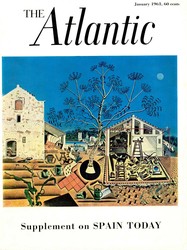
The New Spanish Painters
In the past ten years the young painters of Spain have been producing art that is exciting and unconventional, yet at the same time thoroughly Spanish. For an explanation of this new art the ATLANTIC has turned to CARLTON LAKE, art critic for the CHRISTIAN SCIENCE MONITOR, who has lived abroad since 1952.
Bell (Deep Tone)
Road
The Six Chords
Dance (In the Garden of La Petenera)
Death of La Petenera
False One
De Profundis
Knell
The Pride of the Basques
Internationally known as the author of THE REVOLT OF THE MASSES, JOSÉ ORTEGA Y GASSET (1883-1955) was equally esteemed by his compatriots for his many essays and articles devoted to Spain. He was an unsparing critic of his countrymen’s worst failings, as is attested by this penetrating analysis of a national characteristic.
The Critic
GREGORIO CORROCHANO was working on the foreign news desk of the Madrid newspaper A.B.C. when one day some forty-six years ago he was asked to pinchhit for the bullfight reporter. He did so well that, except for his service as a war correspondent, he has been the A.B.C.bullfighting critic ever since.
The Matador
DOMINGO LÓPEZ ORTEGA fought his first bull in 1928, when he was twenty. Within six years he had established himself as one of the finest bullfighters in Spain, developing a style which was considered one of the most original and effective of this century, He fought his last bull in 1948, and since then has devoted himself to raising bulls.
The Modern Novel
A young writer and poet, MARIANO GARCÍA left his native province of Burgos six years ago to study philosophy and teach Spanish literature at Göttingen. He is the author of a novel, NARCISO,which could not be published in Spain because it failed to conform to the prevailing literary canons.
Galope
The Windmills of Criptana
The villages of the Mancha, which the traveler can easily visit by making a slight detour off the Madrid-Cordova highway, still jealously dispute the honor of having been the home of Don Quixote. José Martínez Ruiz, better known under his pseudonym of AZORÍN,made this pilgrimage to the Mancha many years ago. He is the oldest surviving member of the great literary “Generation of 1898” and his delicate evocations of the Iberian landscape and its inhabitants are well-established classics of modern Spanish letters.
Jorge Guillén: A Poet of This Time
The author of J.B. and twice the winner of the Pulitzer Prize, ARCHIBALD MACLEISH, an American poet, is a profound admirer of Jorge Guillén, whom he regards as Spain’s foremost living poet. Dr. Guillén came to America in 1938, where for 17 years he was a member of the Wellesley faculty In 1959 he was the Charles Eliot Norton lecturer at Harvard.
Snow
Death From a Distance
Cerco Del Presente
The Future of Spanish Catholicism
Professor of ethics at the University of Madrid, JOSÉ LUIS ARAISGUREN is a liberal Catholic who chose to stay on in Spain after Franco came to power. In the article which follows he makes a plea for reconsideration of the relationship of church and state.
Accent on Living
The Romance of Vichy Catalan: An Introduction to Bottled-Water Label Reading
JAMES BOOTH is the pseudonym of an American who has mainly lived abroad for the past decade, taking the waters and engaging in other pursuits. He is currently a resident of Madrid.
They Shall Have Music
The Peripatetic Reviewer
Books the Editors Like
Reader's Choice
Spain
Tunisia
The Boston Evening Transcript: Virtuosos Without an Audience
In some respects the best and in others the worst of its contemporaries, the BOSTON EVENING TRANSCRIPTwas still making few concessions to the exigencies of the early thirties when CHARLES W. MORTON joined its news staff. Revenues and circulation were dwindling, but the paper held firmly to a peculiar standard all its own. This is the second article in a series by the associate editor of the ATLANTIC.
The Threat of African Tribalism
MARGARET CARSON HUBBARDmade her first visit to Northern Rhodesia and Portuguese East Africa in 1922, when she set about learning Nyanja, the lingua franca of Central Africa. In 1935 she made the long circuit from the Cape to Cairo, and since World War II she has made four return visits to South Africa, to the Congo and East Africa, to Ghana and the Federation.
The Irrepressible Randolph Churchill
The son of Britain’s famous Prime Minister, Randolph Churchill has refused to remain in the shadows. Provocative as a reporter and speaker, and a man of inexhaustible energy, Churchill the younger does not suffer criticism lightly: he has recently been awarded 1500 pounds damages in a libel suit at the Old Bailey, and as this goes to press is involved in a second suit.
Loping West at Twenty-One
A Fairy Tale of New York
A New Yorker who studied at Trinity College, Dublin, J. P. DONLEAVYis the author of THE GINGER MAN, a first novel which attracted considerable attention here and in England. The play which was dramatized by the author from his book was produced in London and Dublin and in both places drew endorsements and equally strong condemnations. The narrative which follows is drawn from the opening chapters of Mr. Donleavy’s new novel.
The Atlantic Report on the World Today: Washington
Buried With Mr. K's Statistics
The former president of Inland Steel Company, CLARENCE B. RANDALLhas for some years served as special assistant to President Eisenhower in the area of foreign economic policy, and at intervals he has found time to write the books which have made him many friends in this country, A CREED FOR FREE ENTERPRISE;his autobiography, OVER MY SHOULDER; and THE COMMUNIST CHALLENGE TO AMERICAN BUSINESS.
Atlantic "Firsts"
I Invited Negroes to My Home
After teaching and working as associate librarian of a Korean university, J. MCREE ELROD returned to his homeland in the South, where he is a visiting professor in a Southern college. He here tells of the strident opposition he encountered when he invited Negroes to his home.
Stillness