The Burial of a Friend
Twenty-one years ago, GEORGE H. FREITAG first broke into print in the ATLANTICwith his story “Uncle Horace.” Since then his work has appeared in our pages from time to time, and his “Stories of Childhood,” which we published in December, 1959, evoked a warm response from our readers.
MANY years ago I used to go with my mother to a place in the country known as my Uncle Frank’s Farm. It was only thirty-seven miles from the outside fringes of the city of Canton, Ohio, and in another county, but the distance always seemed, when I thought about it in retrospect, to be a thousand miles and ten, over rivers and lakes and mountain ranges. This was really not so. The added mileage was put on by my imagination and my mother’s assistance, for she helped to paint the envisioned and expanding horizons.
Now, near the old farm that belonged to my aunt and uncle and where my mother and I went to stay for a month or so during the school vacation there was an abandoned cemetery, and my cousin Judith, who was thirteen, used to take me by the hand down the long dusty road and under the leafy trees to where the high iron gate stood half open at the cemetery entrance, and there we moved on into the small burial ground where sweet William grew and snakes slithered along in the high grass. When Judith saw a snake coming along in the grass she wrapped her legs in her white skirt and squealed at the top of her lungs, while I, who would be nine years old in the fall, pretended to have the ability, if not the strength, to climb the nearest tree quickly.
Judith was getting to be very pretty; she had beautiful dark hair that fell loosely about her shoulders and her eyes were a blaze of startling blue and in a certain way she had dimples on the backs of her hands instead of knuckles and she had a soft lovely voice. Almost as soon as we could get through the high iron gate of the burial ground and had been frightened by a few harmless snakes and taken several deep breathings to inhale all the fragrance of such a place, we pretended we were from far away. We did not mean as far away as another planet, because in those days there was no talk of space travel, but far away in leagues, leagues away, and a league was far.
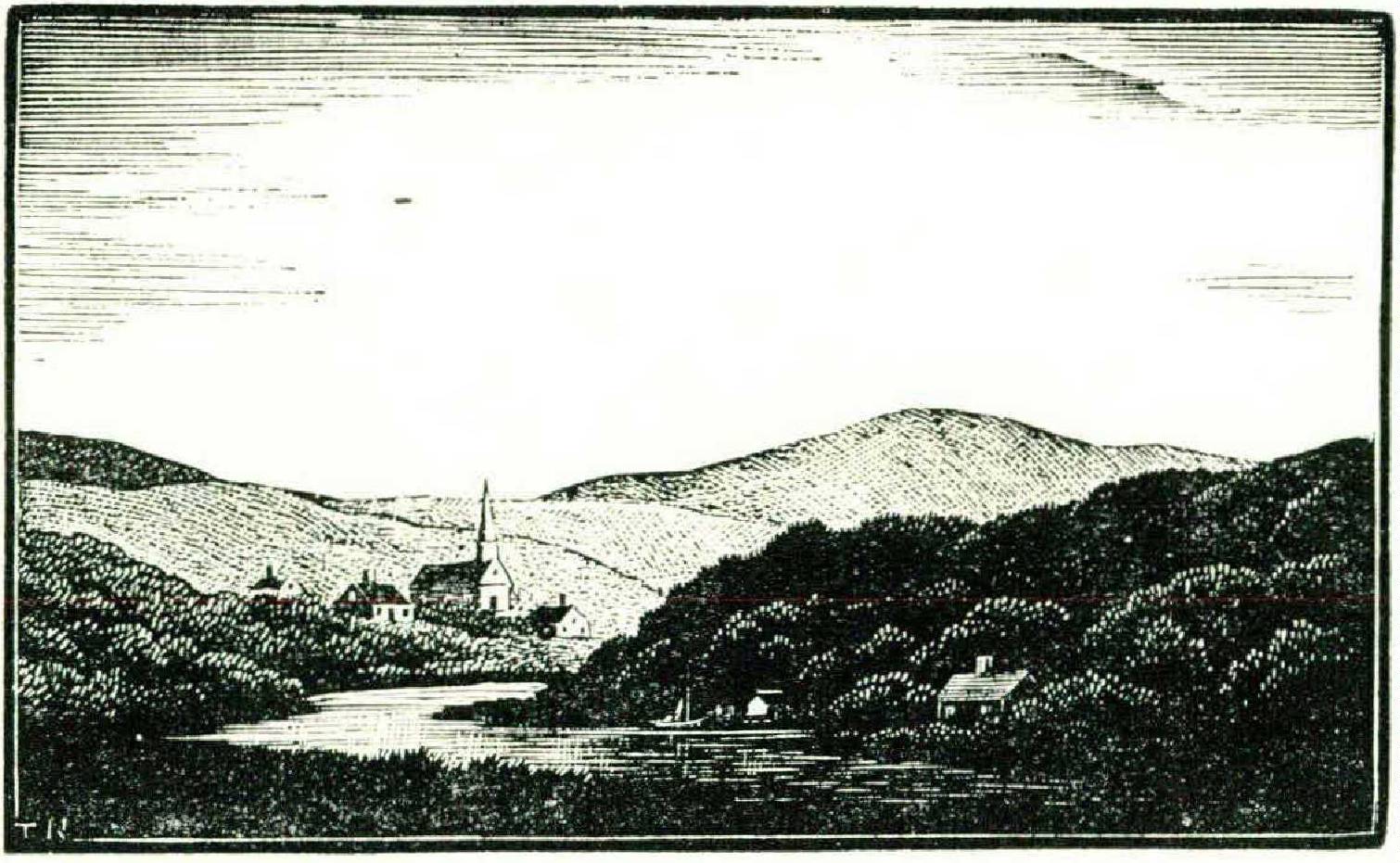
The view from the top of the hill on which the cemetery stood took in a great distance all around and we felt remote and untroubled on the hill of such a wonderful world of bigness. But one day, when we were running back and forth across the small mounds of earth where the dead had lain for more than a hundred years and been forgotten, a thunderstorm came up out of the side of the sky, like a curtain of fury.
The sky grew very black and bleak, and a wind came, and flashes of lightning shot zigzag across the whole world it seemed, and my cousin and I ran for the stark white frame abandoned church whose congregation, or most of it, lay outside under the small stones that had told their names but now forgot them. The wide door of the church was nailed shut, so we found a tall broken window of stained glass and we crawled through at precisely the place where the feet of a no longer remembered saint, possibly one of the tenderest ones, had once managed to take a sudden step, splashed in all the beautiful colors of stain.
Judith and I played inside a long while, one and then the other improvising a sermon, but Judith could sermonize better, she had more words that came frighteningly quick to her tongue, even acted out some of the things she told of and wept true tears that raced down her cheek to her yellow blouse. We sermonized to one great congregation of our imagination after another, and I told them of my mother and father and how my father sometimes drank wine made from berries picked in the woods; and Judith told of her mother who always wanted to be a great artist and who drew every kind of beautiful thing that the eye can feast on and the heart imagine. Then it began to rain and as suddenly the roof commenced to leak in a hundred places and we ran from place to place with our hands cupped together and drank sips of rain. We looked out of the window where we had crawled in and it faced toward my Uncle Frank’s Farm, down in the pocket of the hills, but we could see no house. It was just as it there had never been a place at all and Judith cried and said, The rain has washed away my home and my mother and father, poor mother and poor father; and I cried also because if this were true, my own wonderful mother who was visiting there was gone too.
We could see the tombstones of the dead standing in a leaning position in just the way the weather moved, from northwest to southeast, and the names on the markers were smoothed down by the passing of the endless years. On the wall directly behind the decayed pulpit was a holy scripture in gold letters on the plaster and Judith and I read it over so many times that Judith said it would be terrible to read it even one more time. “It will wear out,” she said, “and then throughout the remaining lifetime of the universe people will be deprived of such a golden statement of Biblical fact and so plunge the world itself deeper than ever into the recesses of stupidity.” But don’t ask me where she spoke from; the words came out as if from a cornucopia in truly a never-ending flow of wonder and in the church with the rain coming down they sounded sometimes like music out of a violin.
I do not know how long we stayed in the church or how devastating the storm was, probably an hour at the most, but in that time no one had passed by, no man on horseback or foot, no frantic mother out looking for her lost child, no excited aunt or uncle; it was just as if everyone in the world except my cousin and myself had been literally washed off the face of the earth and destroyed forever — as in a text.
But finally of course the sky commenced to clear and the storm passed. We could see it raining on the roofs and fields far away and we could hear it thunder far away and we knew that other people were waiting for their special storm to end just as we had and we wondered where they were and what kind of sad or happy thinking they did, whether they were afraid of lightning and if their mothers and fathers were good to them and whether they had good food on their tables and flypaper hanging down from the ceilings in the summertime. And when we were sure the storm had gone and that it would probably be many weeks before another rain should occur, we stuck our noses out between the stained legs of the nameless saint and whiffed the clean fresh air, and it was so new that if we took deep breaths of it without thinking it hurt our chests, and we laughed and yelled and couldn’t wait to get outside again to walk among the sweet William and the old forgotten tombstones and the soft grassy places under the pine trees.
We crawled out of the saint and Judith tore her blouse on a protruding piece of glass and we giggled because everything was once more lovely and beautiful and tender and laughable, and down in the gentle pocket of hills where we knew it was all the time was the soft gray house my cousin lived in with a wisp of blue smoke coming out of the brick chimney; and there were the noisy chickens which we suddenly heard again and the careless grunting of the pigs and the sheltered sound of cattle as they stood beneath their special trees and switched their tails to keep the flies away and a screen door slamming and a sneeze, as if someone were catching a summer cold, coming from within the house.
We joined hands as we ran back and forth across the mounds of earth where the very dead lay in rot and peace, and we sang songs that we had learned in our respective schools, Judith in a much older, wiser school, singing not only different songs but in uselessly different registers, but it did not matter. We walked out of the yard of the dead, the leaves of all the trees dripping with the spent rain, the sun glistening on the old white church and poking into the opening at the window. We walked out through the iron gate and had gone two or three yards or so when Judith stopped. She unlocked her arms from around me and without looking at me she turned back and fastened the gate securely, and then shook it to see if it would come open. When it didn’t, she turned and joined me, but all the way home we walked just a little apart, together but making two separate shadows, together but in a lonely kind of together, and somehow, without Judith’s telling me or without my telling her, we knew we would never return and that if we did it would not be in the same way ever again!