The Future of Spanish Catholicism
Professor of ethics at the University of Madrid, JOSÉ LUIS ARAISGUREN is a liberal Catholic who chose to stay on in Spain after Franco came to power. In the article which follows he makes a plea for reconsideration of the relationship of church and state.
BY JOSÉ LUIS ARANGUREN
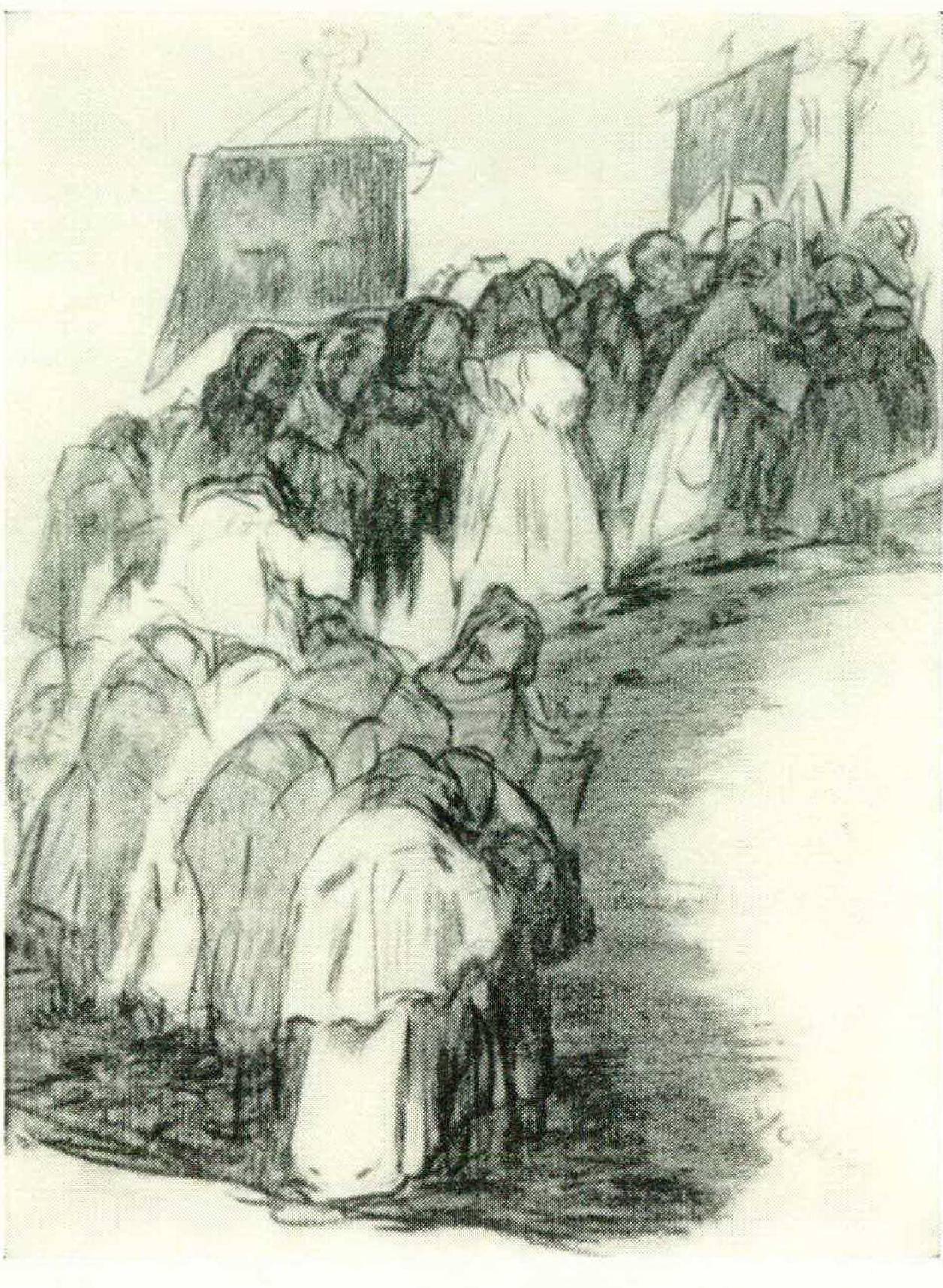
SPAIN’S language and nationhood were forged during almost eight centuries of the so-called Reconquest, against the Moors. Spain was the product of Islam, and in opposing Islam she was partly determined by it. As Hegel once noted, those who fight simultaneously embrace. Spain asserted herself in a struggle which was, first of all, religious, a holy war. Other Europeans could embark on crusades in a desperate endeavor to save the Holy Places. The Spaniards took no part in them, for their own land was the scene of a permanent crusade. Nothing more clearly attests this early fusion of the spiritual and temporal orders in the peninsula than the way in which Saint James, the patron saint of Spain, was called upon during the Middle Ages to lead the Christian hosts to their final victory against the infidel. This warlike characteristic has been one of the constants of our religious history ever since.
The reign of Ferdinand and Isabella, known in Spain as los Reyes Católicos (“the Catholic Kings”), marked the end of the struggle against the Moors and a turning toward new enterprises, European and American. But it was not long before the nation’s energies were once again mobilized for another war of religion, this time against the Protestants and the Turks.
The reign of Charles V is marked by a curious ambiguity. On the one hand, the Emperor, in keeping with the medieval notion of the empire, acted as the prince whose first duty it was to be the custodian and defender of the Christian religion against its foes. Charles V fully accepted this responsibility in waging a religious war against the Turks. But when it came to the Protestants, the Emperor, under the influence of his entourage, who were followers of Erasmus, viewed the problem as more moral than dogmatic. It was, he thought, the sinfulness of the Papal Court and its inability to launch a necessary Catholic reformation which had given rise to the Protestant Reformation; the heterodoxy of the latter was accidental, could easily be reduced, and should, therefore, be combated in its point of origin, Rome. In the final analysis, only an Ecumenical Council, convened by the Emperor, should the Pope refuse to do so himself, could rescue Christendom and the German people from their plight.
The religious notions of the Spanish intellectuals of Charles V’s court were a strange compound of secularism, anachronism, and utopianism. The survival of a political Augustinianism, already outmoded elsewhere, led them to confuse the political and religious spheres and to attribute to the Emperor a jurisdiction in the governance of the Church which was not his.
These ambiguities did not prevent Spanish Catholicism from being enriched by the pastoral experience of the Indies and from giving rise to a spirit of meditation and contemplation which reached superlative heights, with Father Vitoria in the realm of theology, with Friars Luis de Granada and Luis de León in the realm of asceticism, and with Saint Theresa and Saint John of the Cross in the realm of mysticism. This period, the Inquisition notwithstanding, was marked, as the historian Maravall has recently said, by “a freedom of thought which, generally speaking, was admirable, and which only began to wane inside the Kingdom of Spain after 1588.”
About the middle of the sixteenth century, following the Council of Trent, two major and quite different policies came to dominate the chessboard of Europe, one Spanish and the other French. The French policy, which received its theoretical definition from Jean Bodin and which owed its success to the religious lukewarmness of Henry IV, to a general lassitude with religious wars, and to the ensuing skepticism which Montaigne was so eloquent in voicing, was supported by the politiques as an attitude antithetical to the Spanish, This policy reached its apogee under the rule of Cardinal Richelieu and was based on the clear delimitation of a neutral political sphere, separate and apart from the field of religious controversy, within which all citizens could live in peace, no matter what their respective beliefs might be. The separation of church and state, which was finally established in France at the end of the last century, germinated on a soil which had long been prepared for it.
In Spain, on the other hand, after the confused reign of Charles V, Philip II opted for a policy not of separation from but of subordination to religion. Spain was henceforth identified with Catholicism, and the Spanish state elevated as the champion and sword of the Counter Reformation. Bit by bit the Spanish sovereign took the place of Providence, becoming, as the saying goes, “more Papist than the Pope” and confusing his own designs, which were loyally placed in the service of faith, with the designs of God.
During this period of the Counter Reformation, which lasted through the second half of the sixteenth and all of the seventeenth century, Catholic theological thought in Spain rose to great speculative heights under Francisco Suárez and other great Jesuits; but while it took on beautifully defined and lustrous contours, it simultaneously began to grow steadily more arid and impoverished. The freedom of thought which I mentioned earlier now disappeared, and the Spaniards, both through the work of the Inquisition as an institution and also through their own individual, private inquisition, lost contact with scientific and, in general, modern thought, abandoning gradually all but the purely literary or plastic forms of expression.
The Spaniard of the Counter Reformation — grave, reserved, solemn, of funereal attire, or, in the period of decadence, illusionist, empty, and baroque — is a totally different human being from the Spaniard that was typical of the reign of Charles V. The Spaniard of the Counter Reformation gave himself up body and soul to the battle against the Protestant, succumbing in the course of the struggle to the contagion of the very style of life he combated. The “sullen Spain” of the Black Legend had some foundation in reality. The struggle against the heretics, against Lutherans, Calvinists, and Puritans, turned us into something rather like them. Religion came to be lived, far more violently now than in the Middle Ages, as a crusade, as a battle against the infidel, against the heretic. In the end, the positive and hopeful sense of the Reconquest was utterly lost, and what remained was only the morbid obsession of not being contaminated by heresy.
The warlike instinct, which, as I have said, has been one of the constants of Spanish Catholicism, had been inspired in the ascending periods, such as the Reconquest and the first part of the Counter Reformation, by the hope of finally vanquishing the infidel or of destroying the heresy. But later it ceased to be a hope, giving way to a crippling, paralyzing fear. The dominant ideal, in this desperate situation, is the purely negative one of preserving Spain from all contact with the pernicious modern world, keeping her at a safe distance from its errors and, as much as possible, remote, immobile, inaccessible, and insulated from the passage of time.
IT WAS not until the second half of the eighteenth century that another attempt was made to revive free Catholic thought. This period, which is known as the Second Scholastic, coincides with the reign of the liberal Charles III (1759-1788). The effort, like that made by the premature “enlightened” courtiers of Charles V, was a trifle confused. It cannot be denied, I believe, that clericalism has been one of Spain’s religious evils and that from it has stemmed the anticlericalism which, though seemingly opposed to it, is simply its obverse. In its desire to combat clericalism, the enlightened government of Charles III went to the opposite extreme of expelling the Jesuits and of asserting the supremacy of the state, even in ecclesiastical matters.
The surest way of misunderstanding the eighteenth century in Spain, however, is to treat it as nothing more than a Spanish version of the French eighteenth century. The truth is that, in contrast to the negative, critical, and destructive character of Gallic Encyclopedism and of the decadence of the reigns of Louis XV and Louis XVI, the Spanish cultural policy of this period was predominantly positive, aimed at incorporating Spain into the Europe of her time without weakening the live traditional values, and particularly the religious values, of the country. The figure of Jovellanos, one of the noblest in Spain’s entire history, is a true expression of a modern Catholic attitude that was typical of the Spanish Enlightenment.
Jovellanos was an orthodox Catholic who was taxed with the crime of remaining unswervingly faithful to his enlightened views at a time when the monarchy, under Charles IV (1788—1808), fearful of the propaganda of the French Revolution, was seeking a new alliance with the Inquisition and adopting a reactionary and obscurantist policy. For this sin Jovellanos was exiled to Mallorca for seven years, six of which he spent locked up in the castle of Bellver.
After his captivity and the outbreak of the War of Independence against Napoleon, Jovellanos realized that the desired Enlightenment could not simply be taught and learned but that it would have to be won by all Spaniards for themselves. Without perhaps fully realizing it, he had now passed from the idea of enlightened despotism to the idea of modern democracy. The popular insurrection, or revolution, against the French which took place on May 2, 1808, virtually imposed this new view upon him. The former enemy of revolution now embraced this one, even agreeing to become a member of the so-called Central Junta, the real government of Spain, whose powers emanated from the revolution. The Junta prepared the convocation of the first constituent assembly of Spain, which promulgated the Constitution of 1812.
If, in the course of the nineteenth century, Jovellanos had had successors of his intellectual eminence, capable of continuing and developing his trend of thought, Spain would have known a Catholic democracy and a liberal Catholicism of the kind which flourished in France, in England with Lord Acton, and in Italy with Rosmini, Manzoni, and Gioberti. But this did not happen. The incomprehension of Catholicism by Spanish liberals on the one hand, and on the other the opposition of the Spanish church to democracy, an opposition growing out of a form of life dominated by fear rather than hope, resulted in a shortage of Catholic democrats all through the nineteenth century, a shortage paralleled by an absence of any real Social Catholicism comparable to that which developed in other European countries.
At the end of the century, however, three novelists appeared, the Catholics Alarcón and Pereda and the non-Catholic Pérez Galdós, certain of whose works have an exceptional religious importance, as did those, a few years later, of Palacio Valdés, which raised problems involving faith. Almost simultaneously there occurred a revitalization of scholastic philosophy, undertaken at the turn of the century by Don Miguel de Unamuno.
Unamuno burst into the center of the monotonous piety prevailing among the long-winded rhetoricians, the platitude mongers, and spoke in a new, intimate, and intensely personal tone of voice of the religious preoccupation which every man, no matter how much he may try to stifle it, carries within him. Though not himself a Catholic, Unamuno brought to Spanish Catholicism a style and a sensibility which were utterly new, unprecedented, and entirely secular. Unamuno’s influence as the awakener of contemporary lay Catholicism in Spain was very great, and to my mind, very positive.
Unamuno contributed something else of importance — information about religious thought in the rest of the world. The continuer of this task was Ortega y Gasset, who, though not a Catholic either, was familiar with and esteemed foreign Catholic thought, which he offered as a goad and a stimulus to the intellectually inane Catholicism of his period. Thanks to the upheaval created by these two men and by their Catholic disciples, a liberal Catholic thought began to emerge in the nineteen twenties which was truly up to date. Simultaneously, and with the backing of the ecclesiastical hierarchy, such important movements as the National Catholic Association of Propagandists and, above all, Catholic Action made their appearance. The five-year term of the Second Republic (1931-1936) brought this Catholic mobilization to a peak, its primary expression being the CEDA political party, which represented a center-right grouping that was somewhat ambiguously democratic, and its secondary expression being a group which fully accepted the republic, with an unequivocally leftist orientation that was more political than social.
The Catholicism of the Civil War and post-war periods has continued these two tendencies, adapted to the new political circumstances, inevitably galvanizing the old, intolerant, reactionary, and antimodern spirit. The more openminded and forward-looking wing includes the philosopher Xavier Zubiri, the eminent thinker Pedro Laín Entralgo, and the disciples of Ortega y Gasset, Julián Marías, Luis Diez del Corral, and José Antonio Maravall. The truth is that, up to several years ago, all published thought in Spain was Catholic, of one tendency or another. The same cannot be said today. The meaningless, purely rhetorical use of lofty words, certain unsavory compromises and alliances, and the smugly middle-class, socially blind character of the bulk of the Spanish Church have in the last few years alienated many young men from the Catholic faith. Yet, while a sizable segment of Spanish youth has been undergoing a process of dechristianization, a young priesthood has been developing which is fully responsible and conscious of the arduous task that lies ahead of it.
IT SEEMS to me that Catholicism in Spain will have a rougher time in the coming years than it has had of late, and this may be all to the good in the long run, for the resultant situation will certainly be less equivocal and more genuine. In this eventuality, a new spirit must prevail.
Today as yesterday, three main currents are evident in Spanish Catholicism. The most prominent is represented by the nostalgic, who cling to the alliance of throne and altar — that is, to a political absolutism anchored firmly to a religious absolutism. They include Spanish imitators of the monarchist Action Française, old die-hards, and the political sect known as the Opus Dei. Their posture is purely defensive, conservative, negative, and dictated not by hope but by fear.
The second tendency is represented by the Catholic masses. They should be organized into a broad politico-social group similar to the Christian Democratic parties in other European countries, even though in all likelihood such a group would be more conservative in Spain than elsewhere. The Catholic parties in such countries as Italy, Germany, and, possibly, the Spain of tomorrow —in France the Catholics have been losing political strength and cohesion from day to day — are, to my way of thinking, both anachronistic and very effective as politico-sociological means of mobilizing and unifying, even if only externally, a large sector of public opinion. But we are now living in an epoch in which formal democracy seems insufficient to us, and a Catholic party which seems to be manipulated by financial pressure groups constitutes an obstacle, and even a scandal, for an effective apostolate in other social milieus, A Catholic party, furthermore, is bound to receive warnings and directives from the ecclesiastical hierarchy, since it must to a certain extent represent it politically. This presents a grave inconvenience, for the Church thus finds itself compromised in a policy which, like all policies, is fallible.
In the period of anti-Catholic politics, it was understandable that Catholics should tend to band together to protect their spiritual interests. But we are now living in a time of secularization, in which people are no longer fighting for spiritual causes but for material interests. In such circumstances the existence of a single Catholic party is not only an anachronism, it also masks the social and political realities.
The third tendency of Spanish Catholics, at least of the youngest and the most forward-looking of them, is to raise the question of a revision of the relations between church and state, likewise the problem of religious tolerance. The chief representative of this tendency on the theoretical plane is probably Jesuit Father José María Díez-Alegría, who recently published an important article entitled “Choice of the Good and Intersubjective Tolerance.” Based on a work by Cardinal Lercaro of Bologna, it contains this affirmation:
He who in entirely good faith denies his adherence to the absolutely true religion, and grants it to forms of religion that are not adequately true, maintains a religious attitude which at heart is objectively correct, since he claims with utter sincerity to pay homage to God as God wishes to be worshiped.
This deep respect for personal conscience must, at the same time, be allied with a social conscience, as a concrete and immediate guide of action. For this it is necessary to awaken a sense of social justice in Spanish Catholics. The work of Father Díez-Alegría is very important, as is that of another Jesuit, Father Llanos, and of other clergymen and priests. This is a problem which is being lived most intensely by the new Spanish Catholic generations. It is not, of course, a question of advocating a Catholic socialism, which, from the point of view of the Church, would suffer from the same drawbacks as Christian Democracy. It is simply a question of permitting those Catholics who feel thus inclined to engage freely in a great enterprise of social reform. In this way the Church, as such, freed of every political servitude, could be converted into what it should be — the real home of all the faithful, regardless of their attitudes on temporal questions.
It seems clear that this tendency would open up new and broad horizons for pastoral action. The peculiar trait of Spanish Catholicism which I have mentioned, its combativeness and desire for reconquest, would then be preserved and even strengthened, becoming a purely spiritual force placed in the service of purely religious ends. Much can be hoped for from the young Spanish priest, whose great pastoral zeal awaits only the propitious circumstances, circumstances which will allow him to embark on his apostolic task and to bring about that much-needed renewing, deepening, and broadening of our faith.