The Irrepressible Randolph Churchill
The son of Britain’s famous Prime Minister, Randolph Churchill has refused to remain in the shadows. Provocative as a reporter and speaker, and a man of inexhaustible energy, Churchill the younger does not suffer criticism lightly: he has recently been awarded 1500 pounds damages in a libel suit at the Old Bailey, and as this goes to press is involved in a second suit.
Anonymous
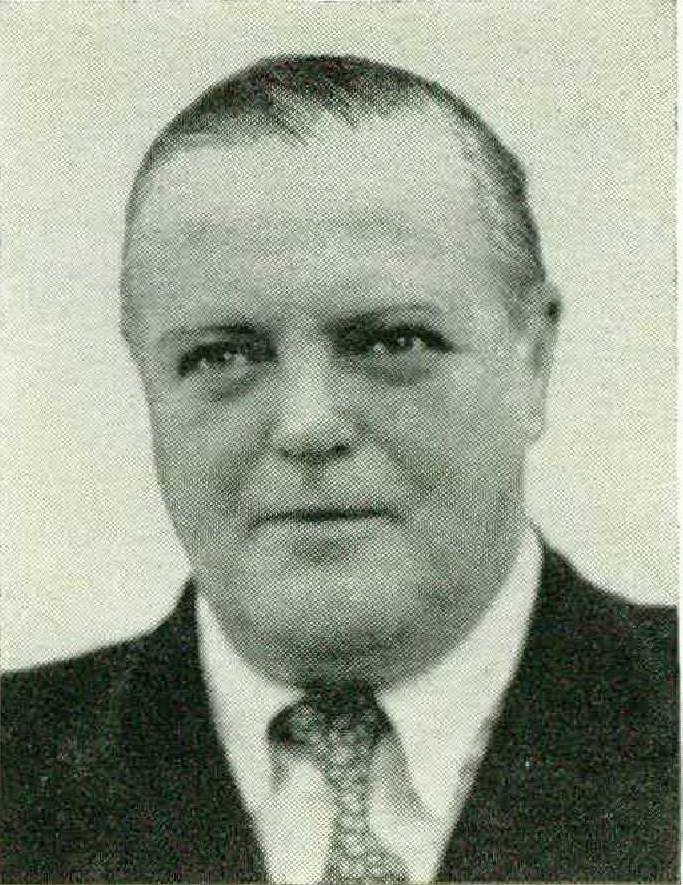
No ONE can set the adrenalin flowing simply by the rumor of his approach as Randolph Churchill can. At the news that he has arrived at a party, at a press conference, at a railway station, hearts pump more madly, temperatures rise, lips tighten, voices sharpen. It is like the day war was declared.
Why is it that Randolph (after his grandfather, the fiery Lord Randolph) Frederick Edward (after his godfather, the vitriolic Lord Birkenhead) Spencer Churchill (after his ancestor, the first Duke of Marlborough) is personally disliked by more people who have never met him than any other public figure in Britain today? And why is it that he should also manage to be personally disliked by a great many who have?
Both groups agree that he presents the same unforgettable unnerving image — a sort of scarlet Michelin-tire man, dangerously overinflated with hot air, bursting with ruderies, strained around the seams with egoism, self-sealing against the tin tacks of opposition and criticism.
But the first group is unlikely ever to alter its picture of Randolph Churchill as a forty-nineyear-old ogre on the prowl.
The second group tries hard to preserve its original hostility. But when its members do get close to the monster, many cannot help succumbing, at least in fits and starts, to the charm of the other Randolph.
Charm would seem to be the last, least likely secret weapon of Randolph Churchill. He himself is as unconscious of it as his enemies are. He assumes that the world will take sides for or against him simply on the basis of the correctness of his opinions. He finds it hard to understand that people would be so childish as to oppose him just because he has called them, say, “jumped-up Communists.” Is the phrase accurate or not? he demands. If not, where is the evidence to disprove it? If it is so unfair, why do they not issue a writ for defamation?
This is why he has the shocking habit of denouncing and rebuking men and women in public at parties and dinners. He gives them all credit for thinking before they speak and immediately interrupts and contradicts them for the sake of his version of the truth. It never occurs to him that anyone can be defenseless in an argument.
This is also why he upbraids waiters, browbeats porters, contradicts taxi drivers. He cannot imagine that this could ever appear to be bullying. After all, he also upbraids millionaires, browbeats press lords, contradicts Cabinet ministers.
Randolph Churchill thinks on his feet. As an arguer he is in the light heavyweight class, nimble and yet powerful. The sound of his own voice never rings embarrassingly in his ears. Indeed, it is to him the most cheerful and comforting noise in the world. It shows that someone is talking sense.
He is very much of an actor, or rather a theatrical old-style advocate. Much of his anger and indignation is simulated for effect. Not that he does not feel strongly and deeply about the subjects of his arias. But while his brain is coolly sorting out arguments and quietly sifting evidence, he realizes that nothing unnerves an opponent more than a display of furious emotion. This is why, after denouncing a group of opponents as “blanks” in an Old Testament falsetto, he will pause and say in normal conversational tones, “No. I take that back. Not blanks. In fact, honorable, intelligent, sane chaps. But on this particular issue” — voice rising in fury again — “on this particular issue, absolute blanks!”
Randolph Churchill has never had any kind of stage fright in his life. His stomach never sinks, except through dieting. He is willing to step forward at a press conference or before a television camera or at a crowded party with the same boundless self-confidence that most people could display only in front of the bathroom mirror. This is why he is so brilliant in the witness box; if he had produced nothing else in his life but his answers in court during his libel action against The People, he would deserve to be remembered as the wittiest witness since Whistler.
COMMENTATOR OR CREATOR?
The secret of this lies partly in his careful rehearsal and repetition of his opinions. His strongest condemnation of any public figure is to say he “hasn’t done his prep.” He rarely plunges out of his depths, and in private he is almost embarrassingly insistent on his deficiencies as a writer or a thinker.
The trouble is that almost no place where Randolph Churchill appears is private. It is only down on the farm, at the registered office of Country Bumpkins Ltd. in Suffolk, where his windows frame a Constable landscape, that a mild, gay, relaxed persona can peep out from behind the mask of the professional angry middleaged manic. Many an unfriendly journalist has been lured there, only to leave a converted ally. (Also, many an old friend has fled on a Saturday afternoon vowing never to return.)
Journalists, as a group, are hostile to Randolph Churchill. They are made uneasy by the ambiguity of his position in the profession. Is he a news commentator or a news creator? Is he an opponent or a pet of the newspaper proprietors? They complain that he is not a real pro.
Yet, though he has a small private income, modest by White’s Club standards, he has earned his living for more than twenty years by journalism. And he cannot resist biting the hand that feeds him; there is scarcely a press lord in Fleet Street who has not a finger or two missing to prove it.
Churchill’s personality seems fueled by an apparently endless flow of truculence. He dares not dodge a fight or ignore a challenge, just in case it might be remotely thought to seem pusillanimous. The only son of a father who has bubbled over with a natural, unthinking courage from his earliest days and courted danger like a lover, Randolph Churchill has always known that many an unfriendly eye would be watching for any weakening of the standard, any dilution of the fighting blood. Compulsive pugnacity was the quickest escape route from Sir Winston’s giant shadow. This bottled aggression may explain his bitter vendetta against Sir Anthony Eden, which has often embarrassed even some of his most sympathetic partisans. It could be analyzed as an unconscious rivalry directed against pretenders to his father’s throne.
But it must also be remembered that, even in the thirties, Randolph regarded Eden as a vain man kept afloat by a certain anemic charm. Before, during, and after Eden’s premiership, he never spared Eden. His admiration for other lieutenants of Sir Winston — a Macmillan, or a Sandys, or even a Soames — is often gushingly effusive.
Though probably not physically daring by nature (he tends to jump at sudden noises and rear at an angry gesture), he forced himself not only into the front lines but behind the enemy lines during the war. He was parachuted into Yugoslavia to fight with the partisans. He took part in the long-range desert raids into the German camps in North Africa. He was wounded as a war correspondent in Korea.
Randolph Churchill’s war record cannot be ignored by even his bitterest enemies, though they are likely to suggest, unfairly, that sometimes he appeared to be almost as much of a nuisance to the Allied High Command as he was to the German High Command. Even in war — perhaps especially in war — it was hard for Randolph Churchill to believe that there could be generals so shortsighted as to turn down an opportunity to listen to his advice.
Politically, Randolph Churchill is a Tory, because he believes that the Tories are more intelligent, mature, efficient, and gentlemanly than the Socialists — and besides, in one of his favorite phrases, he has “known them all my life.” By “Tories,” he means the top Tories. He passionately believes that it is the duty of the undeserving rich to support the deserving poor, of whom he will often elect himself the articulate representative.
The central tenet of his political philosophy is that the class with power should be kept in power, but only as long as it proves itself morally superior to any alternative.
BOTTOMLESS WELL OF ANECDOTES
His conversation has far more liveliness and vivacity and imaginative wit than his writing. He is probably best as a monologuist, and he can spout for hours from a bottomless well of anecdotes, quotations, epigrams, rumors, and theories. His quotations are usually from middlebrow authors — Kipling, Saki, Belloc, Nash, Betjeman — or from solid sonorous classics — Gibbon, Macaulay, Walpole. He has a photographic memory for the authors who impressed him in his youth.
He is fond of the rumor as a genre. When he reaches out by telephone to his friends at three A.M., he always begins cheerily: “Well, what s going on?” It is inconceivable to him that there is a time of clay or night when people are not plotting and planning and making fools of themselves.
Randolph Churchill might have been the original man about whom the child asked, “Mummy, what is that gentleman for?” Nobody, least of all Randolph Churchill, has yet discovered the answer. When he left Oxford, it seemed to him impossible that he would not be in the House of Commons before he was twenty-five. He sat for Preston in the political truce during the war, but he has never won any election he has sought.
As a writer, except when moved to passion or fury, his prose can be dull and ponderous in an empty Augustan manner, though it often has subtleties which are easily overlooked and the structure of the argument is strong and formidable. As a journalist, he is at his best when he is taking us on a guided tour of leading Tory minds. As a news reporter, he has only rarely been successful, because he combines the instincts of a press lord with the equipment of a gossip columnist.
What, then, is he for? Perhaps he is here to express those frustrated furies we all feel but are too self-conscious to express — fury at bad railway food, at grammatical howlers in the London Times, at clumsy waiters, at monopoly in Fleet Street, at stupidity in parliamentary speeches, and a hundred other assorted provocations.
He believes that power is least corrupting, and democracy best preserved, when the power is shared among competing blocs. It is his task to see that blocs do compete and quarrel. Perhaps, most of all, he is here simply to keep us on our toes.