The Pride of the Basques
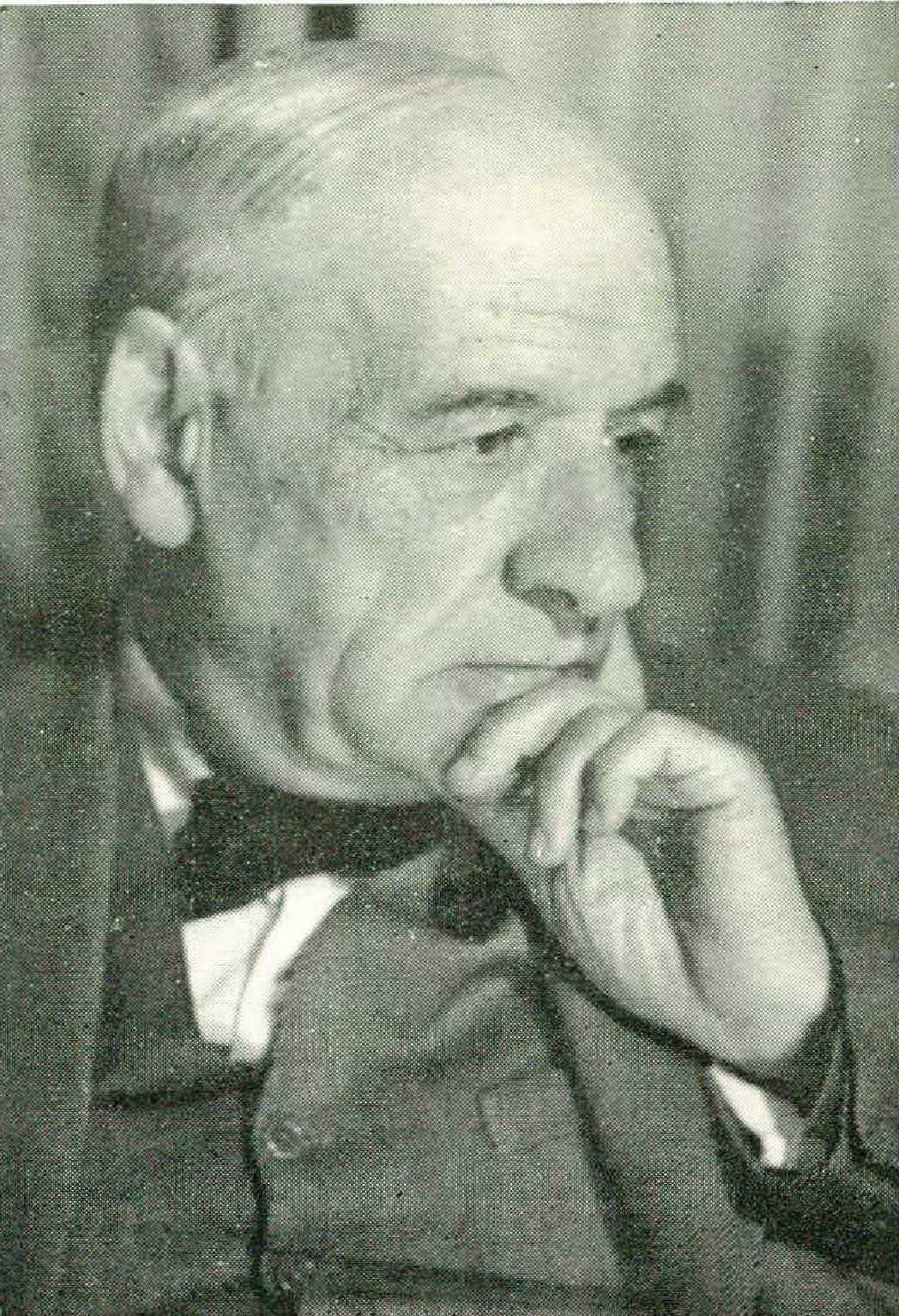
Internationally known as the author of THE REVOLT OF THE MASSES, JOSÉ ORTEGA Y GASSET (1883-1955) was equally esteemed by his compatriots for his many essays and articles devoted to Spain. He was an unsparing critic of his countrymen’s worst failings, as is attested by this penetrating analysis of a national characteristic.
JOSÉ ORTEGA Y GASSET
FOR years now at the height of summer I have been impelled northward toward the Basque country. And each time, on renewing contact with the hardy Basques, the same project is rekindled within me: to write something on Spanish pride. On the road which leads from Castile to the Basque country, the first Basque house one encounters is at Castil de Peones, a little before Briviesca. It is a cube of stone whose sole ornament is a projecting eave and a shield. The eave seems to have been specifically planned to shelter the shield. Why is it that time and again in passing by this architectural milestone the theme of Spanish pride has returned to haunt my meditations?
This is no random association of ideas, no private whim. Between the idea of Spanish pride and the sculptured image of the Basque nobleman’s house there is a meaningful connection which it is pertinent to examine and describe.
Pride is our national passion, our cardinal sin. The Spaniard is not avaricious like the Frenchman, nor sparing of speech and a toper like the Briton, nor sensual and histrionic like the Italian. He is proud, infinitely proud. This ethnic vice extends over the entire territory of the peninsula in a broad variety of shapes and forms, fully apparent in some areas, somewhat concealed in others. But it is in the Basque people, I believe, that one encounters its purest and most classic formula. Anyone who has a good insight into Basque pride has a key to the other prides of the peninsula, and with it he can open the postern guarding the cellars of Spanish history.
But what is pride?
The easiest way to analyze pride is to start with a phenomenon which everyone has at some time experienced. An artist discovers that a colleague rates himself or is rated better than he. In certain cases this realization arouses no emotion within him. The superiority which the other artist accords himself and which is recognized by others is, as it were, anticipated within him; from the very beginning he had more or less clearly felt himself to be inferior to that person.
But in other cases the effect produced by this realization is quite different. The fact that the other artist regards himself or is regarded as superior arouses a revolt in his innermost being. Tlie other’s vaunted superiority was something which he had not reckoned with; on the contrary, he had felt himself superior. He now experiences a sharp pang of surprise, as though the world had suddenly been falsified and a bogus universe substituted for it. He feels belittled in his person. His individuality suffers a grievous wound, and his whole being is shaken to its roots. His spiritual energy is mobilized like a defending garrison, and to protest against this bogus universe it secretly asserts its right to the disputed rank. And inasmuch as the outward manifestations of our feelings are always symbolic and a kind of lyric pantomime, the individual instinctively draws himself up a little, while inwardly reaffirming his conviction that he is worth more than the other. This feeling of contested superiority is accompanied by a stiffening of the neck and head — or at least the muscular beginnings of it — tending to make him taller than the other. In Spanish the feeling expressed in this gesture is aptly called altanería (“loftiness,” “haughtiness”).
ONE will easily have recognized in this description what is customarily designated as a “movement of pride.” Nevertheless, this movement is not, properly speaking, pride. For let us suppose that this protest against the superiority of the other’s vaunted worth is just and reasonable. No one would then speak of pride; rather, it would be thought a natural indignation provoked by the blindness of others who are stubbornly bent on subverting an obvious hierarchy of values.
These inner rebellions of our self-esteem reveal that deep within us we carry, without suspecting it, a highly complicated rating sheet. There is not a person in our social surroundings who is not inscribed in it with the logarithmic notation of his hierarchical relation to ourselves. Indeed, as soon as we meet someone, this secret office begins tacitly to function, weighing the value of the newcomer and deciding if he is worth more, the same, or less than our own person.
If we drop objects of varying density into a liquid, they soon come to rest at a certain level. This localization results from the dynamism that one exerts on another. Let us imagine these objects possessed of sensibility. They would feel their own effort to maintain themselves at a higher or lower level, and they would then have what we can call a sense of level.
The sense of level is one of the most decisive ingredients in our psychology. Our mode of behavior, both among others and alone, depends on the human level on which we place ourselves. Likewise, the character of a society depends on the way the individuals composing it value themselves. Now, there are two very distinct ways in which man can judge his own worth. There are some who arrive at a definite evaluation of themselves by examining and weighing their own feelings about themselves. Let us call this spontaneous evaluation. There are others who value themselves by looking first at others and by observing what others think of them. Let us call this reflex evaluation. For the former, what is decisive is their own estimation of themselves; for the latter, the estimation in which they are held. Pride occurs only in individuals of the first type; vanity in those of the second.
Both tendencies are accompanied by opposite senses of psychic gravity. The soul that values itself spontaneously carries its own center of gravity within it, and the opinions of others never influence it decisively. The soul that values itself reflexively is oriented toward others and lives off its social periphery. For this reason one cannot imagine two more contrary passions than pride and vanity. Pride is situated in the innermost depths, whereas vanity is a peripheral passion, lodged in the outer being of a person.
It is important, however, to avoid a misunderstanding at this point. The man who values himself spontaneously will pay no heed to the estimation which others think he merits, but this does not mean that in valuing himself he will pay no attention to what others are worth. Spontaneous evaluation can be humble, and it can of course be just, delicate, and sure. The individual ranks himself according to what he judges others to be worth.
Having reached this point in our analysis, we can now more clearly discern what pride really is — an excessive error in one’s sense of level. When this error is of limited scope and affects only one’s hierarchical relationship to a few people, it is not sufficient to color one’s character. It subjects a man to movements of pride, but it does not turn him into a proud man. But when the error is constant and general, the individual lives in a perpetual disequilibrium of level; the movements of pride are incessant, and since the emotions are expressed forcefully in the human body, the gesture of conceit hardens in the person and gives him a haughty bearing.
Pride is, therefore, an infirmity in one’s selfesteem. This persistent error in our evaluation of ourselves implies an innate blindness to the worth of others. It is not that the proud man has illusions about his own excellence. No. What happens is that at every moment his own values are selfevident, but never those of others. There is no way, therefore, to cure pride if it is treated as a hallucination. No matter what is said to a proud man, its evidence will be less compelling than what he so clearly sees within himself. Only indirect methods can work. He must be treated as one who is blind.
Pride stems from a psychic blindness to human values which lie outside of oneself; it is a symptom of a general spiritual sightlessness. In vulgar Spanish parlance, pride, with a sure insight, is called suficiencia (“sufficiency”). The utterly proud man suffices unto himself because he is oblivious to what is outside himself. This is the reason why proud souls are likely to be hermetic, closed to the outer world, bereft of curiosity. They lack the gift of graceful abandonment and are morbidly fearful of ridicule. The attitude which characterizes them is the attitude of the gran señor, the grandeza of the Castilian and the Arab which is always a source of wonder to foreigners.
Proud races are consequently dignified but narrow-minded and incapable of enjoying themselves in life. On the other hand, their composure is always elegant. The attitude of the gran señor consists simply in evincing no need or urgency for anything. The plebeian, the bourgeois are needy; it is the noble who is self-sufficient. The youthful abandon with which the aging Englishman takes to games and sports, the sensuous enjoyment with which the mature Frenchman yields to the pleasures of the table or of Venus will always seem undignified to the Spaniard. The refined Spaniard needs nothing and nobody.
This is why our race is so averse to new ideas. To accept something new would naturally humiliate us, for it would mean that we were not perfect and that outside of ourselves there was still some good to be discovered. To the thoroughbred Spaniard every innovation seems a personal offense. This is something that we who have been striving to refresh the stale Spanish repertory of ideas are constantly struggling against. Einstein’s theory of relativity was judged by many Spanish scientists not as an error — they hadn’t taken the time to study it — but as an affront.
We have not yet defined the specific form of Spanish pride. The proud man suffers from a kind of estimative solipsism; it is only within himself that he discovers values, precious qualities, exemplary things. He never sees them in others. But this egotism of appreciation can at the same time assume varied forms, depending on the class of values which he prefers. For example, pride can take the form of thinking oneself the most intelligent, the most courageous, the most just, or the most artistically inclined of men. Talent, justice, courage, exquisite taste are unquestionably firstclass values, attained and realized in man’s persistent cultural endeavor. They are not elemental and generic gifts which man possesses by the mere fact of being born, but rare qualities attained by cultivation, will power, and work.
Let us imagine a man who is not only stricken by blindness to the virtues of others but who pays no homage to the highest values even within himself and who esteems only the elemental qualities generically bestowed on every man. Do you realize the curious inversion of the moral and social perspective that this brings with it? Well, this is Basque pride.
The Basque thinks that the mere fact of having been born and of being a human individual gives him all the value that it is possible for one to have in this world. Being bright or stupid, learned or ignorant, handsome or ugly, inventive or obtuse are differences of slight importance, almost unworthy of attention compared with what it means to be a living human being. I suppose the sea must feel the same contempt toward the mountains. What do those 25,000 or 28,000 feet of elevation above sea level matter compared with the distance between the sea and the center of the earth? All the superior qualities and perfections rising above the level of the elementally human are for the Basque poor, negligible excrescences. The great, the valuable in man is what is most lowly and aboriginal, the subterranean, that which keeps him tied to the earth. Since history is above all a competition and a dispute and rivalry to acquire those superfluous and superficial perfections — knowledge, art, political dominion — it is not surprising that the Basque race has taken so little interest in history.
IN THE Basque this self-affirmation and exaltation of the lowliest lacks all ideological or religious depth and atmosphere. It is an affirmation exclusively nourished by his individual energy, living completely on itself, and it amounts to a bold declaration of metaphysical democracy and transcendental egalitarianism. Who can doubt that there is a kind of rugged greatness in this attitude toward life, satanic though it is! For this is no amorous equality; I doubt very much if there can exist an egalitarianism born of love, which is a great architect of hierarchies, a great organizer of proximities and distances. Since every individual possesses elemental human qualities, and above all the simple gift of existence — the supreme value in this system of estimations — the Basque cannot admit that another might be superior to himself. Strictly speaking, within his hermetic, solipsistic world — and each Basque lives closed up within himself like a spiritual crustacean — he is superior and even unique. This renders any individual hierarchy impossible, and since he cannot avoid the consequences of some social intercourse, minimal in the Basque, he rancorously accepts as the lesser evil “¡Todos iguales!” (“All are equal!”), a terrible, negative, destructive phrase which anyone with an acute sociological ear can hear reverberating again and again through the history of Spain.
This negative democracy is the natural result of a pride founded on the lowest values. It seemed to me proper to localize it in the Basque people, which is where it is to be found in its clearest and purest form. Of the peninsular peoples, only the Basques, in my opinion, still vigorously conserve the inner disciplines of an unspent race. The Basque country is the only corner of the peninsula where one still finds a sound and spontaneous ethic. The souls of the Basque people are upright and hardy. In the rest of Spain we find the same pride, but besmirched and broken.
This kind of pride is an antisocial force. With it one cannot make a great people, and it leads irremediably to a degeneration of the human type, which is what has happened to the Spanish race. Blind to the excellence of others, it impedes the perfection of the individual and the refinement of the caste. To improve oneself one must first admire perfection in others. Vain peoples, like the French, have the enormous advantage of being ever ready to admire what is outstanding, and this goes hand in hand with the desire to attain the new virtue themselves and to be admired in their turn. This is why the French have suffered fewer hours of decadence than any other people.
Basque pride — and in general, Spanish pride — will usually engender nothing more than small hidalgos who nestle in their solitary cubes of stone, like the builder of that house at Castil de Peones, neither hut nor palace, the first in the Basque style that one encounters as one leaves Castile and heads for the Bay of Biscay.