Inside Everybody, With Tv
W. F. MIKSCH is a former newspaperman now free-lancing in New York. He was born in Bethlehem, Pennsylvania, and attended Moravian College.
I wonder if they still bother teaching physiology in school. If so, how does a teacher manage to compete against commercial television for a kiddy’s credulity?
He must feel a perfect fool trying to explain, for instance, the component parts of the human brain when just about every child in the classroom knows from having watched television commercials that there can be no room for cerebellums and medullae oblongatae in a head already crammed full of sledge hammers, lightning machines, and clogged sinuses. And why should a child abandon the anatomical knowledge which has come his way through following The Rifleman for the unsupported theories of a sheltered grade-school teacher?
My own school days were pre-TV, yet I recall next to nothing of physiology. Being a somewhat squeamish child, I usually turned my eyes away whenever an anatomy chart was unrolled. What I looked like inside never excited my curiosity, and until television came along and forced the facts on me, I kept confusing the human body with a drawing of Watt’s steam engine. There, I’ve said it: for me, television succeeded where the school system failed. So if the Department of Education will kindly step aside, I’ll demonstrate how simple the study of the human body can be, thanks to TV:
THE HEAD: The top of the head (which science used to think housed a brain) actually is divided into three cells, or chambers. Two are filled with electrical charges which spark a lot, while the third contains a suspension coil spring from a 1954 Buick. (There are some heads in which this last chamber accommodates, instead of the spring, a small blacksmith shop complete with hammer and anvil, but such cases, happily, seem rare.) The chambers, from left to right, are for 1) Tension, 2) Pain, and 3) Jittery Nerves, and all are capable of lighting up brightly depending on what you’ve been up to. For a really first-class headache, it is important that all three chambers be in good working order.
The middle head takes in the nose and front of the face as far back as the ears. This is the S zone, “S” being the scientific symbol for Sinus. The S zone is pretty much like an ordinary kitchen sink faucet (without washers, of course) and is composed chiefly of membranes in need of shrinking.
Directly behind the S zone is the Cough Control Nerve Center. People with weak cough control nerves are apt to be bores at the theater.
Oh, yes, I almost forgot. The middle head also houses the teeth, whose function is the collection of tiny food particles which, in turn, decay the teeth. Thus, Mother Nature takes care of her own.
THE DIGESTIVE TRACT: This is a vertical pipe connecting the middle head with the stomach. In most cases, the pipe is a straight section, but there also are digestive tracts where the pipe is spiraled. There is nothing wrong with having a spiraled tract, however; it gives pills with quick-flaking action more time to flake off before hitting the stomach.
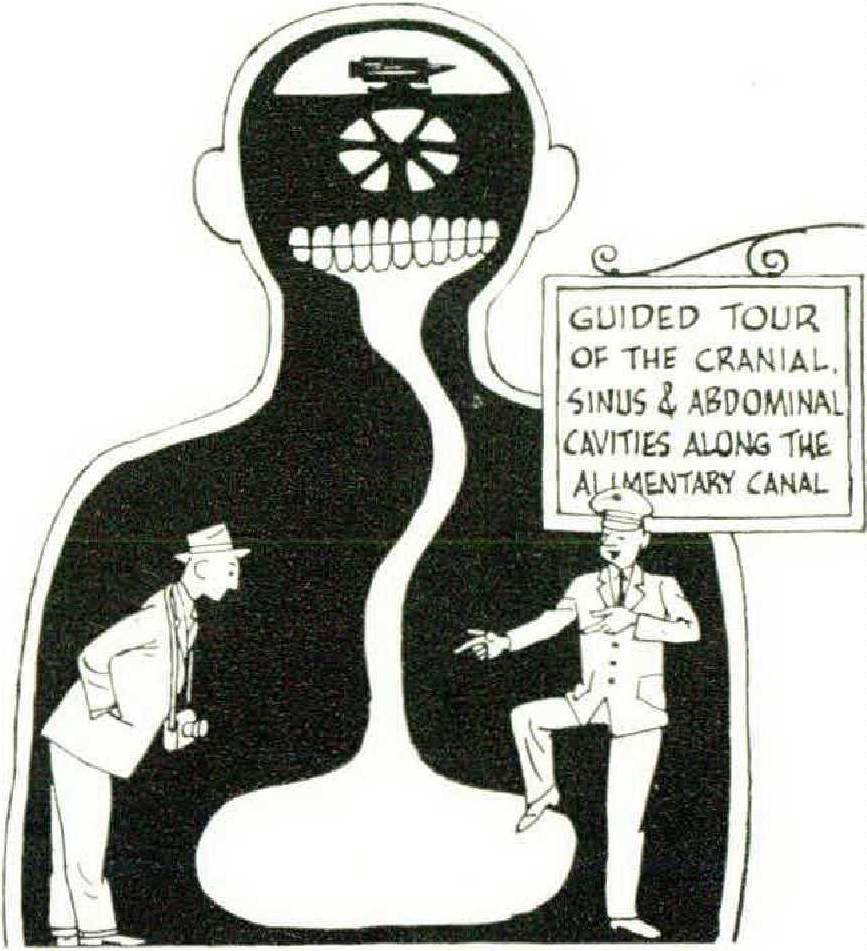
THE STOMACH: The stomach is a transparent glass globe which resembles a goldfish bowl. It is half filled with stomach acid, the supply of which is maintained by a perpetual leak in the roof. It is in our stomachs that A’s and B’s look for a way out — and small wonder.
THE MUSCLES: There are some muscles, situated mainly in the back, which knot up or tire, depending on your activities. If you would like to know what your muscles look like and don’t have a television set handy, just slice up an old inner tube into strips and braid them.
THE SKIN: All the wonderful moving parts previously mentioned are packaged in a handy wrapping called the Human Skin, and the less said about it, the better. The skin is red, detergent-cracked, chafed, and completely covered with bacteria. It’s a wonder we survive inside it.
Well, there it is. TV Anatomy, a snap course if I ever saw one.