"We the People"
VICTOR PROETZ is an architect who has built houses in Saint Louis, where he was born. California, New York. Washington, Florida, London, Malta, and Texas. He is currently living in New York.
One Saturday, when I was visiting Houston, a shower of rain drove me into the public library. Browsing through it, I came upon an entire wall of German books, among which I discovered a Milwaukee high school textbook of 1893 called Vier Hundert Jahre Amerikanischer Geschichte by Dr. G. A. Zimmermann. I was permitted to take it with me into the reading room. With a rainy afternoon ahead, what could be more amusing than random bits of American history in German?
There, in the appendix of the book, was the Constitution of the United States in German. I had never seen it in German, nor in any language but English, before, and was very much impressed by Herr Dr. Zimmermann’s thoughtful, beautiful version. The official translation, which I had never even thought about before, would certainly be somewhere else, somewhere more accessible, but since I had it there, I copied Dr. Zimmermann’s Preamble:
Wir, das Volk der Vereinigten Staaten, um eine vollkommene Vereinigung herbeizuführen, Gerechtigkeit festzustellen, innere Ruhe zu sichern.für gemeinsame Wehr zu sorgen, allgemeine Wohlfart zu fördern und den Segen der Freiheit uns und unsern Nachkommen zu erhalten, beschliessen und verfügen diese Verfassung fü die Vereinigten Staaten von Amerika.
Some time later, at a party in New York, I met a young Frenchwoman. She was sitting with some friends of mine, discussing the Eighteenth Amendment. I thought she could scarcely be having a very good time, and said, “Let’s talk about something else, something you know about. ”
“What do you mean? I studied the history of the United States at school. I know all about the Constitution. Would you like me to repeat the Preamble for you?”
After she had thought for a moment, she began:
Nous, le peuple des États-Unis, afin de former une union plus parfaite, d’établirla justice, d’assurer la tranquillité inférieure. de pourvoir à la défense commune, d’accroîtree le bien-être général, et de rendre durables, pour nous comme pour notre postérité, les bienfaits de la liberté, nous faisons, nous décrétons et nousétablissons cette constitution pour les États-Unis d’Amérique.
“How wonderful!” I said. “Whose translation is that?”
“I don’t remember. Thomas Jefferson’s, probably.”
So I began looking for Jefferson’s translation — I had never heard of that before, either — and in the end I found it. I found it twice, once in Beck’s La Constitution des États-Unis at the New York Public Library, and again in Conseil’s Mélange politique et philosophique extrait des Mémoires et de la correspondence de Thomas Jefferson in the Franklin Library of Yale’s Stirling Library.
Shortly thereafter, I had lunch with three friends — a member of President Eisenhower’s Cabinet, a diplomat with the State Department, and a newspaper editor. “I have been doing it the hard way,”I said. “There must be a simpler way of going about this.”
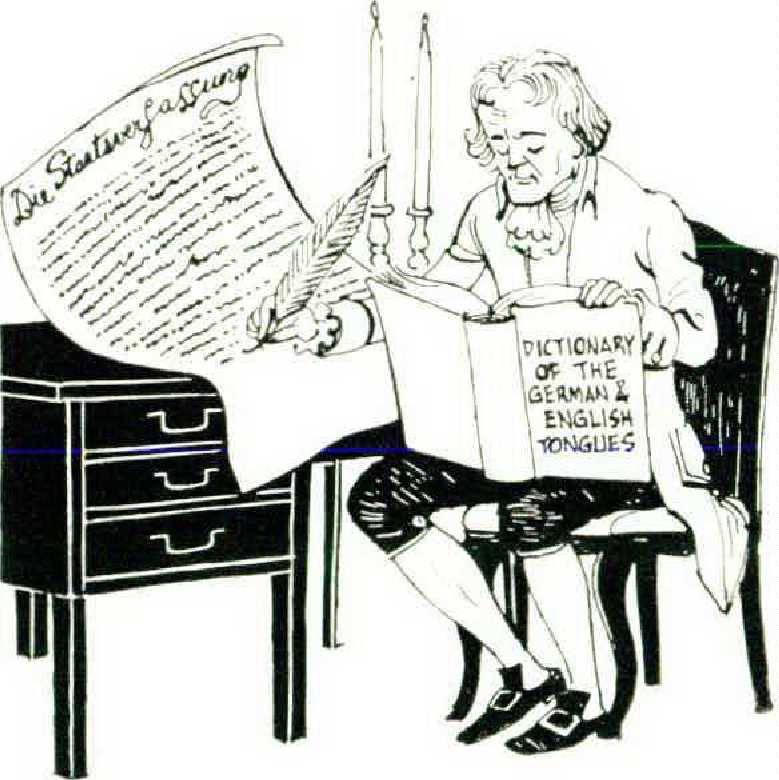
“Did it occur to you to write to the Government Printing Office?" asked the Cabinet member.
“They would have sent you hundreds of little blue pamphlets of the Constitution, translated into every language imaginable, at ten cents apiece,”added the newspaper editor. “I’m not a bit sure.” said the diplomat.
I decided to find out right away and sent off two identical letters, one to the United States Government Printing Office, the other to the Library of Congress.
GENTLEMEN:
Does the Government Printing Office issue official translations into foreign languages of the Constitution of the United States? If so, will you please advise me where and to whom to apply for a French and a German one? If not, can you tell me where to find what may be considered the standard translations?
The two replies came back to me very promptly. The Printing Office returned my own letter with pencil notes in the margin. “Not available from this office” was written in after “translations into foreign languages,” and “No information available” was the answer to where to find the standard translations. There was a slip of green paper enclosed thanking me for my inquiry.
The Library of Congress was good enough to provide me with five references. To my great surprise, these were no less obscure than mine. The New York Public Library, for instance, did not have two of the five references.
While I was waiting for these letters, I had thought of one more possibility. I remembered that there was a bookstore in the basement of one of the United Nations buildings.
“No, sir,” said a clerk. “We wouldn’t be carrying anything like that here.”
“Non, monsieur,” added another who had overheard us. “Your Constitution has certainly never been translated into any other language.”
So here we are. That’s all of it, and isn’t it incredible? The number of foreigners living in the United States who have no English and who, consequently, never can and never will read the Constitution must be staggering.