Irishness in America
An American of Irish antecedents, JOHN V. KELLEHER has become an authority on Irish history and the Irish mind in the years of study that have brought him to his present professorship at Harvard. Mr. Kelleher is a native of Massachusetts and a frequent traveler to the land of his forefathers.
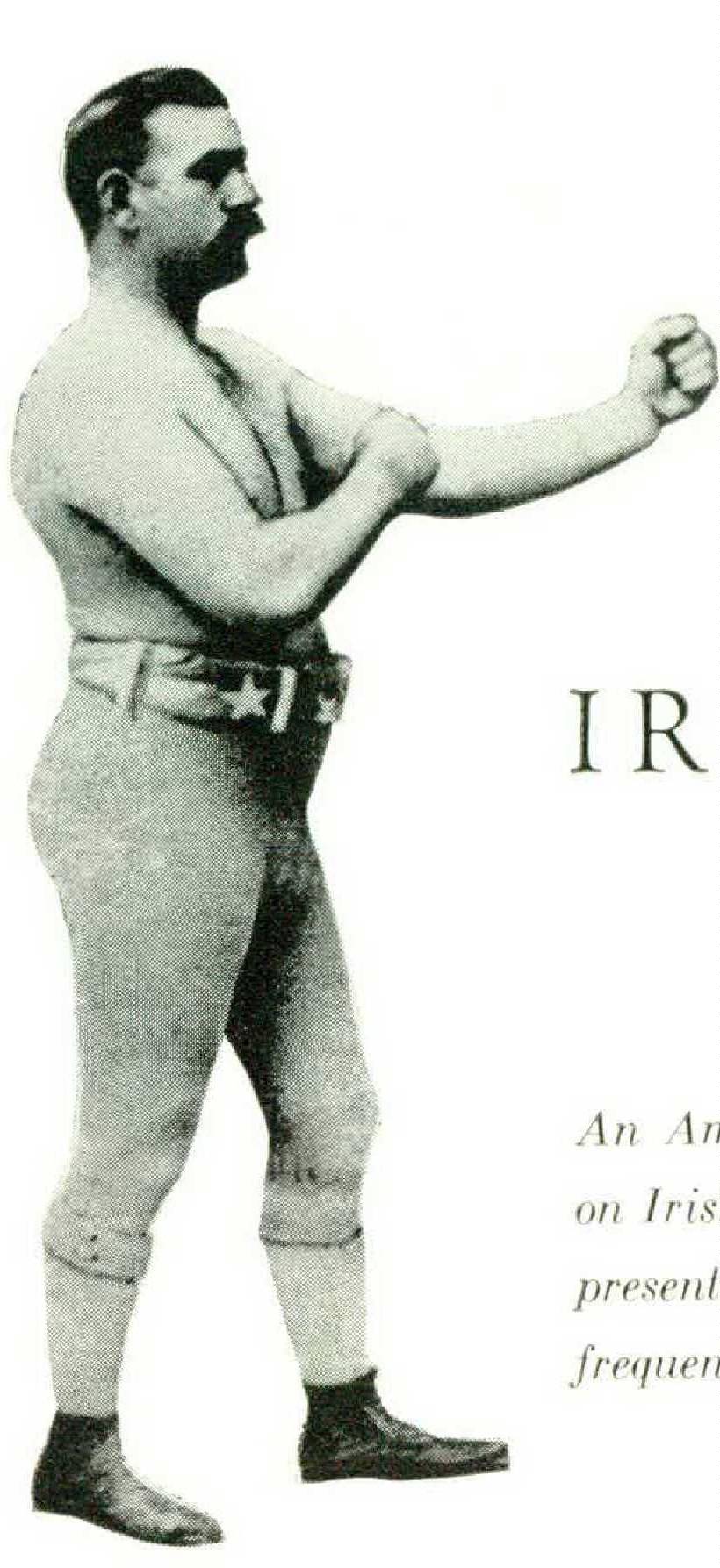
IN 1892 my grandfather took a steady look at the facts and predicted that Jim Corbett would beat John L. Sullivan. For a month before the fight he was laughed at by all his neighbors in the Irish section of Salem, Massachusetts. For a month after, none of them would speak to him.
Though I am proud of his intelligence, I can understand why the neighbors might feel that this uncalled-for rationality was vaguely treasonous. Whether or not they could define their feeling, all surely sensed that much more than the heavyweight championship was at stake. It was not that they objected to Corbett. Under the new rules he won the championship fairly. Presently, indeed, they would like him and approve of him, for in a curious new way he was a credit to the race. But he was not Sullivan’s equal. He was a clever fighter, a trained and disciplined athlete. Sullivan was a hero — the hero — and when he went down, the heroic age of the Irish in America fell with him.
Recall that no one then or since ever said, “Shake the hand that shook the hand of Gentleman Jim Corbett.” No one fastened on Corbett as the image against which to vent such a rage as I once found in an old A.P.A. pamphlet: They may boast of their vaunted John L. Sullivans, but one clear-eyed Yankee boy with a Winchester repeater could take care of a dozen such.” Corbett himself was well aware of the difference. It was he who told about the old lady in Boston to whom he was introduced as “the man that licked John L. Sullivan.” She shot him a glance of indignation and snapped, “It’s little you had to do!”
Yet, of what was lost sixty-nine years ago, little would have lasted out the decade anyway, and there was less that the Irish really wanted to hang on to. Sullivan was lucky that he went when he did, while he was still the meaningful symbol of what the Irish here had perforce to be proud of: native strength, the physical endurance that made possible the “Irish contribution to America” that orators and writers have since sentimentalized so much. What they really mean is that from the 1840s on, floods of Irish immigrants gave the country what it had not had before, a huge fund of poor, unskilled, cheap, almost infinitely exploitable labor, and that this labor force was expended, with a callousness now hard to comprehend, in building the railroads and dams and mills, in digging the canals, in any crude, backbreaking job. The contribution was real enough, but it would be difficult to distinguish it from the drafthorse contribution to America, and it was rewarded with about as many thanks.
Let us not imagine, either, that the Irish were somehow the better for it. A man who knows that he is considered valueless except as a broad back and a pair of strong arms is not thereby impelled toward education, refinement, and high ambitions. All too many of the Irish who were not killed by that usage were ruined by it. That was a plain fact of life, reflected flatly in the cartoons that accompanied “Mick” jokes in every comic paper, the unvarying depictions of the baboon-faced shanty Irishman and his slatternly button-nosed wife. (Not that the Irish were the only people thus complimented. Pick up any number of Judge for, say, 1900, and look at the drawings of Negroes, Jews, Swedes, Germans, and “Hunkies.” You may well wonder to whom this humor was addressed. Somebody apparently felt secure enough to laugh.)
Nonetheless, the heroic age was a fact. Heroic qualities characterized it: not least, the unconsidering wastefulness of men who felt they had nothing for which to save. Then every Irish quarter had its strong man, who would lift a dumpcart on his back or bend a crowbar, and who ruptured himself or died of booze, and who in my childhood might dimly be remembered as the “sort of idiot” that used to be around in those primeval times. That was what Sullivan superbly and prodigiously embodied. The dumpcart lifters had the strength of two or three . . . Yankees, let us say, but they were poor. Sullivan displayed the strength of ten for purposes impartially pure or impure, lavished his money like a pagan king, drank like a whole bevy of royalty, and with iron pugnacity and iron confidence bade defiance to the world that undervalued the Irish. He was only eight years older than Corbett, but they stood on either side of a gulf of history neither experience nor imagination could bridge. Ten years after his defeat, his people were already forgetting what he had meant. They had begun to refer to him as a figure of fun. And that was the last thing the real John L. ever was.
Corbett was equally representative. He was a prophetic figure: slim, deft, witty, looking like a proto-Ivy Leaguer with his pompadour, his fresh intelligent face, his well-cut young man’s clothes. He was, as it were, the paradigm of all those young Irish-Americans about to make the grade.
These were the children of what you might call the “hidden Irish,” who, by 1890, were the vast majority of the Irish in America: the men and women who, though denied opportunity for themselves, confidently counted on it for their children, and, like millions of later immigrants, scraped and saved to give their children a fair start. Publicly these people were all but invisible, because they did not look or act as everyone knew the “real” Irish acted and looked. Moreover, they lived in the Irish quarters check by jowl with the wild Tads and thick Micks, who were recognizable.
Which is a point my father made twenty-five years ago when he was explaining why neither I nor anyone of my generation would be able to write the great Irish-American historical novel in three volumes. “You don’t know,” he said, “and you can’t imagine what it was like before the great sorting out took place, when the cleans and the dirties, the lazy and the vigorous, the decent and the criminal were all mixed up together down on Valley Street.” He was right. I do not know, and I would not trust my imagination. I did get one remote glimpse of it at his wake. An old man I had not seen before came up to me and began explaining that he was an old friend of the family’s. “I lived next to them for eight years on Park Street. They were a fine, quiet, respectable family, all of them. I’ll say this to you, though you may not believe it — not once, mind you, in all those eight years did the patrol wagon drive up to their door.”
THE sorting out is the key event in the whole history. There are a dozen books that proudly recount the rise of Irishmen to American fame and fortune throughout the nineteenth century, but these instances are irrelevant to the main theme. Most of those who succeeded vanished as Irish. Not until the grade was made en masse could any ordinary man feel secure in what he might attain. That happened just after the turn of the century, and the generation to whom it happened, my father’s generation, is the only one to whom the term Irish-American can properly be applied. Before them were the Irish in America, ill-assimilated, unaccepted. Since them, with people of my age, what is there left that can be considered significantly Irish? But at that moment they were Irish-Americans: a hundred and sixty-two per cent American, born here, educated here, conscious of their citizenship, illumined with the fresh capacity they sensed in themselves to fulfill the promises Horatio Alger and Teddy Roosevelt had revealed to all who would Strive and Succeed. Their confidence rested on a calm faith that innate Irish vigor, its fetters thrown aside, was worth at least another hundred and fifty-nine per cent in any open competition. They got the jobs their fathers could never have got. They made the grade like walking up a hill. They led their parents out of the Patch, the Acre, the Shantytown, and into the new two-apartment houses in the new streets. A lot of them later went on to single houses in the suburbs.
There, for the most part, they stopped. At least, they did in New England — and really, it was only in New England that the whole process was unfolded, for only here did their own numbers and a sufficiently coherent opposition ensure that they would remain a distinct group so long. With rare and universally scorned exceptions, they had no desire to move socially “higher.” What they wanted and got was a mutual standoff with the Yankees. True, the Irish social climber did exist in sufficient numbers to be known as a type made comic by his genteel paroxysms of doubleinvoluted inverted snobbery. I remember one woman who drove my father to the verge of apoplexy by saying of a man he admired, “Judge O’D_—— must have Protestant blood in him, he’s so refined.” Or another who remarked that her people weren’t common Irish; they came from a castle in Ireland. “Indeed,” my father snorted, “it was bloody democratic of your old father to come over here and work on the Lawrence Sewer Department. What castle did he come from, will you tell us?” Loftily, she named a flea-bitten market town in Mayo.
Inevitably, that generation has become far less Irish than they began. They were yet in early middle age when the old, powerfully emotional bond with Ireland suddenly dissolved; or, let us say, when it was revealed to be woven only of emotion. Men who never saw Ireland, even the few who had some notion of Irish history, set great store in the expectation that Ireland free would somehow be a glorious and transcendent fulfillment of — of what, I don’t know. I don’t think they knew, either. They tended to imagine it emerging as a sort of forty-ninth American state with a difference.
They were completely out of touch with the actualities; their Irish politics were, at best, thirty years out of date. That Ireland must become a small country in the butter-and-egg business, that it was already a land in which most of the cultural evidences were secondhand English, and Victorian English at that, never occurred to them. Nor could they conceive that Irish and American interests might possibly conflict. My father once mentioned that, for the year between the Easter Rising of 1916 and the American entry into World War I, a lot of Irish-Americans were pro-German. How did they make the switch in 1917? I asked. “There wasn’t any switch,” he said. “They went on the principle that England couldn’t be right, but the United States couldn’t be wrong.” The Irish Revolution was shelved by them till the end of 1918, when they again became happily anti-British without the complication of a proGermanism that had never agreed with them.
For the next three years they piled into big organizations like the Friends of Irish Freedom. Their fervor was so unbounded that it survived de Valera’s American tour in 1919-1920 and his quarrel with the American-Irish leaders. In no small part that enthusiasm depended on Michael Collins, in whom they saw a man so much like their own best image of themselves that they took it as proof of the identity of Irish and AmericanIrish. They were wrong. Collins was not an American. The supposed identity was tenuous in the extreme.
Then suddenly came the Irish civil war, which blew everything apart. Collins’ death in the civil war was the end. Of all the men I knew as a boy, only one, a veteran of the Irish Brigade in the Boer Army, maintained any interest in Irish politics. And as for identification, what American could identify with de Valera?
Like Sullivan’s fall, it was well that it happened quickly and unexpectedly, for it would have happened anyway and was best not lingered over. Ireland, instead of being a dream mutually shared with Irish nationalists, had become a foreign country — a country specially, if mildly, well regarded, but foreign nonetheless. Irishness in America petered away into a genial, largely uninterested St. Patrick’s Day recollection of faded pieties. In place of the big organizations, evaporated like the dew, there now remain a few societies that concern themselves intelligently with Irish culture and a few others that exist because for some reason they exist. No one should repine, least of all the Irish, who can now pursue their own course without worrying about what some rabid American relic of extinct Fenianism may do to Anglo-Irish relations in prosecuting his vendetta against George III and the late immortal Victoria.
Is there, then, nothing to show for all that century-long struggle of the Irish to become American? Practically nothing. They became American, and that was it. There is no point in talking about this or that people’s contribution to America. The only contribution any people consciously make is what they want for themselves, and, predictably, in America that has always been what other Americans of older vintage already possess. When the newcomers get this, they throw away what they had to content themselves with before. Or, another way of putting it is, the Irish contribution was their grandchildren, no longer Irish.
To answer a last objection: probably more than any other group (though not as singlehandedly as they liked to imagine) the Irish did build and staff the Catholic Church in America, and insofar as they are still identifiable, they produce for it a disproportionately large number of vocations. Actually, though, the Catholic Church in this country is the clearest proof that the story is over, the connection dissolved, the alienation completed. This is never more apparent than when an American bishop addresses an “Old Irish Mother of Mine” speech to incredulous Irish ears or tries to get chummy with the Irish hierarchy. The results make Dublin and Galway seem very far away. Aye, and long ago. Like it or not, we’re on our own.