The Americanization of the Unconscious
Professor JOHN R. SEELEY was educated in Chicago and now leaches sociology and psychiatry at the University of Toronto. He is co-author of CRESTWOOD HEIGHTS, the first intensive psychological study of a North American community.
AMERICA is the world’s Wonderland. In all the shadings and nuances of the word, she is before all others the world’s producer of wonders and is a matter of wonder to the alien, and, a fortiori, to herself. Of only one thing can we be sure: that the face she presents to the world — the simple, plain-spoken, direct, homely, straightforward, practical face — is the least of her aspects and serves chiefly to conceal the complexity within complexity that is characteristically hers. The myth of simplicity which she has woven about herself and persuaded others to weave about her serves as a penetrable mantle that, like the latest bikini, calls attention most to what it is ostensibly designed to conceal The love affair between America and its image is unlike any other under the moon or sun. Other nations hold before them for relatively lengthy periods rather steady images of their own collective personality, clear-eyed or distorted. Some move from phases of self-glorification to phases of selfdenigration: from Rudyard Kipling, say, to the Angry Young Men. Some brood endlessly on the mystery of their being, sinking deeper into a mystery that is always the same. Some romanticize, or, as in Canada, pursue frantically a national identity which eludes perception because it is pursued. But only in America does one turn and turn the corporate image before all the available transforming mirrors of this frame of reference and that. Other peoples glory also in their singularity, but since the singularity of America is its variation, how could America fail to glory precisely in that?
An air of messianic expectation pervades the culture, as one would expect in a society where the conventional belief is in fundamental equality. The log cabin to White House legend masks rather than reveals the much deeper conviction that some much more general and profound savior from something more pervasive than the moment’s political problems will at any moment appear and be recognized. The excessive and unadmitted expectation accounts in part for the typically rapid rise and fall of the hero: overrapid rise because the expectation creates the necessity to project onto the candidate the preshaped halo; overrapid fall because such distortion of reality cannot be long maintained. (I know the habit is to account for such phenomena in terms of the highly developed communications media, the maneuvers of publicity, the harsh glare of the spotlight. But the media are the means, not the purpose. One does not develop a far-flung net of detection to observe what is not of paramount interest.)
It is true, no doubt, that to a very large extent Americans have made what they call “religion” shallow, but it would be only a slight exaggeration to say that Americans are the most unsecular people on earth. If devotion to an idea, if ardor in its affectionate development, if the rendering of the idea immanent in the body of thought of the time, and if the pervasive embodiment of the idea in behavior are, as I believe, the hallmarks of a “religious” attitude toward it, then ideas are religiously treated in America. It is true that one religion rather readily succeeds another, but this is rather from the devotion to the general religious quest than from disloyalty to the particular religion abandoned. “God by God goes out, discrowned and disanointed, But the soul stands fast that gave them shape and speech.”
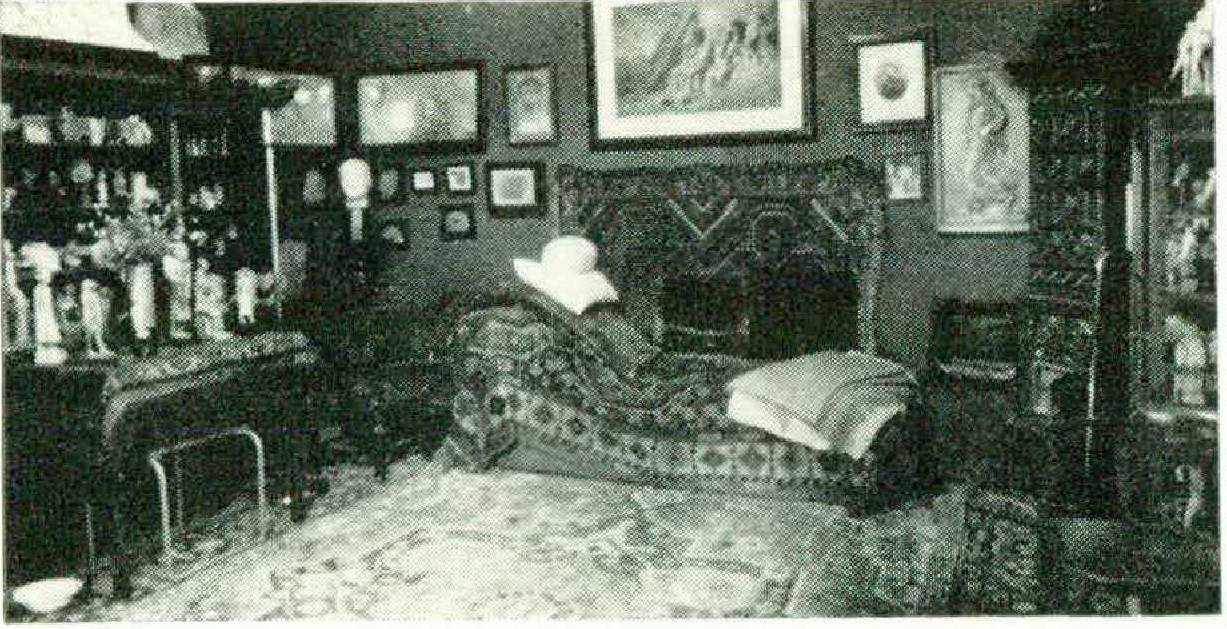
Photograph by Edmund Engelman.
Lastly, contradictory but coexistent, just as everyone who is anyone becomes a hero, so everything that is anything tends to become an industry. By an “industry” I mean nothing more than some enormous organization in which some input is put in, brought under a rational process, characterized by a maximum of rationality (minute subdivision of labor, immense organization, and exact adaptation of calculated means to ends), and thereby some output is put out. Whether the matter is child raising, or higher education, or entertainment, or the production of a new generation of non-Momistic mothers—or even religion, in the narrower sense — almost inevitably it is so organized and so put into production.
INTO a culture so constituted in its general workings was implanted, about 1909, a cultural seedling, the thought and technique of Sigmund Freud. In almost any soil, the seedling was bound to become a mustard tree, with room for all manner of fowl to lodge in. In America it was to transform and be transformed by the society.
The practice of psychoanalysis underwent almost no change in the transplantation, except that for reasons which have more to do with politics than culture, it fell amost exclusively into the hands of doctors. (It should be remembered that Freud to his life’s end tried to live down his definition and attitude as a physician in favor of a redefinition as a psychologist-philosopher of theory and unquestionably a prophet-priest of practice.) It was the theory, by far the more important part, that was to be modified and made over, and to modify and make over men, theories, and institutions.
Freud’s doctrines, as they reached these shores, were by implication stern, if not gloomy. Since his writings fill a good-sized shelf, it would seem idle to attempt to reduce them to a paragraph. The leading ideas that are of interest here concern the instinct theory, the “institutions of the psyche,” and the nature of man and society. Man, as Freud portrayed him, comes to the world panoplied with a full accouterment of instinctual drives. Pleasure (or happiness) lies in the satisfaction and gratification of these instinctual demands, which are in principle insatiable; more particularly, the pandemic demands are for outlets for sexuality and aggression. It is in the very nature of man, in Freud’s view, that he cannot live outside society, while at the same time it is in the very nature of society to require renunciation of instinctual gratification, the only source of happiness. Since society cannot survive without taming the instinctual demands, and indeed subverting them to its uses, it achieves its ends, at the expense of individual happiness, by routinely, radically, and inevitably dividing the psyche against itself. This double assault upon the possibility of any sensible degree of happiness — the truncating of the individual’s opportunities for gratification, together with the internalization within him of the conflict that “really” lies between him and his fellows — is carried out upon the helpless infant by the unwitting adults.
The first figure in the drama of the child’s ontogeny is the “id,” an institution of the psyche, largely unconscious, representing in principle unlimited demand for the gratification of sexual and aggressive instincts. The nature of the environment requires from the child sufficient appreciation of that which is independent of his wishes that he does not totally stultify his own search for gratification by the use of inappropriate means. A second institution, custodian of “the reality principle,” is thus differentiated in the “ego.” But dominant in the child’s significant environment are those who can and do most obviously give and withhold gratification, mete out reward and punishment; the custodians of the culture, the surrogates for the society’s interests, the parents or their deputies.
In the course of time, the watching, warding, judging, criticizing, ruling, governing behavior of these virtual jailkeepers of the instincts is internalized in yet a third institution, differentiated from and set over against the ego, the “superego,”again mostly unconscious, but none the less censorious, vigilant, and punitive. The ego now has an additional reality to deal with, the conflict between the excessive demands of the id for gratification and of the superego for the limiting or extinction of these demands. A great deal of the limited energy available to the ego is thus consumed in ceaseless adjudication between one party, that would empty life of pleasure, and the other, that would rob it of safety. The child is finally his own prisoner, jailer, and the mediator between the two. By a final and exquisitely ironic twist, the very aggression that is thus cut off from its gratification becomes the very source of the energy of the superego, so that the psyche is indeed “the plough-cloven clod And the ploughshare drawn thorough.” What is to be inferred with regard to man and society, Freud says in one of the starkest of his works, Civilization and Its Discontents. The burden of the volume is that, as man seeks to defend himself against disasterbearing nature and against the disease and deathbearing body, the very necessities of the defense organization (society and culture) require the attenuation of sources of satisfaction to such a degree that the life thus secured is mostly precarious and, even when stable, scarcely to be endured. He leaves both the survival of civilization and the capacity of men to survive under it as open questions.
THE popular myth is that these gloomy doctrines, running into the irrepressible optimism and meliorism of the American people, underwent characteristically American reversals and came out transformed, pupa into butterfly, in the much more palatable dogmas of those who were politely called the Revisionists: Horney, Fromm, Sullivan, and others. It is true that a “revision” occurred, a revision perhaps as radical as the one that produced Marxian materialism out of Hegelian idealism; but what made the revision possible and necessary had little to do with American optimism directly. In any case, what is most interesting and most American is not the revision as such but the subsequent “psychoanalyzation” — horrible coinage, but what word will serve? — of American thought, institutions, and life.
In the first place, the words were hardly cool on Freud’s lips, the ink hardly dry on his pen, before revisionism — or, as he looked upon it, apostasy — set in, even in Europe. Jung, Adler, Ferenczi, Reich, Reik, Rank, and Stekel were the most eminent of Freud’s disciples to break away from him. In a sense — though, tragically, he did not see it so — revision was a movement that the master himself set off, both by his method and the power of his example, and he had as much chance of stopping it as Luther had of limiting Protestantism to his own first great protest. So the fact of revision is not purely American.
Nor is the direction taken by revision so easily to be explained. Horney, Sullivan, and Fromm each developed a connected viewpoint, either implicit or explicit, and in the case of Sullivan, the least known of the three, something that approached a new systematics. More of Freud survives in all three than any one of them is ready to admit; so much, indeed, that one can see a distant ecumenical reunion, perhaps a century off. What binds the major revisionist schools together is a sizable shift from a biological determinism toward a cultural and social determinism, together with a preoccupation with the self as the unit of concern and investigation, the central element in theory, in contradistinction to the preoccupation with the fate of instincts and the squabbles of the psychic trinity. This is not to say, of course, that any of the revisers denies instincts, though all reduce the role played by infantile sexuality and aggression. But what was peripheral in Freud’s developed work — ego function, the role of ego ideals, and so forth — becomes central for the three; and what was central for Freud becomes peripheral.
Since society and social relations — “interpersonal relations,” as Sullivan significantly calls them — are thought to be more readily amenable to rational improvement than biologically given instincts, there is unquestionably a greater air of optimism in what the revisionists say and an unmistakable foundation for meliorism for those so inclined. Indeed, in Erich Fromm, the message very nearly moves from historical analysis, in Escape from Freedom, to a combination of character typology, philosophy, and institutional analysis in Man for Himself, to a virtual trumpet call to a quite particular social reform as the means to psychological health in The Sane Society.
What made this particular line of revision necessary and possible was the prior existence in America of a fairly well-developed body of fact and theory in the social sciences generally, more particularly in sociology, anthropology, and social psychology. It was the collision with this rival episcopate, already considerably entrenched in American affections, already holding up its crosier over American life, and already holding out the promise of offering America more images of more of its illimitable aspects, that gave the revisionists the impulse, the possibility, and the model for their subsequent development. The existence of this body of specialists, their particular orientations, and the actual and potential public interest in them are, of course, consequences of American affluence, the necessities of self-understanding posed by the melting pot, by rapid social mobility, and by all the characteristics of American culture pointed to at the beginning of this article. But it was the collision of European psychoanalytic theory and case material with American social and social-psychological theory that gave the revision its form and preoccupation and part of its content. From the time of the collision, neither was ever again quite the same. Much social science continued with studied inattention to psychoanalytic theory; some psychoanalytic theory continued in studied disregard of social science; but a great deal of each now took a new turn, fertilized by the other, and out of the fertilization grew a new child that might be labeled either socialpsychoanalytic theory or psychoanalytic-social theory.
It is hard to see how, in a social-scientific community sensitized by the work of a long line of social psychologists, reaching from Baldwin to George Herbert Mead, the central problem of the organization of the self, stated in terms of role taking and role generalization, could be long evaded by any group claiming to understand the genesis of personality. The interest of Charles Horton Cooley in “the primary group” and its relation to the “social self" was contributory to the focus on “interpersonal relations” which Sullivan was so expertly to fill out. The hard-won anthropological and sociological materials were ready to cross-question any general theory of human nature or human development that was too narrowly based on a single society, a single class, or an otherwise biased sample. Each parent needed what the other had: adequate case materials, particularly of Sufficient depth and intimacy, were lacking to give body to the rather lofty generalizations of social psychology; adequate formalization of the relation between social process and psychological process had been lacking in most psychoanalytic thought.
The interplay between social science and psychoanalytic theory becomes too complex to follow much further. It results at one point in the anthropologically informed psychological theories of social character of an Abraham Kardiner, the psychoanalytically sensitized anthropology of a Margaret Mead, the revisionist sensitized social character typology of a David Riesman, the exquisitely sensitive playing back and forth between person and society, concrete and particularized, rather than abstract and general, of an Erik Erikson.
IN A fashion somehow also typically American, orthodox Freudianism survives and develops. There is inter-sect antipathy, but. characteristically, no wars of religion. Indeed, the true church not only survives and develops, it flourishes, is favored by the hard-core social scientists over the offerings of the revisionists, who are rejected partly on intellectual grounds and partly on the emotional ground that they make things, including the life of the social scientist, too easy. The psychoanalysts come to terms with what David Riesman has called the “dirty secrets" of sociology — social class, ethnicity, and the like; the sociologists come to terms with the corresponding dirty secrets of the analysts — sex and aggression. The preoccupation of each with the supposed preoccupation of the other can be explained sociologically or psychoanalytically and appears equally interesting either way.
Much more dramatic than any of this analysis of analysis and its fate among the professionals is the story of its destiny and development into something immanent in American life, interfused with all thought and activity, making over the society in as radical — and as shallow — a way as the official religions had done earlier: Christianity and liberal, capitalist democracy.
Perhaps this is the point at which to set up some contrasts with Europe, which I toured last summer, in company with the perceptive Leonard Duhl, with but one question in mind: How far had the views and preoccupation of mental health spread, ramified, infused the views of educators, city planners, makers of social policy generally, parents, writers, politicians, administrators, executives, and so on — in short, nonpsychiatrists?
In the first place, they had access to, had read, and were highly interested in our social science and psychoanalytic literature, American and — what there is of it — Canadian. They regarded it predominantly in a detached way: an interesting expression, symbolically, of America, no doubt, and a good enough account of American life. but neither directly applicable to them nor providing a model which they might apply to their own selfstudy. (Actually, excellent similar studies had been made of European life by Europeans, but they were less widely known or appreciated.)
We found excellent mental health enterprises — indeed, some so excellent that the best in America suffer, I think, by comparison — but little or no tendency to generalize, either by reproducing rapidly copies of the dramatically successful enterprises or by “drawing out their principles” and seeking to apply them over a wide range of life, let alone re-examining general social objectives in the light of them. We found remarkably good research, but the people who knew or cared about it were largely the professionals, and then either, as in England, in a task-oriented sense or, as in Germany, in a dominantly philosophical one. It is as though the movements of thought which in America are almost instantaneously communicated to every cell of the body — a sort of intellectual-emotional metastasis—were there localized and only allowed to exert a general influence gradually, if at all. The remark of a very literate, sophisticated old schoolteacher may be allowed to stand as typical: Yes, she knew a good deal about Freud; no, it had little to do with the bringing up of children. We found the same sharp split in France between problems of therapy and problems of development. Our teacher and her contemporaries had even once taken a course on the Geisteskrankenheiten, but she spoke of it with the same reminiscent delight and the same air of separation from the everyday concerns of life as if she had been speaking of a course in Egyptian hieroglyphics. In fact it had for her something of just that travelogue quality: interesting, quaint, but happily remote, and someone else’s worry.
More typical of America would be to take one institution, the school, faintly adumbrated in Crestwood Heights, but to be found in pure form in numberless U.S. suburbs.
In the pure form, not only means and methods but goals and criteria of performance have been made over in terms of available psychoanalytic understandings. Just as religion has become a way to peace of mind, thereby emptying it of specifically religious content, so education has become the way to strength of soul, to positive mental health, to maturity. It is not that teachers are preoccupied by pathology; they are too healthy for that, though their rather general viewing of children as problems — parallelled by parent perceptions in the same terms — begins to border on that danger. It is rather that everything is seen, understood, and acted upon, as far as reality permits, in terms of the depth drama actually or possibly underlying any act. Little behavior is taken at face value; almost without consciousness of alternate possibilities of perception, very nearly everything is interpreted. The role of the teacher as a parent surrogate is understood and accepted. It is expected that hostility will be displaced upon her, that drawings, essays, polite exchanges have covert meanings much different from their overt content — and much more real and much more interesting. The libidinal giveand-take that accompanies all communication (or motivates it?) is noted, although less easily accepted. If Johnny throws a spitball at Mary, nothing so ordinary as mischief is afoot. The possibilities have to be — are joyously — entertained that Johnny is working off aggression, compensating for deeply felt inferiority, asserting his masculinity in ways appropriate to his developmental stage, testing for limits, or, in a characteristic upside-down way, saying to Mary in a circuitous and hence safe way, “I love you.”
And so, not only for students, but for the interrelations of staff and of all to authority. The mental health of the staff as a prerequisite for the mental health of the pupils is a matter of concern — not, of course, in the bare sense that teachers should not be mentally sick, but that they also should be positively well, continuously growing, always developing and maturing, and manifestly happy, continuously emotionally rewarded in so doing. I will not go on. The rest spells itself out. Except, perhaps, that I should note that in such schools the parents — or, at least, the mothers — must be continuously caught up in the enterprise to a point of unexampled intimacy and in a role partly of lay assistants in the child’s upbringing and partly of apprentices or pupils.
What is true for the school is true for the church, for industry — on the white-collar side, at least — for the family, and even, to a sensible degree, for the peer-group institutions among the youngsters themselves. The explicit awareness of high school kids — and those in the elementary school, down to kindergarten— of the depth-psychological world they now inhabit is exquisite, and many of them know their gamesmanship better than the adults.
This development in America, and it has still to run the major part of its course, makes for a change in the very nature of the society, comparable in the magnitude of its effect to the original American Revolution. But that was a revolution of mere externa: this is of interna, ultima, privatissima. We are confronted by the possibility — perhaps, now, the inescapable necessity — of a highly selfconscious society of highly self-conscious individuals, a society that must sustain, cope with, or use all the new possibilities of vertical complexity in addition to the pre-existing ones of horizontal complexity. We have added a dimension, and there is no more radical act. We are in the process of producing, if we have not already produced, a distinctly American unconscious.
Such a society has the possibility of approximating a therapeutic community, or, rather, a community favorable to the emergence of a humanity more humane than any we have ever known. It has also the possibility of becoming a manipulative society in which the minor, clumsy attempts depicted by Vance Packard in The Hidden Persuaders are perfected to the point where resistance is virtually meaningless; a society in which, moreover, the threats of manipulation from without are countered but fatally compounded by self-manipulation, which is also in the current American stream. The dice are heavily loaded in favor of the latter risk, the risk of catastrophe, by the American devotion to mastery as the deus deorum. Only if we can bring out of the consulting room into the society, as well as the ideas we have already brought out, the intelligent affection that contains and domesticates the otherwise threatening possibilities of insight, only if we can institutionalize this intelligent affection in public life, revolutionizing other institutions in the process if necessary, can we hope to call out the forces of life rather than tap upon the door of death’s angel. Insight is mere technique; Eros and Thanatos still dispute whose; and their representatives in us will determine.