The Catholic Pioneers
Born in Manchester, England, and educated at St. Bede s College and at the University of Louvain, MONSIGNOR PHILIP HUGHEShas been professor of history on the faculty of Notre Dame University since 1955. He is the author of more than ten historical works, the most famous being his three-volume HISTORY OF THE CHURCH.
Msgr. Philip Hughes
OF THE 180 million Americans today, 43 million are Catholics. They are the largest single group of Christians in the country.
In 1789. when the first President was inaugurated, there were 4 million Americans, and there were perhaps 35,000 Catholics. Methodists numbered 43,000. The great bulk of the citizens were not affiliated with any church. Organized Christianity was in ruins, and the mass of mankind godless. This is an incredible picture to one who contemplates the present-day situation, with voluntary church membership at nearly 70 percent, and popular identification with the churches even higher. The Catholic achievement is not, of course, something unique in kind.
Whatever influence the Catholics of today possess, it is not effective throughout the nation in the way that non-Catholic Christianity can be effective. There are two main Catholic blocs, and two lesser. In a region we may conveniently call the East — New England, the states of New York, New Jersey, Delaware, Maryland, and Pennsylvania as far as the Alleghenies — there seem to be between 15 and 16 million Catholics. In the territory between the Mississippi and the Ohio, leaving Minnesota out of account but taking in the rest of Pennsylvania, there are 10 million Catholics. In Louisiana there are one million; in California about 3 million. The remaining quarter of the Catholics are spread over the remaining 80 percent of the territory of the continental United States.
To break down some of these figures, we may say: 1) in our “East" — that is, in an area no more than one twentieth of the United States — there live one quarter of the total population; the proportion of these 43 million who are Catholics is high, 37 percent; 2) in our “Midwest,” where there are 42 million people in 271.000 square miles, 24 percent of the total population in 9 percent of the total area, the Catholics comprise about 24 percent of the population.
Yet these bare figures can seriously mislead. They do not, for example, show that this “Midwest” is a territory where, evidently, somewhat less than one man in four is a Catholic, for 63 percent of these Midwestern Catholics are concentrated in half a dozen metropolitan areas. It is in Chicago and Detroit, in Milwaukee, Cleveland, Cincinnati, and Pittsburgh that Catholics form a notable part of the population, varying greatly according to their national origins, and still inclined, after all these years, to maintain a certain clannishness according to their historical origins. In these metropolitan areas Catholics average a little less than 40 percent of the total population. In the small towns of the region they may be all but nonexistent. And almost never are they AngloSaxons.
And what about the historic South, the Pacific Northwest, and the sixteen states of the plains between the Rockies and the Mississippi? The area constitutes about four fifths of the United States, the population some 75 million; and of these, the Catholics number perhaps 13 million. In this region too — if our inquiry is about the effect of Catholics in the general life of the community — allowance must be made for the concentration in a dozen or so metropolitan areas where the population varies from 250,000 to a million. There are still many counties in the United States in which there is not a single church; and no doubt many more where there are but a handful of Catholics.
The impressiveness, as a national social force, of the 43-million Catholic minority begins to dwindle as one considers its extraordinarily varied distribution. The fact that this body was built up at all, in the circumstances of the place and the time, and almost entirely out of alien immigrants of the poorest kind, becomes more impressive the more it is studied.
THE immigrants came slowly at first; an average of 8000 annually, it is thought, for the first thirty years after 1789. Then, coinciding with the ‘’portentous revolution” of the 1820s, which soon had 2 million operatives in the various new factories of New England and New York and Philadelphia, the rate began rapidly to increase. In 1830, 23,000 were admitted; in 1840, 84,000; in 1850, 370,000 — a figure not to be reached again, however. for twenty years. The cause of this particular tidal wave was. of course, the Irish famine. As well as the Irish, the Germans were now coining in great numbers. Of the foreign-born inhabitants in 1850, 42 percent were Irish, 26 percent German. We can safely believe that the proportion of Catholics among the Irish was extremely high. What proportion of the Germans were Catholics can only be guessed. If the national population increased by two and a half times in the thirty years from 1790 to 1820, and by as much again in the succeeding thirty years, the proportion of Catholics in the national population developed so very remarkably as to provoke hostile reactions of various kinds — these hundreds of thousands of new citizens of foreign birth, with a religion as outlandish as their accents and their customs.
The 35,000 or so native Catholics of 1790 had been concentrated, with their forty priests, in Maryland and Pennsylvania. Apart from these there was little more than a tiny congregation in New York. To the average American, to the New Englander, Catholics were as rare as Chinese. But by 1820 there were 200,000 of them, by 1840 600,000, and by 1850 nearly 2 million, with 1000 priests serving nearly 1500 churches and mass stations of various kinds and ruled by a hierarchy of thirty-five bishops. The Catholics were a minority indeed, about 8 percent of the whole. But in the days of the grandparents of the fanatics who now demonstrated against them, and at times burned their churches, the Catholics had been barely one percent.
The recurrent waves of newly arrived brethren might well have broken the tiny Catholic community upon which they came. Its future owed everything to the fact of the Catholic tradition — the tradition of teaching, of worship, and of church government — that is everywhere the same and is the very life of this church. From the beginning the Church is a lederation or union of churches equally possessed of the tradition, each ruled by the bishop. It is upon the bishops that everything has always depended, and it was the fact and presence of bishops everywhere that mattered most in the United States during the long critical century when Catholics, continuing to increase beyond all likelihood, slowly moved, with the rest of the nation, from the Atlantic to the Pacific.
That so many bishops were provided was the work ol two nineteenth-century Popes, Gregory XVI and his successor, Pius IX. Historians have more than once noted the strange contrast between the bold, masterly skill of these Popes as organizers of the worldwide missionary effort of the church and their lack of effective leadership, relatively speaking, in the long international crisis of the Italian Risorgimento. In nothing did they display more strikingly their intuitive understanding that an utterly new kind of country had come into existence than in the princely way they scattered episcopal sees across the nascent American empire. Let there be no more than hall a dozen missionary priests in a new territory, days, perhaps weeks away from the bishop who sent them, one of the missionaries very soon would find himself a bishop.
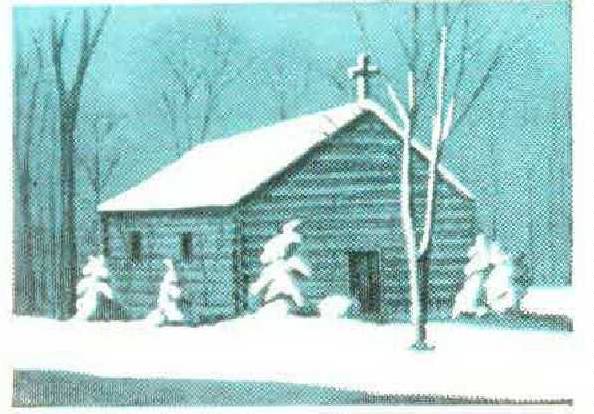
Such a one was the first bishop of Bardstown, Kentucky, who arrived at his see, in 1810, to find himself ruler of three priests and ten log huts called churches and some 6000 Catholics, in a territory that extended over three frontier states. Another such was the first bishop of Cincinnati, who found awaiting him, in 1821, fifty Catholic families. By 1832 these Catholics numbered 7000; a seminary and a Catholic newspaper had been started. In 1868. when James Gibbons was sent as a bishop to North Carolina, he had only two priests. And so it was, in one place after another all over the country, for a good hundred years; and in more than one state, the priest — and the bishopcontinues today to be the itinerant, apostolic missionary. Everywhere there was some local center of full episcopal authority, with power to decide on the spot and to make the necessary accommodations of law and religious practice which the needs of the place called for.
It was in 1789 that the first bishop was appointed — John Carroll, one of the great Maryland clan — and styled bishop of Baltimore. Four more sees were created in 1808, at Boston, New York, Philadelphia, and, more significantly, at Bardstown in the wilds of Kentucky. In the East — there were in 1808 but three priests and 1200 Catholics in Massachusetts — nothing more was to happen for a long generation, but from Bardstown, in the years 1821 to 1837, sees were founded in most of the new Western states — Ohio, Indiana, Michigan, Tennessee, Missouri — and as far away as Dubuque. The old Spanish foundation of New Orleans had also been revived, and in Virginia, South Carolina, Mississippi, and Alabama, too, bishops had been appointed.
In these years before the railroad, the pioneers had managed to travel from 300 to 500 miles beyond the great mountain barrier. The mass of them survived the atrocious extremes of climate, the hazards from beasts and new diseases; they cleared the forest and built the villages that were their cities; but there remained, to take a heavy toll of all that was not purely animal, the unavoidable isolation and crudity of a life reduced lor years to what a man could win from the wilds with his own hands. Ill-fed, hard-drinking, inevitably dirty, increasingly illiterate, brutal in their quarrels, degraded by their own unkemptness and their scarecrow clothing — this is the picture of the backwoods life that has been drawn by observers blind to the pathos and the human tragedy.
Nevertheless, in these barbarized communities there were everywhere exceptional men, pioneers and their children, who reacted against the social degradation. Too much can never be allowed the part played, in the Catholic communities of those heroic times, by the leadership of the French exiled clergy, with their real holiness of life and their fidelity to the tradition that the priest is formed only by years of careful training and that he needs to be an educated man.
With the 1840s, when the railroad was taking full possession of the East and the flood of the immigrants was rising rapidly, sees began to be lounded from the three centers on the Atlantic coast. By 1854, there were nine in the East and another eight in the Midwest. A see was founded at Santa Fe almost as soon as it became American territory; others were established in Minnesota, Kansas, and Nebraska, five in the South, and three on the Pacific coast. By the time of the Civil War, there were forty-six sees in all, at least one in every state of the Union except New Hampshire, Rhode Island, and North Carolina.
The Civil War was the great dividing event of our national history. Among the Catholics, the Irish, at any rate — whose fate it was, already, to be city dwellers — were born politicians, and in the great slavery controversies of the 1850s there were few of them who sided with the radical New Englanders. But when war came, all the Northern Catholics stood by the Union, as their brethren of the South — clergy and laity —stood by the Confederacy. There seems not to have been between them, however, any great mutual vituperation. And after Appomattox their common life was resumed without embarrassment on either side.
FROM the peace of 1865 to the closing of the frontier — a second dividing point — is another whole generation. During these twenty-six years, the organization of transportation and of industry, of new technical inventions and high finance brought about such a transformation of habits of life that it has long been a commonplace with the historians to say that the effect of these years was a new nation. They were years, also, in which the numbers of the immigrants moved into a new dimension. Where there had been 2.7 million immigrants in the ten years from 1870 to 1879, there were twice as many in the decade that followed.
The Catholics faced the period with fresh hope and courage, finding somehow the means to help the innumerable immigrants who shared their faith, to maintain their clergy, and in the years 1868-1891, to set up another thirty-nine sees. Of these ten were in the East, seven in the Midwest, and seventeen in the Western plains; three were in Texas, one in California, and one in the South.
Wherever the bishops went they took with them their books, in the tradition set by the greatest of them all. the pioneer French. Colleges to train priests were founded at Baltimore, at Ernmitsburg, even at Bardstown and in the Cincinnati of Mrs. Trollope. Colleges for general education were also established: Georgetown in 1789, Emmitsburg a few years later. In the wilds of Indiana the French priests who had crossed the ocean to minister to the Indians founded, as by an afterthought bred of necessity, the curious educational settlement (education at all levels) which the legislature chartered in 1842 as the University of Notre Dame.
From seminaries at home and abroad there evolved in the hundreds a new type, the American diocesan priest, and in hundreds also came the foreign-born, foreign-trained priest, sped by the ancient tradition of missionary duty.
Everywhere, too, religious orders came into being. In 1789, the Jesuits were almost the only priests in the country. Gradually, beginning with the Dominican settlement in Kentucky, other orders came over to help the mission in the newly formed country. Benedictine monasticism, which had been cut down to the roots by the French Revolution, found yet in Germany and Switzerland, in the first years of its restoration, the generosity which renewed over here the epic story of St. Boniface and the Carolingian centuries Into a wilderness no less forbidding, at places like Latrobe in Pennsylvania and Collegeville in Minnesota, the monks once more adventured; and where they went with the gospel and prayer, the wilderness yielded as of old before their pioneer sacrifices, and from their abbeys men learned once again the humane way of life. New religious orders were also founded in the wilderness, such as the Dominicans of St. Catherine of Siena in Kentucky and, a product of the same region, the Sisters of Loretto at the Foot of the Cross. And amid great poverty, in the heart of the settled East, a convert from one of the “best families,” Mother Elizabeth Seton, gave her widowhood to the foundation of a teaching sisterhood; also, though she never knew all that would come of it, to the foundation of the greatest single achievement of the American Catholics, the system of the parish schools.
More than seventy years have passed since the quasi-siinultaneous admission of the half dozen states between Minnesota and the Pacific closed the frontier, brought to an end all that world of wonder that still is conjured by the words “the wild West,” and proclaimed that the whole country was now settled. As with much else, the formative period of American Catholicism was over. The next national happening seriously to affect its history was, perhaps, the new policy of controlling immigration. The effect of the laws enacted in 1921 and 1931 was immediate and dramatic. In the last ten years of the old system there were, in all, 10 million new arrivals. In the ten years following 1931 there were less than half a million. For the first time in nearly a hundred years, the Catholics have been able to give their whole attention to a domestic situation that is stable — to a continuous activity of overhauling their system in all its parts, and of consolidation. This is still going on vigorously and is perhaps responsible for the general note of self-criticism which was the main change I noticed in the general tone of Catholic life when I returned to the United States after thirty years’ absence.
I have said nothing of two very important developments of these years: the creation of a great “mission to the heathen” movement which maintains some 5000 priests, brothers, and sisters in the mission field, and the rapid development of the houses of contemplative monks, Cistercians and Carthusians—the two most promising signs for the future, if the constant teaching of the Church in these matters is recalled.
Too little has been said about the part played in the history by the great army of religious women; too little about the religious orders as almost the sole founders and maintainers of the 267 colleges; too little about the part of the foreignborn clergy. And nothing has been said about the mistakes of 170 years, for there have, of course, been mistakes, and they have had to be paid for.
In conclusion, when the various religious bodies went into the wilderness in the 1790s, to wander in it and with it for another hundred years, they did not venture into a merely physical wilderness. But the Catholic Church plunged into it laden with all its traditional baggage, with all that aroused prejudice as well as with what caused or might cause admiration. The Catholic generations that have been my subject understood that the United States was not, in fact, an a-religious civilization but a Protestant civilization in which, although nowhere is religion established by any public authority, there was nevertheless a Protestant ascendancy, conscious of itself and intent on survival. The real challenge to this of the Catholic Church has been to present itself exactly as it is, confident that one day, in the Yergilian phrase, vera incessu patuit dea.
The Church has survived the transplantation into a world dominated for years by traditional foes, and it has never modified any of its essential features. It has maintained the fullness of its sacramental teaching and discipline, faithful to the age-long tradition that sacraments do more for man than his own spirituality can accomplish, since the sacraments derive this power from God and not from the spiritual rapture experienced by the recipient. It has insisted that doctrine is of major importance - what Christ really meant — and that this can be known with certainty, the Christian not being dependent on what he can understand of the findings of the scholarly expert, but debtor to the constant witness of the believing and the teaching Church. It has never ceased its direction that the Holy Scriptures are the inspired word of God: nor its definite direction as to what is right and what is wrong, what is very wrong and what is less than very wrong; nor has it ceased to train the Catholic, with principles, to think out these things for himself in the habit of systematic self-examination of conscience. And maintaining this, the Church might make its own those famous words, “Here I stand, God helping me I can no other.”