A Kind of Demon
A naturalist and a writer who was for many years a trustee of the American Museum of Natural History, W. DOUGLAS BURDEN now divides his time between Vermont, Canada, and Washington, D. C. He is one of the founders of Marineland. His first book described his search and capture of the dragon lizards of Komodo, and his most recent volume, LOOK TO THE WILDERNESS, received an appreciative reading in 1960.
BY W. DOUGLAS BURDEN
A REAL grouse hunter is a kind of demon. If you have never been out with one, don’t try it, particularly on the last day of the season. I made that mistake today, so I know what I’m talking about.
Though my friend is overage (forty-nine) and much overweight, he prowls through impenetrable thickets like a determined panther. Head-high brambles and low-grown gnarled apple trees are his preference. When he sees them, he can’t wait to dive right in. He purrs constant encouragement to his dog. And his speed is incredible.
In fact, I learned that the whole thing was some kind of race, a four-way race. The birds were runners. The partridge ran ahead at full speed. Then came the dog, trying to keep up without flushing the bird. Then came Hanford, close on the dog, coaxing him ever so gently: “Careful now — careful. Junior.” And finally, me, far behind, trying to think of some way to slow the onward rush. My hat was constantly being knocked off by stray branches. Thorns had me so completely in their clutches that I could not have shot a sitting bird, let alone a flying one. And all the time Hanford was calling with considerable irritation, “Douglas, where are you?” “Away back here,” I would reply with even greater irritation. But it was all quite hopeless. “Hey! Hanford, wait for me — wait for me.” The pressure was just too intense; nobody would wait for anybody. The partridge wouldn’t wait. The dog wouldn’t wait. And of course, Hanford wouldn’t wait.
Another bird got up twenty feet in front of Hanford. He couldn’t even see it, but he did stop for a moment. When I caught up, I attempted to engage him in conversation. “Do you see that magnificent pine up there?” I panted, pointing to a nearby ridge. “That tree is at its period of maximum growth.”
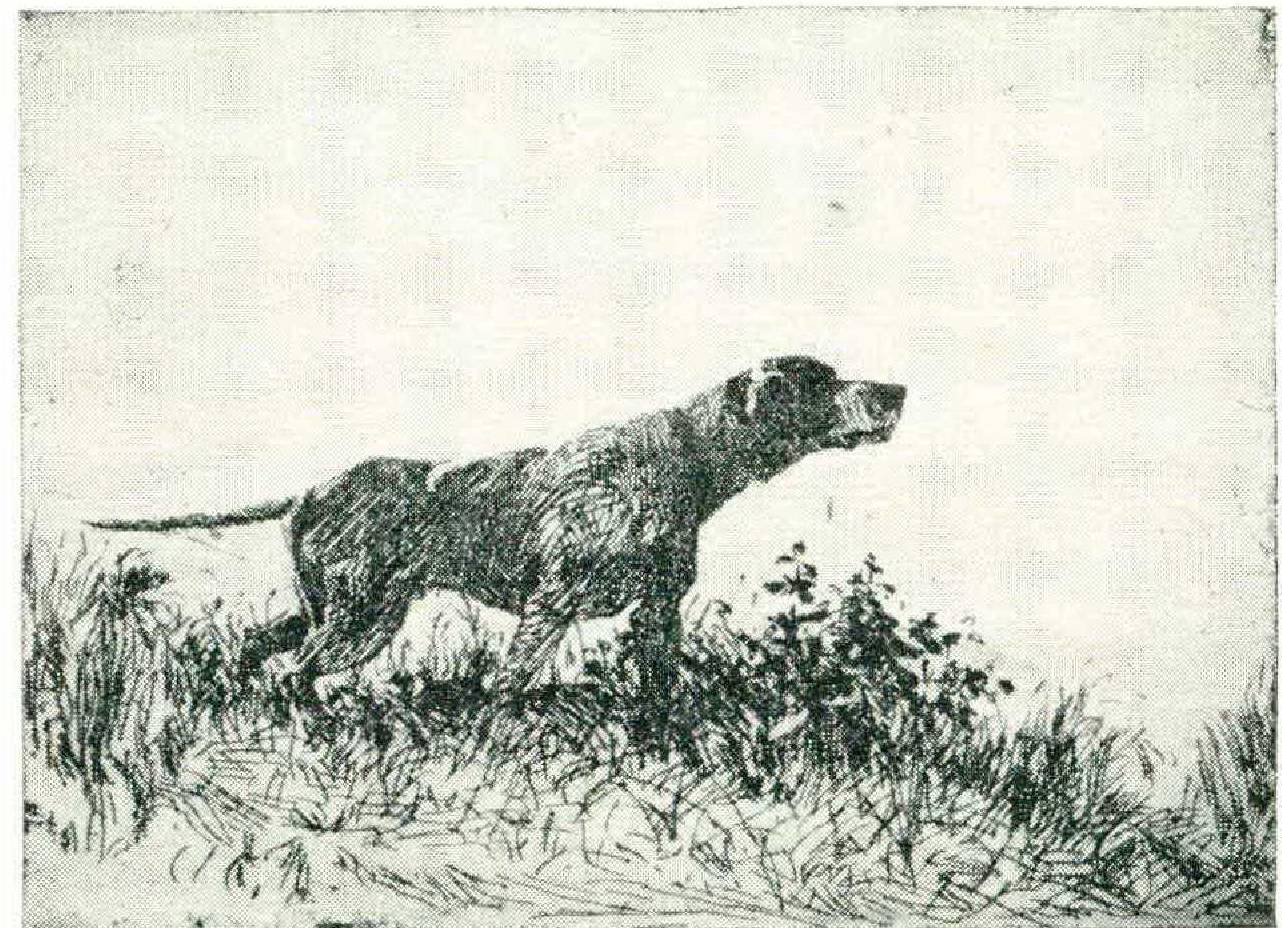
Hanford ignored my comment and called his dog. “junior,” he shouted, “come here!” Then his voice dropped to a whisper. “There may be a bird around.” I thought he was crazy, but when Junior finally showed up, he suddenly made game right toward a clump of scrub pine so dense that it looked like a solid wall of green. The clump was only three feet away and not more than seven feet high. When the dog went into the other side, a partridge burst out on our side with the noise of thunder. Hanford had to duck to avoid being hit in the face. The bird glanced off his gun, and when he finally got a shot, he was so rattled that, to my great pleasure, he missed. I didn’t even have time to know what was happening. And, incidentally, Hanford was right in my way.
Then Hanford said, “There’s a nice little cover up on top of that knoll.” He pointed to a stupendous ridge and immediately took off as though the devil were after him. Halfway up, I called to him and said, “Hanford, a man can’t shoot if he is all out of breath, and what’s the sense of climbing away up there if you can’t shoot anything when you get there?”
Hanford allowed there was some point to my comment. He called in his dog and made him lie down. Then he sat down himself. I felt as if I had achieved a major miracle. I began to understand that a real grouse hunter does not stop even for a fraction of a second to look at a beautiful tree or a great spreading dome of emerald moss or anything whatsoever that the good Lord created other than grouse. He is a man possessed. I said, “Hanford, what do you think about when you are grouse hunting?”
“There is only one thing I think about,” he replied. “I think about where that bird might be,” and he added, “I think about it so hard I often get turned around and don’t know where the hell I am. Last time I was here a bird got up right over there, and I killed him.”
“Hanford,” I said, “it seems to me you remember the circumstances of every single bird you ever shot in your whole life.”
“Yes,” he said, “I sure do, and the worst of it is that I remember every bird I missed, too.”
Apprehensive that he was about to spring up and make a dash for the summit, I asked, “Hanford, how is your son Skipper doing?”
“Well,” he replied, “I don’t know.” Then, after a moment, he went on. “To tell the truth, it’s pretty discouraging.” Long pause.
“Why?” I asked.
“Well, as far as I can see, Skip doesn’t think of a goddamn thing except about shooting a deer.”
After that we bolted for the top. In the course of a couple of hours we moved at least twenty birds. The cover was so thick Hanford didn’t get a single shot. I could have had one, but the safety catch on my long-unused gun stuck.
AS IT grew dark, we emerged from thick cover onto an old road that extended westerly across my line into the Toole lot. Though ray boundary was well barred with deep bulldozed excavations to prevent jeeploads of hunters from pouring in during deer season, there was nothing to stop a person on foot.
On rounding a bend, we saw an old man advancing up the narrow leaf-covered road. He carried a rifle with a telescope sight. It was a few days before deer season, and he had just passed a No Trespassing sign. As he approached, he began to breathe heavily, and when lie came to a halt he said, “By God, I don’t know if I can make it.”
“Make what?” asked Hanford.
“Well,” he said between gasps, “I cain’t climb like I usta. So I thought I’d come round the easy way. There’s a fine runway — best one hereabouts, I guess — that comes up from my land onto yourn, and I kinda thought I’d like to see what’s been moving on it so’s I’ll know what to look fer when season opens.”
This was a gray old man who obviously had never spared himself. He was chawing hard. I reached for his rifle and examined its fine Lyman telescope sight. “Cain’t see like I usta,” he said. “Need that fer m’old eyes.”
We talked for a while. Then he went his way. As we parted, Hanford said, “You know, Toole is a great one for hard cider. They say when he’s plowing he has a jug at both ends of the furrow. It’s against the law, but he sells a lot of it to his friends. A few years ago they arrested him. His cellar was full of hard cider, which the police confiscated. Toole refused to plead guilty. The jury, knowing that hard cider turns into vinegar, was open-minded. They waited for a little. Toole was so convincing the state ended by having to return all the hard cider they had confiscated.”
Darkness was gathering as we headed home, and for the first time that day Hanford suddenly stopped voluntarily. “You know,” he said, “the last time I was out I missed five easy shots before lunch and went home disgusted. Today I had only one impossible shot. That’s no way to end the season.”
When we had settled down in front of a good fire with a couple of martinis, I asked Hanford how he happened to become so keen on bird hunting.
“Well, I don’t know,” he said, “maybe it was because my father was so keen — maybe I caught it from him. The first thing I can remember about bird hunting was my father coming home and throwing his game coat on the floor of the kitchen — we had a tremendous big kitchen. I was about five, young enough so that the number of pockets in his game jacket was a challenge to me. I’d reach into the big back pocket and pull the birds out and lay them on the floor. My father was watching me all the time, and he’d say, ‘If you keep looking, I think you might find a woodcock.’ So I’d lay the coat down and I’d feel all over it again until I’d find a little mound. I’d keep working until from some concealed pocket I’d pull out a woodcock, and he’d say, ‘Well, keep looking,’ and by then we’d have ten or a dozen birds on the kitchen floor. And finally I’d get the last woodcock.”
“Hanford, when did you actually go bird hunting yourself?”
“I first went with my father. I just went. I didn’t have a gun or anything. I was allowed to carry the game.
“Finally, I remember a Harrington & Richardson 20-gauge single-barrel shotgun. I had to use the whole palm of my hand on the hammer of this tough old gun because I didn’t have strength enough in my thumb to cock it. So when a bird got up, I couldn’t shoot, because the bird was gone by the time I got that gun off my knee and the hammer back. I can remember the spot vividly to this day: my father and Ted Chappee and I were up in Goshen; a bird flushed, and I shot. My father said, ‘Well, you’re getting on to it — at least you’re shooting. You’ll never kill a bird if you don’t shoot, and you’ve got to the point now where you can shoot, and maybe some day you’ll learn to hit one.’ It thrilled me to hear that. At least I could shoot.
“The next bird that got up, I shot — and I shot Ted Chappee’s hat right off his head! My father took the shells away from me and ordered me back to the car. I didn’t know where the car was, I had no idea which direction it was in, and he said, ‘Well, you find it.’ Whereupon they strode off toward the next cover. I started to blubber and cry; there we were, way up in Goshen somewhere. I found the car, and I sat in it until dark. When they came back, they wouldn’t speak to me. But I learned never, never to shoot a gun even in the general direction of anybody else. If you are south of me, I don’t shoot south. I barely shoot southwest. I mean, I shoot in the opposite direction. As I look back on it, I was going to please my father by at least getting a shot off, and it took a lot of doing to get that hammer back and shoot. But I shot — there was no question about that!”
After a while Hanford said, “Junior is waiting to go, so I think I’d better be moving.”
On the way to the door I asked him if Ted Chappee had ever forgiven him for shooting his hat off. “Oh, I guess he did,” he replied. “I wasn’t too long after that nearly fatal shot that I was out again with my father and Ted Chappee and my brother. Ted used a pump gun. We were up here by Bressee Mills, a place I hunt a good deal now. I killed my first grouse there. Ted had a dog by the name of Count, an English setter, beautiful dog. He pointed alongside a large ledge of rock. My brother and I had one gun between us — this old Harrington & Richardson — and we each took turns with it, thirty minutes apiece. At that moment my brother had the gun, and his thirty minutes were up while the dog was pointing those birds. I reached over for it. Even though the dog was on point, it was my turn, and to my brother’s undying credit, he didn’t argue; he gave me the gun. When the birds moved, the air was filled with them. My father shot two and Ted shot three. Very few people make doubles on partridge. Ted made a triple. Then another bird went off back of them in the opposite direction. It took off up a road right in my view. My barrel was wavering and wavering. I was trying to get a sight on it, and when I pulled the trigger, the bird dropped. We paced off the distance. It was about seventy-five yards. My father was sure that Ted Chappee had killed the bird, but Ted convinced him that it was my bird.
“The next night, Ted called me up. He had a litter of pups, and he said, ‘Anybody who can kill a partridge at that distance ought to have his own dog,’ so I went over the next day and brought home a setter pup. I wasn’t over twelve or thirteen, and that was my first bird dog. I’ve never been without one since.”
As Hanford climbed into his car he said, “Just think of it, six misses in a row. That certainly is no way to end the season.”
And somehow I felt that he would not end the season that way.