Travel Light
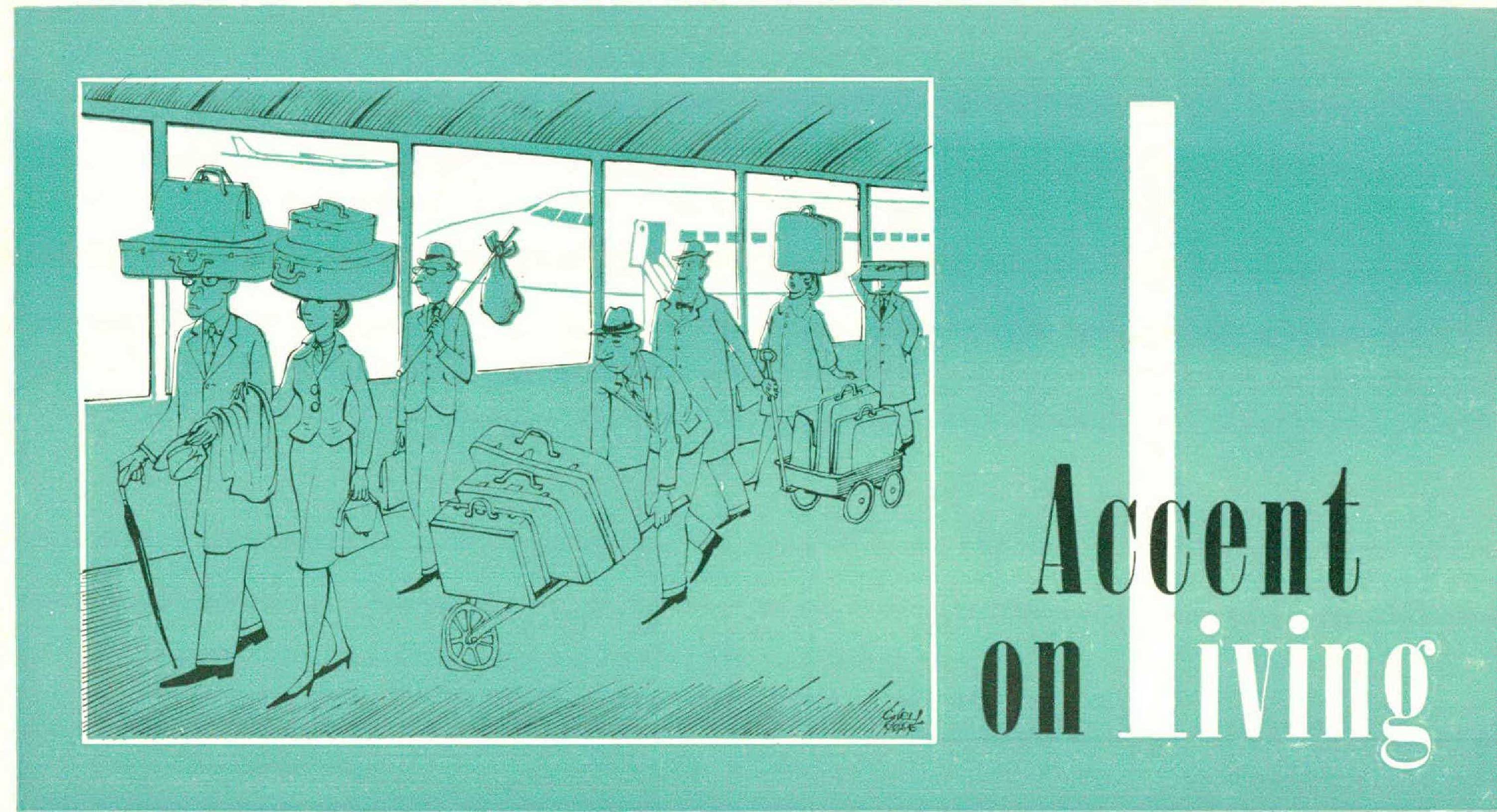
BY CHARLES W. MORTON
Air and rail travel in the United States today offers a lively outing for the athletically inclined. There is a good deal of walking to be done, especially if the traveler has planned so recklessly as to need a meal at a metropolitan airport, where his waiting room is likely to be at one end and the restaurant at the other, some fifteen or twenty waiting rooms away. And where would a better test of stamina and fitness await him than at the lower level of Grand Central, on a muggy summer morning, when he disembarks from the Owl and begins an airless hike of a quarter mile or so, with various ramps and stairs thrown in for good measure? Where, indeed, unless he were scaling Mount Moran with a suitcase in each hand? One ought to mention that carrying one’s own luggage away from the Owl is de rigueur for travelers of all ages - tots, crones, or gaffers.
The minor catch in these arrangements is that the Alpinist has gone out for the rugged stuff by choice; he knows what he’s up against; not only is he in climbing trim, but he has the equipment for it — salt pills, oxygen, and such. But most rail terminals and airports leave the luggage to the traveler, regardless of his wind and muscle, no matter how many or heavy the pieces.
Three small airlines share one of the waiting rooms at the Boston airport, where my wife and I arrived with a fair amount of luggage, but my inquiry about a porter was received with incredulity.
The very word “porter” seemed exotic, as if I were seeking the fabled unicorn. Our line’s man finally suggested that one of the others had a porter, or perhaps it had formerly employed one. There proved to be no porter, and while we were hustling the bags ourselves, the plaintive voice of an announcer came over the public-address system: “Will a skycap come to American Airlines? Will a skycap come to American Airlines?”
A skycap, I gather, is the unavailable airport opposite number of the unavailable redcap at railroad stations. At any rate, one of the biggest airlines in the whole place didn’t have any.
Since it seems now to be accepted that no self-respecting American will be a porter, it is time for the machine age to take over. So far, one can buy little caster attachments for hauling a suitcase, but what is needed from luggage manufacturers is some built-in device that will enable the single bag, and others in combination with it, to be wheeled about by the owner.
Just as the supermarkets depend on their own wire carts for conveying goods to the customer’s car, some adaptation of this cart for the airline and railroad passenger might be within the span of man’s imagination. In a land where pushing a lawn mower means a loss of social status, and where even the elderly cut grass with a gasoline outfit, a powerassisted rig that will propel itself up the ramps would pay its way. (What is the annual return from a coin-inthe-slot storage locker, in relation to its cost?)
For the interval, while these modest engineering goals are being reached, a crash program of attracting porters from overseas would be helpful. Let us open a new frontier, with inducements once offered the Western homesteaders, to those cheerful young men who meet the trains in London or Milan. Let us employ them, enrich them, and send them home again after a three-year hitch to spread the word of the great careers awaiting the able-bodied in the U.S.A.
Otherwise, it’s best to keep the kit down to what can be carried in a knotted handkerchief (bandanna?) on a stick over the shoulder.