The Time Enough for Glory
“I never sailed before the mast, washed dishes, or went to war, ” writes OSCAR MILLARD. “I’ve always managed to survive by writing of some kind and never had any other ambitions.”Mr. Millard, who is London-born, attended private school, went on to Louvain University, and became London correspondent for a Brussels daily paper before he finally succumbed to the California sunshine and screen writing.
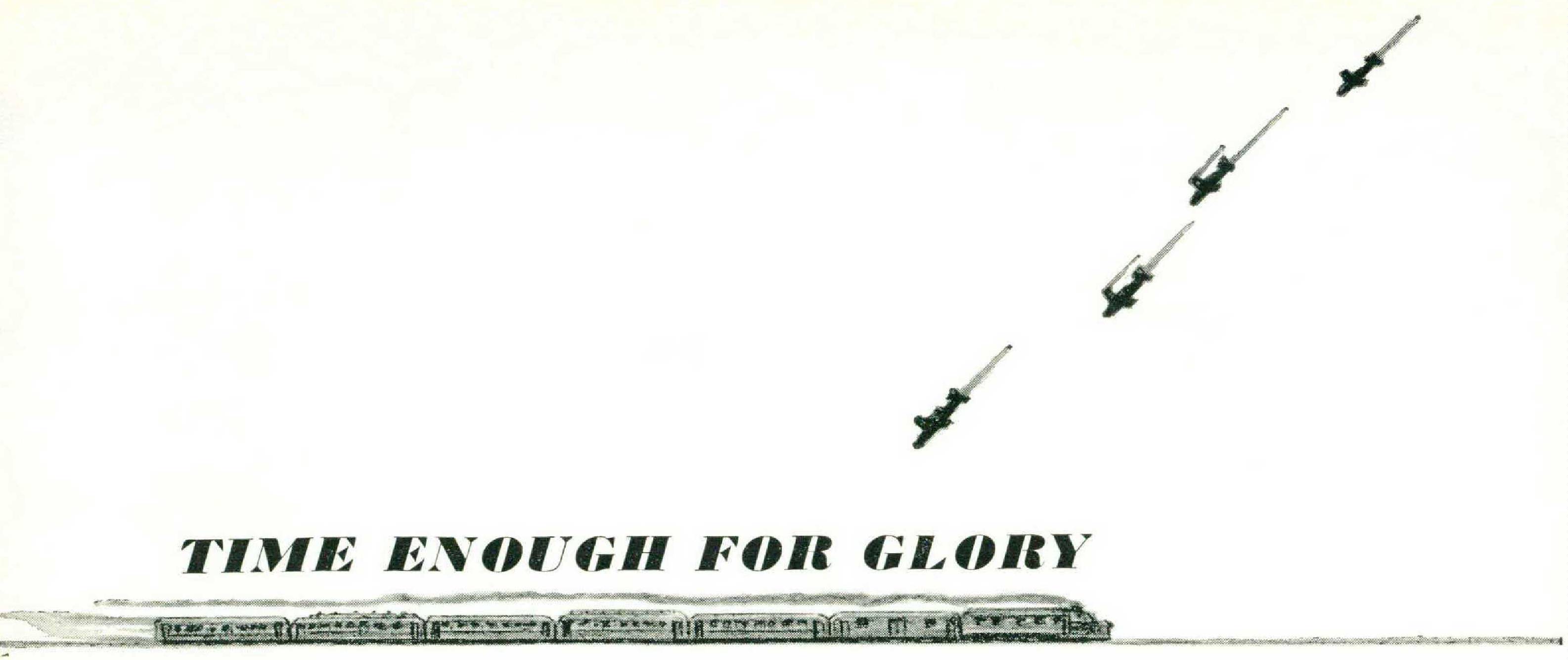
by OSCAR MILLARD
THE train was approaching Cuprija, halfway to Belgrade, when Oustasie saw the planes.
“See, my dear fellow,” he said. “As I told you. The Yugos will not be caught napping. They’re keeping an eye on the Bulgarian frontier too.”
Even then, before I recognized the planes as Nazi Stukas, the remark seemed less than felicitous, for the three Yugoslav Air Force officers sharing the compartment with us had been sprawled in unsoldierly sleep since the train left Skoplje. The Athens-Belgrade Express had been sidetracked there by the military, and the army was taking over all trains to Belgrade. The station was teeming with uniformed men, rawboned giants and swarthy, hawk-faced, bowlegged runts, and veiled women wailing their farewells. The men, charged with slivo and prospects of full bellies and glory, appeared less stricken than their women, who were generally rated lower than the family ass.
Oustasie had surveyed the scene with lofty distaste. “I will arrange this, my dear fellow,” he said, and sought out the local brass and convinced them that his presence in Belgrade, along with his Angleski journalist friend, was vital to the glorious defense of Yugoslavia against the Nazi juggernaut.
Oustasie, not a journalist himself, used words like that and was invaluable in such circumstances. He was extremely handsome and had an air of elegant depravity about him that European women found attractive and minor Balkan officials irresistible. He was at home in God knows how many languages, but claimed French, which he spoke with fluent grace, as his mother tongue. He was, in fact, a Syrian, one of seven sons of a wealthy carpet merchant, and by some vagary of Wilsonian self-determination he became a Greek, and by some Levantine artifice acquired a diplomatic passport. He was the type of cosmopolitan diplomatic lounge lizard that foreign newsmen cultivate with distaste. He knew everybody, and the long butts of his gold-tipped Turkish cigarettes were to be found in the ashtrays of drawing rooms, first-class hotels, and embassies all over Europe. He had a trick of letting remarks fall so casually that it was difficult not to attach importance to them. When he was portentous, he was usually wrong, and when he spoke with conviction, he was always lying. I assumed that his contributions to the garbage on the troubled waters of diplomacy were cover for more devious activities.
I’d known him for some years when I ran into him in the lobby of the Grande Bretagne in Athens early in the fiasco period of World War II. Big things, he said, were about to happen. A turning point. If the Nazis thought Yugoslavia was going to be another walkover for their panzers, they were in for a surprise. He had it on the best authority. In fact, he was just leaving for Belgrade. Mais naturellement, he could get me a visa, even though I had just been turned down. He laughed. Especially if I’d just been turned down. He would arrange it. We could travel together. Delightful.
He had indeed arranged it in Athens, and again in Skoplje. The befrogged and braided railroad official superciliously ignoring the civilians clamoring at the entrance to a first-class coach glanced at Oustasie’s pass and stepped aside deferentially while kicking the shin of an opportunist who tried to squeeze in with us.
Oustasie was evidently not the only civilian who had wangled a pass. All the compartments were full and the doors closed. Then we came to one occupied only by three young men in the uniform of the Yugoslav Air Force. They were dozing. I pulled at the door, but it was locked. They looked up and exchanged glances and shrugged. One of them reached out without getting up and flipped the latch. We entered, and Oustasie thanked them in Serbian and bowed and said, “Oustasie.” They rose, straightened their uniforms, and bowed, saying in turn, “Kovachevich, Milanavich, Sokolovich.” Like a declension, I thought. “Evich, Avich, Ovich.” I said my name, and we all shook hands. We put our bags up on the racks and settled down. Milanavich, who appeared to be the youngest, gave up his corner seat to me and put his feet up on the seat beside Oustasie.
On learning from Oustasie that I was an Angleski, Kovachevich, the oldest of the trio, asked if I spoke French. I said I did, and we talked of the war and of Simovich, the new strong man who was going to lead Yugoslavia to glory with his air force and the help of the gallant British. They were very dramatic about it in their stilted French, and said florid things about the R.A.F. and questioned me eagerly about the British effort and what I had seen of preparations in Greece. Having seen no preparations at all, I was noncommittal, but Oustasie was eloquent, and by some trick of speech and gesture implied more than he actually expressed. They told us they hadn’t been to bed for two nights, and I gathered that this was due more to celebration of anticipated victory than to any labor in preparation for it.
After a while they pulled their greatcoats around them and slumped down in their seats. They were still sleeping, hours later, when Oustasie saw the planes and remarked upon the unsleeping vigilance of the Yugoslav Air Force. I looked at the vigilant Yugoslav Air Force in the persons of these three snoring men, then followed Oustasie’s gaze into the red-streaked dawn sky. I had seen too many Stukas over London not to recognize them at five thousand feet. They were coming in from the East, low over the mountains that fence off Yugoslavia from Bulgaria and Rumania, and heading right across our path.
“Stukas,” I said.
“Not at all funny, my dear fellow,” Oustasie said, still looking up at the planes. Then he turned sharply to me, and there was a flicker of fear in his eyes. “That damned English sense of humor,” he said. “Why do you say things like that? It would be no joke if they were Nazis.”
“It isn’t,” I said. “Look.”
As I spoke, three of the Stukas peeled off a few miles ahead of us while the formation flew straight on, the even drone of their motors drowned now by the mounting screech of the diving planes. Oustasie jerked his head in from the window and said something in a taut, sharp voice to the sleeping men. They jumped up and fell over one another and me in their haste to get to the window on our side. As they jostled at the window, the gut-knotting screech of the Stukas reached its peak. There was the distant wumph of the exploding bombs and the snarl of the Stukas pulling out.
The train jolted as the brakes were slammed on. Then it lurched forward again, as if the driver couldn’t make up his mind whether to stop or put on speed. Oustasie hung on to the luggage rack, his debonair manner in tatters.
“ Dieu de Dieu! What does one do?”
“One sits tight,” I said, “and hopes to Christ they don’t come back for us.”
The officers crowded at the window ducked in their heads. They were all talking at once. “Kragujevac! Kragujevac!” young Milanavich kept saying in anguish. He stumbled after the others across the compartment into the corridor.
“Kragujevac!” Oustasie repeated, as though the name ought to mean something to me. “The national arsenal. That’s where the planes are going.”
“Not all of them,” I said. I could hear the shrieking of the Stukas again. Much louder now. This time they were coming our way. I jumped to the window, but the main formation had already passed and I could see nothing from that side. But I could feel them coming, at me personally; I always felt that way when I couldn’t see them. I turned and saw the three Yugos throw themselves flat in the corridor. Oustasie was still standing there, hanging on to the luggage rack, paralyzed. He kept moaning. “Nom de Dieu! Nom de Dieu!” Suddenly he let go of the rack and flung himself down on top of the men in the corridor. I wanted to do the same, but at that early stage of the war I was still trying to prove something to myself, so I stood quite stiff, holding on to both the luggage racks, waiting for it.
The shriek was mounting in pitch. I waited for the change of note that comes a split second before impact. I wished to God the train would slow so that I could jump, but it was moving faster than it had done since we left Skoplje. I was thinking, “The bloody driver’s trying to play tag,” when the coach leaped into the air. The racks wrenched out of my grasp, and something hit me on the back of the head. The next thing I knew was the feel of bodies heaving under me and the smell of musky scent and Oustasie screaming bloody murder in my ear. The coach was on its side, and we were almost on our heads. I yelled at Oustasie to shut up and tried to get up from under the stuff on top of me. But then I heard another plane and a rattling of slugs right above me in the compartment. I’d been bombed often enough, but never machinegunned.
When the roar of the plane had died away, the screaming began. It wasn’t Oustasie this time. He made no sound. Nor did the men underneath us.
“Oustasie,” I said, “are you all right?”
I heard a moan and muffled grunting. The huddle underneath me heaved. I tried to push away the bags and seat cushions piled up on top of me. It felt as if I had a couple of grand pianos on my back. I poked about for a foothold and tried to arch my back. There was a yelp from Oustasie. “My ankle! Imbecile! You’re breaking it!”
I had my foot pressed in his instep as if it were a stirrup and had been using it for leverage. I hauled myself upright. The corridor was a howling, struggling mass of men. Smoke was billowing through the torn open end of the coach. I reached up to the door frame and swung up to the outside of the coach. People from the neighboring compartments were swarming through the broken windows heedless of where they fell. I stood for a moment on the side of the coach. Telegraph poles had been snapped off, and wires were festooned all over the wreck. There wasn’t much left of the coach ahead of ours. Just pieces and smoke, like the remnants of a tram I’d seen flattened on the Thames embankment. I couldn’t see the locomotive, but I could hear the hissing through a fog of steam. The rear coaches were piled up across the track. The bombs had missed them, but the Stukas had done well by their Führer with their machine guns. Soldiers were crawling through the shattered windows. Some, with legs or arms dangling, were dragging themselves over the embankment.
As I stood astride the window, Oustasie grabbed at my ankle and yelled at me to help him out. I took his wrists and pulled him up. He stood panting there next to me on the side of the coach. I looked down inside and saw Kovachevich and Sokolovich trying to lift up Milanavich. He was unconscious. I helped haul him through the window and laid him out on the side of the coach. The other two came up after him. Sokolovich put his hands up to his girlish face and began to cry. Kovachevich looked as if he might start crying too. God help Yugoslavia, I thought, with officers like this. Kovachevich saw it in my face and said apologetically, “It was still peace with us when we fell asleep. It seems not just.”
“It never is,” I said. I looked down at Milanavich. I could see no wound, but his face was gray and his breathing noisy. I looked around for Oustasie, but he was gone. The wind had changed, and now the smoke and steam were blowing hot over us, scented with burning flesh. “We’d better get him away from here,” I said to Kovachevich. They came to life then, and bent over their comrade. As I climbed down the rods to the ground, I nearly trod on Oustasie. He was emptying his bladder with devout concern against an axle.
“Make yourself at home,” I said.
“Il faut toujours uriner après un choc pour éviter la jaunisse,” he said, as one quoting a major verity. “I would advise you to do the same, my dear fellow.”
“I did it in my pants,” I said. “Now, for Christ’s sake, forget your jaundice and lend a hand with this man.”
We lowered Milanavich onto the embankment littered with hunks of metal and shredded garments and lumpy bundles of bloody rags that still retained the shapes of men. We carried him into a field between the tracks and a road. Wisps of smoke curled up from the neat rows of young green sprouts, an alien crop of smoking cinders broadcast by the locomotive’s shattered firebox. On the far side by the road was a low stone house in an orchard, and standing near it an old woman in a babushka and embroidered skirt. She was waving her arms and hollering furiously at the people trampling her crop. A realist. She was the only person doing anything of any purpose. Everyone else was just gaping at the wreck or running aimlessly up and down shouting. Or dying.
I WAS bending over Milanavich when I heard a droning in the western sky; they were coming back, still in perfect formation. Oustasie and the two officers were arguing hotly in their language. They hadn’t yet noticed the planes. Nor had a knot of soldiers alongside the wreck, shouting among themselves.
Then all at once there was a panic scattering across the field in all directions away from the track. Those who couldn’t move just lay and screamed.
The old peasant woman stood her ground, nearly dancing with impotent rage at the havoc being wrought upon her Held.
Kovachevich and Sokolovich stood irresolute, looking from Milanavich to the plane and then in the direction of the cottage. Kovachevich said, “We will take our comrade to the house, if you will help.”
“We’ll never make it,” I said. I looked around and spotted a stream about fifty yards away. It flowed toward the tracks. “There’s probably a —” I couldn’t think of the word for “culvert” in French. “A hole — a tunnel. It’s nearer.” I looked around for Oustasie, but he had already started running for the house. I yelled to him, but he took no notice. I took hold of Milanavich’s shoulders, and Kovachevich and Sokolovich each took a leg.
Up above, the Stukas were peeling off one after another in a dive at us as we started dragging the man across the field. They all wanted to get in on the fun this time.
There was a corrugated iron pipe about four feet in diameter that carried the stream under the railroad. It was about half full of water. We ducked and waded in as the guns of the leading plane started their lethal chatter. This time there were no bombs. They’d unloaded everything on Kragujevac. The planes just came screaming down, one after another, and as each leveled out it gave a burst along the whole length of the train.
Milanavich’s head and shoulders rested on my knees. He was breathing in the same labored, snoring way. I soaked my handkerchief and put it on his forehead. Sokolovich took one of his limp hands and began chafing it mechanically.
From where I crouched I could see nothing but the stream and a circular patch of field, framed in the end of the pipe. At first it was empty, and then I saw a peasant, an old man with baggy pants and skullcap, moving in a lumbering run across the field, unmindful of the crop. He brandished something at the sky, then stopped and raised it to his shoulder. It was a shotgun. He was firing at the Stukas.
I watched him, expecting him to go down at any moment. But he stood there popping off at each plane as it passed, as at a clay pigeon, fishing out fresh shells from the pocket of his short jacket and reloading with deliberation.
The last of the planes snarled away, and the tangible quiet was torn by the screaming victims of their sport. The old man lowered his gun and shook his head in bewildered disgust as if he couldn’t make out how he’d failed to get even one of these strange birds.
Kovachevich looked inquiringly at me. None of us had exchanged a word. My companions seemed bowed down by some disgrace. I nodded. It was harder getting out than in. My legs and feet had gone numb in the cold water, and I didn’t realize it until I tried to move. I slithered on the smooth corrugations of the tube and went waist deep. It was like the nurse putting the cold sponge on your belly when you have a high fever.
We got out at last, slipping and cursing. The wind, fresh off the mountain, wrapped our soaked trousers in a cold plaster around our legs. We laid Milanavich out by the edge of the stream. I dried my hands on my jacket and took a cigarette case from my inside breast pocket.
“Welcome to sunny Yugoslavia,” I said. “Smoke?”
Sokolovich’s hands were trembling so much that he burned his fingers as he tried to shield the lighter flame. The field began to mushroom into life. Heads and shoulders poked up gingerly from between the furrows. The old woman had disappeared, but the peasant who had been firing at the planes stood looking down at something near his feet. I saw Oustasie come from around the house. He spotted us and waved and walked over to us.
“That foolish old woman got it,” Oustasie said. “That’s her husband standing by her now. Did you see the old fool shooting at the aircraft?”
People, the soldiers and civilians from the train, were gathering again about the wreck, seemingly attracted as strongly to it now as they had been repelled when they heard the planes. The wounded were still moaning and screaming, but no one was doing anything about them. I thought that if I were covering this, I’d say there was no panic. But there was. Panic in reverse. We were, in fact, all numb with panic.
I threw away my cigarette and said, “We’re like rabbits that hear a shot and think they’re dead. How are you going to get your friend to the hospital?”
“Yes, that must be done,” Kovachevich said.
“More to the point,” said Oustasie, “how are we going to get to Belgrade?”
“Does that matter now?”
“Matter, my dear fellow?” Oustasie raised his dark immaculate eyebrows. “Matter! It is of the first importance that I reach the British embassy without delay.”
“It was, maybe,” I said. “The war’s started now.”
“Nevertheless, it is important.”
The two officers were talking, meanwhile, apparently discussing what to do next. Kovachevich turned to me and said, “With your assistance, we will carry our comrade into the house over there. Cars will no doubt soon be here from Cuprija. We shall be happy to arrange for you to accompany us by road to the capital if you still desire.”
I did not desire. I knew what the Luftwaffe had done to Rotterdam and Warsaw. I knew what they’d done to London, despite the R.A.F. I could imagine what they’d do to Belgrade, and from the look of things they weren’t going to get much opposition. No, I had no desire to go on to Belgrade now to get another dose of what I already had had an overdose of in London. But Anderson had asked me to go and arrange some contacts to give us the best possible coverage in the event of a showdown. Galvin, our permanent correspondent in Belgrade, was a good man, but too old to cover a war. So I had no choice.
I thanked Kovachevich, and we picked up Milanavich and started toward the house. As we moved across the field we passed near the old peasant. He still stood looking down at his wife’s body in surprise and anger. Kovachevich said something to him, but he made no reply. Kovachevich spoke again, and this time the old man looked up as if astonished to see us. He mumbled something, the same few words over and over, and as he spoke tears started running down his crumpled face. He bent stiffly and picked up the bundle of petticoats that was his wife and carried her across the held. We followed him with Milanavich to their one-room dwelling. At the door he stood aside, inclined his head, and spoke a word of welcome. We entered and lowered Milanavich to the hard earth floor before the hearth. The old man laid his wife upon the ornate bed that occupied a good third of the almost bare room. Then he turned, and with a dignified gesture in the direction of the bed addressed us.
Kovachevich replied and said to me, “He invites us to place our comrade on the bed also.”
Oustasie shuddered with distaste and said to me, “These peasants have no notions of bienséance.”
He leaned down and warmed his hands over the embers. I helped put the man on the bed beside the dead woman. The sight of them — the young officer in his uniform lying there close beside the old woman in her embroidered petticoats and red-stained kerchief—made me think of a royal lying-in-state.
Suddenly Oustasie straightened from the hearth and said, “Sacré nom, my bag!”
We had all completely forgotten about our baggage. I wondered if there would be anything left of it. The last time I’d looked that way, the coach was all but hidden in smoke and steam.
WE LEFT Sokolovich with his unconscious comrade and walked back across the field to the train. Most of the soldiers had gone over to the road, where they stood about in groups. Not one of them had his rifle, as far as I could see. “Were there no officers with them?” I asked Kovachevich.
“Without a doubt,” he said. “They must be dead. They would all have been together in a first-class compartment. This is a great disaster.”
The dead and wounded still lay scattered about the edge of the field. The wreckage of the first coach was smoldering, and the smell that came from it was not pleasant. The whole front end of the next coach, which was ours, had been blasted off, and a crater separated it from the smoking remains of the forward coach.
“Nous l’avons échappé belle,” Oustasie said feelingly.
A number of people were scrambling about the overturned coaches, throwing bundles and suitcases to the ground. Seeing them, Oustasie quickened his step. “We shall be lucky if we find our stuff,” he said.
Kovachevich looked at him coldly. “I think you need have no fear. Our people are not thieves.”
“You misunderstand me, my dear fellow. I meant, in all this confusion and excitement—” He spread his hands and, seeing that Kovachevich ignored him, shrugged.
At the foot of the permanent way we stopped and surveyed the black greasy tangle of the undercarriage. Oustasie said, “There is really no point in all three of us climbing up there, is there? If you don’t mind, my dear fellow, I’ll stay here and take the things as you pass them down.” He smiled ingratiatingly.
Kovachevich gave him a cold stare and scrambled up the embankment. Oustasie said plaintively, “My clothes are in a ghastly mess already, and I haven’t another suit with me.”
“That is too bad,” I said, and jumped up the embankment after Kovachevich.
We walked along to the far end of the coach. I climbed onto the broken coupling and gripped the top edge of the coach. “Give me a leg up,” I said.
As I pulled myself up onto the side of the coach, I came face to face with a man leaning out a broken window. He wore a fez, and his eyes were popping out of his fat face. His pudgy fingers gripped the jagged glass, and I thought he was trying to hoist his flabby body through the window frame. I bent down to help him out, but he would not let go of the frame. Impatient, I took hold of his coat collar and pulled hard. The head and shoulders came through so suddenly that I nearly fell off the coach. He had been cut in two. I dropped him and turned away, feeling sick.
I lit a cigarette and helped up Kovachevich. His hand was sweaty and his face pale. He had seen the severed trunk. He stared down at it, and it was as though the gruesomeness of the thing brought sudden awareness of the enemy his country faced. The muscles of his jaw trembled. “Les bandits!” he muttered. “Les bandits!”
“Do you remember about where our compartment was?” I said.
“They will be made to pay for such things,” Kovachevich said. It didn’t sound trite, the way he said it, with such quiet intensity.
“Our compartment,” I repeated. “Do you remember where it was?”
He looked up, it seemed reluctantly. “Our compartment? Oh, yes. Excuse me. I was distrait.” He looked thoughtfully along the length of the coach and shook his head. Then he made a gesture of impatience. “Wait. How stupid! I have the precise number of my voucher.”
He took out his wallet and consulted a pink slip. “Eleven A,” he said.
We picked our way along the side of the coach and found our compartment. I dropped down into the pile of bags and overcoats and jumbled seat cushions.
“Stay here,” I said. “I’ll pass them up to you.”
Glass crunched underfoot as I pulled aside the cushions. The woodwork was full of splintered furrows, and the upholstered seat backs riddled with singed holes. A view of Lake Bled above what had been my seat was ripped clean out of its frame. The corridor side of the compartment lay on the ballast of the roadbed.
The far end of the corridor was heaped with bodies. It looked as if everybody in the coach forward from our compartment had got it.
I found our luggage — Oustasie’s black morocco briefcase was scored as if a hot poker had been drawn across it — and handed it up to Kovachevich. Then I remembered my binoculars. I rummaged among the cushions lying on the ballast in the broken corridor windows, and discovered them half buried in the gravel. And then I saw a Yugoslav Air Force cap. I guessed it must belong to the wounded man, because the other two had managed to keep theirs on. When I picked it up, I was sure. It had a small hole in the crown.
I climbed out and showed it to Kovachevich. “Is that your comrade’s?” I asked, pointing out the hole.
“A bomb fragment,” he said. “Without a doubt. Poor Mihel!”
We tossed the baggage down to Oustasie, who stood smoking impatiently at the edge of the field, and climbed down.
When we got back to the house we found Sokolovich and the old man kneeling by the side of the ornate bed. Milanavich and the old peasant woman lay side by side with their hands crossed on their breasts. We stopped in the doorway and put down the bags. Kovachevich walked over to the bed and made the sign of the cross. Then he put his hand on the shoulder of the kneeling Sokolovich. After a moment Sokolovich crossed himself and rose. The old man did not move. He kept mumbling his prayers, unmindful of our presence. Sokolovich’s mouth quivered, and I thought he was going to cry again. But he saw Oustasie and me by the door, and he took out a handkerchief and blew his nose self-consciously. We carried the bags inside, and Kovachevich walked over to the window and looked up at the sky.
“I’m sorry,” I said to Sokolovich, and put out my hand. It seemed the right thing to do. He took it and said, in his careful French, “My friend is dead. I am sad for that. But I weep not because he is dead but because he died thus. Do you understand? He was my good comrade and a good soldier. He wished to do glorious things for our country. And he dies stupidly, without battle, hitting his head against a railway carriage. Such a foolish death. Without glory. Do you understand?”
“I understand,” I said. Perhaps I did. I walked over to the bed and put a hand carefully on the dead boy’s head. His thick black hair was damp and sticky. I moved his head slightly and saw a wet patch on the blanket. I went to the door and picked up the cap which Kovachevich had dropped on the baggage as we entered. I took it to Sokolovich and gave it to him, pointing to the hole.
“It was a bomb fragment,” I said. And I added, “It’s the same as if it had been flak.”
Sokolovich’s girlish face lit up as if I’d told him his friend had come to life. He studied the hole reverently, then turned to the dead boy on the bed and saluted.
I went outside and lit a cigarette, feeling weary, Oustasie was by the road talking to Kovachevich, convincing him the fate of the world depended on his reaching Belgrade. I suddenly hated the sight of him. I moved on into the orchard. It was peaceful now under the low trees. The quiet green valley and the foothills rolling up to the mountains recalled Switzerland and other afternoons. From somewhere, not far away, I heard the thin tinkle of cowbells. Then, unexpectedly, there came the distant peal of church bells, and I remembered it was Sunday. Palm Sunday, April 6, 1941. There was time enough for glory before it was all over.