A London Tasting
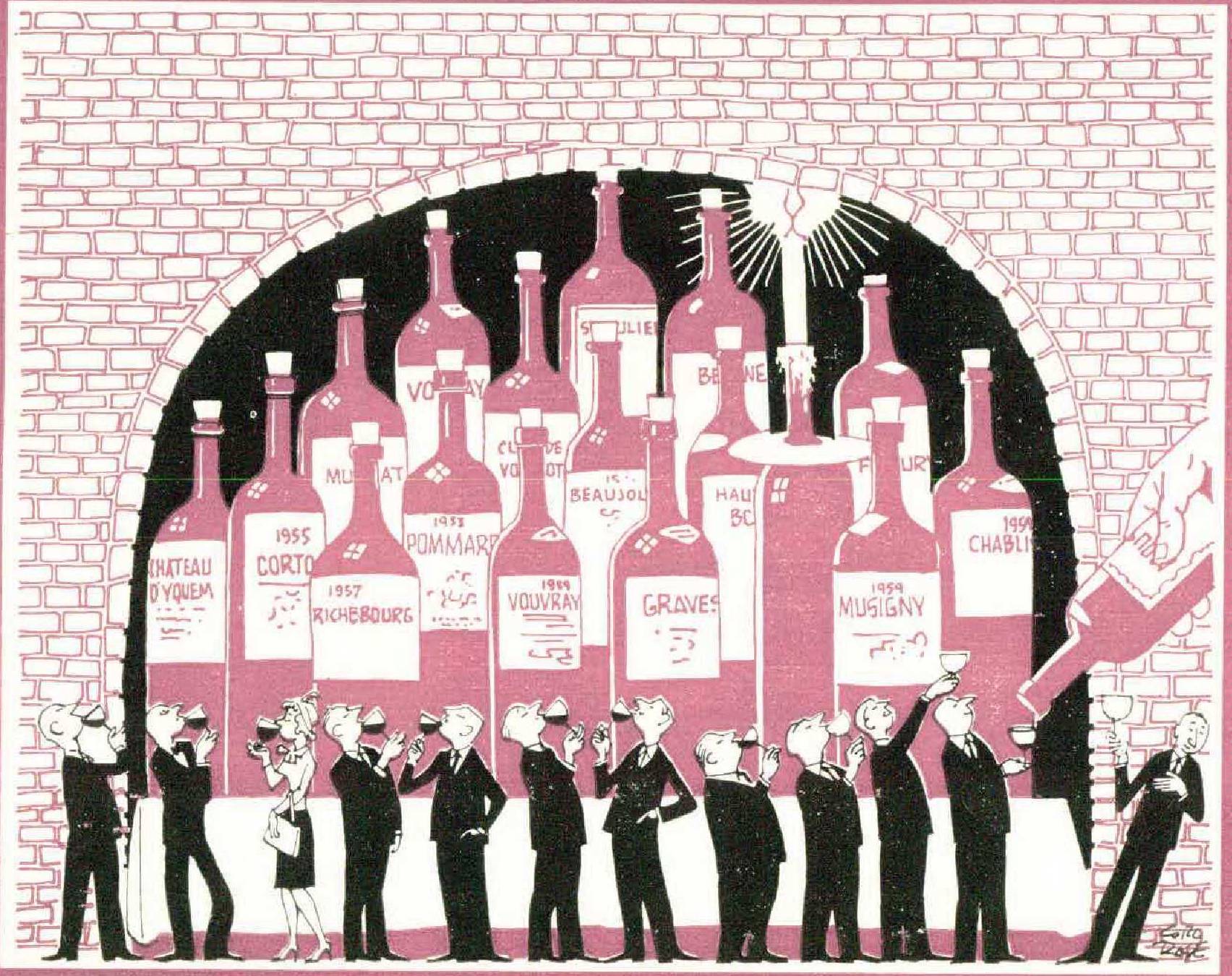
An annual tasting of French wines that presents no fewer than 196 varieties would seem to be covering its field of inquiry with some thoroughness. It was, at any rate, the widest assortment ever uncorked in my experience, and I must say that the scene itself and what was modestly listed as its “Buffet Fare” were even more beguiling than the wines. The tasting is held each fall in London in the vast cellars of J. L. P. Lebègue & Co., beneath London Bridge Station. It was especially interesting as an example of doing extraordinarily well, brilliantly, something that another sponsor might have foozled sadly through parsimony and inexperience. But Lebègue is an old firm, bringing French wines into England for upwards of a century, and its head, Guy Prince, is a descendant of its founder.
The Lebègue cellars are laid out in long aisles, under a succession of arches, with tall racks of bottles on each side. The wall and ceiling surface is white brick, giving a fine lift to the illumination, which is entirely from candles, thousands of them, in iron chandeliers overhead and in rows along the wine and luncheon tables. There is much more light than one would expect — a steady, warm yellow ambience.
How to provide for 800 to 1000 guests at a festival of this sort, without crowding or imposing any sense of haste on the company, is no mean feat; this Lebègue achieves by spreading the tasting over three days and asking the guests who accept the invitation to name their preferred day for coming. The result is that the usual turnout on any one day is around 300, a number easily taken in stride by the ample serving and catering staff. The guest list seemed a lively mixture of dealers and wellknown amateurs, the civil service, peers and politicians, the press, as well as a handful of the producers of some of the more celebrated château wines.
The tasting is really a luncheon occasion, the first guests arriving shortly after noon and the last leaving around three o’clock. The buffet fare proved to be just about ideal for the occasion, perfect in every respect. Food of this sort served at room temperature is encountered all too infrequently, and I append the all-British menu in its entirety:
Shellfish
ORKNEY LOBSTERS
Hams, Meats and Game
WILTSHIRE TREACLE CURED HAM
SADDLE OF SOUTHDOWN LAMB
BARON OF SCOTCH BEEF
GAME PIE
English Cheeses
BLUE CHESHIRE
CHEDDAR
STILTON
Sweet
I have never developed the vocabulary of wine tasting, although it is always a pleasure to sit down with a couple of old friends on a Sunday noon and work one’s way slowly through a comparison of four white wines, accompanied by a suitable cheese and souffléed crackers (recipe on request). So it was that the spaces for comments in my Lebègue catalogue went unmarked, while after the Wiltshire ham item on the menu I set down the word “strong,” in distinguishing it from its delicate York competitor.
For the rest, the Orkney lobsters were excellent and identical with Maine’s, but the beef and lamb were far beyond anything generally available on this side of the Atlantic. The saddle and the baron are spectacular cuts, endowing any buffet with a lavish quality, especially when two or three examples of each are offered together. I lack enough anatomical information to describe a “baron” precisely, and the dictionary is doubtless correct but not quite enlightening; at any rate, it seemed to be some thirty inches in length, weighing fifty to sixty pounds and affording in its midsection a vast area of sirloin which had been roasted to an even redness throughout, instead of being rare in the center and well done at the edges.
We were too late for the game pie, but having sampled one in the grillroom of the Savoy, I count this as a small loss. I am willing to assert that an aged Vermont cheddar is better than its British prototype, while the Stilton, with all its devotees and its distinctive flavor, is usually too crumbly. The Double Gloucester, on a direct challenge, becomes a matter of apologies, yet everything on Lebègue’s menu combined most agreeably under a quotation from Proverbs: “Give me neither poverty nor riches; feed me with food convenient for me.”
So, feeling incompetent to venture as a taster, I restricted myself to three glasses of wine, which I drank unabashed: a 1959 ChassagneMontrachet with the lobster, 1953 Chêteau Margaux with the meat, and a golden 1958 Château d’Yquem for the finale. It was a lovely affair, every drop and morsel of it.