Winter on Monhegan
BY R. J. SIEGLER
We could see the island now, black bluffs bursting the ocean’s strength. Spray flew forty feet, fell back to coat the unfeeling rocks with saltwhite ice. This is winter, and this is Monhegan, ten miles off the coast of Maine, broadside and unmoving against seas that ran 3000 miles to strike it.
In a frothy backwash the Laura B. hipped up to the dock, her crew swapping friendly insults and advice with the reception committee ashore. My wife and I looked about. Here is a lovely land, fashioned for the delights of a summer’s day, the heady air a distillate of spruce and salt. But this is winter, the air conditioner gone amuck in a fury of surf and a cloud of snow. Islanders greet us in mild surprise. They have the anchor of home thrust deep into the heaving sea, but what brings us here? This is the season of work, of hand-to-hand combat with the elements for a livelihood. Now the tide of life for forty-five men, women, and children on Monhegan Island is rising and falling on the numbers of lobsters trapped and the price they bring.
Above the harbor are the houses, uniformly neat, uniformly weathered-shingle gray. The air seems warm after the mainland, after the one-hour trip out. This warmth is just a few degrees above illusion. The sea is unfreezing, and the island gains by the fact; but out on the water the wind is bitter, bitter, bitter. Lobstermen pile on layers of wool topped with a windproof yellow slicker, the badge of their trade. Even so, spray freezes on eyebrows and eyelashes, and is beaten off the slickers in tinkling shards.
But of the seventeen adult males on the island last winter, fourteen were lobstermen. Move inshore? Unthinkable. Rugged independence is a state of Maine trademark, but on Monhegan Island it is worn like epaulets. You want winter lobster? Winter lobster you get. We’ve got colder water, deeper water, and our product is the best. True. A premium price is paid for it.
In the early dark the boats return. Lamps are lighted in the cottages above, where the women are mindful of the arrivals. After the routine of tying up to the moorings, sluicing down the cockpits, placing the day’s catch in the half-submerged holding “cars,” the men come ashore in little skiffs. They haul these above tide line. They clump homeward stiffly, in heavy black hip boots, still balancing against the heave and toss of a little boat on a big sea.
All of the buildings are on the inland side, facing across to tiny, barren Manana Island 400 feet away. This gut forms the anchorage, partially protected on the north by ledges. Here, in 1614, Captain John Smith dropped anchor and chronicled the event: “Monhegan is a round high isle and close by it is Mananis betwixt which is a small harbor where wee ride.”
Smith was just another admiring visitor in a long line that probably extended back to Norsemen. Runic characters are found on Manana (along with a bona fide hermit and a beacon), and while they have not been deciphered, there is more evidence than not that they were inscribed on the rock and were not created merely by weathering.
For Monhegan offered undeniable advantages to the ancient mariner: timber for ship repairs, fresh water for his casks, a deep anchorage out of sight of prying eyes on the mainland, lobsters and clams and mussels for a change in diet. Portuguese cod fishers were regular callers in the sixteenth century, and the island has been host to Spanish and French freebooters and English explorers. Today it still has a link to bluewater shipping as the pilot pickup point for vessels headed north to Penobscot Bay ports.
Some of the 1962 residents believe another chapter is being written now; that the permanent settlement is shrinking and will continue to dwindle to oblivion. In 1961 no children were born among permanent residents. Llewellyn Oliver, the 58-year-old bachelor schoolmaster and librarian, says classes in his one-room white schoolhouse have declined steadily in the last dozen years. He has had as many as twelve at one time. This year there are six youngsters in four classes.
High school students, of course, must go ashore. Some of them return home to stay; many of them do not. For those who do, there is little choice — summer hotel waitressing for the girls, lobster fishing for the boys.
The island summer is short, frantic, and profitable. There are two boats arriving each day (compared with one boat three times a week the rest of the year); the hotels are booming; and every home that will take a boarder is asked to take two. “In August we go mad,”says an island wife.
To each newcomer Monhegan is a personal discovery. The natural beauty and simplicity fill a void in all us creatures of the world, whether artist, photographer, poet, or Magellan from Podunk. What does one do on a wooded island a mile and a half long by a half mile wide on a January day? Walk out either end of the lone dirt road, past summer cottages hung with a rainbow of buoys; past hauled-up dories, red bottoms up; past stacks of silvery traps. Then pick a footpath. These spread through heather and yew and forest like a spider web, end to end and back to front. You may walk through a cathedral-like wood of perfectly splendid mast spruce before you are guided out of the tunnel to the apex of a 400-foot promontory. Below lies a limitless blue sea; above stretches an endless azure sky.
Go on to the next bluff. It looms ahead, a study in black rock and white snow patches, bearing a crest of wind-sculptured spruce. Beyond is another, and another. Careful now, the rocks are icy, and a fall into the boiling maw below would be fatal.
In January we saw deer, “planted” and protected. The island is singularly devoid of wildlife, although clouds of birds, shooting like campfire sparks through the cavernous vault of the spruces, are there in all seasons.
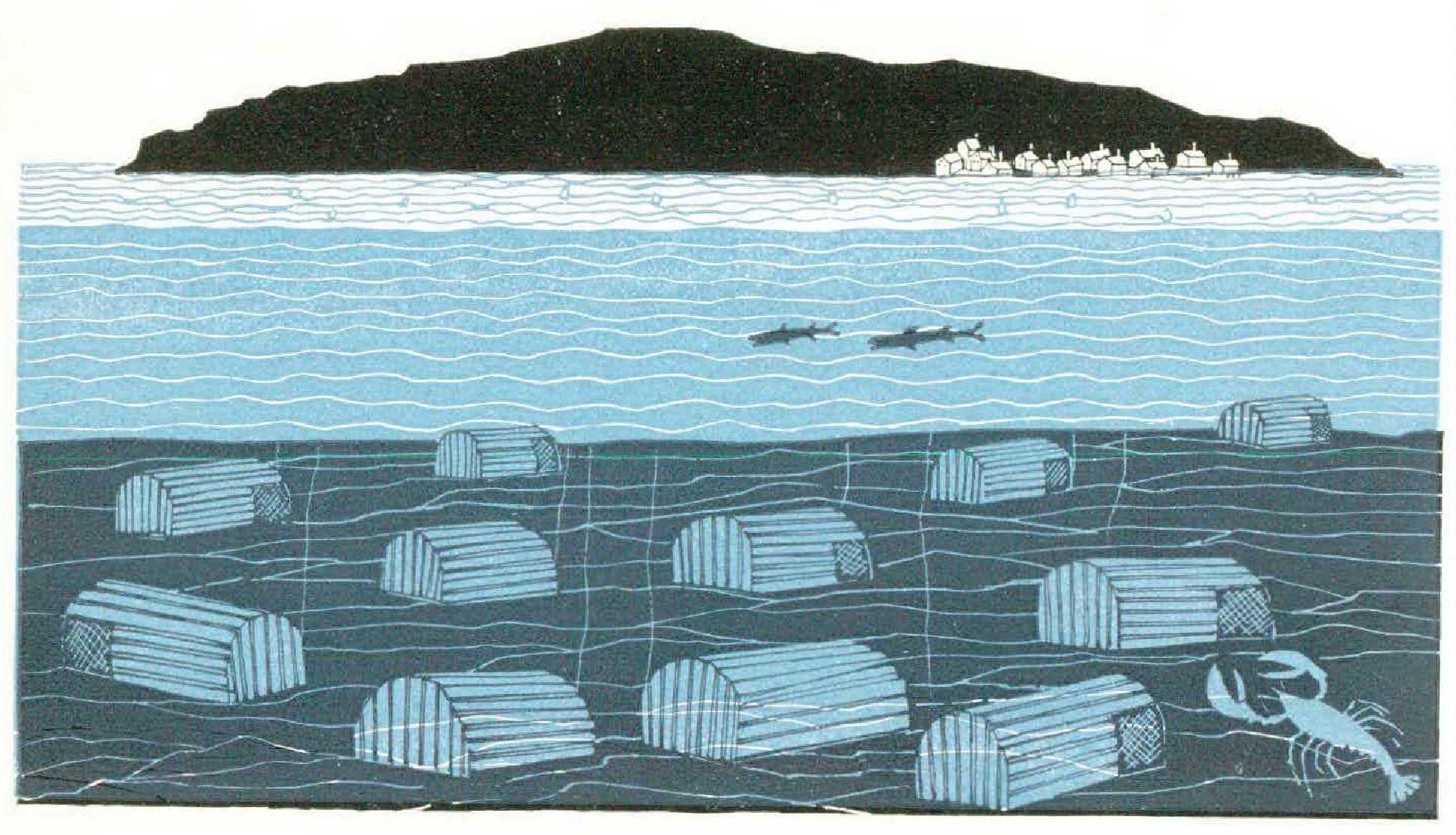
We spent hours in a fish house, watching a man stuffing bait bags. The herring bait is another cost in a long procession that causes fishermen to mutter, “If you can afford to lobster, you can afford not to.”A boat represents about $7000 afloat. Add to that $1500 in line and buoys for a 300-trap layout. Traps are built in spring, when fishing slacks off, and cost from $7 to $8 each.
With Christmas behind, everyone is caught up in the community excitement pointing toward January 1. New Year’s Eve means only the night before the lobstering season legally opens. This has sometimes been referred to, in capital letters, as Trap Day, but not by the islanders. Said one scornfully, “You’d think we had a parade or fired a cannon or something just because it’s the day we start.” Nevertheless, the tensions are evident, and sometimes this has a boomerang effect, so that no one will turn a wheel until George — or somebody else — goes first.
As the men go off about their business, the women stare into the face of winter, waiting and countingincoming boats. Social life is meager. There are no interconnected telephones. Says Mrs. Marion Cundy, sturdily, “I like the quiet of winter, but I’m always glad to see people begin to arrive in spring.” We talked in her warm little front room at a round oak table whose hub was a kerosene lamp. Framed on the wall was a prized possession, a color photograph of Marion in a group of lobster diners. It appeared in a national magazine a few years back.
Mrs. Cundy is one of the leaders of a Thursday night sewing circle. Their handiwork, readily sold to the summer hordes, helps keep the island church in paint and repair. They even have a resident pastor, the Reverend Miss Gertrude Anderson, a retired missionary. Her cottage is weathered to the universal camouflage gray, but inside, blaring like trumpets from the walls, are the gorgeous hangings and art reflecting the minister’s twenty years in Burma. About a dozen adults turn out for the Sunday evening service,when schoolmaster Oliver plays the organ.
The island has a well-stocked store, boasting one of the two telephones with service to the mainland. Many groceries are brought in by the Laura B., along with the mail. A small tanker comes in occasionally. Then one of three or four trucks on the island, a refugee from a wrecker’s yard, bounces around on deliveries.
We stayed at the one island home that would accept winter boarders. Late afternoons we sat in the warm living room, lavishly hung with island paintings. When our host arrived after the ritual of making right his boat and pulling the skiff above high water, his first act was to start the diesel generator in the basement. At the first thump-thump and heavy muffled beat, the house lights sprang into being. We would look at one another and smile in this sudden wealth of vision.
“Someday,”our hostess said, “we’re going to move the generator out of the house. It makes me feel as if I’m on board ship.”
Indeed, that is one of the many charms of Monhegan — at any season.