The Banks of the Ohio
Southern-born and a graduate of Radcliffe, class of 1958, SALLIE BINGHAMstarted the writing of fiction while she was in college. One of her short stories won the Dana Reed Prize for 1957 and was reprinted in THE BEST AMERICAN SHORT STORIES 1959. Her first novel, AFTER SUCH KNOWLEDGE, was published by Houghton Mifflin in 1960.
A Story by SALLIE BINGHAM
EVERY afternoon that summer, rain or shine, the yellow taxi would turn into Pion Way at six minutes past six o’clock and stop in front of the house. Lutie’s mother would spot it from the window seat where she had spent the day, licking envelopes for charity and watching the world go by, and she would call, “Lamb Tail, I believe I see him.” Given a chance, she would add, “Lutie, I’m not at all sure he should park there. It’s marked No Parking, and you know I try to be impartial.” So Lutie was nearly always ready when Shriver came, and she would run downstairs and out the door with the long day coiled like a spring behind her.
Outside, she would calm down and walk slowly, under the weight of her mother’s watching, across the strip of burned grass to the yellow taxi. Shriver had never been known to get out for her, but he would lean across the seat to open the door.
Several times a week, Lutie brought a picnic hamper packed with tuna fish sandwiches and hard-boiled eggs — the same meek food she and her mother took every April to Burning Bush State Park to see the wild flowers. For Shriver’s sake, she would add a pickle jar of gin and ginger ale; the picnic was to be eaten in his rowboat, the Dolly.
The Dolly was the only thing Shriver owned. The taxi, of course, was borrowed — he was a college graduate, the taxi job was only for the time being — and he lived in a boardinghouse on Third Street. Even the town he worked in, the town where Lutie bought every stitch she wore and ate cottage cheese salads with girls she had known in school, had no claims on Shriver. He had hitchhiked up from Florida, stopping in Louisville because the trucker he was riding with had a load to deliver at a cigarette factory. After two years, Shriver still did not know the names of the city streets, and he usually had to ask his passengers to direct him. When they did not know, he would telephone Lutie from a diner — “Ah, hello, did you ever hear of a place called Shawnee Parkway?”— cutting into her quiet morning with a question about a place she might have heard of, but would surely never want to be. For some reason, most of Shriver’s customers wanted to go to the South End.
He would never have kept his job for so long if his boss, a man named Daddy Armstrong, had not had such respect for education. Daddy had never had a college graduate driving for him before, and he was so impressed that he let Shriver keep the taxi at night, after work. Lutie sometimes thought of telling Daddy, in a joking way, that she knew every crack and seam in that taxi’s cocoa-colored plastic upholstery. But that was ancient history — before the first of July, when Shriver bought the rowboat for twenty-five dollars and christened it with a bottle of ginger ale.
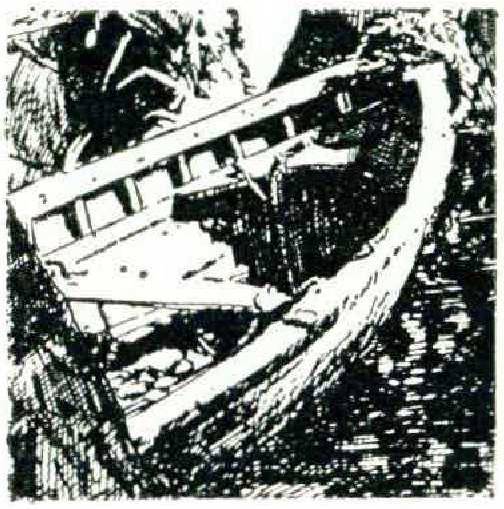
One afternoon toward the end of August, when the heat was at its height, they parked the taxi on Henny’s Public Pier and took out the picnic and carried it down to the Dolly. Lutie got in first and settled herself in the stern. She was chary of her white piqué dress; the Dolly’s seats were still not really clean, although she had gone after them with a scrubbing brush. Shriver cast off from the iron ring and gave the shore a shove with his foot, and they drifted out into the oily river.
IT WAS hot enough to raise the smell of the yellow mud which the spring flooding of the river had left caked on the low-hanging trees. Under the trees, the banks were beaten bare except for poison ivy, lovely in autumn; back farther, green corn nobody owned grew as high as forests. The bare roots which humped along the banks were used for moorings by the houseboats. Lutie and Shriver drifted past one, the Sugar Belle, snubbed up tightly against the bank; there were geraniums in her window boxes under blue-striped awnings, and deep inside, a radio was playing softly. Next they passed an inhabited barge, with laundry limp on a line and a woman hunched over, stirring dinner in a tin pot.
Shriver dropped the mooring rope in a wet tangle on the bottom of the boat, and Lutie said, “If this is my house, you should make more effort,” as she bent to pick it up. Shriver said, “Be careful, now,” and started for the rowing seat. He was a tall person, not heavy but large, and each time he put his foot down the boat dipped to that side. At last he sat down and fitted the oars, which were not even a pair — one was blue, and a foot longer—into the oarlocks. He pulled the boat around in a tight circle. “I never thought to see the day when I’d put up with a person afraid to dirty her skirt,” he said, watching the way Lutie was handling the wet rope.
“Every time I come home with a spot on my skirt, Mother thinks she’s lost me,” Lutie said. “Look out for that boat.” The river was crowded in the late afternoon, and half the people on it didn’t know beans. The big motor cruisers were just excuses for mindless lechery; they were always running aground on Hog Island with an unmarried couple in every berth.
Shriver pulled the Dolly to the left just in time. He did not lower himself to look over his shoulder at the houseboat they had barely missed. “Did your mother give you a lot of jaw about getting in late last night?” He sounded practically hopeful.
Lutie did not answer until she had taken a good look at the houseboat they were passing, the Doreen Ann, and drawn her own conclusions from the beer bottles and the fat women sitting with their legs up. It was Shriver’s river, not hers. The only river she knew was the protected stretch below the yacht club, where her father used to sail his Lightning every Sunday until he died.
“She didn’t say anything, except she had gotten a little lonely,” she answered Shriver finally, and when he huffed she decided not to tell him that her mother had drawn her down onto her bed: “Lambie, these nights go on and on.” Her mother’s sweet wistfulness, as well as the pink crepe de Chine nightgown she was wearing, had reminded Lutie of the nights just after her father’s death, when they had been close and sorrowful as two birds in a nest. Shriver did not know anything about the sweetness of that bedroom, where the shades were always down and the drawers were full of hand-embroidered underwear and lavender sachets, breathing. Shriver was always saying she could not cat her cake and have it, but her mother needed her, and for more reasons than one.
“It would be better if she did get angry with us,” Shriver was droning on. “Then at least something could be discussed.” He failed to understand that nothing could be discussed with her mother except clothes or the weather, which covered a good deal of ground. “Eighty-nine at six fortyfive; I heard it on the radio,” her mother would say, and if Lutie replied, “I didn’t suffer,” it meant her evening with Shriver had been nice and well behaved. Twice her mother had almost lost her, when the humidity had risen as high as the heat and the only thing Lutie could think of was to shed her clothes and her complications and lie back in cool passion, allowed if not admired.
“Duck,” Shriver warned, and he leaned on the oars while they floated under a low limb. “The funny thing is, I sort of like her,” he said, beginning to thrash the oars again, “and she sort of likes me. Remember that time I came to dinner? She kept saying, ‘Thank you, Mr. Ellis, for giving my little girl some excitement.’ ”
Lutie laughed. “Excitement!”
He leaned on the oars. “That’s all it’s been, isn’t it, Lutie?”
“Oh, Shriver, we’ve been over and over that ground.”
“We’re spared a lot,” he said, going back to joking. He never would drive her to the wall. “Think if she actually liked me and we had to go there to dinner every other night. Over the peachwalnut soufflé she’d be asking me my intentions.”
“It’s not that I mind Shriver Ellis being poor and half educated and having no future,” Lutie mimicked what he must think her mother would say. “It’s just he’s such a plain person.”
“Does she mean my face or my soul?”
She looked at him. It hurt, to have to say. She knew his face so well she couldn’t defend it, even from her own spite. He was yellow-brown from a summer on the river, and his eyelashes and eyebrows were bleached out white, so that he looked as though he were always startled and staring. Yet it was a plain face, one she wouldn’t have had any trouble losing in a crowd. He had spotted brown eyes which still did not really interest her—his soul? — and his cuticles rose halfway over his nails, and she never could think of his size with any comfort. Sometimes she thought it was his sheer bulk which prevented her from wanting to see him without clothes and not, as he was always hinting, the look she would find afterward in her mother’s eyes. He would simply have too much flesh to bear, once he was naked. And such solemn flesh! She had known from the first time she rode out from town in his taxi that Shriver was different from the well-bred boys she knew, who would roll all over you on the country club golf course and then go back to college and send you a postcard: “How’s tricks?”
“Your soul, I guess she means,” she said, and then she hated herself for a minute, because after three months of necking and straining she was still holding him down to jokes. “Oh, Shrive,” she said, “it looks like we never can be serious.”
That was a mistake. He dropped the oars and came for her, getting over the seat on all fours like a bear getting over a log. The boat dipped to one side, and she held on with both hands. “Go back, Shriver. You’ll sink us both.” But he was already kissing her on the ear and leaning his full weight on her shoulders until she thought she would cave in. “How about some supper, it must be way past seven o’clock,” she said, reaching under his arm for the picnic basket.
He sat back then. “All right, church social. How much am I bid for this box?”
Unwrapping the sandwiches, she pressed each piece of waxed paper out flat and laid it back in the hamper. “You should have married a poor man,” Shriver said, “with your ways.”
“Don’t get ugly with me, Shriver. Shall we tie up to the shore?” For the last five minutes, they had been floating sideways across the river.
“If we tie up, I’ll try to get you to go on the bank, and you’ll fight me about it for an hour.”
I am just a girl, she wanted to say. I am just frightened. I wear elastic garter belts with blue roses and white cotton petticoats with eyelet embroidery, and although I really like you, I do not know your ways. But he had shamed her out of using those excuses. “All right, then, we’ll just float wild in the river,” she said, handing him a tuna fish sandwich to plug his mouth.
Watching him eat, she knew that was what she really wanted: to feed him, with homemade lemon cupcakes and gummy chess pies, with hot love and cool affection, beef stew and jellied broth, until he was finally filled up and could let her be. “I guess it doesn’t mean anything,” she said, to rile him, peeling an egg. “All the good meals we’ve eaten together, the picnics and the casseroles and the blue-plate steak dinners. I guess nothing means anything, to you, except that.”
“It’s pretty thin pickings.”
“Not for me, it isn’t.”
“Well, maybe not, but you have your house and your mother, and pretty soon, that job practically running L.A. Leak Dry Goods. And all your other neat little things.”
“I don’t see why you have to be so pitiful. You have your job, your life —” She had to stop there. His life had no more to it than a gnat’s. Hitchhiking up from the South with his family dead or gone; he didn’t even have a picture to show her of the place where he’d been born. Thin pickings, indeed!
“You’re right,” he said. “All my life, I’ve had my job and my life and the whole weight of myself on my hands. It’s not a satisfaction.”
“Have another tuna sandwich,” she said. She refused, of all things, to pity him.
AS SHE held out the sandwich, she heard the drumming of a big boat. “ That reminds me, we haven’t seen another boat for an hour,” she said, and she shaded her eyes to admire the big blue motor cruiser coming toward them slowly and trailing a wide wake. “L’Heure Bleu, Port of Lou,” the gold letters along the bow read. Lutie remembered the name; the boat docked at her father’s club. Now she saw three people laid out in lounge chairs on the top deck. As the boat came closer, one of the people leaned down and said something to the man who was steering, and they all laughed. The big horn honked rudely, twice.
“Blat, blat ” Shriver said, making a face over his shoulder. He turned back to Lutie. “You’re bound to know I can’t go on this way forever.”
That made Lutie angry; she wouldn’t stand for threats. “You know what I wish?” she said. “I wish for just one second I was laid out in a deck chair on that boat, with a Tom Collins in one hand and about six dozen peanuts in the other. Just for one minute, so I could enjoy myself.”
“All right, Miss Priss,” Shriver said. “I thought it was something else holding you back, but I guess it’s nothing but goddamned prissiness.”
“Don’t you curse at me, boy,” she said, flushing.
Blat, the horn said, over her head.
Shriver grabbed an oar and began to thrash the water. Lutie looked up and saw the big boat hanging over them.
She reached for the blue oar. Shriver was pulling them around in a circle. The motor cruiser hummed and thumped as the engines were reversed. She screamed at Shriver, but he gave a last desperate thrash and they turned in under the blue cruiser’s bow. Lutie reached to fend it off, and then she felt Shriver’s hand in the small of her back and she fell, scraping her shin on the side of the rowboat.
Coming up with a gasp in the warm water, she thought, thank God, no more arguments.
Then a wave slapped her in the mouth and she drew in a long gasp of water. Choking, she spat out, and then remembered to breathe through her nose. It felt stripped. She had been in the water all summer, and now it felt more comfortable than the air. Treading water, she began to work off her shoes.
The stern of the big boat was already some distance away, but the loud thumping of the screws was still vibrating in the water around her. Hearing that, Lutie realized for the first time that she was in danger, and she heaved onto her back and began to kick for the shore.
After a few kicks, she thought of Shriver and came upright in the water, pushing her wet hair out of her eyes and looking.
He was floating about ten yards downstream, hanging onto the Dolly, which had capsized. The blistered brown hull rose and fell gently on the water. “Go for the shore,” Shriver called in an ordinary voice. “I’ll hang on to the boat.” Then he turned his head away, as though he had seen her hesitating.
Lutie hung a minute, treading water. One day on the pier, Henny had asked Shriver, “Can you swim?”, and he had answered, “Don’t you know I was raised at a country club?”
Then she turned over on her back and began to kick toward him.
The river, so calm and oily on the surface, was fierce a few inches underneath with an offshore current. Each time Lutie kicked, the current caught her foot and dragged it sideways. Soon she turned over on her stomach to measure the distance.
Shriver and the boat had already floated farther away. This time Lutie did not hesitate; she turned over on her back and began to kick hard, dragging her arms up over her head and down through the water to make time against the current. Mrs. Leland, the lady swimming teacher, had given her a lesson every Monday in the shallow end of the country club pool; each time she had learned a stroke, Mrs. Leland had given her a lemon lollipop. The thought of the lemon lollipop made Lutie feel lost, and she tried to fix her attention on the small, the very small chop her feet were setting up in the water.
A long way upstream, the big blue motor cruiser was nosing along the bank, and for the first time she thought, the bastards! They never even bothered to stop.
A little later she began to notice the weight of her dress, and she let her feet drop and came upright in the water, to work on the side fastening. Clumsily, she wrenched at the tiny hooks and finally eased the dress off one shoulder and then off the other, sinking, as she did so, below the surface. The dress was hanging around her waist when it occurred to her that she was about to put her foot on the filthy muddy bottom. She pumped hard with her legs and came back up. She rested for a minute, then doubled over and worked the dress down over her knees. It fell away and hung in a white clot just below her feet. Free at last, she leaned back and swam on.
Soon she grew tired and turned over on her stomach to try the crawl. She had never really mastered the stroke, and her legs kept sinking below the surface of the water. Each time she turned her face to take a breath, she looked at the shore. After ten breaths, she had to admit that she was not getting anywhere; the big white sycamore which had been opposite her head when she started was now just off her knee. So she lay and floated, giving herself up to the tug of the current, until the thought of Shriver drifting farther and farther away started her up again, hammering through the water. This time she had to stop almost immediately. Her legs had become limp and soft, and the current was pulling her out to the middle of the river. Dry panic clung to the roof of her mouth. Raising her arms once more, she thought, here I am in the middle of the Ohio River, drowning, and nothing has ever happened to me. That seemed more important than anything else. A feeling of great luxury was sweeping over her, and she raised her arms languidly over her head, knowing it was for the last time.
Shriver caught her by the wrist and pulled her to the side of the rowboat. “Hang on,” he gasped, “I can’t hold you.” He folded her fingers over the narrow ridge of the keel, and then he let go of her and hung from both his hands for a moment, and then he put his left hand back over hers. She shook her head, to tell him that she could hang on by herself— she knew, from his face, how long he had been waiting — but he kept his hand clamped over hers. So for a while she lay with her legs streaming out behind her and her cheek resting on the scaly hull of the Dolly.
Then she raised her head and said, “We better get started.” She looked around the end of the boat to gauge the distance to the shore. It did not look too far. She took a new grip on the keel and began to kick, and after a moment, Shriver started too, and the Dolly lumbered forward.
Their combined kicking seemed very strong, and she turned her head to smile at Shriver, “It’s you should have gotten the lemon lollipop.” He did not smile, and she wondered why he had to look so white and stricken when the shore was practically within reach. Then he turned his head toward her and laid his cheek on the side of the boat, and she heard his kicking falter and stop. “Too heavy,” he gasped. “You swim. I’ll wait.”
Lutie looked around the end of the boat and saw that they still had some way to go. “I don’t know about you, but I’m not leaving the Dolly,” she said.
“She’s served,” he whispered, and she saw that his eyes were closing.
“Not yet, she hasn’t.” She was frightened; his voice sounded so peaceful and dull. “I take back what I said about the lollipop,” she told him, trying to sound angry, and then at some expense she made a loud thrashing in the water with her feet. Without Shriver kicking, the boat hardly moved at all, but she went on working, out of pride, not daring to look at him. After a long time, she heard him begin to kick. But with only one foot. At least, that was the way it sounded. After her own pair of kicks, she listened for his, and the little soft splash he made, like a twig falling into the water, almost drove her mad. “Kick with both feet, you nuthead,” she gasped. “You’re supposed to be the strong one.”But he did not even lift his head off the boat.
Then the other side of the Dolly butted into something solid, jarred, hung still, and began to rock in place as peacefully as a porch swing.
VERY slowly, with heavy paddling motions which had no connection with any stroke she had ever learned, Lutie eased around the end of the boat, holding on with one hand. She saw the branch they had hit, jutting like a horn out of the brown water. But when she tried to stand, the sweet soft mud sank away beneath her, and so she had to leave the boat nodding against the branch and paddle farther in. When she had found a place where she could stand, chin-deep in still water, she marked it in her mind and swam slowly back to the boat, where Shriver was hanging.
“Come on. We’re there.” She had to unbend each of his big fingers to get him off the keel. “Swim.” But he hung, a dead weight, off her hands until at last she grew angry and said, “At least make some effort.” It was quite a way to the shore, and she had to drag him the whole distance, hitched in the crook of her elbow. Even then, he kept slipping away from her, stiff and unmanageable as a waterlogged piece of tree. At last she was standing and he was sitting or crouching beside her in the shallow water.
She stood beside him, mechanically wringing out her hair.
Presently he looked up, and she saw that his eyes were bloodshot from the water. “Can you make it from here?” she asked formally.
He nodded, and when she leaned down and hooked her hands under his arms, he struggled to his knees and finally to his feet. Standing, he leaned his whole weight on her, and she felt, with strange wonder, his weight, and his weakness. Then he leaned away from her and walked carefully to dry ground and sat down. She followed and sat down near him.
After a while, she asked, “Why didn’t you look at me all that time I was trying to get to you?” She made it sound as though he had been rude.
He shook his head, knocking water out of his ears. “I guess pride cometh,” he said in a husky voice.
“I thought you could swim. I thought that day on the pier you told Henny you could swim.”
“I thought you weren’t going to make it, and all I could do was hold onto that boat and try to push it toward you.”
Then she began to shiver. Her fingernails were purple, and her teeth clacked loudly in her head. “I’m too cold,” she complained, and she kneeled and pulled off her wet white slip.
“Here,” he said, and he took the slip from her and wrung it out. She looked at him. His white shorts were pasted to him with water, and water was running down his thighs, combing the dark hair straight. She watched him wringing out the slip, and then she looked down and saw the tops of her stockings and the metal hook of her garter. She sat down and tried to cover herself.
“Oh, Lutie, you’re freezing,” Shriver said, and he took off his shirt, which was soaking wet, and wrung it out and laid it across her shoulders.
She thought of saying, It’s late in the day for that, but instead she thought of his great weight when he had leaned on her, and his weakness. It seemed a wonderful mixture, wonderful and terrifying.
Then he got up and went to spread her slip out to dry. Lutie watched him and pulled the sleeves of his shirt down to cover herself. He slapped the wet rag against his knee and spread it carefully on a rock, where the last sunlight lay in a little pool. He untangled the slip straps and draped them over the edge of the stone as though he had been doing this kind of thing for her for many years. Finally he turned around and came toward her, shaking river water out of his hair.