Watch Their Smoke
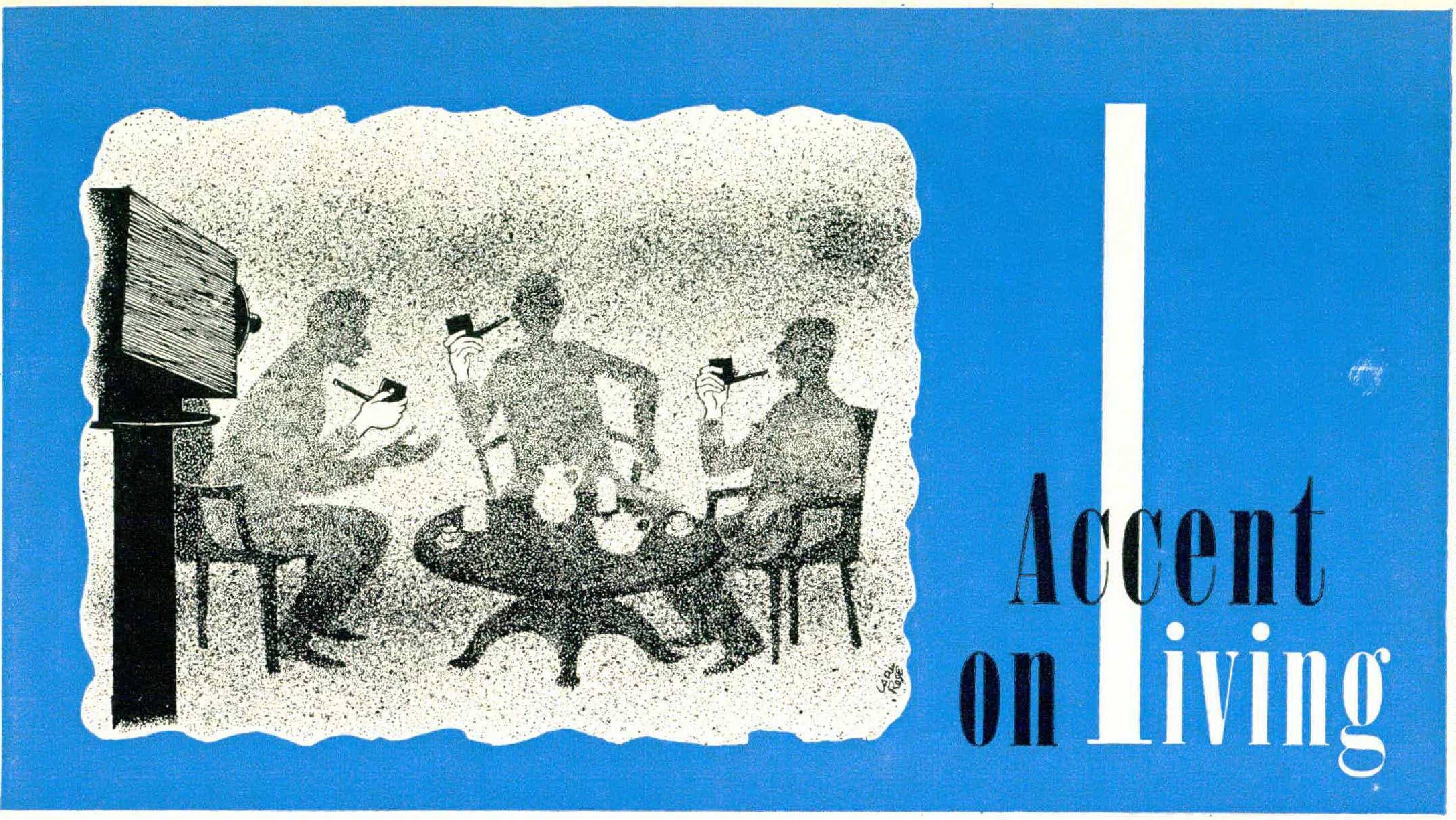
The four members of the discussion panel have been duly presented to the television audience. They relax in their leather armchairs. A clublike atmosphere, or what TV producers imagine to be a clublike atmosphere, is being attempted; there are side tables with ashtrays and tall glasses. Water? Whiskey? Cold tea? Even a painting, of impressive dimensions — a genuine Gimbel, no doubt — is dimly visible in the background.
The moderator is a veritable Grand Old Man of panel shows, but he is all humility as he takes up the business at hand. The humility bit makes everyone regard the panel members as much bigger shots than they really are. “Let me kick off the discussion,” he begins — the opening or beginning of anything today is a kickoff and not an opening or beginning— “let me kick off the discussion by asking Professor Doakes to tell us why he is against compulsory seat belts.”
Even such an old classroom hand as Professor Doakes is too flustered at his kickoff role to make a direct reply. He takes refuge in the words which have staved off many a gulp and stammer for panel discussants: “What I want to say is this —”
Now, the listener may wish to hear, reasonably enough, what it is that Professor Doakes wants to say, although he may wonder why in the world Doakes doesn’t go ahead and say it instead of first affirming his desire to do so. But just as Doakes, on whom the camera has focused hopefully, is about to say it, he vanishes altogether from our view in a billow of smoke.
The smoke cloud, exaggerated perhaps by the peculiarities of studio lighting, is so dense that the viewer’s first thought is of calamity. It would not be surprising if a heavy curtain marked “Asbestos” were lowered or alarm gongs and sirens were touched off. Fire!
These impressions tend to distract us from what Professor Doakes had said he wanted to say and is now saying, so it is with astonishment and relief that we see, when the camera shifts to the next chair, that the source of the conflagration is no more than panel member Merlin Zigler in the act of lighting his cigar. “What I would like to say (puff-puff) in reply to Professor Doakes,” says panelist Zigler (puff-puff-puff), “is simply this —”
Meanwhile, the rest of the panel is getting into the spirit of the debate. Number Three extends a mannerly light to Panelist Four before disappearing behind a smoke screen of his own. Professor Doakes, caught napping at the kickoff, now breaks out a massive curved-stem pipe which he charges and fires up. From here on, the evening belongs to Doakes.
Doakes, as it happens, is a roundfaced, young-looking chap; in fact, “baby-faced” is the first term that comes to mind when he reappears from behind his smoke cloud. Like all pipes, his quickly goes out, but he continues to fondle it and hold it up and look at it and wave it about. So great is the incongruity between his appearance of immaturity and his outsize pipe that even the studio engineers are fascinated; they keep the camera on him even while someone else is doing the talking. We see Doakes, who obviously regards his pipe as a powerful totem, staring at it as if finding some mysterious guidance in its nearness.
There has been an attempt of late to revive, in TV commercials, a once famous pipe tobacco. It was an uphill pull, for all the valuable words — richer, milder, smoother, finer, fresher, cleaner — are already just about exhausted by the cigarette trade. What the pipe tobacco crowd needs is a dedicated fetishist or totemist like Doakes and more panel discussion shows.