News About the Fair
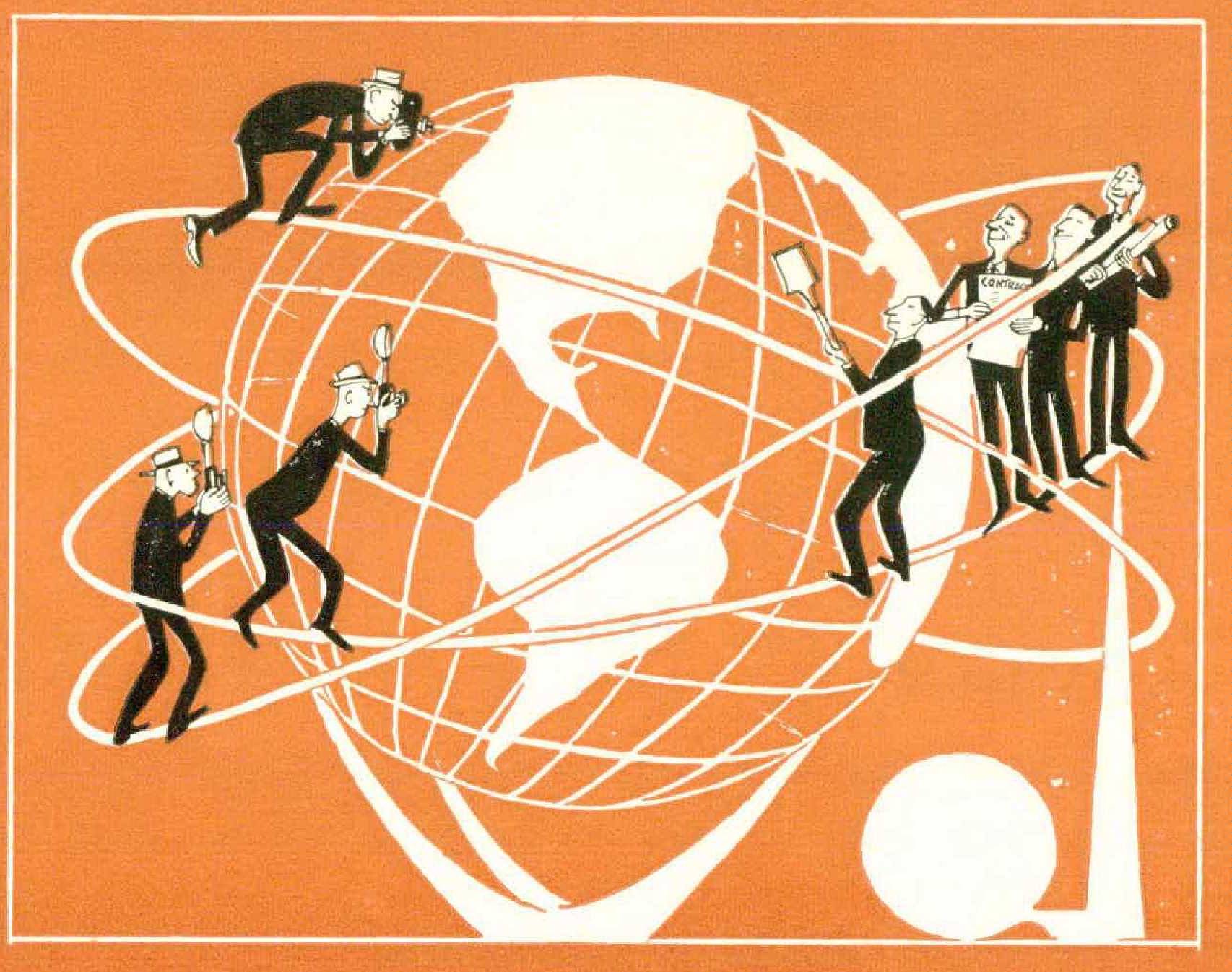
Preparations for the New York World’s Fair have emerged from the stage of what its literature terms “shovel wielding ceremonies.” A certain amount of ribbon-cutting has touched off bulldozer activity, and all sorts of people have been bestowing and receiving “the Fair’s silver medallion.” The Florida authority in charge of that state’s exhibition gave a luncheon for Fair executives. Elsie, the Borden Cow, lowered her muzzle on a plunger which detonated groundbreaking operations for the Better Living Building, with her employers and the building contractors standing by for the camera. Ground for the Billy Graham Pavilion was broken April 17.
The great number of photographs purporting to show the signing of important Fair contracts are remarkably alike; aside from small changes in men’s clothing over the years, such as the disappearance of the four-button coat, the vest-watchchain variation, and the detachable stiff collar, these photographs might well have come from the Fair of 1939 or the Columbian Exposition. They continue to show the two principal signatories beaming at a sheet of paper that appears to need both men to hold it within view, backed and flanked by lesser participants, all grinning as if delighted by the contract’s provisions, which they are obviously too far away from to be able to read.
When one considers that with two men holding a single sheet of paper it is quite impossible for either of them to read it or sign it or do anything else but stand there holding it, this cliché of the news photographer becomes easily the most artificial-looking pose that two adults can assume. It always reminds me of Winston Churchill’s rebuff of a news photographer in Boston back in the early thirties.
The future Prime Minister was out of office at the time and turning an honest penny on a lecture tour. During our interview with him in his hotel bedroom, a photographer asked him to pretend to be reading something. Churchill replied that he had nothing to read. The photographer handed him the hotel’s leatherbound telephone directory. “Be reading this,” said the photographer.
“Nonsense,” said Churchill icily “I shall do nothing of the sort.” He was wearing a gray suit and a carelessly knotted blue bow tie with white polka dots, and a wing collar, as I recall it, and he was photographed neither reading nor simpering nor posturing but looking very much himself— impatient and eager to be rid of us.
Posed or unposed, the contract signers and shovel wielders of next year’s Fair are giving the photographers a busy interval. Nothing escapes the lens. “His Excellency Angel Sanz-Briz,” a caption of one stirring action shot explains, “Consul General of Spain and Governor Charles Poletti signing the agreement which increased the size of Spain’s exhibition site to 50,000 square feet.” At the “Unisphere Pedestal Ceremony,” addressed by Roger Blough, chairman of the board of U.S. Steel, no less a personage than the grandson of the man who built the Eiffel Tower was present, although the photograph with this story in Fair News happens to be a studio portrait of Blough and not of M. Eiffel. The Unisphere is a huge globe of stainless steel on which a map of the world is depicted, and it is the Fair’s “symbol.” The Fair will contain, also, a World of Food Pavilion, for which ground was broken with a “giant knife, fork and spoon.” (Whatever becomes of these ceremonial shovels once the captains and the kings have moved on?)
Amid these marvels of modernity, it is reassuring to find General Motors standing firm with its quaint old title for the display, Futurama. The word has been diluted somewhat, by years of use and by all the Flavoramas and Foodoramas it has spawned. But at the risk of having some millions of Fair-goers turn away with an I’ve-seen-it reaction, GM is still loyal to the word, even though the future envisioned in 1939 may not have been quite the one we eventually got.