William
SHEILA BURNFORD is a Canadian doctor’s wife whose tale of three animals, entitled THE INCREDIBLE JOURNEY, has become a classic of its kind and has been read and loved by thousands since it was published in March, 1961.
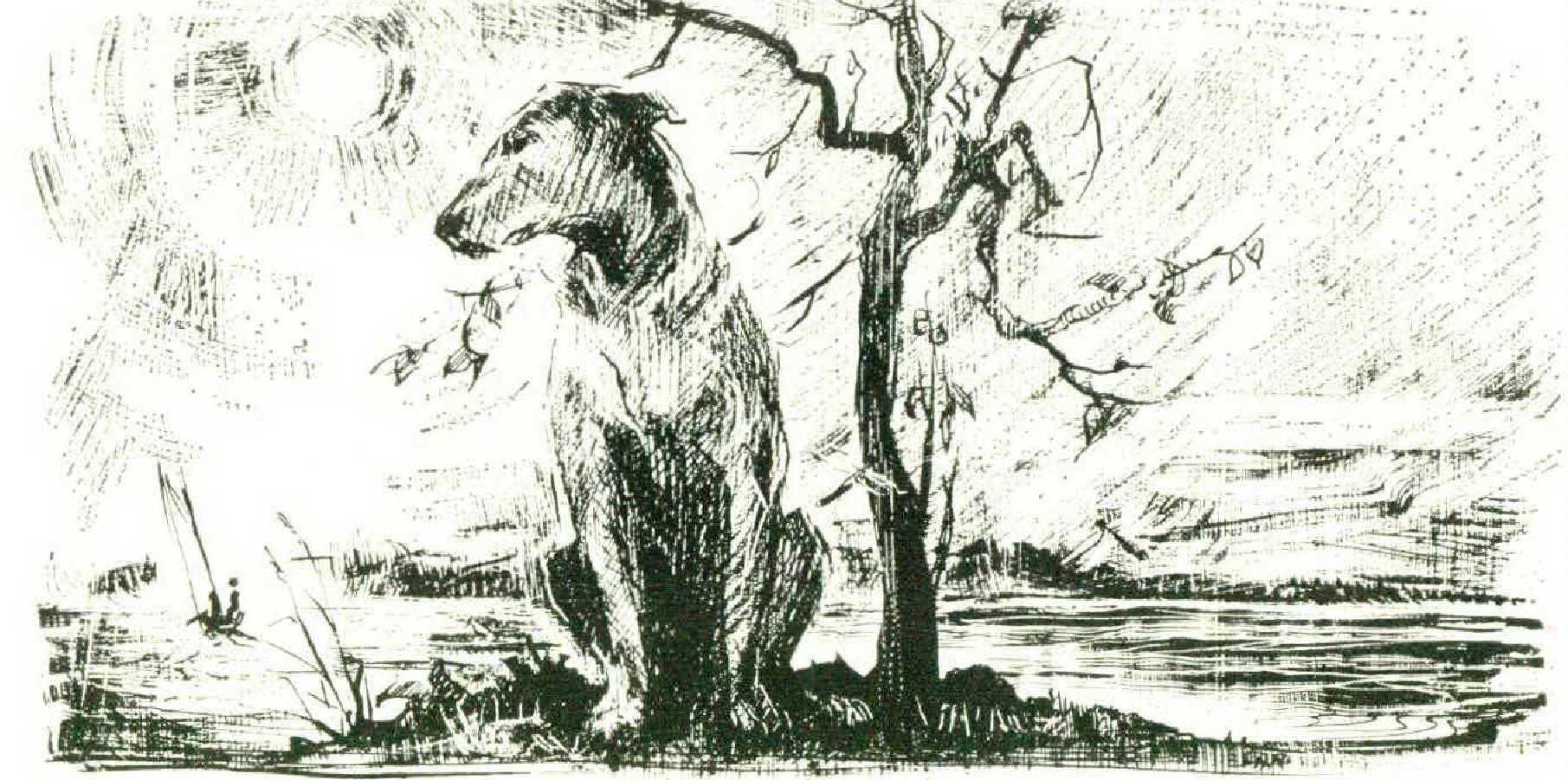
by Sheila Burnford
SINCE early morning, when he had awakened the household with his imperious whining, the dog whose name was William had been restless and had craved incessant attention with all the privilege of his fifteen years: he importuned first one with his insistent bullethead, and then another with a demanding paw; he whined to be let out, then almost at once demanded readmittance; and always there was a strange puzzled intentness of appeal in the questioning ears and in the depths of his small almond eyes.
The children of the family were very patient: they did not scold him when he lay down on the floor in the midst of their game of Racing Demon and his pleased tail scattered the piles of cards; when, slowly and stiffly, he rolled over onto his back in the preliminary to a game they had almost forgotten, they accepted the invitation — they bent over him in turn, daring him, then shrieked triumphantly “Missed again!” as he snapped with finely calculated error at their noses. Later, when the rain stopped at last, they set off on their bicycles, their young retriever running behind; but halfway up the winding drive one of them had looked back and seen a white figure plodding determinedly after. They waited for him then, and walked very slowly, pushing their bicycles to his pace. Very soon, however, he had tired and sat down, mulish ears laid back, eyes slitted protestingly. They had come only a short distance from the cottage, so the children pointed back and told him firmly to go home; he drooped his head and allowed one leg to shiver pathetically so that their hearts were touched; they left their bicycles at the side of the road and walked back with him. Usually when he had scored some point like this he was immediately transformed with gaiety, but today he did little more than stir his tail apathetically. When he sat down again, halfway home, the eldest picked him up without comment and carried him into the cottage.
The wide windows of the living room looked out over the lake, the low white ceiling was bright with the rippling reflections of sunlit waves, and the thin curtains billowed gently before a fresh light breeze that brought a heady, rain-washed potpourri of clover and thyme, mint and wild roses into the room. The terrier sniffed appreciatively, then climbed into his basket, which the children had moved into a warm patch of sun. One of them picked a sweet pea from the bowl on the table and dropped it in beside his nose for his additional pleasure. They filled his water dish, patted him affectionately, and left.
He fell asleep at once, the waves slap-slapping a cheerful accompaniment to his gentle snoring. But all too soon he woke, whining softly, to resume his restless wanderings. At last he pushed open the screen door and ambled down to the shore, where he lay in the shallow water and lapped in a desultory way at the little waves breaking against his nose. Presently he left the water, barked from long custom at the insolent sea gulls on the raft, then settled down by a favorite young apple tree to wait for the children’s return. They rode quickly when they came, for one of them carried an already melting ice cream cone. She kneeled on the grass beside him, turning the cone as he licked his painstaking way around, but halfway down he turned his head away, and the cone was tossed to the waiting retriever. They teased him afterward with long grass stalks, tickling his sensitive ears and dropping clover on the long down-arched nose, for they loved to watch him clasp his paws tightly around in protection, his cunning dark eyes peeping out between, bright with humor. The young retriever watched hopefully from a few feet away, but when he was about to move over to participate in the fun he was warned off with a despotic, pettish growl and stopped in his tracks.
IT SEEMED this day that some newly developed need turned the terrier to the children, although for many years now they had outgrown the almost proprietary interest he had shown in each of them since birth. He had continued to be possessive and jealous if they displayed too much affection for the newcomer within the house, although he seemed to recognize their need for a younger, more active companion outside; he was like an elderly nanny who sees that her brood has grown beyond nursery care, yet still exerts her discipline. And they, who had pulled themselves up in turn from the ground to their first steps by his tender ears and patient tail, who had poked exploratory fingers into his loving eyes and turned back his pink lips to examine his shining teeth, were now as tolerant and patient as he had been with them.
In the early afternoon they left their own young dog behind and took William with them in the sailing dinghy, unable to withstand his wistful expression when he saw the picnic bag brought aboard. He was no longer certain of his balance in a heeling boat, so they wedged him securely between their knees. But in a short time the boat was at the end of the dock again; he was very unhappy, the children explained — whining and looking back always to the shore. They helped him out, and he stumbled up the dock in anxious haste, and there at the end he came upon a wooden garden chair, so low that his head was level with the arm.
He laid his muzzle along the arm and stood there, searching the face of the occupant. And she who had lived a decade and a half of her life in his company, looking back at him now, patting him in welcome, would not admit in her heart that this was an old dying dog but sought only to justify his desperate weariness by saying that this sultry weather would make anyone tired. And when the eldest child said, almost pityingly, “Mother, there is something wrong when William is not hungry — ”, she would not even then come halfway toward the admittance of truth but remarked only on the healthy coldness of his nose. And when the youngest, blunt with impersonal honesty, said, “Of course, he is really ancient, isn’t he?”, her mind sidetracked this issue too, and she reminded them only of great Argos and of Wassie, their grandfather’s dog, who had lived for seventeen rat-catching years.
She looked down fondly as she spoke, seeing only the familiar recognition in his eyes, shutting her mind to their bluing blindness. But the children saw a thin-necked, frail dog with stiff, sinking hindquarters and trembling legs. They called their young retriever, and he leaped into the dinghy with flailing exuberance. Once more they set off for their picnic, released from uneasy pity.
Their mother watched them go, the dog leaning against her knee, her hand absently turning one of his ears inside out and back again. Small cat’spaws of wind frisked over the water to tinkle the sheep’s bells hanging from a nearby birch; an ax rang against wood from somewhere across the bay and was silent again; the children’s voices receded. Soon the red sails were out of sight, and the lake was quiet and empty once more. A fish rose with a small plop off the end of the dock, and even before the circles had gone, there was another and another. Presently a reel whirred and a line snaked out over the water; five minutes later the dog pinned a small, flapping perch down with an experienced paw and held it there until the hook was removed and the perch dispatched. He picked it up by the tail, then followed with slow importance up the steps and into the cottage, the fish dangling from his mouth. The screen door banged to, almost defiantly, behind them.
By evening the wind had risen until the lake was wild and stormy again under scudding black clouds, and the rain lashed at the windows; the gulls soared screaming over the birch tops in the gusts of wind that rattled the doors and spattered the rain down the wide chimney to sizzle on the log fire. The lamps were lit early, and when darkness closed out the wild night the streaming windowpanes reflected only a tranquil softly lit room, undulating gently in the rivulets. The children finished at last a seemingly endless, involved game with counters and dice spread all over the floor; then they made hot chocolate, and popcorn on the fire. They offered some to the terrier, who normally relished a saucer of chocolate and as much popcorn as he could hypnotize out of anyone, but tonight he could not be persuaded, although he accepted a lump of sugar soaked in rum from the hand that had first given him this strange treat when he had been desperately ill as a puppy, and his nose and lips wrinkled with the same shocked delight at the strong rum fumes that they had many years ago.
This memory touched a responsive, reminiscent mood in the children, sprawled contentedly before the fire; as they occasionally appealed to their mother for verification, the familiar enchantment of “I remember when — ” took hold of them.
The span of their conscious remembrance stretched back across the years and half a world away to a rambling old house in the south coast country of wartime England; stretched back to a time when they were so small that sometimes tonight they had a sudden catch of memory, involuntary as a catch of breath, but holding such intriguing promise that they felt if only they could grasp the fleeting second an instant longer they would remember the secret of something more important, of a time before life even. “I remember, I remember,” they said, their brown faces flushed in the firelight and tense with concentration. “I remember, I remember, too,” echoed their mother silently from the shadowed depths of a chair beyond the pool of light, and she marveled that their perspectives of memory could project such different images.
THE voices rose and fell, and the terrier slept in the security of their midst, no longer restless and demanding attention, unaware that he was receiving now the fullest recognition of all in a world of retrospect, where his identity emerged as manysided as the facets of memory reflecting it.
The childhood world was one of endless summer, it seemed: where you went to bed when the sun still shone and rose to find it still shining, and only the nightingale singing in the cherry tree wakened you to look out and see the miracle of a moondrenched garden through eyes just clearing the level of the nursery windowsill; where your burdens were few and light — tapioca pudding and the skin on tepid cocoa being among the heaviest; and under the dining-room table sat a discreetly invisible ally, loyally sharing them. . . . Upstairs in the nursery world the children slept at night, undisturbed and calm, but downstairs was the other world of a blacked-out house in a darkened country, strained and haunted by absence; the creeping oppression and utter silence of the endless evenings, shared only by the dog lying curled in the armchair opposite — a dog who must listen to the interminable Chronicles of Barsetshire (because the voice that reads must break the silence somehow or be stifled by its weight), whose tenor howl alone joins with the giggling soprano at the piano and sends the offended silence fairly scurrying into the night before the duet of ”Afton Water,” who is always willing to lead the way down to the abysmal dark of the coal cellar, who fears not bats or mice, and whose teeth gleam reassuringly until the footsteps are identified.
A childhood world of delightful absurdity where, tabletop small, you could yet look down into the strange anemone eyes of giant farm horses, because their great necks arched over into your garden at ground level while they stood on their field that dropped away below; a sunlit, fragrant world of blackberrying in the hedges of those vast fields that stretched forever from that garden — purplestained faces and hands, sunbonnets and sandals, and a purple-mouthed dog who enjoyed blackberries too, whose tail thrashed the basket from your scratched hands, who was ever valiant with cows. . . . But in the other world those same vast fields were small, too small and vulnerable, that still summer evening when the first obscenely sputtering black birds of war wobbled low across them and sickened the mind of one who watched with the as yet unguessed purpose of their evil; but before it had time to grow, the loneliness of fear had been dispelled by the furious wild barking of the indignant custodian of those fields, who had erupted out of his house and given chase, racing through the hedge and across the churchyard, hurdling the gate into the fields beyond, barking defiance at the monstrous bird until it sputtered redly out of his range and the staccato barking of the batteries beyond took up his cause, whereupon he had turned his back upon it and with the most expressive dismissal at his command, lifted his leg against a fence post. . . .
One world of breathless excitement where a gigantic rabbit with ruby eyes called Nigel romped in acres of orchard with a marmalade cat as big as a tiger called Daniel and a huge, whirling dog called William, scattering a thousand enormous hens among windfalls never equaled since in juiciness; and you drew a terrible face on a brown paper bag stuffed with straw on the end of a stick and scared the greedy starlings off the ripening fruit; and for this you received a penny, and another for that same William who had assisted but had no pockets of his own. . . . And another world, where children’s gas masks, dolefully camouflaged into a goitrous cross between Mickey Mouse and an anteater, hung by the cellar door; and an infantsized dog obligingly deputized for the trial run of a “Helmet, anti-gas: Infants, for the use of,” as supplied by a benevolent government, breathed the air pumped in by a hand bellows with such reassuring affability that he had looked, to the now suddenly hilarious audience that peered through the plastic window, exactly like the Duchess’s Pig Baby. . . . The apples that year were small and sour, foxes made off with six of the twelve hens, and Nigel got into the vegetable garden. . . .
“I remember, I remember,” said the children of those distant years when horizons stretched no further than the blue blur of sea glimpsed from the breathtaking heights of the Downs, those hills across whose springing turf you raced at the heels of your dog after a long-tailed kite, the dragon soaring and curtsying before the cloud shadows, the meadowlarks filling the skies with delight. . . . “I remember, I remember, too,” silently echoed their mother of a distant, never to be forgotten dawn on those same hills, when the horizon that stretched across that blur of sea was the waiting coast of France; and a young woman and her dog, with only the sleepy stirring sheep to share their vigil, had waited in the predawn darkness until they had heard at last, not meadowlarks, but the steady droning increase of a thousand engines; and they had seen, not dragon kites, but line upon endless line of mighty bombers towing behind them long tails of silent gliders, and with myriad proud lights in the paling skies a great airborne armada swept majestically over the last little hills of England and across the coast to France and the dawning of a new day. It had been too much for the infinitesimal being to witness alone; the indifferent sheep moved off, and the patient bullethead of the dog soaked up the warm spontaneous tears of pride and hope and exultation, and the slow corroding ones of grief and pity were already welling up and would surely have fallen too had he not struggled free before them to celebrate the miraculous new day with more suitable emotion. He had raced in mad exhilaration around her, barking joyfully, until at last the infection of his mood brought her to her feet and she raced him down the hill, scattering the rabbits, stampeding the cold-eyed sheep, flying down the chalky tracks, and rolling down dew-wet slopes in a whirling world of sky and grass, shadows shortening in the rising sun. . . .
“Bedtime,” she said at last, still breathless and laughing from the descent, and moved her numbed foot from under the same bullethead that had struggled free from the bitter salty threat of morbid emotion years — or was it minutes? — ago. “Bedtime,” she said, more firmly.
But the long day was not yet over; in the middle of the night she was startled out of sleep by the cold brilliancy of a lightning flash, followed almost immediately by a tumultuous clap of thunder overhead. Her eyes screwed up tightly, her heart pounding, she waited for the agitated scratch at the door that must surely follow, for she and the terrier shared a deep and shameful secret: they were cowed and abject to the very marrow of their bones before a thunderstorm. They had accepted with reasonable detachment in their time the earthshaking crumps of mortal thunder and its accompanying murderous lightning and had never lost a night’s sleep lying awake to worry about it, but one small distant rumble of celestial thunder in the night reduced both to craven curs, sharing a bed of misery, with blanket-muffled ears.
But no sound or movement in the cottage followed; with a sudden dread that overcame all other, she went in search of her companion in fear. She saw him in the next searing flash — huddled and still, on his side under the table in the far corner of the room. She slid him out along the floor, then carried him over to the sagging old sofa by the fire, where she wrapped him in a blanket. Working swiftly, not daring to think, she lit a candle, found eggs, brandy, and sugar, switched them together, and poured some down his unresistant throat. His ears and muzzle were cold, and she rubbed the blanket to and fro across his body, then kneeled and looked closely into his eyes for the spark of recognition, of life; it was there — in the very depths, but there — and she rubbed more vigorously. Presently he grew warmer, the pink tinge returning to his ears, nose, and eyes; in her relief she took his head between her hands and laid her cheek to it.
She put another log on the fire and watched the flames curl up the birch bark; in their comforting light she returned to the sofa, slipping her bare feet under the shared blanket against his returning warmth. He lay there peacefully, his head on her lap, and his eyes wide open, yet far away and dreaming. Beyond the windows the storm was subsiding at last, and together, for the first time without fear, they listened to the grumblings of a thunderstorm in retreat across the lake. The moon sailed free from ragged clouds and lit the dinghy dancing at its buoy. In the pale light she leaned over the old dog: his eyes gleamed in sudden amusement; then a split second later came the soft click of teeth a fraction off the end of her nose. “Missed!” she said exultantly, laughing down at him, and at the sound of her voice his tail stirred under the blankets. She lay back against the cushions, smiling. “Good dog,” she said, and then, still smiling, fell asleep. He sighed deeply and slipped as easily into sleep.