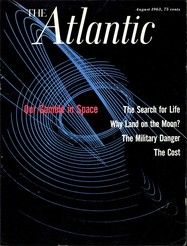
August 1963
In This Issue
Explore the August 1963 print edition below. Or to discover more writing from the pages of The Atlantic, browse the full archive.
Articles
Why Land on the Moon?
“Critics ask whether the exploration of the solar system is a valid enterprise for the United States to undertake at this time.”
The Costs and the Choices
Malaise Yellow
Formerly chief of the London bureau of an American weekly, ROBERT MANNING is now an assistant secretary of stale.
My Father Dreams of Baseball
Short Ballad of Indifferent Performers
The sensitivity of a turtle’s ear falls off rapidly beyond 1000 cycles, thus making it impossible for it to hear the highest note of a soprano, flute, violin, or piccolo, according to Princeton University scientists.
Blue-Chip Firms in Puerto Rico
Barcelona
Record Reviews
The Peripatetic Reviewer
Reader's Choice
Potpourri
Addis Ababa
Guam
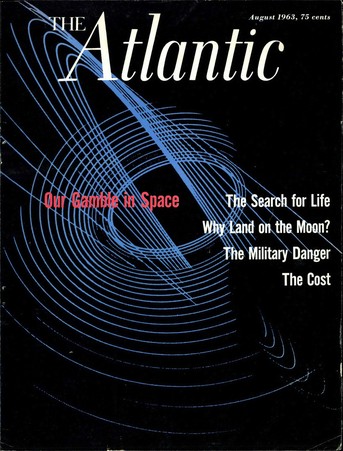
Our Gamble in Space: The Search for Life
Following the challenge of Sputnik, President Eisenhower in 1958 established NASA, the civilian space agency. After the Russians put the first man into orbit in their Vostok I, President Kennedy, warmly supported by Congress, embarked on an all-out space program. In the two years which hare intervened, some of us have had second thoughts. What are the long-range objectives? Why should we land on the moon? What are the military threats in space? And what are the costs? These four aspects of our most portentous adventure in this century are here examined in depth, and the first contributor is the eminent Canadian biologist and author N. J. BERRILL, professor of zoology at McGill University.
The Atlantic Report on the World Today: Washington
The Military Danger
A political scientist primarily concerned with the interactions of scientific progress and public policy, ALTON FRYE has been a close student of the national space program as a scholar, journalist, and government consultant. The article which follows grows out of his recent tenure as Congressional Fellow of the American Political Science Association.
Old and Country Tale
SHIRLEY W. SCHOONOVER’S stories have appeared in NEW CAMPUS WRITING II, TRANSATLANTIC REVIEW, and in the 1962 O. HENRY PRIZE STORIES. Her first novel, MOUNTAIN OF WINTER, will be published by Coward-McCann sometime next year.
The Road to Moscow: De Gaulle and the Kremlin
Many explanations have been put forward as to why General de Gaulle has vetoed Britain’s admission to the European Economic Community. It is the contention of the present article that the General’s opposition to Britain is a deliberate part of his long-range diplomatic maneuvering with the Soviet Union. CURTIS CATE represents the ATLANTIC in Europe.
A Plea
William
SHEILA BURNFORD is a Canadian doctor’s wife whose tale of three animals, entitled THE INCREDIBLE JOURNEY, has become a classic of its kind and has been read and loved by thousands since it was published in March, 1961.
Unpublished Parodies
The Negro Is Your Brother
The Nation's Worst Slum: Washington, D.C.
A constructive critic of American democracy and a staunch defender of civil rights, AGNES E. MEYER for more than three decades has made her winter home in Washington, and her appalling account of the misgovernment and of the misbehavior within its limits must be taken seriously.
The Kings of the Dove: Or, False Gold
Critic and literary historian, MAXWELL GEISMAR has written a series of books on the American novel during the past hundred years and has edited collections of the stories of Ring Lardner and Sherwood Anderson. This article is extracted from his forthcoming book, HENRY JAMES AND THE JACOBITES, a study of the artist and his contemporary cult, to be published by Houghton Mifflin.
Not Far From Ararat
Who's Who Among the Undesirables