A Matter of Form(s)
From a West Coast university, CELIA DARLINGTON supplied us, in support of her article, with all the forms she mentions. They range in color as widely as womens stockings.
Before I went to work for the state university I had had more than a dab of bureaucratic experience. The Navy had taught me to accomplish various office procedures in seven copies on paper of assorted colors and sizes. I had learned to bundle up secret documents in skeins of literal red tape before stuffing them in the dusty files of the vault, and to burn with care all shorthand notes of secret correspondence containing such statements as “Reference A of Enclosure B is hereby forwarded unread for comparison with Enclosure A of Reference B, after which both should be canceled.”
I was also no stranger to the office setup of international bureaucracy, having lived through a successful attempt to get a worker’s permit in Mexico, where, doubtless, twenty front and profile snapshots of me are still scattered through a plethora of files. Perhaps the confidential secretary to the subsecretary to the secretary of state at Gobernación may still remember my familiar figure waiting between the potted palm and the two brass cuspidors in the secondfloor sala de esperanza.
To work for the state university, after my prior conditioning, sounded like a cinch. I looked forward to my association, in a relaxed and interesting academic milieu, with the department of traumatology.
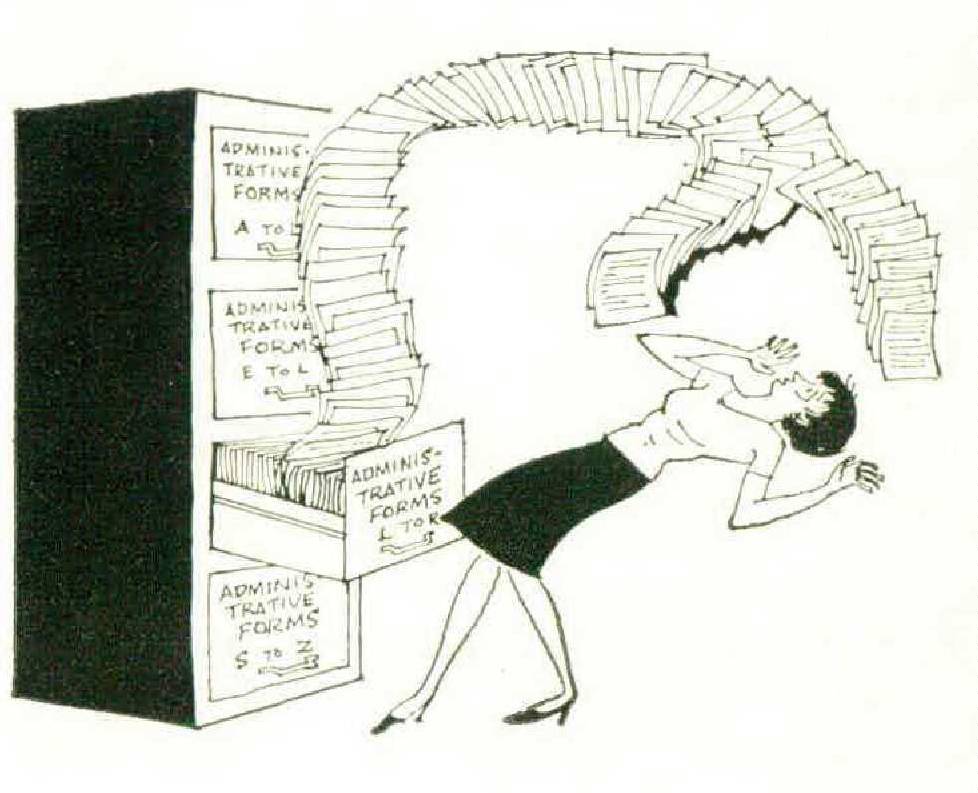
My hopes first became a trifle dashed when I discovered a fourdrawer cabinet stuffed with forms. Under “G,” for instance, were stacked “Form for Report on Tender of a Gift,” “ Report of Acceptance of a Gift,” “Report on Rejection of a Gift,” “Report on Withdrawal of a Gift,” “Report of Ultimate Disposal of a Gift,” “Regents’ Statement of September 13, 1879, Governing Acceptance, Rejection, and Ultimate Disposal of a Gift,” each form printed in ten copies on different-colored onionskin sheets bound into a pad. Research disclosed that the department of traumatology had received one gift, an etching of the Colosseum by moonlight donated in 1921 by a retiring professor of oral hygiene. The “Ultimate Disposal" of this gift was not recorded on a form.
As the days passed at my new post I discovered that in a university of some 20,000 students the small residue of the office worker’s life which is not directed by a form is directed by a voice referring to a form. It is a nameless voice, sometimes suave, sometimes crotchety, foreign perhaps, or enriched by the old South, curt or loquacious, but still only a voice, identified loosely as Personnel, Veterans, Payroll, Garbage Disposal, Retirement, Controller, Soil Erosion, Military Science, Library. With the aid of voices and forms the work of the great shapeless institution goes forward; well, at any rate, it moves. The seven-dollar-map episode was my initiation into this surrealist world.
Professor Wurtenflicker had been doing a piece of summer research on the relative spread of decay between the first and second molars of illiterate Otomi Indians of the sixteenth century, as compared with the incidence of tonsillitis in youths of the Tarahumara tribe who had read all or parts of Hamlet. For this he needed a map of the state of Sinaloa as it was in 1732. Since no such map had been published, it was necessary to draw one. For this, in September, he hired a young man named Gregory W. Smyth, a part-time employee of the department of geography. Mr. Smyth charged $1.50 an hour for his work, which took four hours. He also spent $1.00 for drawing paper, ink, and pen. The map was soon made, and Professor Wurtenflicker was satisfied with it, although, as he pointed out, the details of the delta section of Topolobampo Bay could not be indicated clearly on so small a scale.
The university, perhaps because it was too busy running off forms, had neglected to issue a manual to explain their use. For a new office worker it seemed to be a case of dipping lightly into the file and bringing forth some form that would do. It would be an easy task, I thought, to get $7.00 for Gregory W. Smyth. I selected Form #5377, “Request to the Regents for a Check,”and sent it along with Greg’s original bill attached.
In about a week I started to hear voices about this matter. The controller’s office called me — a definitely testy voice — to point out that Greg was already an employee of the university on a part-time basis, and this made it impossible to write him a check. He would have to be placed on a General Assistance Hiring Form (ten copies) for the additional charge. For this I would need a little extra information: not only Greg’s name and address, but his age, birthplace, citizenship, whether he had any relatives employed by the state, and whether he had ever lived abroad. It was thought for a while that he could bypass signing the loyalty oath, since he had already signed one for the geography department, but a voice later informed me that he would have to sign again, “just to be on the safe side.”
After a week’s quiet, Miss Payroll hailed me to point out that Form #293 for Gregory W. Smyth had been mistakenly signed by the chairman in the space marked for his signature. As any fool would know, the fact that the chairman’s signature was called for on the form did not mean that it was desired in this case. Professor Wurtenflicker should sign, since he was responsible for spending the research grant. It would be better, perhaps, to begin again.
Ten days later, toward the middle of the semester, a call from Payroll informed me that Professor Wurtenflicker’s signature, while it did show that the bill was genuine, was not correct for the General Assistance Hiring Form #293, which must be signed by the chairman of the research committee, Professor Allstone Cheltenham of Physics, on behalf of Research Grant X 2397J, allocated for study of mental and dental deficiencies among backward tribes. This Payroll voice left me with no doubt of my place among the backward tribes.
It was perhaps two weeks later that Form #293, Research Grant X 2397J, came back to my desk with the scribbled notation “Should have been hired by Geography,” and it was another week after Geography had retyped Form #293 (with copy to me) before I heard again from the voices.
This time it was Personnel. “The matter of the hiring papers for Mr. Gregory W. Smyth,” Personnel said. “We in the university do not arbitrarily assign salaries or wages. We consult the Personnel Bureau. Our price per hour for map making is set at $1.47. It will be impossible to honor a bill for $1.50 an hour. I’m glad that Mr. Wurtenflicker thinks it reasonable, but that makes no difference. We could write in the figure ‘$1.47,’ but wouldn’t it be better for you to begin over?”
When I heard again from the controller’s voice things had become a little more confused. Maybe the intervening Christmas vacation had something to do with it. The question was how a bill for $1.00 for materials could be appended in unitemized form. How could the university know what the money was spent for? Where was the original bill? It had been clipped to the original “Request to the Regents for a Check.” I told the voice, but there was no saying where it might be now. After much pleading this voice agreed that the $1.00 bill might be passed with the notation that it had “probably” been spent for mapmaking materials.
We had now to face — Professor Wurtenflicker, Gregory W. Smyth, and I — only the petty details of a Special Payroll (Form 204-2W) to get Smyth paid, and Severance Papers (Form 617-00) to show that Wurtenflicker was through with Smyth.
At the beginning of the second semester, Greg called to tell me that he had just received two checks, one for $1.00 for materials, another for his work at $1.47 an hour, with the usual ten percent deduction for his eventual retirement. Professor Wurtenflicker felt in honor bound to make a special trip to Geography to pay Smyth the twelve-cent difference between four hours’ work at $1.47 and $1.50. “After all,” he told me, “it was a good job, in spite of the Topolobampo mix-up.”
The voices were quiet then, at least on this particular matter, until almost graduation time. Then one day Payroll phoned to ask me if Gregory W. Smyth had done a piece of drafting for Professor Wurtenflicker the September before. I agreed that he certainly had. “In that case,” she said, “he is eligible for the retroactive five percent costof-living raise. We are sending through a Special Payroll and check in the amount of twenty-nine cents. If you will just fill out a Form 0072XL#, Receipt of Cost of Living Raise —”
It’s some years now since I’ve worked for the university. I’ve been mastering various other office procedures: welfare forms for state medical care, workmen’s compensation forms for industrial indemnity, and my own private purgatory of income tax forms, property tax forms, and assorted material.
One hears a lot about the population explosion. But even more imminent and fearful seems to be the explosion of paper work for office worker and private citizen alike. Surely a pill could be developed to halt the multiplication of forms before they snow us under? Something simple, cheap, and painless, which would allow the office worker the pleasures of bureaucratic paychecks while eliminating the proliferation of paper work. As a matter of fact, I am thinking of composing a form which can be filled out to initiate this new system. But I haven’t decided yet whether to make it up with ten or twelve carbons.