The Culinary End
W. F. MIKSCH is a free-lance writer living in Newtown, Connecticut. He was born in Bethlehem, Pennsylvania, and attended Moravian College.
If, a century or two from now, archaeologists poking about in our kitchen midden turn up a yellowed copy of Larousse Gastronomique alongside a petrified package of ready-toheat-and-serve manicotti, they will have stumbled upon the key to the collapse of our civilization. And don’t tell me we are not on the verge of collapse. No society that reads about café brûlot while drinking instant coffee can long endure.
We the consumers are caught on a battlefront between opposing lines of cookbook publishers and food packagers, and no matter which side finally prevails, the most we can look forward to is either indigestion or eyestrain.
That cookbook publishers have marshaled an imposing force for this battle is evident from a sampling of titles in any bookstore. There are cookbooks for bachelors (The Bachelor’s Cookbook), for designing females (How to Appeal to a Man’s Appetites), for the literati (The Literary Gourmet), for suburbanites (What Cooks in Suburbia), for winos (The Winelover’s Cookbook), and for sleepyheads (The Eating-in-Bed Cookbook). There are cookbooks to match good moods (Joy of Cooking) and bad (The I Hate to Cook Book).
They have collected recipes for prospectors (Authentic Sourdough Cookery), for history buffs (A Fifteenth Century Cookry Boke), for reluctant hostesses (Small Meals for Company), and for those who would rather just drink their dinner (The Compleat Imbiber). For the culinary expatriate there is no end of books on global gourmandise, ranging from The Art of Syrian Cookery to Swedish Baking at its Best. There even is a Cook Book Guild ensuring members a steady flow of epicurean reading matter à la Book of the Month. Our preoccupation with typeset gastronomies is fast blossoming into a national mania, and although I have not yet heard of a cookbook titled Lucrezia Borgia Entertains, it should roll off the presses any day now.
With cookbook tonnage at its peak, we might be tempted to concede victory to the publishers — until, that is, we browse through the supermarket. Then it becomes evident that food packagers are matching book lists ton for ton. Shelves and freezers are stacked with frozen, desiccated, canned, ready-mixed, aerosoled, partly baked, quick, or instant, entrées, hors d’oeuvres, soups, desserts, beverages, sauces, and baked goods which require no reading of recipes beyond a glance at the directions on the label.
A recipe for bouillabaisse, which may take up three solid pages in the gourmand edition of Cook Along withAunt Sadie and call for such not readily obtainable ingredients as red snapper from the Blue Danube, is reduced to a simple “Pour contents into boiling water and serve” on the packet of Instant Kiln-Dried Bouillabaisse Soup Mix.
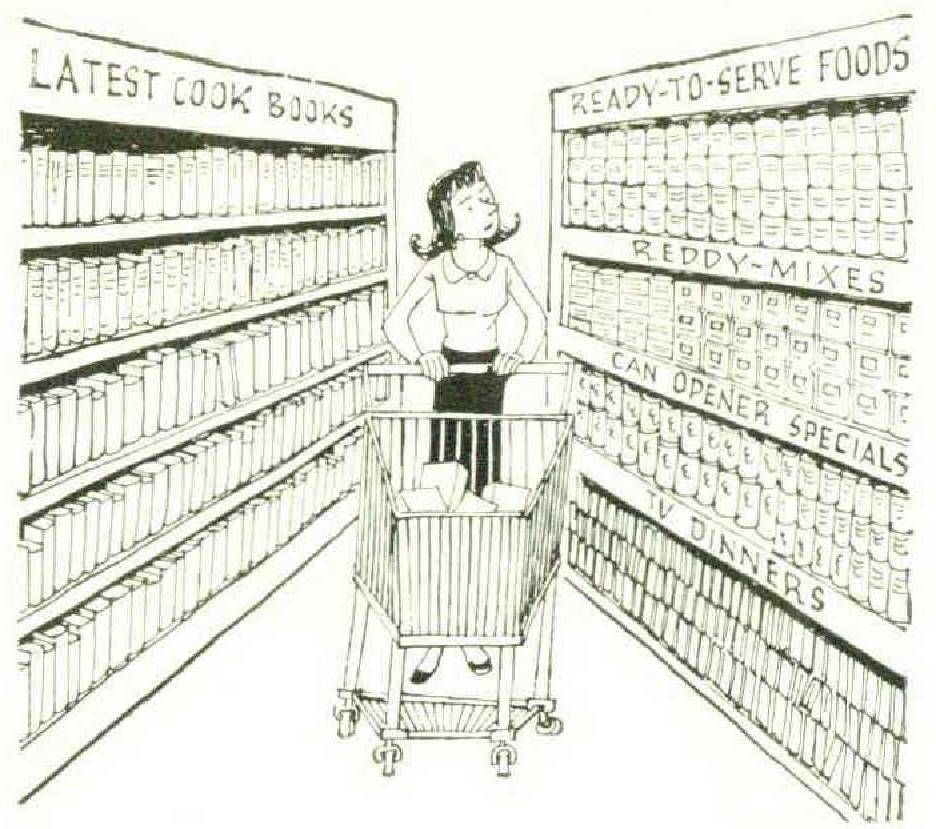
Packagers have stripped cookery of its complexities to such a degree that the only time-consuming thing about whipping up a beef stroganoff is the wait at the check-out aisle.
So now it would seem the packagers hold the advantage, for who will read Escoffier when one can buy his sauce? Who, indeed? The answer is a paradox: just about everyone, that’s who. This was made clear to me last week when, sitting in our kitchen eating a thaw-andheat pizza, I was suddenly dashed to the linoleum by the collapse of some shelves under the weight of my wife’s cookbook library.
The same people who buy the cake mixes also buy the cookbooks!
Ask today’s hostess how she made her cheese dip, and she probably will say, “Oh, I read this wonderful recipe in my Amy Vanderbilt and then I found the ready-mix at the A&P.” Such symptoms of mass inconsistency could well trigger our end, and we may yet go down in an avalanche of mushroom sauté instead of up in a mushroom cloud, as anticipated.
Take the case of the husband who is foolish enough to ask his bride the once sensible question, “How come you can’t make cinnamon buns like Mother used to make?” Does she simply phone her mother-in-law and ask for the recipe? Nothing of the sort. Instead, she will haunt the bookstalls, acquiring a collection of cookbooks which rivals the complete works of Dickens in shelf displacement, and then, after some weeks of avid reading, will slip down to the shopping center for a cylinder of half-baked doughballs that need only be popped into the oven.
Not only will her husband be led to believe that she created them, but she will come to believe it herself, and both will decide that those cookbooks are worth their weight in gold. It is a wonder that the ghost of Great-grandma (who had to mash her own unfrozen potatoes and struggle along with only a copy of Fannie Farmer, if she was lucky) doesn’t come back and roll the pair of them in cracker crumbs.
Even a backyard cookout, which, at first glance, somewhat resembles the basic cuisine of a pre-cookbook, pre-supermarket era (what with all that smudge and lack of organization), turns out to be a mockery — a dismal testament to our eagerness to please the twin tyrannies of publishing and packaging right to the bitter end. For here we see a grown-up man, bristling with shiny skewers and steak thermometers, dressed up in a funny hat and apron, and loaded down with barbecue cookbooks, who can’t even manage to set fire to the handy-pack of self-kindling charcoal.
He is well read in the recipe department, a discriminating gourmet at the food market, yet, like his wife, he has relied on the printed word and the clever package to the point where he is completely helpless and doomed to extinction without them. For when the recipe publishers and food packagers finally have killed each other off, he will be left to starve. And I don’t think I shall like starving one bit.