A Problem in Architecture
AI.FHKD BKNDINKH is a Fellow of the American Institute of Architects who lives in Philadelphia. He is widely known also for his caricatures of personalities in the world of music.
One of the first things an architect should learn is how to deal with wives. A good solid Bryn Mawr or Vassar A.B. with hockey muscles bounds off her marriage couch and starts clipping the magazines which advise her where to hang the guest towels. She makes up glue-smelling, five-and-ten-cent-store manila paper loose-leaf albums filled with little paste-ups and photographs of every detail of a house — snitched or copied from her friends and hosts at teas and bridge parties, showers and receptions — blueprints, magazine cuttings, scribbled notes, razor-cut swatches of draperies, bed linens, towels, and napery. Like a savage little wren cluttering the nest with pinfeathers, dried grass, and breastbones, the bride keeps adding to her little hoard, awaiting the day when she needs more room, a house, and an architect.
She is the worst type and usually is a menace to the young architect who needs a show-off job and has been existing on toilet alterations, factory additions, and changing the big family house into a cozy one for the grandparents, with just enough room to dump the grandchildren for the summer.
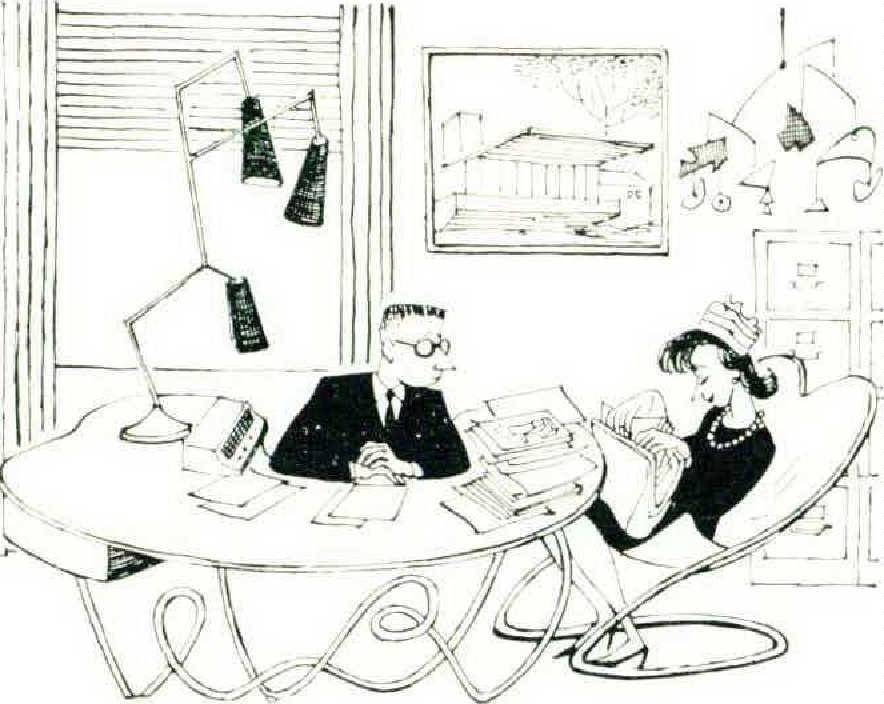
The young client is usually a half hour late for her appointment. She is dressed in that cocktail-hour, allpurpose black and the right jewelry for 5:00 P.M., even though it is only 10:00 A.M., and smells to high heaven of expensive behind-the-ear stuff. She snilfs at the cute secretary borrowed for the morning to make the office look prosperous. The secretary gives the boss an immodest wink and swishes out, banging the door. Well, this is it. The hardened, moneygrubbing lady of the house versus the airy, aesthetic, cultured spendthrift, the architect.
As expected, the client sits down, hoists her skirt to courtroom length, and puts her book of cutouts and swatches alongside her chair. She exhales, deflating her low-cut dress, and takes on a baby-talk voice. This patter is supposed to convince the savage architect that she is a poor motherly thing trying to shelter her brood, despite lack of appreciation on the part of her husband and family, and also insufficient money to build the minimum of her needs. The immediate implication is that the architect can handle the job and still save enough money to get his full fee.
To begin with, she has always wanted a small house which could be enlarged to take care of everybody until the children went to college. At that point there would be no need for a large house. The whole thing should be planned so that it could later be reduced to grandparents size.
The client reaches into her bag and starts fumbling around and comes up with a crumpled plan on a cutout from the Sunday newspaper real-estate page.
She and her husband had been to the Home Show and had seen that I house. It was almost exactly— but not cpiite exactly — what she had dreamed of. Of course, they had been looking for years and couldn’t decide whether it would be a ranch house in Lonely Hills, a rose-covered colonial in one of those quaint villages an hour from the city by train, or whether they should build their very own house. Her parents finally got tired of being needled and gave them a piece of ground right off Nutts Road and told them to get an architect.
The place had a tree, it was only an hour from her husband’s office, and it was free. The Homebuilder house had seemed fine, but the tree would come right in the middle of the living room unless the plans were altered.
They knew lots of architects, and she had already seen them. Her husband was the twelfth vice president of the Fidelity in charge of realestate appraisal: he was also the famous dancing quarterback from Cornell and a member of both the Racquet and Tennis Club and the Union Republican Club. The American Institute of Architects had given her a list of small-house architects, and he was fifth on the list. She had seen the first four, and they had told her that number five was her boy.
She had gone even further and inquired around, learning that he told stories well and could sit up at the dinner table. Her husband had inquired at the bank, and they had said Ok, which really meant something. because most architects’ credit ratings were about on a par with artists’.
There is no adequate school training to get the architect over this moment, and only brutal hardening by experience can teach him to push the hidden button which will bring in the secretary with a letter to sign, or the card of a cinder-block salesman who must see him on an important matter. This gives the architect a breather, clears the heady, perfumed atmosphere, and gives him a chance to reason that, since the banker had said his credit was good, he might be able to make up his losses on her house in some future alteration for the bank, or maybe even on a house for the president’s daughter.
While the architect has been pulling himself together and giving his secretary instructions on when to interrupt again, the client has been making a quick estimate ol him.
This being 1963, his office is completely glazed on one side and looks across the street to another completely glazed office. Japanese lanterns hang from the ceiling, which has light filtering through egg crates. The walls are of exotic plywood, and the window is covered with fishnets and flanked by a couple of rubber plants. The chairs are plastic, delicately balanced, and uncomfortable, and the oversized desk is a slab of black Micarta resting on a pretzel twist of polished aluminum. The walls are covered with his diplomas, perspective renderings for a job much too large for the little office, a drawing of a small house, a signed photograph from his professor, and a plaque of recognition from the local Homebuilders Association.
The next move is the architect’s, and he leads with his chin. “What is your problem, madnme?”
Madame has been waiting through four A.I.A. architects, all of her husband’s friends, her parents’ friends, and her friends for somebody to ask her this pertinent question, and all have skillfully avoided it. At last her moment has arrived.
About five aeons later she finishes the basics of her problems. They are as old as the second house built in the world families. Any girl, with the very small exception of orphans or refugees, comes to her husband with a family which just simply adore her. They have been awaiting the day when they can unload on her all the antiques, pictures, paintings, and objets dart which had been unloaded on them. Most of these are not worthy of thrift-shop salvage, but they have become heirlooms just by lasting this long.
In the good old days people had attics. Today the little spot on the plan marked “storage” is about large enough to hold a vacuum cleaner and a whisk broom.
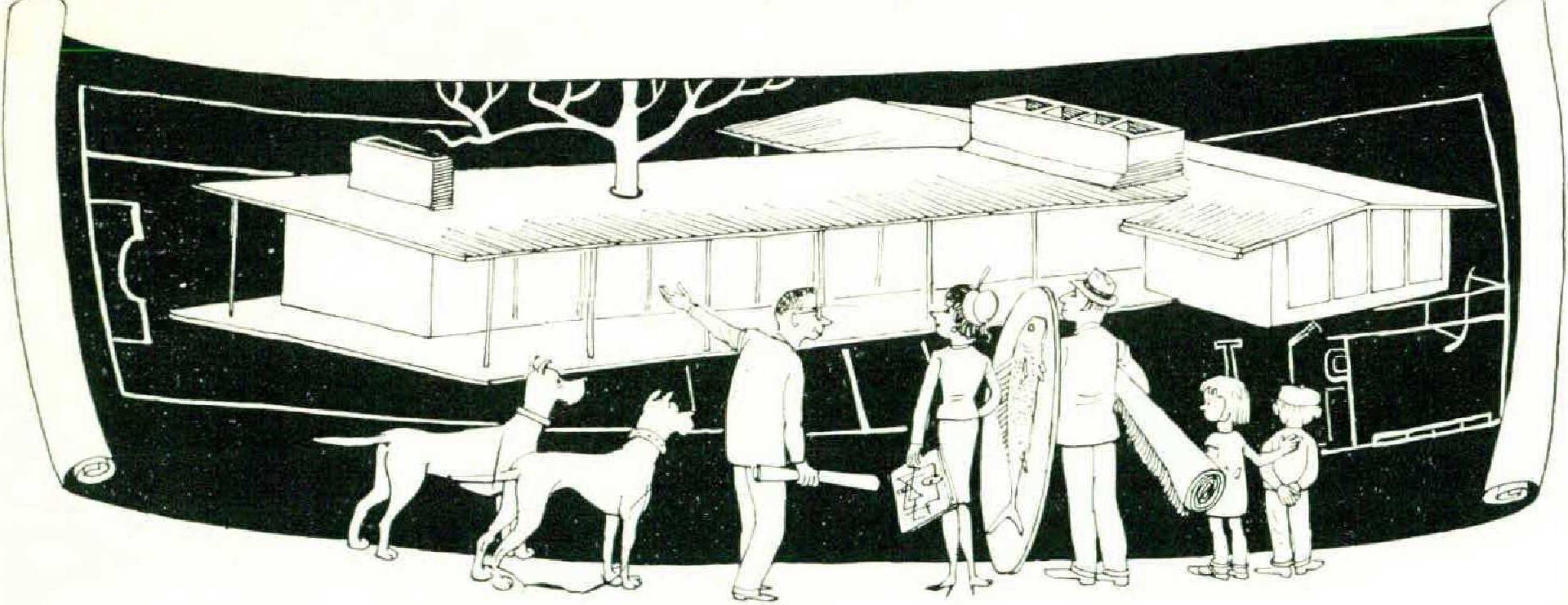
This architect’s client has “things” and parents. She has a grand piano on which Paderewski played just before he taught Truman the “Missouri Waltz.” She has to keep it because Mother played Chopin every night and is going to give them not only the piano but her dining room suite and the bedroom suite, which were carried across the plains in a covered wagon and buried in the Rockies in buffalo skins against the cold of winter. In the spring they were uncovered and taken to Denver. That’s how important they were. Then there is the rug which Great-grandpa had bought in a bazaar in Baghdad when he was an attaché. The dealer had to smuggle it across the desert to Beirut because it was sacred and should not have been moved from the mosque — Mohammed’s horse had ridden across it and left a mark which is visible to this day. On and on went Milady, and finally paused.
The secretary is back from lunch, the architect is hungry and needs a martini, the client is sitting quietly, waiting to be invited for a bourbon on the rocks and a big meal.
“Why don’t we continue this after a bit of lunch, madame?” says the architect, signaling to his secretary to please lend him ten bucks.
“And now, madame, we are ready for the details.” He knows that small house — he designed it. It has three bedrooms and a sliding couch in the all-purpose room for Mother, if she wants to be uncomfortable instead of going to a hotel. The living room cannot take the Baghdad rug or the piano; the bedroom cannot take two three-quarter beds with testers, a chest-on-chest, and a lowboy. The ceiling is much too low for a grandfather clock with a gallery, and there isn’t a wall which will lake Grandaunt’s portrait by Sargent.
It’s a new day, and all those things should be in a museum or sent to auction, unless madame wants to pay much more for the house. And a house which bends around a tree costs more than a box. Pushing up the ceiling a teentsy couple of feet and making the living room a trifle larger run up the cost because of more expensive beams and joist sizes. The client wants all these things incorporated. And now, what does her husband want?
Again the architect sits back and checks it off. He has heard it all before. Her husband wants an indoor-outdoor one-story house, a patio with an outdoor grill for cooking steaks, a swimming pool, a television and radio in every room, air conditioning, and a small room lor his home movies and bridge games, with a fireplace and a mantel for his golf trophies and a space for the tarpon he caught off Miami. He thinks her parents would be happier in a city apartment; his parents should live in Florida and fish; and it is time the children were in boarding school. Old Katie, the family retainer, should be pensioned and sent home; and a modern house could easily have a couple of Great Danes wandering in and out.
Well, I got tired of listening and built the house. It was twice as large as the Homebuilder ranch and cost twice as much, but everybody was happy, and the client gave me a camera and a light meter and a champagne party, and I gave them one of my lithographs of Rachmaninoff, which sits just above the grand piano but is lost in the big living room. The place represents my overhang, sliding-glass-wall period, with a slanted blond-wood living room wall, a twoway lire pi ace. and a dining table which is set up in the kitchen and pushes into the living room. The grandparents moved to California, but the children each got an outside bedroom suite so that they could come in and out, like the Great Danes, without disturbing Mama, who was lying in a fishbowl bedroom, looking out at the expensive garden.
The tree around which we built the house died a year after they moved in, and what with Great Danes you can’t tell where Mohammed’s horse crossed the Mesopotamian rug. Sargent’s painting of Grandaunt is over the entrance wall, and Pop has his tarpon rotting bluely over the free-form mantel, which is littered with golf trophies, a picture of Eisenhower, and hole-in-one golf balls. The place is rigged for sound in every room. There are bedside televisions, outdoor grills, doubleacting doors for the dogs, and a big kidney-shaped pool.
The contractor was the old-school craftsman Scotsman with a wonderful burr and a smelly pipe, and although he thought the whole thing goofy, he built it as if he loved it. When we finished, he said that he would be embarrassed in that allglass bedroom.
It was a successful job, and it solved everybody’s problems. The owners arc so pleased they won’t let any of my prospective clients look at it, and maybe that is good.