The Imitation Meal
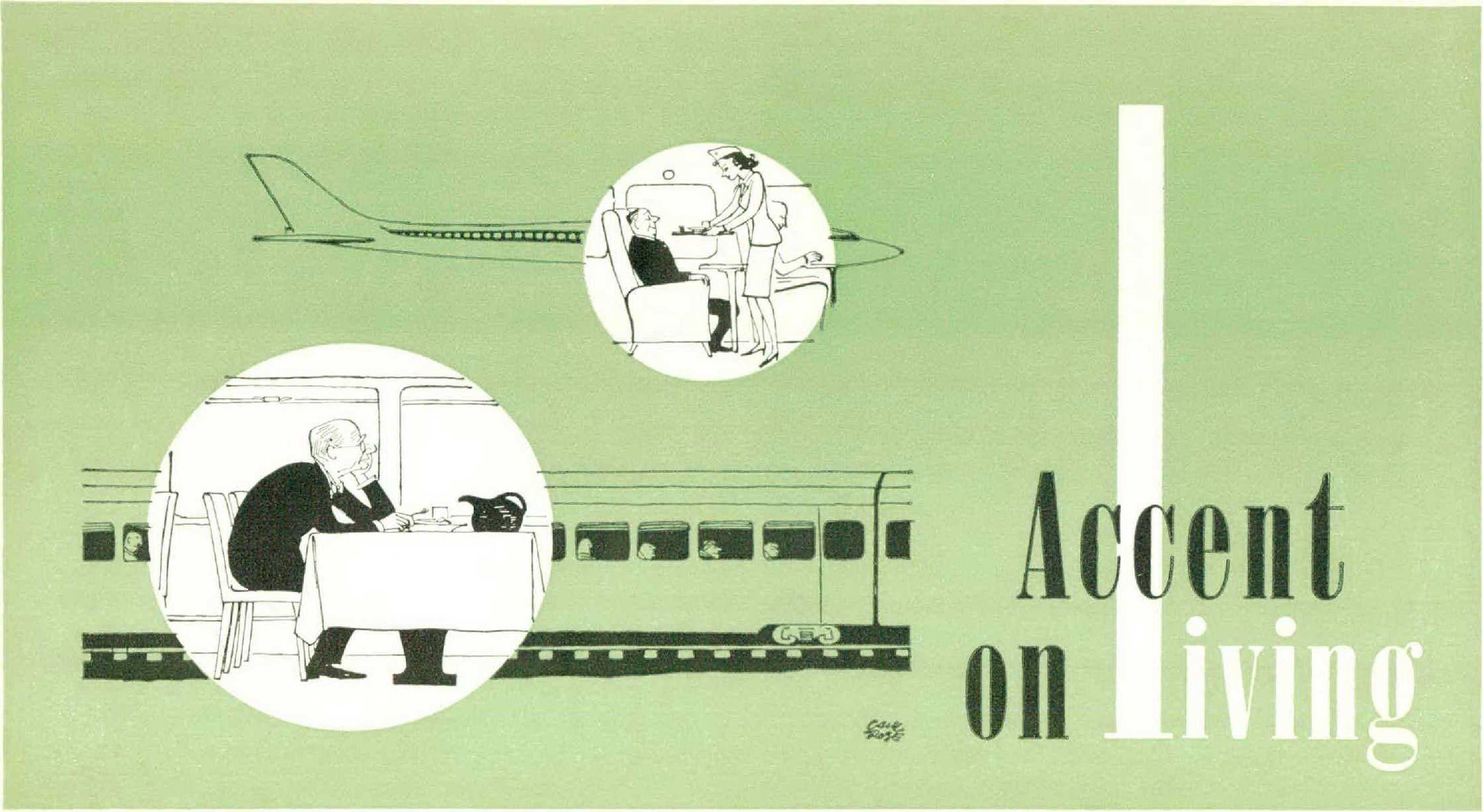
The man sitting next to me in the dining car ordered the turkey dinner. It seemed to me a foolhardy choice, bound to lose, but even my gloomiest expectation failed to prepare me for what the turkey dinner proved to be. It was all arranged on a single dinner plate, neatly, in fact much too neatly, as if no human hand or mind had entered its processing at any stage; it reminded me of those papier-mache viands used in window displays, only in this case one felt that long exposure to the sun’s rays in a window display had bleached the imitation to the point of needing some restoration. A bit of paint was wanted, to touch up the faded peas, give a richer hue to the pallid gravy; some varnish might bring it all back to life.
My own choice was outright disaster: a veal cutlet, watery mashed potato, and broccoli processed to a light French gray. The veal was tantamount to a practical joke, inedible, uncuttable, not even worth a complaint. So, I ate a roll, a small slab of ice cream, and drank a bottle of beer (not the brand I ordered). From where I was sitting I could not help seeing in the open door of the galley two large cardboard cartons overflowing with trash. A half-dollar tip gained me not so much as a nod from the waiter.
There is no use in blaming the railroad for details of this sort. The railroad is clinging to a system that cannot possibly succeed in today’s world. One need not doubt the companies’ statement that the dining car is a great money loser. It is an expensive contraption, especially when operating at far below capacity, as it is bound to do with fantastically poor meals at high prices. Almost any passenger could do better with a couple of homemade sandwiches.
The great error on the part of the railroads is their belief that they can offer several choices of hot meals of fair quality at a suitable price, without more resources than a short-order cook, a freezer, and a radar range. There are still dining cars on some of the long-distance runs, where meals are cooked and served in more or less traditional fashion; these are surely the remote exception.
The food in all sorts of eatingplaces leads me to believe it is no mean feat today even to have a firstrate cook on the payroll, let alone provide him with good foodstuffs and evoke from him the best versions of them. The multichoice meal, produced and served under the conditions imposed by a dining car, is more likely than not to be an abrasive experience for all concerned.
The air traveler is fond of grumbling about airline meals, but these seem to me incomparably better than what the dining cars serve. They’re free, too, and if the meal includes anything the passenger doesn’t like, he can skip it.
The meal in the air has improved a good deal since the early coffeeand-doughnuts snack of a quarter century ago. Two hostesses can make a pleasant interval of it for an amazingly large number of passengers, and without overexertion. The railroads seem to have found nothing in all this to emulate. The reason, I suspect, is that not even the most energetic young woman could carry a tray and at the same time open the end door of the ordinary railroad car, especially of the kind that is equipped with the compressed-air assist (not at the moment in working order).