Who's in Charge Here?
A cigar commercial on TV is granting a special dispensation to smokers: you don’t have to inhale it to enjoy it, says the announcer. His words bring relief to anyone who ever inhaled, inadvertently, a nickel cigar and felt, thereupon, as if he had been kicked in the chest by a horse. Inhaling nickel cigars is an acquired taste, and it is good to know that we are not obliged to acquire it. We are appreciative, also, of the continuing offer of the cigarette that still gives us, without extra charge, a quantity of air with each puff. Favors of this sort are always welcome, but the really spectacular events in the tobacco world seem to lie in the period between now and next July.
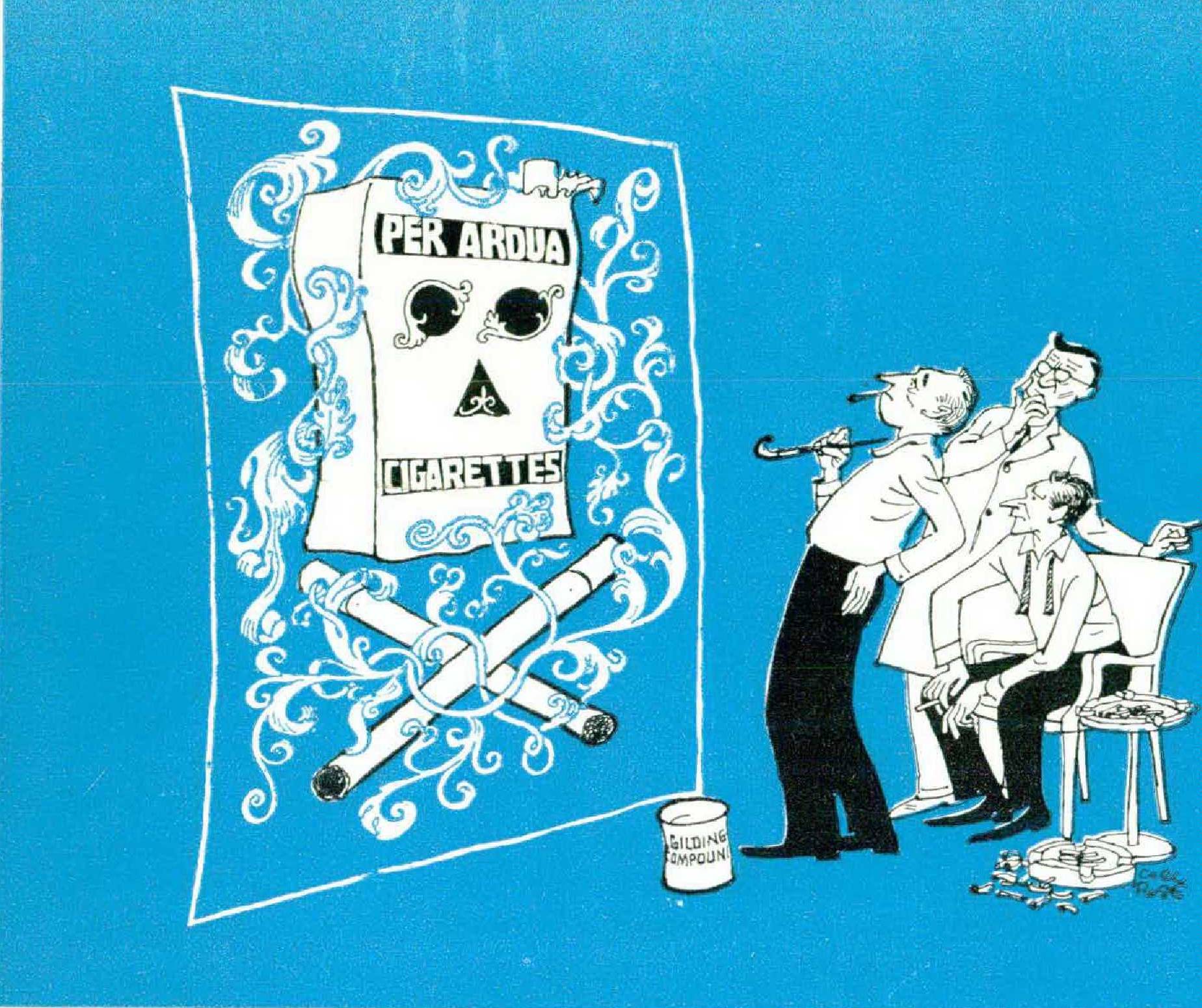
By the first of January, for example, the label on each package of cigarettes will have to include the warning that “cigarette smoking is dangerous to health and may cause death from cancer and other diseases.” The order to this effect comes from the Federal Trade Commission, which magnanimously adds that a cigarette maker may paraphrase the language of the warning provided its meaning remains unmistakably clear. The same stipulations will apply to cigarette advertising after July 1, the FTC tells us. Spirited opposition by the cigarette makers will bring cases into just about every court in the land.
Meanwhile, a sizable interagency row must be in the making as the Food and Drug Administration and the Surgeon General try to establish who’sin -charge -hereanyhow. Further involvements will take in the subsidy of tobacco growers, through the Department of Agriculture, that keeps thousands of civil servants on the nine-to-five shift; not without heavy infighting will the field agents, file clerks, supervisors of stenographic pools, messengers, chauffeurs, and the whole GS horde withdraw to private employment. Surely the tobacco statesmen in Congress will be making themselves heard at the same time.
The Department of Justice is no doubt astonished to find that it has a tobacco dilemma on its hands: Will it be obliged to prevent the adoption of the wonderful new “code” of the cigarette industry? The code, we recall, will be very stern with member companies who try to persuade young people to smoke and with those who assert health-giving properties for their product; and the administrator of the code — as yet unnamed — can fine offending companies as much as $100,000 when the code goes into effect — if it ever does. The possible hitch is pointed out, perhaps unexpectedly, by the cigarette companies themselves in raising the question whether this self-policing effort might constitute a violation of the antitrust laws. In other words, would an agreement not to insist that athletic prowess is due to cigarette smoking be a conspiracy in restraint of trade? What will the Department of Justice say about that?
The questions are knotty enough to provoke severe jurisdictional disputes. Although both agencies have managed to ignore the issue in the past, what will the FTC do if the FDA rejects a label approved by the FTC? Will one try to usurpate — a word I garnered from a harangue by Governor What’s-his-name of Alabama — the prerogatives of the other?
Tireless in its pursuit of comic relief through what might otherwise seem a grim inquiry, the American Medical Association has brought out a small pamphlet on what risks to health smokers may be incurring. Foremost among the hazards, says the AMA, and without cracking a smile, is injury by fire, especially for those who smoke in bed, not to mention damage caused by burning holes in clothing and upholstery.
The AMA’s view on excessive use of alcohol might be similarly entertaining. Intemperance would be bad for the soinal cord in certain cases, presumably, while in others the cosmetic effects could be embarrassing. That is, the inebriate might (a) fall downstairs and break his neck or (b) become quarrelsome in a bar and get beaten up, with consequent damage to nose, teeth, eyes, cars, etc.
The right words for paraphrasing the FTC’s warning about cigarettes do not seem to have been put together so far. A contest may be necessary. But somewhere, we may be sure, some gifted euphemist is hammering out the slogan that will keep the smokers coming, even at the risk of death, disease, and burning holes in the furniture.