The New Sportswriter
C. MICHAEL CURTISiS a member of the ATLANTIC’S staff. He is a Cornell graduate and lives in Cambridge.
It used to be that kids who loved sports but were too small to play football and too fragile to carry water turned to sportswriting as a natural alternative. Sportswriters, in the old days, had fathers who played semipro baseball, mothers who wouldn’t let them shoot cap pistols, English teachers who encouraged them to write bad poetry, and either acute asthma or very thick glasses. The old sportswriters were quick to develop an inflated prose style, a distrust of simple language, and the conviction that it was they, and not athletes, who kept the world of sport in the heart and mind of every living American.
Their prose enlivened the daily newspapers, just as their unfailingpresence made it quite impossible for a baseball player to take a shower without first telling what it was like to drop a fly ball in the sun or be shelled from the mound early in the second inning. As interest in sporting activities grew, the sports magazine arrived upon the scene, dedicated to exploring the deeper metaphysics of the athlete and his time. The new market called for a new style of sportswriting, and progress, as always, was served.
The new breed of sportswriter writes as if he were a graduate student in sociology or psychology, on leave from a large Midwestern university and happy in the discovery that the Ford Foundation does not care how long it takes him to research his exploration of “Motivational Factors in the Role Quantification of Professional Athletes.”
His scholarly interests, stifled in the humdrum coverage of the daily newspaper, are given full play in the monthly sports magazines, whose editors believe sports fans are easily bored by ordinary hero worship. The modern sports fan, these editors believe, no longer cares who is the greatest home-run hitter among contemporary left-handed relief pitchers, or how it feels to be stepped on by Bronco Nagurski. He wants to know how his heroes tick, or better yet, why they don’t.
Rookies, we are assured by the new sportswriter, are not dropped by major league baseball clubs because they cannot pitch or because they do not hit baseballs in such a way that they are not immediately caught. The modern rookie who fails to win a big league berth lacks “motivation.” For the purposes of public consumption, this shortcoming is described as the absence of “the will to win,” or, simply, of “desire.” This difficulty afflicts older players as well, as latent neuroses gradually rise to the surface, spurred on by imagined trauma, such as psychosomatic charley horses and hardening of the arteries.
Managers, too, succumb to this neurosis, particularly the managers of second-division teams. Club owners face a peculiarly difficult task in finding replacements for these men, it being an ironic coincidence that successive managers generally fail to improve upon the record of their predecessors. The Washington Senators, it is reliably reported, have embarked upon a full-scale study of their executive hiring practices in an effort to determine why so many successive managers have proved lacking in motivation. The Senators have already experimented with the drastic ploy of shipping their entire team to Minneapolis-St. Paul, in the hope that in doing so the latent death wish could be banished at the same time.
Track performers, particularly those good enough for international competition, fall victim to unusual psychological stresses, and the new sportswriter is quick to catalogue these infirmities. Americans who lose in head-to-head combat with Soviet or other Communist bloc athletes are widely known to have fallen prey to psychological blocks suggesting exotic childhood stresses and possibly impugning their patriotism. Future candidates for American Olympic squads may face a battery of psychological tests calculated to determine whether or not they really wish to defeat the Russians, and if not, which category of national athletes they most wish to defeat.
In addition, a new pattern of Olympic competition could be devised, pairing American athletes with competitors who most wish to lose to them. If this robbed the games of an element of suspense, it would certainly afford a satisfying pairing of noncombative psychological factors.
There are sports enthusiasts who prefer the clash of similarities to the neat balance of opposites, and professional football is a good example of a sport arising out of this appetite. Discerning sportswriters can always sort out those halfbacks who don’t really want to advance beyond their line of scrimmage, or quarterbacks who compulsively throw footballs beyond the reach of split ends, but some measure of discipline would have to be imposed upon a contest involving athletes who reliably possessed the will to win. Touchdowns, clearly, are scored only against a defensive secondary riddled with hidden reserves of nonmotivation.
Two teams equally possessing the desire to win could only achieve endless scoreless ties and gradual decimation of personnel. Concessions could probably be arranged so that one team or the other would win and thus satisfy the technical requirements of league competition, though the repressed desires which would surely result present an entire slate of new problems.
The only sport which can be said to have achieved emotional maturity is professional wrestling, in which psychological factors have been recognized and sharply regulated. Wrestlers who lack desire are regularly pitted against wrestlers with the will to win, and little effort is made to persuade their audience that the result of the match is not preordained.
In order to further the accomplishment of social goals, professional wrestling competition is restructured so that competing wrestlers assume positive and negative social roles. Winning wrestlers are publicized as bright young college graduates who wrestle professionally in order to subsidize their efforts to become neurosurgeons.
The winning wrestler sells stocks and bonds when he is out of the ring. His hair is cut short, his physique is fairly trim, and he is known by his first name, usually Bill, or George.
The loser, on the other hand, has long, unruly hair, is unusually obese, and is said to have been rescued from a wolf den on the Malayan archipelago or from somewhere behind the Iron Curtain. His assumed name is appropriately grotesque (Gorilla Monsoon is a current example) and is usually linked with the suggestion of sadomasochistic tendencies. In order to preserve an impartial interest in both categories of wrestler, promoters of the sport publicize a list of the ten top villains, presumably those wrestlers whom they would most like to see maimed, blinded, or permanently crippled.
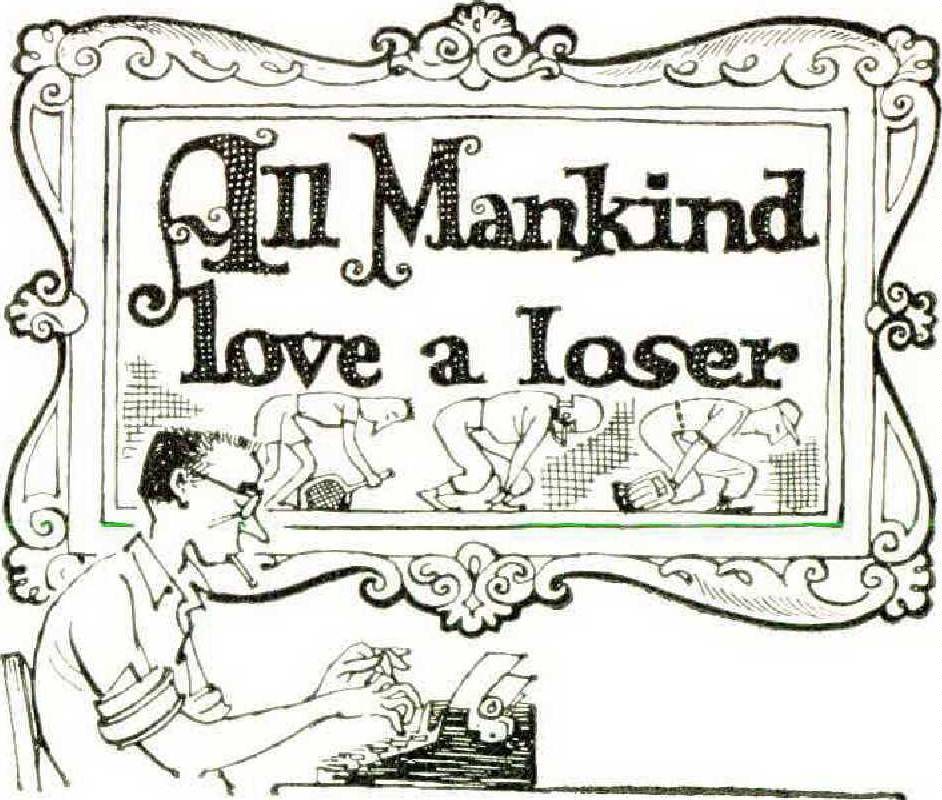
The insights of the new sportswriters have not been entirely ignored by the promoters of professional baseball. Realizing that nondesire is as common to sports fans as to athletes, a wealthy widow brought to New York a baseball team comprised wholly of athletes committed to losing. The nonachieving New York baseball fans, who had endured the Yankees for generations and had finally given up the Dodgers and Giants in disgust, gave the Mets their unqualified support, and made the new New York franchise one of the most profitable in professional baseball. Mets players are carefully chosen for their “will to lose,” and enormous popular acclaim came to Marv Throneberry, a first baseman who had mastered the art of dropping pitched, thrown, and batted balls. When Throneberry showed some signs of restiveness and threatened to turn into an ordinary achiever, he was sent to the minors to recapture his lack of form.
Similarly, Roger Craig was adored by the New York fans while he lost eighteen straight games, but was immediately traded to the St. Louis Cardinals when he began to look like a winner.
The new sportswriters have done much to improve our understanding of athletic competition, and the requirements of mental health. What will happen when the Ford Foundation calls in all those graduate theses is anybody’s guess.