Italian Land Bargains
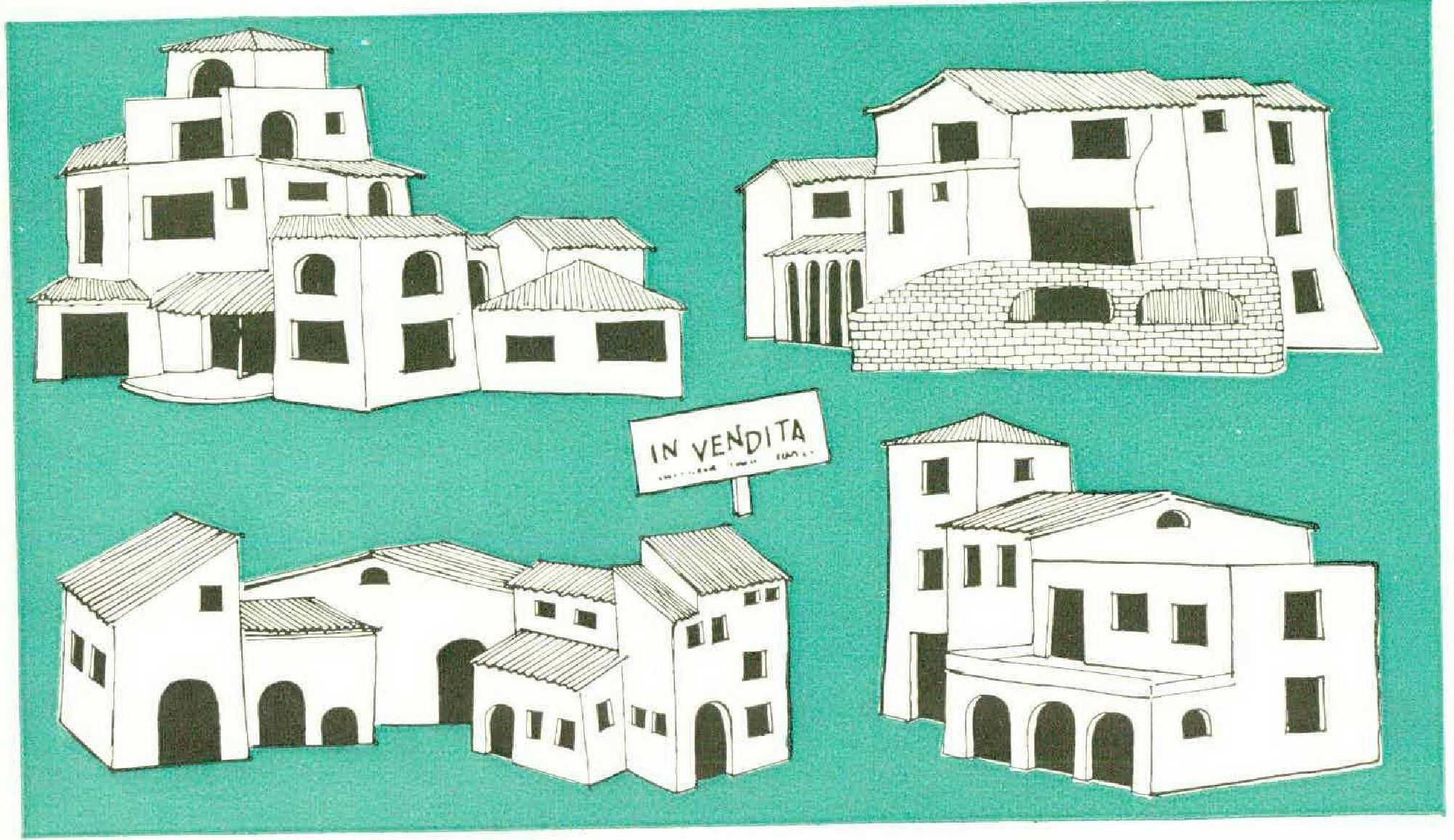
A Mediterranean home is a muchenvied possession: many people have wanted to own a castle in Spain, but castles are notably difficult things to acquire, no matter how much one dreams of doing so. But nailing down a villa in Italy, even for a very modest price, is lar from impossible, though there are a lot of intangibles to take into consideration.
Certain minute cells, scientists say, can never be photographed as desired, because the very act of observing them makes them change. Real estate in Italy is much like that. It is ruled by fashion, by the search for cheap living and good beaches, and nowadays by the new highways, which make commuting easy.
I remember when living in Taormina, on the east coast of Sicily, some sixteen years ago, a Milan businessman had paid $50,000 for a house (it was an excellent buy and is probably worth three times that sum today). However, from then on nobody ever bought another house in Taormina, as $50,000 became the asking price for anything better than a peasant cottage. The spell was broken by a famous American dietician who moved from his rented villa in the town and bought a beach bungalow at Mazzarò, an almost deserted village situated in a pretty little bay eight hundred feet below Taormina. The beach craze had not then begun in Italy, but when it was realized that modern tourism meant sunbathing and swimming, the development of Mazzarò was frantic.
The whole period, dating from Kaiser Wilhelm, who was a winter visitor at Taormina, came to a close in 1963 when the last of the old-style foreign residents died: he was a Canadian, and he gave his house to the municipality. Taormina is now part of the tourist run and no longer can be considered the “right” place to have a villa. Capri, equally, is not the immediate choice anymore for a Mediterranean home, lovely as it is. Several years ago, Ischia took over as the new nepenthe, but only on the top level — its prices were too high to attract the artists, the exiles, and the lunatic fringe which had years before abandoned Capri. One artist I know lived for many years on the tiny windswept island of Procida, next door to Ischia; he said it was inexpensive, but only because there was next to nothing to buy. Italy, in fact, is a place where luxuries seem to cost less than necessities. The Italians are big spenders, whether rich or poor. They are rarely prudent, and the recent economic miracle, even as shaky as it is today, has done little to prove them wrong.
In the last few years, there have been national invasions of various areas of Italy by mass tourism; these have increased land values, but not in the way that most property owners would wish. There has been a German invasion of Ischia, as there was, much earlier, a Swedish one of Taormina; and, more recently, a French assault on the Amalfi and Calabrian coasts, and an English one on Alghero in Sardinia. On Ischia, the street signs, and even the homily during Mass at some churches, are often in German. The French now have a well-defended beachhead near Palinuro, but in Amalfi, Gallic factory girls, and a castrum of Austrian girls in Praiano (a village between Positano and Amalfi), rule the roost; the effect of this is that it is now difficult to get any service after 8:30 P.M., as there is a general exodus of the younger members of the catering staff at that hour. Alghero also excludes itself as a place to live because of the airlift, shuttling all summer, of Lancashire holiday makers, who fill every hotel.
However, the autostradas are putting new parts of southern Italy on the map in a practical sense. In the old days (and I speak of only a few years ago, things are changing so fast) one filled one’s tank with gasoline and loaded a few extra cans of gas and water before venturing south of Salerno. Now that Naples is only a half-hour drive on a six-lane highway from Paestum, Sapri, seventy miles further on, just after Cape Palinuro, is developing as a resort. Even Apulia is, nowadays, not too distant. There are planes to Bari and Crotone from Rome, as well as good roads, and the British Rosa Marina Company is building small beach houses for sale to foreigners, more as places to retire to than as summer homes. Recently I met a young architect who is working on a project to make Tropea in Calabria into an elegant resort — or, better, a refuge from civilization. The yacht basin is already under construction, but it will be some years before the villas are built and their gardens flourishing.
The Adriatic coast has always been the cheapest part of Italy and the one where development is easiest because of the flat terrain. The beaches are fine, but it is distinctly cold there in winter. It is not tor sun worshipers, even in summer, as there is always somewhat of a cool breeze. The latest growth there is just north of Pescara at Montesilvano, which has been made possible by the new ITAVIA air service and the newly widened trunk road.
Such places are unlikely to become smart; they are for modest living. Fashion, however, has set up two new seashore places of residence within easy commuting distance of Rome. One is the Orbetello Peninsula (it has been named Argentario), and the other the Circeo-Sabaudia complex, south of Rome. Argentario has been made attractive by the ruling royalty who summer there: Roman princes and distinguished members of stage and screen. Here the prices are mostly in the bracket of six to eight thousand lire a square meter, and for certain plots with a private beach, the rate goes as high as twenty thousand.
The method of turning Italian land prices into American terms is to multiply the lire figure by 93/1000 to turn the meters into feet; then divide by 620 to convert into dollars. Or just divide the lire by 7000, and it comes out less than one hall of one percent below the correct answer. So the median price of 7000 lire for this current elegance is about one dollar a square loot. Hectares you will also come across, but they can safely be considered to be two and a half acres.
Porto Santo Stefano on the Orbetello Peninsula is one of the new spreading residential resorts. It has a northern aspect and consequently is not excessively hot. Ansedonia and Porto Ercole, nearby, look south and are for those who like to broil themselves all day. Sabaudia, on the sand flats of what were once the Pontine Marshes, and Circeo, which is on the little mountain on the promontory, are for real salamanders, and I note that villa owners keep their suntan all year round. This area is also more convenient to Rome than Argentario because of the straight roads across the marshes, a fast car can make the trip in a hundred minutes.
There are many ways of going about buying property. There are no realtors, in the U.S. sense of the word, nor estate agents, in the English style, to make it easy, but there are one or two distinguished and capable foreigners who are filling the breach with honors, one of whom — a Russian princess — rightly claims to have invented the idea of transforming the lovely old palaces of Old Rome into smart apartment houses.
On the whole, if you ask foreigners how they got their Italian property, they will say that they bought it from Prince this, the Marquis of that, or Baron the other. This is a method which is most reliable, because there is rarely any doubt about the real ownership of the property and the vendor’s right to sell it. Some, who bought from small landowners and peasants, have had their title to ownership, even after many years have elapsed, contested by some brother or uncle living abroad who was not consulted in the sale and was not paid his share. There is also the risk that one buys mortgaged land or land which has debts on it to the municipality; in all cases, then, a lawyer or a mediator should be employed to get a clearance from the municipality. I he local consul can usually recommend a reliable man.
The municipalities and the fine arts commission own land and houses — the demanio, this is called — and they will, to the right person, rent or sell for very reasonable prices. In Rome, for example, some of the most desirable residences are sited inside classified antiquities and are rented for a song to celebrities, usually actors or artists. This is true of many parts of Italy: the foreigner can rent a national monument, such as a Palladian villa in the Veneto, provided he guarantees to maintain it and, in some cases, restore it.
Architects are excellent advisers for real estate, and since, as often as not, their assistance will be required anyway for putting in central heating and other services, it is worth employing them from the start.
Serious things, such as buying land and houses, in Italy work out best on a high social and professional level — that is, if you like down-toearth democratic values and no snags cropping up once everything is signed and sealed. Starting at a lower level, you may meet inexperience and illusions which are charming and colorful, but which could also be expensive and irritating.
Recently I made a trip into the countryside to see how one could set up modestly. I visited a village thirty-five miles from Rome where they are giving away eleven thousand square feet of olive groves to artists who ask for them. The rush is formidable. I asked the way from a highway patrolman early one Sunday morning, and he said he’d been asked ten times already how to get to Monteleone Sabino. There are now a thousand applicants, eight bundred Italians and two hundred foreigners from twenty-seven different countries. The project has a long way to go, and to my mind, like Aspen, Colorado, will have need of a millionaire to put it into orbit. The price of land there for nonartists who want to live in an international art colony is from one-half cent to one and one-half cents a square foot, The lower price means that some earth moving is necessary before you can lay a foundation for a house. I he village has its points, among which is that the Terminillo ski slopes are only an hour’s drive away.
A half-hour drive above Subiaco, the Benedictine monastery town, there is a village for journalists -Monte Livata. This is already operative with 150 chalets, though water is only now being supplied. Here, again, ski slopes are not far away, and the summer climate is cool. The price for nonjournalists is eleven cents per square foot, considerably more than at Monteleone Sabino, but there are already hotels and restaurants at Monte Livata, and the convenience of shopping in Subiaco as well. The basic price, then, for land well away from Rome in the hills is from one-half cent to eleven cents.
But for the rich, or for foundations, it is a very different story. The twohundred-room Villa Mondragone, which is located just above Frascati town (where the Gregorian calendar was worked out), and which, until recently, was an academy for the Italian aristocracy, is offered for forty-five cents a square foot, including 150 acres of land, a considerable olive oil production, and masterpieces by the sixteenth-century architect Vansanzio. Several of the other enormous villas of Frascati are for sale: the asking price for the Mondragone is more than S3 million, the Grazioli Villa is said to be about $400,000; and the smaller Villa Rufinella is now also on the market.
Frascati, as much today as in the past, is a most envied residential area. Land a couple of miles out of town costs about eighteen cents a square foot, but going up toward Colle Pisano the price drops to live cents for smallish lots. Valmontone, some ten miles away, is becoming interesting because the new autostrada from Rome has made it quickly accessible. Prices have risen to ten cents for well-sited plots near die highway, and in some places to as much as thirty cents.
I have driven for hundreds of miles in Umbria and Tuscany with people who know the area, and they continually point out uncultivated farms and unlived-in farmhouses. The mayor of Gubbio bemoaned to me the fact that his little domain lost two able-bodied inhabitants every day; this does not sound like many, but more than ten years of steady emigration has drained the countryside. Much land has been mechanized, but much has been abandoned. I saw one lovely earlynineteenth-century country house near Arezzo; it had 150 acres - - five of vineyards, fifty under crop, and ninety-five of woodland, where there was another house and farm buildings. The price is about one cent a square foot — in all about $56,000. Near Chianciano, I visited an American who had bought a magnificently sited citadel tower, already converted to modern comforts with a prolusion of bathrooms and radiators. His twenty-room residence with superb formal gardens and an orchard had cost him well under $100,000. He was plainly delighted with his purchase; it was a bargain, he assured me, by any standards. On a drive to Montepulciano, he pointed out farmhouses and land I could buy for sums which could be counted in hundreds of dollars, not thousands. He had been touring when he saw his tower, he told me; he had stopped and asked who owned it. Within the week, he had bought it from the biggest landowner of the area, the Marquis.
A major problem with buying in the country is water and electricity, both of which should be closely investigated. Sinking wells and pumps is expensive, particularly as they can and do run dry. If water is available, even a trickle, it is worth putting in huge cisterns. There are three types of electricity in Italy, each for a different purpose. There is ordinary lighting, which varies around 130 volts, but it is often of an amperage sufficient only for peasants. However, if it is available, the government electricity company will supply more. There is the harder-tocome-by industrial current, which, at 220 volts, is for domestic appliances and drinking-water pumps; and then forza motrice for farm machinery. But throughout all Italy there is no difficulty in getting a supply of liquid gas in canisters, for cooking, heating, and even lighting.
Recently, an Italian magazine discovered, with surprise, that the small towns in tire hills just behind the Italian Riviera were being depopulated and that you could buy a house for $500 only a half-hour drive from the beaches — the $500 house, however, is a peasant house which needs about $5000 spent on it to make it habitable.
It is tire foreigner who usually sets tire pace for finding new places to live in Italy. In one case it was Thor Heyerdahl. 1 met him just before he published Aonl iki, and lie told me that be had bought a wonderful old house for next to nothing in the hills behind the Riviera, not far lrom the French border.
The idea of buying property in Sardinia has fascinated many people in the last five years or so — again tire foreigners led the way. However, when the Aga Khan started shopping there, the boom got out hand, and many withdrew. The Aga Khan’s syndicate, which owns most of the Emerald Coast (on the northeast tip of the island), would seem to have found the problems development onerous, and it is proceeding cautiously: so far there are two unconventionally chic hotels already open, and a luxury “fishing village” is in the last phase of construction at Porto Corvo, which would seem to be a latter-day shepherds’ and shepherdesses’ world for harried executives.
The real estate flurry has now died down, and less ambitious elements are trying again. Recent asking prices were sixty cents a square foot for land adjoining the Aga Khan’s; eleven cents for almost any coastal land in lots of 6 acres or more, dropping to eight and even two cents for 500 or 1000 acres; less than ten cents for prime agricultural land; and less than a cent square foot for rocky rough-shooting country. But these were only asking prices.
To my mind, the south coast is the most practical proposition, for as well as having all the modern conveniences of a major city like Cagliari at hand, the prices for land arc sensible, and values are sure to rise. Santa Margherita di Pula, to the west of Cagliari, is already considerably developed, with hotels and villas in the pinewoods along the beach. And the land behind the beach is excellent, well-irrigated agricultural land. Villasimius, to the east toward Cape Carbonara, is also interesting and dramatically wild, scenically, but it has the disadvantage of having a dirt road, which should soon be asphalted, and perhaps for some people the coastline is aggressively solitary. On the east coast, near Arbatax, there are three villa villages in operation where one can build, or buy already built new villas; with half an acre of land each costs about $8000.
Fighting with a foreign language to build a beach house or a mountain chalet which needs few architectonic pretensions seems to me excessive, particularly when one remembers that it is an old Italian custom to watch the builder at work every day. I have noticed that many people have taken the easy way out and put up a prefabricated cottage. This works out at $6000 for three rooms, a bathroom, a kitchen, and a garage, with all plumbing, central heating, and fixtures — anywhere in Italy, with a small extra charge for the sea crossing to Sardinia.
I have looked at these places I mention, and so have many other people; logically, therefore, they have already changed. Word has it, for example, that a Dutch and an English syndicate have recently been buying land in Umbria and Tuscany at rock-bottom prices. Already people are looking for a new Sabaudia, with equally long sandy beaches, but which costs much less. I wonder where it will be; possibly they’ll choose the lonely beaches below Tarquinia, which cry out for development — if a ruling monarch builds a villa and makes it famous or an Onassis sinks the money to develop it.
Instead of conforming to rule and buying a house in Frascati, two Americans I know have just acquired country houses in the rich hill farmlands beyond Tivoli: one near Castel Madama and the other close to Palestrina. They bought well, but will the next man? He may, but if he comes up against difficulties, he may be wise to take advantage of the autostrada and look next in the medieval town of Ferentino for a real bargain; or, perhaps, only ten miles up the Via Cassia from Rome, by the ancient city of the Etruscans, Veii, particularly desirable as it is slated as a new national park; or, again, there is the pretty little village of Anguillara on romantic Lake Bracciano, which has a good view of the Orsini Castle. Many Americans are buying villas and cottages outside Florence for a song. One woman has found Renaissance frescoes in hers which neither she nor the former owner knew about and which, at great expense, she is having restored.
The subject of real estate is vast and many faceted. However, if you decide to buy a house — or, better, build one — you will find yourself in enthusiastic company, because there are no other people who revel more in bricks and mortar than the Italians. With them, you may find that the sheer pleasure of building outweighs the inconveniences, and perhaps you will catch their infectious passion for always having some construction or architect’s plans in hand, a custom which is almost as much a part of Italian life as the afternoon siesta.