Working for the Government
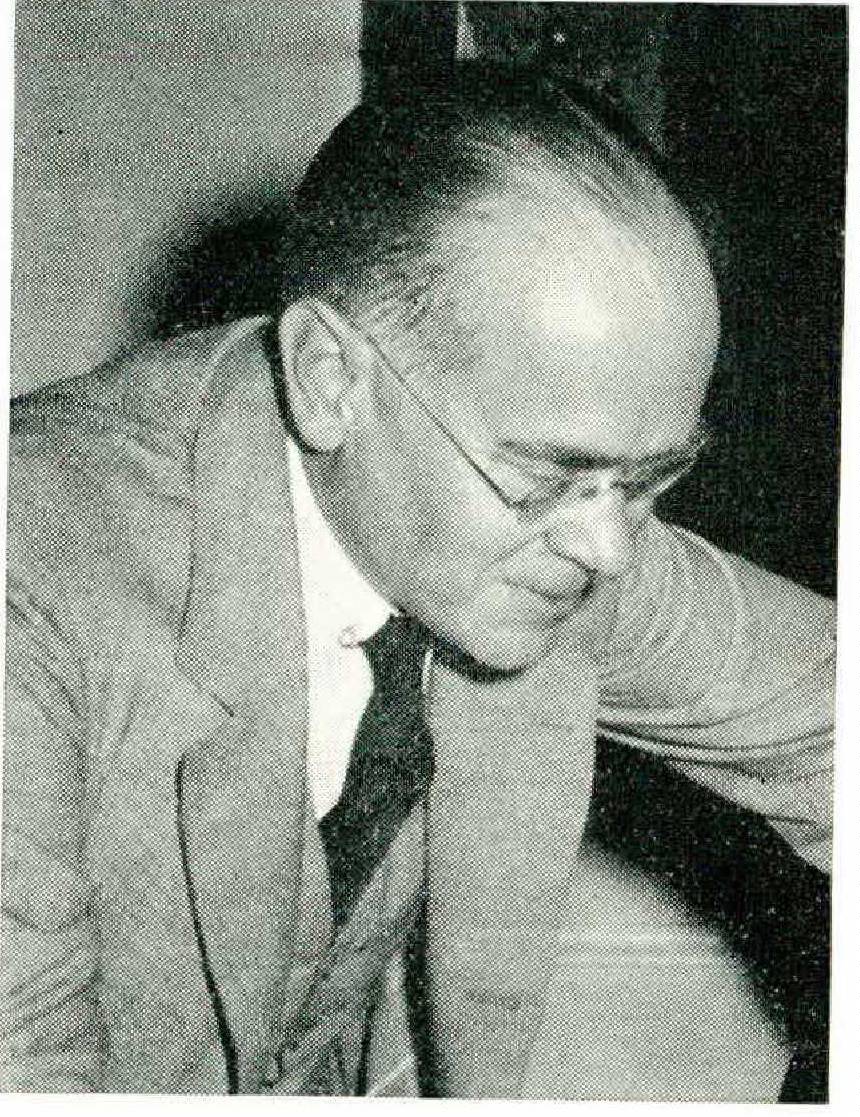
A native of Omaha, Nebraska, Charles W. Morton came to the ATLANTIC to become the associate editor after valiant service as a reporter on the BOSTON EVENING TRANSCRIPT in the worst of the Depression, the pages which follow are part of an occupational memoir which we hope to see published in book form.

THE Boston Evening Transcript, by early 1936, was going into the first of the many convulsions of ownership and policy which occupied the five years before its death in 1941. Its president and proprietor, George S. Mandell, died suddenly in 1935, and for some months none of us had any idea of who owned the paper or headed the company, until a wealthy Boston businessman, an accredited Brahmin, came in one day and began giving peremptory, if somewhat piffling, orders to Henry Claus, the editor. Word of this got quickly about the office, but no one knew whether he had become the principal stockholder, or was acting for the mortgage holders, or was simply a rich and convincing nut, a not unlikely role for a Bostonian of his status and vintage.
The position of this magnifico in the Transcript was of some interest to the staff, for not long after his first descent on us he set out on a grand tour of Europe and began sending back accounts of his travels to Claus. They were addressed to “Editor,” and it was plain that they were intended as something more than mere greetings from overseas: it looked ominously as if the sender expected them to be published in the Transcript.
The letters were, unintentionally of course, high comedy. The Late George Apley in John Marquand’s novel wrote similar letters to his family, from London: It was much like Boston, only there was more of everything. Two of our man’s findings reported from Rome were that the Colosseum was really not very different from Soldiers’ Field, the Harvard stadium, while the celebrated Capitoline Hill had a good deal to put him in mind of our Beacon Hill, and so on.
It was one thing to work for a paper that was running out of funds, to skimp, extemporize, and struggle to keep up a journalistic standard, but it was quite another to expect such an editor as Henry Claus to put letters like these into the Transcript. The paper would look as if it had lost its wits. I believe it was the late James Ernest King, the chief editorial writer, who devised the elegant facesaver. The letters would be run inside, under a news head and possibly only in the first of our three editions, and preceded by an editorial note somewhat as follows: “This is the first of a series of letters just received from Mr. Blank B. Blank, who is traveling in Europe. Mr. Blank is one of the principal stockholders of the Boston Evening Transcript.”
The first real casualty of this new pseudo-regime was the man who had become our combined managing editor, city editor, copyreader, and, in a pinch, rewrite man. He was the only staff member with a background of good newspaper experience elsewhere.
Newspapers at the time, even the more sensational, usually turned away from putting into print the term “sexual intercourse,” preferring so ornamental a substitute as “intimate relations,” which could, after all, mean nothing more extreme than a first-name basis. “Improper relations” was another standby bit of language bottom-pinching? a kiss in the dark? “Assault” could be almost anything, yet it had stylebook status with many deskmen.
The upset point for the Transcript came in an out-of-town murder case that I was covering, when the prosecutor asked “the other woman” whether the defendant had engaged with her “in sexual intercourse.” I included the question in the long exchange of questions and answers that I was filing with an old Western Union telegraph operator. About half an hour later the messenger boy handed me a note that I was wanted on the telephone. The managing editor, in a state of some tension, was asking if I was sure that I had quoted the prosecutor precisely. I told him the court stenographer would confirm the language. Was I sure? Certainly.
“Good.” The managing editor sounded much relieved. It was approaching three o’clock, and our final edition was about to close. Then, with a damn-the-torpedoes air, he said. “I’m going to run it that way.”
His decision pleased me. I seconded it heartily. Let the Nice Nellies tremble in their beds.
There was much favorable comment on the Transcript’s boldness by others covering the trial when the evening papers reached us at our hotel. None of the other papers had mentioned “sexual intercourse”; it was as if the Transcript had accomplished a coup of some consequence, but our prestige lasted only overnight.
Midway through the next morning’s session, the boy handed me a message: File no more copy, and return to the office immediately. The managing editor was fired out of hand and had left by the time I got back that afternoon. For the rest of the trial the Transcript used the A.P. The managing editor was, I think, part of a clearing out of the ancien régime, and this excuse extremism — was as handy as any other for getting rid of him. We had, I found, a new “publisher” — a title which no one had seemed to hold up to that time and a news editor who was taking charge of everything but the editorial page, which Henry Claus continued to conduct and which was about the only redeeming feature the paper had left. Several reporters and deskmen were let out for reasons of economy, local news all but vanished, and Page One became largely an assortment of odds and ends from the A.P. It was the beginning of the most disagreeable interval in my experience, lasting some six months and ending on a hot Saturday morning in August, 1936, with a delicious abruptness.
The Transcript itself had been declining more severely than the rest of the business community. Two circumstances, nevertheless, served to gloss over the poor prospects: the fantastically rich entertainment afforded by the daily round of a news reporter, and the advent of the New Deal and its impresario, Mr. Roosevelt. News reporting was a great pastime, but the pay was too little, and I found myself yearning to become involved in the surpassing novelties proliferating so grandly in Washington. How or with whom I could not quite envision. After all, what was my credential other than a few years of work, at a declining wage, on a paper that had never in its life backed a Democrat? To point with pride to my brief interval at the New Yorker would be like the student from India who boasts in his curriculum vitae that Ids work for a Harvard or Oxford degree ended in failure.
THE only close friend that I had in a New Deal agency was Robert E. Huse, who was about to move to Washington to help John G. Winant set up the administration of the newly enacted social security programs. Bob and his family we met quite by chance; they proved to be our next-door neighbors in a Cambridge apartment house, and we all found many interests and pleasures together through the years that followed. A New Hampshire Yankee who had worked for the Frank Knox paper in Manchester and for the Associated Press, Bob was highly regarded by Winant; he was among the first score or two of the key people picked by Winant for an agency which came to number tens of thousands of employees. As for Winant himself, the lanky, Lincolnesque young former governor of New Hampshire, there was no personality in Washington for whom I would have gone to work with more gusto. He had an extraordinary power of making people feel that they ought to try to help him.
Bob was as close to being a ground-floor connection with a nascent New Deal agency as I could have wished. He was buying in on a nuisance in trying to help me‚ but he said to me, just as he was leaving for Washington in 1935, “Don’t worry. I’11 get you the kind of job you ought to have.” My own bid to Bob for an escape from the Transcript was that I would take anything running an elevator or opening mail — anything at all.
I can think of few more nagging tasks than filling out application forms for employment by the lederaI government. By mailing the forms to Bob for expert examination, I was able to retrieve my errors of omission and insufficiency until, in the course of six or eight months, I had brought together enough sanguine interpretations of my meager occupational past to make a faintly affirmative impression on a hasty reader. The great stumbling blocks were an almost total absence of what the U.S. Civil Service Commission regarded as “educational qualifications,” and my failure to have had sole authority over and responsibility for and to have directed the work of large numbers of my fellowmen. In simple truth, I had always worked for someone else and never with so much as a secretary to direct and be authoritative about. My previous employment was supposed to have been not only continuous but also “progressive” — hardly the term for a long downhill trend in the Transcript’s payroll.
The general custom of the period was that any young man who was not in college got a job and went to work, unless he had a great deal of money. Not wishing to return to college for my sophomore year in the fall of 1919, 1 went to work in my father’s hardware business. I stayed in it quite without progress for eight years. I could hardly expect the Civil Service Commission to understand why I thought Williams College a complete waste of time and why being a clerk in a hardware store was so much better than completing three more years there. I thought it absurd to believe that more of the life of a Williams undergraduate would have augmented my usefulness to the Social Security Board, but I was bound to admit that my total offer must have looked pretty thin.
The fruits of my news reporting were old clippings from the Transcript. Nothing is worse than a newsclip to present as proof of anything more than the mere employment itself. A self-contained masterpiece might help, but most news writing has to be judged by many extrinsic values: the time available for getting and writing or dictating the story, the risks and difficulties of the occasion, how the work compared with that of competitors, and how many faint hearts among his superiors the reporter had to persuade in order to get it into print at all. Few of these considerations show through to the stranger who reads the clip. Worst of all, the more formidable the local reasons for developing the story and printing it at some length, the more trifling it may seem to one who thinks all news begins and ends in New York or in the mimeographed releases from prime ministers in world capitals.
My clippings were no more impressive than my one year of college. I was not even a veteran, and this at a time when Veterans’ Preference was supposed to put, automatically, at the top of a civil service list ol eligibles those veterans who had merely passed the examination, no matter how high the grades of the nonveterans might be. I doubt the principle was consistently applied, especially in higher strata, but it was a handy dodge for the commission and the politicians to invoke in filling a job or keeping someone out of it. My own application, alter months of suspense, was firmly turned down.
THE job I was trying to get had many virtues. It would be in the New England regional office of the Social Security Board in Boston, as representative of the board’s informational service. The work involved all publicity and information necessary for the launching of federal old-age insurance, unemployment compensation, and the three big federalstate public assistance programs for the aged, dependent children, and the blind. Some nineteen million wage earners were affected by old-age insurance alone. Many novel federal-state relationships would be coming into being, while the political temper of the six states ranged from one-party Republicanism in Maine and Vermont to one-party Curleyism in Massachusetts.
My friend Bob Huse caused me to meet John Pearson, another trusted aide of John Winant’s, who was to be the board’s regional director for New England and who was equally determined that I should be the information and publicity man. Some interim cheer came shortly afterward when the Civil Service Commission informed me that I had been accepted as “acting” representative on a purely temporary part-time basis, to be paid by the hour on a voucher system so cumbersome that I turned in only enough to indicate that I was indeed “acting.”The regional office consisted at the time of Pearson, myself, two stenographers, a switchboard that none of us knew how to operate, several suites of vacant rooms, and, roughly, a desk and a couple of chairs for each of us. Pearson, I soon found, was a genuine virtuoso in the art of public administration. It would take a long string of adjectives to describe him: courageous, tenacious, honest, generous, determined to help his associates do their best, intuitive and intelligent, extraordinarily farsighted. He was, into the bargain, a man of sound risibilities and a gay companion.
My status as “acting” became the more tantalizing as Pearson and I began sizing up the work to be done during the first years of getting it all started. More permanent arrangements had to be made. The civil service people were still standoffish, and I decided to confide my problems to an old friend, Elizabeth Eastman, who had once described herself to me as a “one-woman lobbyist.” She was a sister of Joseph B. Eastman, the chairman of the Interstate Commerce Commission, and it was her pleasure to take a hand in any sort of occasion or hearingin Washington where she thought her advice would be useful. Her gentle, soft-voiced manner, white hair, and slight figure gave the impression of an amiable young grandmother or elder aunt, but she knew everyone and everything in the government, and she was immensely respected by the more permanent administrative personnel. She sent me back a pleasant note, and said she would see what she could do.
The Transcript closed at one on Saturdays. It was a dull day and approaching noon when the office boy laid a telegram on my desk. It told me I had received a permanent appointment as the New England representative of the informational service and bade me report in Washington Monday to begin a basic training course. Claus was out. We were paid for the week on Fridays. No one kept anything in his desk worth having. I was out of the office in seconds, running for die last time down the long flight of stairs to Washington Street, where the erroneous old brass plate, surviving other changes, continued to misinform the stranger: “Editors 2 Flights — Reporters 3 Flights.”
I telephoned Claus my farewell at his home that evening. He seemed as pleased as I was over the great escape. He made a handsome escape of his own not long afterward and became publisher of the paper in Wilmington, Delaware, at a salary approximating the Transcript’s total editorial payroll. The story goes that his wife came home late one afternoon, just after he had received word of his new position, and found Claus methodically smashing into a trash can a dozen or more empty milk bottles which had been awaiting return to the market for refund. She remonstrated, at which Claus announced. “Neither of us is ever to return another bottle for a refund for the rest of our lives.”
I NEVER found out what had finally moved the Civil Service Commission to accept me, but I believe Bob Huse and Elizabeth Eastman talked to the skeptics and carried the day. I believe too that the qualifications laid out for the informational jobs had been so highfalutin, envisioning a kind of journalist-editor who was also an accredited social worker and chamber of commerce promoter, that no one came along who could meet them. If the civil service had been straining at a gnat in my case, it had surely swallowed a few camels in some of the new colleagues I met on the Monday morning. Much of this impression was due to the assortment of personalities and behavior when strangers from one end of the Land to the other arc suddenly put to work together, but I do recall a senator’s mistress, queening it behind her mascara, a putative relative or two of other senators, and an occasional big figure from the American Legion. Even so, it was an eager group, full of curiosity and belief, and achieving. in the event, a remarkably successful result.
I learned early that it was bad form to ask anyone where he was from. One could ask almost anything else, but a good half of the recruits seemed to become flustered and unresponsive to even the idlest questions on this subject. It reminded me of the two confidence men in the O. Henry story, one of whom identifies himself as hailing from “the Mississippi Valley,” at which the other invites him to look in if he is ever “on the Pacific Coast.” The reticence in the Washington group, I learned, came from the fact that many had not lived in the city where they were to be stationed, and they dreaded outcries and political wire-pulling from the local aspirants if this were emphasized: the less said about it‚ the better.
It seems absurd that responsible adults should be troubled by such cares, but I soon realized that administrative circles in Washington were a vast whispering gallery through which the wildest rumors — usually having to do with some drastic and supposedly imminent interference with the agency by Congress — were always rocketing. The old-timers ignored rumor, but the newcomer was less assured, having yet to learn that though the power of Congress was vast, so was its inertia. Since we were all newcomers, we tended to believe almost everything we heard, as well as some of the singular preconceptions we had brought along with us to Washington.
Our rosiest illusion, which seemed to be shared by everyone front top to bottom in our very new organization, was that we were not going to become encumbered by “reel tape.” We were not quite sure what that meant, but red tape was, vaguely, too much system, too many steps to be taken before something could be done. Red tape was all very well for the stuffy old-line agencies—Treasury, Post Office, and such —but we were modern, we felt: energetic, quick, decisive, determined to get on with the work itself and not to be slowed by mere methodology.
Paper work would be held to the minimum. Here, too. were great programs dealing with people, with human beings, and not with commodities or finance or mines or waterways. So, all would come down to the grass-roots level, where the people were, the only sensible policy in a nation whose grass roots varied so widely. Instead of a centralized control in Washington, far from the real pulse of American fife, the agency’s field organization would be the dominating force; Washington would be available, of course, to offer discreet advice and information — if we wanted it • but we should all be going out virtually on our own, each to be meeting in his own way the needs of his own particular kind of grass roots.
No more agreeable attitudes than these could be expressed to a green staff about to go out on field jobs. Naturally we preferred to believe in them; in fact, it embarrasses me to remember how many odd and impossible ideas I accepted unquestioningly during those first weeks in Washington.
I was hardly prepared for the velocity of the basic training course. The informational service occupied our first Monday with an all-day meeting. The Washington staff explained their work and ours, and we were given schedules of the lectures and seminars that were to fill the next six weeks. From the next day on, our sessions began as early as eight in the morning and lasted until six, sometimes running on into an evening when the lecturer was not available earlier. It was the most concentrated intake of information in my experience, before or since, bringing us a brilliant succession of experts on every aspect of the program — law, economics, public welfare, pensions and insurance, government, industry — and with it all we were drilled daily in every line and word of the Social Security Act itself, what it meant and what it did not mean. In point of getting its money’s worth, the basic training course was about as good an investment by a government agency as I could imagine. I recall not a single speaker of the scores who talked to us who was not interesting and well on top of his assignment. I had not worked so hard and so uninterruptedly since I was a schoolboy.
The group with whom I entered the course, numbering forty to fifty men and women from all the various bureaus and departments of the Social Security Board, were excellent company, bright, lively, and friendly. With no more than some two hundred of the professional and executive staff as yet on the job, no social stratification, no hierarchy according to official status had developed. Almost all of us were on a first-name basis immediately; no one was on the way up or the way down; friendships came readily. It was too soon to decide who was Important or where the center of gravity lay among the bureaus, and in truth I believe most of us were too inexperienced to have sensed the evershifting caste system in federal employment. We looked askance at the old-line agencies, and we realized dimly that they felt the same way about us. We tended to huddle together in our newness, with the result that morale was high.
Of all the recollections from meeting so many strangers in that summer of 1936, the one most clearly in my mind is certainly, also, the most trivial. Some of the training course group went on to distinguish themselves, and two or three reached positions of great prestige in the public service. But most of them are blurred for me today with the exception of one man, a pleasant, well-turned-out Middle Westerner, perhaps four or five years older than I was, who invited me to his small apartment one evening for a drink before dinner.
We were in the kitchen, and while he was setting out glasses and a bowl of ice, I undertook to refill the ice trays. I was just sliding one back into the freezing compartment when I heard anguished shouts from my host in the next room. “Don’t do that! Don’t do that!” Out he came on the run, and I am not exaggerating when I say he was in a state of near hysteria, panting and sputtering with concern. I could not imagine what was troubling him so.
“Never,” he said to me as he seized the tray that I was holding, “never put a tray back like that!” He snatched a dish towel from the rack and wiped off the bottom of the tray. “II you don’t wipe the bottom first,” he said, “it will stick.”
I do not know the origin of my host’s trauma on ice-tray techniques, but he certainly transferred it to me. Not that I was such a sloppy operator myself; I could strip off bottom drops with the best of them. But I don’t believe I have ever refilled an ice tray in all the years since without thinking of the man and his alarm, and wondering what ruthless discipline had imposed it on him. I have forgotten whether old-age insurance benefits were provided by Title II or Title VIII of the Social Security Act, but on ice trays I have total recall.
BY THE time the basic training course ended and I got back to Boston, the regional office had expanded considerably. All the bureau representatives were on the job, some with assistants. We had an auditor, an attorney, and — most usefully — an executive assistant, who was the only genuine oldgovernment-hand in the place, a harried but pleasant man in his early thirties who knew every form and regulation in the appallingly complex piocess of getting anything done in a government office. His name was Henry Thurston, and he was so intensely the professional at times that one could not resist giving him a workout.
Other than rail transportation and a five-dollarsa-day living allowance when away on business, I had no authority to make expenditures. For the entire needs of the regional office, we learned eventually, a petty-cash fund of something like fifty or perhaps one hundred dollars every three months was provided. Yet I would receive from tune to time urgent telegrams ordering me to rush photographs or copies of some publication to Washington, these I simply ordered after asking the price, and told the trusting supplier to send the bill to the regional office for my attention.
A bill for some pathetically small amount would reach me a few days later, I made it a point not to give Thurston any advance explanation of the purchase, and I simply scrawled an OK or “approved on the bill, signed my name, and sent it along to him. It never failed to strike fire. Minutes later, perhaps accelerated by a knowing office messenger, the bill was flung down on my desk, and there was Thurston, bursting with procedural data. The conversation was always much the same.
“What is this ‘approved’ supposed to mean?”
“Why, just that — I ordered the stuff, it was delivered, and the price is correct. Naturally, I approved it.”
“But this approval is not worth the paper its written on. You haven’t any authority to approve bills.”
“I know that very well.”
“Then why do you send me this?”
“I want you to get it paid.”
“But you didn’t follow procedures.
“There wasn’t time.”
“I’m not going to pay it.
“It will look mighty queer when this poor damn little photographer tells the papers that he can’t collect the $7.93 owed him for materials supplied in good faith to the U.S. Social Security Board in Washington. D.C. You have the correspondence on it.”
“Oh, give it here.”
Our regional attorney was something else again. He was a South Boston Irishman, phenomenally hirsute, squat, heavy, but airily light of foot when dancing a jig or a reel under the alcoholic drive of a Christmas office party, when he would also give rather long recitations and sing old-time ballads. His appearance, as he peered out at the world from under immensely bushy eyebrows, was forbidding, but he was a harmless chap, a small-time police court lawyer whose main ambition was to be a judge on the federal bench.
I suppose the attorneys we kept getting more and more of them - were the most dispensable members of the regional staff. They really had nothing to do, for the brave visions of the decentralized agency, guided from the grass roots, never gained the least substance. Any legal determination. however unimportant, was made in Washington. yet additions to our attorney’s stall kept appearing unexpectedly, and office space had to be found for them. If I looked in on the attorney to say good morning, there were always several lawbooks open on his desk. He would lay aside his morning paper, chat affably, and, just as I was leaving, pick up his diary and begin writing in it. He confided in me one morning why the diary was so important.
“When you and I have a talk like this,” said the regional attorney, “I always put down in my diary, ‘Conference with regional representative, informational service,’ and I note the time and the subject of our consultation. I do it with everybody who comes in here — telephone calls, too.” I would be surprised, he went on, by how big the totals became in the course of a month. “It makes a great impression on Washington in my monthly report.”
The regional attorney was a great word scrambler, given to adding or dropping out a syllable in many common words. It came to be considered quite high style by the staff to respond to him at a meeting with one or another of his own metamorphoses. A staff man would say. for example, that he was going to call on one of our “suburbuan” offices, while the next might announce that he was about to make up an “itinary.” This last was so popular that we began using it not only at meetings but also among ourselves, and it even carried over at times into conversations with outsiders. Of all his inventions, that which lingers most fondly in my mind was the statement that he would take the matter up with “my fellow colleagues.”
Just to brighten his day once in a while, I used to ask the regional attorney to read some letter that I was about to send. It always pleased him and evoked from him intricate pronouncements on all manner of legal pitfalls. But it would start him musing on the desirability of setting up a general review of all correspondence going out of the office, under, of course, his own supervision, and it was not altogether safe to encourage new ambitions in one already so crammed with them. Boston politics was his passionate hobby, and he was lost in his thoughts when I dropped in on him on the morning after Maurice J. Tobin, still in his thirties, had been elected mayor of Boston. It was a great upset; the attorney was actually talking to himself about it. “What an opportunity,” he kept saying. “What a magnificent opportunity, and for such a young man!”
“How do you mean?” I asked him. “Is it really that good?”
“Why,” said the attorney, “the honest graft alone is worth a quarter of a million a year.
“What’s the ‘honest graft’?”
The attorney was like a patient teacher giving a simple explanation to a backward child. “The insurance kickbacks,” he said, “the insurance kickbacks alone. . .” His voice trailed off dreamily. “What a chance for a young fellow. , . .”
Making speeches appealed to the regional attorney even more than politics. He was incurably the orator: of nonstop capacity, he would have been a real anchor man in any long filibuster. Our speaking engagements were intended to provide information about the Social Security Act and its workings, and to this end the regional attorney was booked to address a breakfast meeting at a convention of the National Association of Morticians. I wrote a tight fifteen-minute text for him and went along to hear him deliver it before some five hundred delegates in the ballroom of the Statler hotel. The speech was supposed to be a sort of divertissement. a transitional filler between the last of the breaklast col lee and the opening of the day’s convention business; there was a firm understanding that it would begin and end on schedule.
I had an uneasy feeling that the attorney might be tempted to add a few flourishes of his own, for he had seemed rather offhand about it all when I gave him the text. On our way to the meeting I cautioned him about the time: essential, I said, to stay within our fifteen-minute allotment.
I turned the attorney over to the chairman and took a seat near the door. I he next forty minutes were as grueling for me as any that I can recall, far from embellishing the fifteen-minute text, the attorney discarded it altogether and was off on his own all the way. He began with the historical significance of Boston as the seat of revolt against the cruelty and oppression of British rule, and it was a good quarter hour before he reached the War of 1812 the wretched British once again. Ife was somewhere around Appomattox when the chairman got up and whispered to him at some length. The attorney nodded, reassuringly, and broke into a rousing endorsement of Woodrow Wilson, to be followed, one could sense, by the achievements of an even greater Democrat.
The whispered warning was not going to be heeded. Of that I was certain. There was, in fact, no way of stopping the attorney that I could imagine, and I think the chairman must have realized this. His remedy was a masterpiece.
The chairman went to the speaker’s side, and not appearing to do so with any violence, simply edged him firmly away from the lectern — and the microphone—right in the middle of a sentence, and superseded him there. “I am sure we are all grateful to the speaker, said the chairman in ringing tones, “for giving us so generously . . et cetera, et cetera. There were a few hasty handclaps. I ducked outside to wait for the attorney. Not a syllable had been uttered on his main subject, the Social Security Act.
The attorney was in a great state of exaltation when he joined me a moment later, still transported by the sound of his own voice. “How did I do?” he asked me.
There was no use rowing about it after the fact. Nothing would ever make the attorney any different from what he was. I could only stay clear of his speechmaking in the future. At the moment, he would have taken it as a matter of course if I had told him it was the most wonderful speech I had ever heard in my life. “Fine,” I said. “Everything was fine, but I think you talked a little too long.”
The regional attorney was incredulous. “What the hell ” he said. “I stopped when they told me to, didn’t I?” He never fulfilled his ambition to be a federal judge. I doubt not that he would have made it had lie lived, but he dropped dead of a heart attack some years later. It must have been a joyous end. for he died while in full flight, doing what he loved to do more than anything else; making a speech on a public platform.
WE WERE not long in finding out that most government activities must be recorded; it is not sulliciem. that is, to do the work; in addition, a report of it’ with carbons on papers of various colors, must be filed. The report, often enough, took more time than the work did. It sounds like a cumbrous way of doing things, which of course it is, but two circumstances make it unavoidable: bigness, causing the disappearance of personal relationships in operations involving such huge staffs and expenditures; and the profound mistrust existing between Congress and the government’s agencies. Size alone has created similar ills for big business, but dependence on Congress puts its own freaky twist on how a government office must be. It is not the fault of either but of both: each expects the other to cheat. The agency asks for more money than it needs; Congress responds by an uninformed and heavy cut in the appropriation.
Somewhere in between, with just enough information and prestige to keep the transaction in the realm of feasibility, however high the amounts wasted, is the Bureau of the Budget. Underfinanced and understaffed, the Bureau purports to study the agency’s needs and advise Congress on a reality somewhere between the request and the proposed cut. One is tempted to envision an all-powerful Bureau of the Budget, whose findings would he based on a true understanding of what is needed and what is unnecessary - an attractive idea if enough selfless supermen could lie found to run it.
Cur own people in Washington, for instance, railed a series of meetings toward the end of our first year. A well-filled three-day session would have been enough, but for a time we were shuttling back and forth almost every week and seeming to develop little to show for it. We learned eventually that we were using up a modest unexpended balance which would otherwise have remained a surplus in our travel budget, and this, it was explained, would have embarrassed the whole chain of functionaries who had made and approved the original request, as well as all in Congress who had been parties to so heinous a deed: giving the power-crazed bureaucrats even more than they could squander. Better to end with a small deficit than any hint of surplus, or we might never get any more travel money at all.
The report—daily, weekly, monthly — makes the public employee live, I found, in a perpetual world of overstatement, It must prove, in the first place, not only that he was alive and on the job on this date or that but also that his accomplishments were as those of ten. For statistical returns, a form with various headings to be filled in was customary, but beyond this some long general statement, or boast, was usually wanted, and the longer the better. The long report meant that the work had been done thoroughly; its length also gave its author a chance to bury well down in it anything that might be especially controversial.
One of the statistical marvels that I recall turned up in a Washington meeting, when a report was read showing that a regional representative had held some nine hundred “informational interviews” in a week, while doing all his other work in addition. He was asked about it somewhat pointedly, and he explained that the figure was the estimated number of delegates at a convention where he had made a speech. A speech was much more informative than an interview, he contended.
The long report was at the opposite extreme from boasting when there was something to be played down. In one of the federal-state programs, a nasty situation of illegality became known, and the bureau representative went to the state capital to look into it. He asked me to read his report, and after two pages of single-spaced odds and ends I found the nub of it in a couple of short sentences in the middle of the third page. Any reviewer in Washington would have tired by that time, and it would have taken a very keen reader indeed to find cause for alarm in the bland, carefully hedged statement of the facts so briefly put.
I asked him why he had not made the matter the subject of his report and begun with a more emphatic reference to it. His explanation discouraged me, but from his point of view it had considerable force: The dirty end of the deal in the state office was being supported by political power of consequence, and further, he had reason to believe, the situation was not altogether unknown to Washington. His mention of it, even half concealed and mild as it was, would keep him in the clear if trouble did come. “Why should I be the one to stick my neck out?” he said. If the situation continued, he could protect himself in future reports simply by referring cryptically to the dates of his previous reports on the same subject, in the certainty that no one would take the trouble to look them up and find out what he was talking about.
The demand for reports and paper work seemed to be largely an attempt at self-justification by the agencies and their bureaus against that awful day of wrath when Congress would suddenly snatch off the lid from the Ant Palace and demand to know of every ant, from chiefs to supervisors on down to the lowliest: Where were you on October 23, what were you doing, and why were you doing it? The day never comes, but meanwhile, the reports multiply, and so do the people who are hired to read and digest them, and the people who must then analyze the digests, and so on. By the time these documents have settled down in the files, the people concerned in them have gone somewhere else, the law has been amended, and the agency’s great friends, or enemies, in Congress are off on the hustings trying to get themselves re-elected.
THE writing style that I began to affect marks my first year with the government as among the outstanding jackass periods of my life. I have in mind the appalling mixture of governmentese and legal jargon which took over my attempts to answer inquiries from the public and which loaded office reports and most exchanges with Washington with an overpoweringly high-toned imitation of what I supposed to be the going thing in official prose. Oddly, I managed to keep news releases and speeches and radio texts in reasonably plain English, but the rest of what I wrote was pure rubbish. It puzzled me why I should have fallen into a vein so artificial and so unproductive. On mulling it over, I believe I found the cause.
Messages to Washington were, for instance, couched in an ornate third-person form, with much scrollwork: “It is respectfully requested that . . .” or “The informational service representative wishes to inform the director that. . . .” This was, of course, nonsense, but I think it was an attempt to eliminate any personal quality in my language that might embarrass my friend Bob Huse or make it seem as if I were trading on his friendship in any given situation, for it was he alter all who had really got me the job. I suppose a case could be made out, for just such reasons, for a third-person way of life in the government service, but I must say it is more fun to work with people you like and trust and to treat each other accordingly.
The legalistic spree that must have made most of my letters unintelligible was due simply to greenness, It faded away as I gained experience and under the kindly nudging of John Pearson, the regional director, and his question: “What is the use of sending a man a letter that he cannot possibly be expected to understand?”
We were so stuffed, for a time, with the social security law itself that we tended to spout it, with learned references to sections and subsections. It was exhilarating, too, to discover that we actually knew more about the law than the lawyers did, but this in itself was of small help to the old person who wanted to know how to set about collecting “the social security.” The terminology itself was confusing; I doubt that the public in general has ever come to distinguish between such terms as welfare, assistance. benefits, insurance, compensation, although these words had precise legal meanings and little in common. The philosophy underlying these distinctions, of which much was made by the framers of the programs, held that Americans over age sixty-five would support a plan for “insurance benefits” based on the varying previous earnings of the individual, and turn proudly away from “welfare” or “assistance” payments based on need and presumably on destitution. What this becomes in the insurance program is to pay A $91.60 as a monthly benefit, for example, and, by dint of prodigious record-keeping carried on at an astronomical cost, to pay B $91.85. or $94.02, on the grounds that B’s records show more earnings. The practical effects of such differences are certainly debatable, while most of the old people that I know who really need the “insurance benefit” are by no means disdainful of “assistance” into the bargain, especially in those states where old-age assistance is often large enough to make the insurance payments seem niggardly. To explain why the social security programs in general need profound revision would be a book-length job, so I shall say only that they were created to meet conditions that have long since ceased to exist and they have little to do with what such legislation, in the light of past experience, would lie for today’s needs and those of the future.
Foremost among problems as our work began to take form was the presidential campaign of 1936, when any administrative move by the board touched off Republican objections on a grand scale. The post offices were about to issue the application forms for social security account numbers, and this was seized upon as a scheme to make every American wear a “dog tag” on a chain around his neck. I remember being shocked by what I regarded as an all but criminal falsehood: the papers carried photographs of a man wearing only shorts, and it was either Alf Landon, the candidate, or John D. M. Hamilton, the chairman of the Republican National Committee, who was pointing to the telltale chain and tag around the man’s neck. The implication was not only that we were going to make him wear the tag but that we would make him take his clothes off to prove it. Why, as a newspaperman who thought himself highly informed on the ways of politics, I should have been so surprised by these tactics is hard for me to understand today. We actually sought reassurance from Washington and were relieved to learn that no dog tags were to be used, and it was hardly conceivable to me that the candidate himself, and his most highly placed advisers, would indulge in such fabrications.
I was laboring, once again, under the same naïveté that had made me astonished to find that the senator’s mistress had been cleared by the Civil Service Commission as an “expert” informational officer. I was too green to realize that the dog-tag allegation was not so farfetched as it seemed, since we were in fact laying out the first steps in fastening a lifelong number on the individual. Most of all, I was too green to know, offhand, that the whole episode would be ignored by the electorate in its determination not to replace its hero FDR with the nonentity governor of Kansas. I took it very seriously, as it seems to me I took everything, great and small, during my sojourn in the classified civil service of the United States.
I suppose much of this seriousness, not to say worry, about our work resulted from the general climate with which the press surrounded the New Deal, its “professors,” and what it chose to regard as a kind of jocular insanity on the part of the President, its creator. By 1936, at the peak of his popularity, newspaper proprietors had turned bitterly against him; their stall’s had seen too many of their own people dumped into the void of unemployment to feel quite the same way; the news and editorial writers, consequently, were disposed to go along with such programs as ours, and we were getting powerful support from many papers that denounced the Administration regularly on other counts. If we could only avoid some wild lapse or folly in our dealings with the press and public, there was much solid informational work that our field organization —rapidly becoming a big one, with some fifty offices planned for New England and more later—could accomplish.
Washington was not long in giving us something fancy to worry about. It must have been some time in October when the office boy unloaded on my office table a hundred or more, perhaps two hundred, cartons from a large packing box. Each contained a reel of 35 millimeter movie film, and since we had no word of what they were for or why, we left them on the table.
A few days later came a long memorandum; we were to book the films without charge — one reel dealing with old-age insurance, and another telling about the other parts of the program — into any theaters that would show them. There were great bundles of forms for us and the theater to fill in, mailing labels, shipping instructions; I believe there was even some prescribed action (with forms) for us to take against a theater that failed to return the reels. We had no practical way of finding out whether the films were actually shown by the theaters, but like “informational interview,” the goal was partly statistical, and we were not disposed to look behind what the theaters told us.
Few activities draw so sharp a line between the dabbler and the professional as the production of motion-picture film. Regardless of subject matter, the effective use of the sound film is simply unattainable by beginners; compared with their efforts, the cheapest, shoddiest quickie from Hollywood is a model of suave storytelling and technical excellence. In a documentary, the difference is even more pronounced: here the bungler’s best becomes a hodgepodge of pictorial propositions, poorly connected if at all, the narration often unrelated to the pictures, and the whole managing to ramble and to make its eventual point almost as an afterthought.
This simple lesson became painfully clear to John Pearson and me as we sat with the proprietor of a chain of New England theaters in Ids projection room, watching the board’s two documentaries. I wonder whether any reel of these two productions survives today in the archives, for they would be worth reviewing: a mixture of stilted interviews with people whom I knew as perfectly civilized and sensible but who were made to seem selfimportant, didactic, and even untidy in their appearance. Their pronouncements were punctuated by crude animated cartoons in which merry streams of dollars came hopping and skipping out of the U. S. Treasury and right into the pocket - perhaps it was the bank account — of Mr. John Q. Citizen. Something for nothing, in spite of all our indoctrination to the contrary, was the order of the day: Uncle Handout would soon be pelting the public with money.
The films, in spite of their exaggerative implications of easy money to come, were so amateurishly contrived that one could scarcely imagine what a theater audience could make of them. Some of their statements were incorrect. Persons with a near-term stake in the programs would inevitably be disappointed if they believed the films, and everyone else, it seemed to us, would find them unintelligible and boring.
The owner of the theater chain turned to us sympathetically as the showing ended and the lights went on. “Really tough, aren’t they,” he remarked. He genially agreed, nevertheless, to show them in his theaters. We thanked him and were about to take our leave. “By the way, said the theater man, “where are you storing these films?” I told him they were stacked on my office table.
“In your office?” The theater man was shocked. “My god!” he said. “How long have they been there?” I am sure he had rightly sized us up as being generally ignorant of the film business, but he was genuinely alarmed on finding out how grossly he had underestimated our ignorance. “My god,” he said, “these films ought to be in a vault. They could burn the building down and kill a lot of people.” He hastened to explain: What we had were nitrate, not safety, films. They could be used only in a fireproof projection booth by a licensed operator. They were highly combustible, and given to blowing up for no particular reason other than a jolt or a supposedly moderate rise in temperature. I recalled that a few nitrate films that a man was carrying in a suitcase had exploded in a car of the Boylston Street subway a few years earlier and all but melted the whole car. so intense was the heat, and that several passengers had lost their lives.
The films, piled high on my office table, would have remained there until they finally blew up, I assume, so far as Washington was concerned. Our telephone calls and warnings made no impression: we were not authorized to rent a vault tor the films, and that was that. But a three-day holiday weekend was imminent, and John Pearson decided that none of us could enjoy it so long as the films were allowed to stay on the table. He telephoned one of the film companies, arranged for proper storage, and the films were off our hands that afternoon.
We were glad that the films could not be used except in the fireproof booth, for this ruled them out on all sorts of occasions when we should have been obliged to show them, and they were not films that we wanted to show to anyone. Our Henry Thurston persuaded Washington, eventually, to pay the storage bill.
Working for the government was not only a splendid refuge for one escaping from the Transcript but also an extraordinarily interesting interval, filled with many novelties, especially so for one unaccustomed to being a part of an organizationchart way of life on the grand scale. The first three years of it were exciting and challenging, but once the beginnings had been made and the new programs more or less stabilized, the repetition on the grand scale — became tedious. After five years of it I was in a dead end, I decided, and perhaps good for one more move, provided I could find the escape hatch.
The hatch in this case led to the Atlantic, where I went to work after resigning from the government service. My first day at the Atlantic was a long one; I worked with great intensity. But when I set out for home that evening, I felt anything but fatigued. I felt so vigorous, stimulated, yet curiously at ease that I could not help wondering why. What had happened during the day to give me such a lift.
The answer came to me abruptly: no report to write, no need, in so small and intimately associated a group as ours, to write the clay up and prove that I had been there and done a day’s work. In fact, all I had to do was my work, and never again in my occupational life was I to write another report.