The World 'S Greatest Automobile Collection
BY KEN PURDY Automobiles have remained a central interest for Ken Purdy throughout his brilliantly varied career as an editor and writer. The unique automobile collection of Williani Harrah fascinates the antiquarian, the sportsman, the collector alike, and is as much an attraction as the gaming tables for the tourist in Nevada.
SINCE the end of World War II there has been a remarkable resurgence of interest in the automobile, not only as a means of transportation but as an instrument of sport and as an artifact. Museums dedicated to the preservation of the motorcar have sprung up all over the Western world. Some of them are impressive. Probably as many as 250,000 people a year visit the Montagu Motor Museum at Beaulieu in England. The Daimler-Benz Museum in Stuttgart-UntertÜrkheim concentrates on the products of the oldest motorcar manufactory in the world, founded by the two men most frequently cited as the actual inventors of the automobile: Gottlieb Daimler and Karl Benz, who never met.
The Museo dell’Automobile Carlo Biscaretti di Rulfia in Turin has an extraordinarily varied collection; Fritz Schlumpf of France owns some 130 specimens of a single make, the legendary Bugatti.
More collections existed in America during the 1940s and 1950s than there are now: the collections of James Melton and Cameron Peck have been broken up; the Pollard collection of Detroit is unrestored and unshown; in California Briggs Cunningham’s sizable collection is private. Brooks Stevens has a line inventory of about 150 motorcars in Milwaukee, and the Ford Museum in Dearborn has a notable collection. The elegant collection of Henry Austin Clark, Jr., at Southampton, Long Island, continues to be on view from June 1 to October. But the biggest collection, and the finest, is in Reno, Nevada.
William Harrah of Reno is the world’s premier collector of automobiles. He has 990, give or take a few. (His master records may lag forty-eight hours or so behind the reports of his buying staff, so that he does not always know the exact census.) Harrah’s purpose in amassing this astonishing number of motorcars is not mere acquisition. His is not the string-saver’s compulsion, and except for two makes, Ford and Packard, he is not personally motivated. For many years Harrah owned Fords and Packards in preference to other makes, and he thinks them both important in the history of the motorcar. As this was written, he had acquired ninety-seven Fords and forty-six Packards. Partly because of this kind of duplication, the Harrah collection favors U.S. over European cars by about twelve to one.
Harrah wants to accumulate that number of automobiles that will, assembled under one roof, demonstrate the history of the vehicle. Harrah still has about 200 cars on his wanted list. His buyers are busily searching them out, while the rest of his stall — painters, upholsterers, mechanics, wheelwrights — look after those already on hand. The Harrah collection occupies the full-time attention of 102 men and women.
Many cars come into the collection’s receiving department as “basket cases,” rusted, dented, broken, after perhaps three decades under the leaky roof of a farm shed. Occasionally, one may arrive under its own power. They may come, four at a time, in the huge Peterbilt tractor-trailer pickup rig, its sleeper cab fitted with the three bits of equipment that distinguish all Harrah regular-use cars: air conditioning, fire extinguisher, seat belts. However a car looks on arrival — and some look very good indeed — it is not good enough to go on the floor of the Number 1 exhibition building in the complex that houses the collection in Sparks, Nevada, just outside Reno. First it will be checked against factory specifications. The automotive library, housed in the main exhibition building, is the largest in private ownership. The staff can reproduce detailed specification sheets, blueprints, catalogues, magazine estimates, and road tests on many thousands of automobiles.
Every new acquisition is checked. Perhaps an original Rochester carburetor has been changed for a Stromberg; or the wheels are wearing the wrong size of tire; or three body stripes are too close by a millimeter. Researchers who are knowledgeable and intent will fill out a report, and the car will go to the shops. If it is a modern motorcar and has been well cared for, it may be ready in a couple of weeks. If it is an antique, with wood framework rotted out, bodywork missing, its engine a lump of rust, it may be worked on for months.
AMONG old-car buffs, restoration is a term loosely used. It may mean merely washing and polishing the car, daubing paint over any obvious rust spots, and making the engine run somehow. In Great Britain, cars wearing the original paint and upholstery are esteemed, and American methods are held to be vulgar, except by those collectors, such as C. W. P. Hampton of Sussex, who can afford them. To Harrah’s technicians, a restored automobile is one that has been restored to the condition in which it left the factory. Underrestoration is thought unprofessional and slack; overrestoration is heinous. For example, steering-wheel spokes that were originally plated in nickel must not be done in chromium. The fact that chromium is better looking and easier to maintain is neither here nor there; nor does it matter that few visitors will be able to tell the difference.
What matters is the original specification. Harrah thinks no effort or expenditure excessive if it is necessary to establish an original specification.
For example, he has paid $165 to make a set of 1928 Pierce-Arrow pedal pads, although a mint set of 1929’s was available, indistinguishable from the 1928’s except by advanced experts. Harrah will never order a part made unless it appears impossible to find an original, but he has on occasion cast whole engine blocks, and a few months ago his head metalworker was building a 1910 Pope-Hartford crossflow radiator, welding up a complex of some seventy-five flat oblong water tubes one eighth of an inch high. Harrah does not think it unreasonable to spend weeks determining the exact construction methods and materials used for the interior of a door, and then seal the work off forever with upholstery.
Harrah is obsessed with perfection, and so a screwhead is as important as a steering wheel. He sees no difference. Philip Frohman, architect of the National Cathedral in Washington, insisted that a molding 250 feet from the ground be moved by a fraction of an inch. From the floor, an expert with a binocular couldn’t tell the difference, but Frohman couldn’t understand why his action should be thought remarkable: the molding was in the wrong place, and he knew it. Therefore it was imperative to move it.
When a car has been restored, it is tested on the road by Lee Jellison, a master mechanic who functions as automotive operations manager, and by the general manager of the collection, Ralph Dunwoodie. If these two pass it, Harrah takes it on the road. He rejects approximately 40 percent of the cars as unsatisfactory and sends them back for more work. If there is something amiss, he will almost certainly find it.
He has watched the car in restoration, and he knows every corner of it. “He sees, and holds in his hand,” one of the mechanics told me, “every part that comes in here. Everything is spread out on a bench for him, with a ticket showing where it came from and what it cost.”
A “part” can be a set of rear springs for a 1912 Garford or a head-lamp lens for a 1934 Cadillac. It can be anything from a bulb horn to a custombuilt touring body. Harrah’s chief buyer, Edward Cattlett, is a shrewd and indefatigable man. One room in one of the parts warehouses is solid with brass horns, headlights, sidelights, taillights. If a body-shop man needs a component part, he can take it out of inventory, have it bought, or have it made; and whether it’s a mudguard brace or a “King of the Belgians” touring-car body complete doesn’t really matter. When I was last in Reno, a replica pre-World War I Rolls-Royce body was being built. Finished, it will be indistinguishable from the original in every particular except one: Harrah’s upholsterers can and do duplicate old diamond pleating or any other kind of leatherwork; his wheelwrights can make a wooden wheel for a 1910 Palmer-Singer; and his painters could do 1910 coach-painting too, but they do not. The coach-painting technique was to lay down ground coats of color and cover them with many layers of clear varnish. The job took thirty days, and the finish lasted a year. Everyone uses modern paints today. Most collectors couldn’t afford the old technique. Those who, like Harrah, can afford it in money cannot afford it in time.
THE, income that enables William Harrah to consider reasonable an attempt to demonstrate the history of the automobile through 1000 perfectly conditioned, beautifully housed and lighted specimens comes from the largest gaming establishment in the world, the fabulous complex of Harrah’s Clubs in Reno and in Lake Tahoe on the California frontier. Like all Nevada gaming houses, they run twenty-four hours a day. Unlike many of the others, they run to near-capacity most of the time. Harrah runs the same games, at the same house percentages, that other places run, but there is a startling difference in air, in tone. The root of the matter is shiny cleanliness and good taste. A marquee sign detailing the show-business acts with which all the big Nevada houses divert the client is lighted and moving, but only just: it’s no jungle of neon or flashing bulbs; it’s a big rectangle of pearlescent white squares, moving slightly from side to side, and so, flickering in the backlight. It’s better looking by far than any other such comeon in town, and it probably pulls more business.
One enters Harrah’s through a $40,000 air door —it keeps out flies, warm air, all but determined dogs, and relieves the client of the necessity of so much as turning a knob. Within, the place shines. It is startlingly clean. The slot machines glitter. (Incidentally, it is the vogue now to play two at one time.) The felt surfaces of the crap tables obviously were vacuumed not long since. There are ashtrays everywhere — one in each slot machine, for example — and they are all empty, or they hold at most one cigarette butt. In the case of a major catastrophe — a dropped drink, for instance — a cleanup man will be on the scene within a minute, and probably sooner. There are square yards of mirror on the walls and ceiling, and it all glistens like new ice. And it is all Argus glass, one-way mirror. Behind it are galleries from which every foot of floor in the club can be observed, and in these galleries men sit at small tables with field glasses in their hands. They’re looking for cheaters, for known criminals, for employees who do not smile and say thank you to the customers, and for overflowing ashtrays as well.
When Harrah came into Reno after the war, an unknown in the gaming world, he had three basic ideas: that a really successful gambling house would employ pleasant people who would run strictly honest games in a surgically clean atmosphere. On this system he has prospered, to state the matter mildly. Since Harrah’s is privately held, public disclosure of profit and loss is not required, and since gambling is entirely a cash business, even the Internal Revenue people can only estimate, on the basis of spot checks. He has between 2500 and 3000 people on his payroll according to season; his expenses run to around $114,000 a day. The closest anyone who knows will come to disclosing Harrah’s income is the term the Rolls-Royce people use when asked the horsepower of their cars: “It is adequate.” Harrah’s income is adequate for his purposes, even if those purposes include the maintenance of 1000 motorcars. The collection may in time contribute substantially to its own support: admission is one dollar, refundable at Harrah’s Club in Reno if it is presented within twenty-four hours.
The just-washed, shiny-bright tone that marks the gaming rooms obtains everywhere over the live acres that house the Harrah collection. There are separate shops for sandblasting, for steam cleaning and washing, for bodywork, for upholstering, and they are all as nearly spotless as possible. The main restoration shop, housed in the same building with the executive offices, the library, and the best of the cars, looks like a small demonstration factory: machine shop, massive overhead electric hoists, soft fluorescent lighting. A dozen projects are simultaneously in hand. Three mechanics are rebuilding a Stutz Bearcat, one of the earlier, bucket-seat models, a bright buttercup yellow. Every part they are working with has been painted or polished; there is nothing in sight that would stain a white glove. Next to them a young man wearing a cinnamon-brown pointed beard is striping a 1913 popcorn wagon. He does striping only, and he will work on the wagon from ten in the morning until five the next morning. There is a big rush on it, as there is on the Stutz: both must be ready for a major meeting of the Nevada Horseless Carriage Club in a few days.
The popcorn wagon, which Harrah’s buyers found in California, is red and white, rich with cut glass, extensible awnings, frosted light bulbs. The striper’s long knife-blade brush is laying on red, gold, and black. The wagon has been rebuilt inside and out. The cabinetmakers have made new shelves and drawers of oak; the tiny steam engine without which no popcorn wagon could claim to be the real thing has been seen to by a specialist steam mechanic. When the striper has finished restoring the original pattern of straight lines and curlicues, the wagon will be ready to roll out and open for business, except for one thing: a frosted glass panel offers for sale “Popcorn and Crisps.” The research department people have not yet discovered what “crisps” were in 1913. Opinions vary: crisps were potato chips, or they were corn chips, or they were something else altogether. Never mind, there will be an adequate supply of veritable 1913 crisps in the wagon when the little steam engine begins to spin.
A pair of Rolls-Royces, a Doble steamer, a longchassis Duesenberg, a stretch-out Cadillac bus from Yosemite Park, a Thomas — mechanics and artisans work on them behind a protective line of finished cars, and signs enjoin tourists not to question the help. Nearly always in family groups, the sightseers pass on into the main exhibition room, with many a murmur, “They don’t make ‘em like that anymore!”
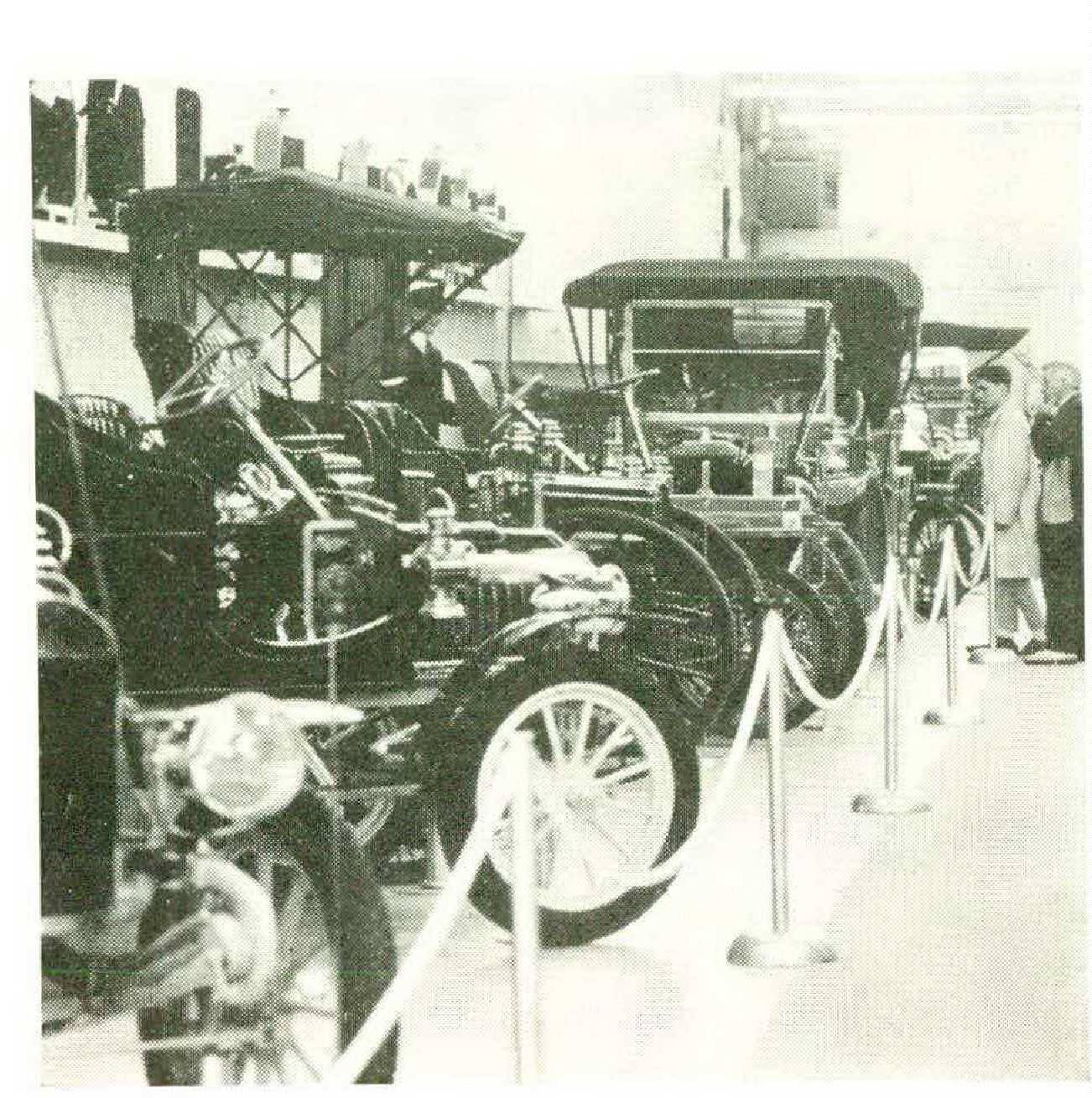
This building was a railroad icing plant handling the long expresses running cast out of the Pacific Coast fruit-growing country. It is high-ceilinged and huge, lined with cork slabs from top to bottom. The near obsession with neatness and detail that marks Harrah operations shows everywhere: the aisles are marked off not by dust-catching fabric ropes, but by transparent plastic tubing, and the supporting posts are topped by small ashtrays. A commentator guard mounts an observation platform high in the center of the room. He answers questions, directs the tourists, and suggests strongly that they keep their hands off the automobiles. He is bored but competent. He is well paid. The room is air-conditioned and pleasant. At lunchtime he’ll go to the employees’ cafeteria, a clean well-lighted place. (At least once, every time I was there, a man came by to polish the glass in the front door.) The food is good, the servings generous, the prices under the market. There is a low turnover among Harrah’s employees. His tendency is to think well of people. He loathes being cheated, out of money, time, work, or anything else, but otherwise — A watchman in one of his two Reno garages tells of a Sunday afternoon when Harrah came in and asked him how he felt. The man said he was a little on edge; there was nothing to do, nothing happening.
“Why don’t you get in the back of the brown Rolls-Royce and turn on the television?” Harrah asked.
He wouldn’t think of it, the watchman said.
“Oh, go ahead, get in,” Harrah said. “You can still see the door from there.”
Harrah is a tall, lean, graying man in his early fifties. He has a soft voice and speaks infrequently. He is a good listener in the sense that he absorbs everything that is said around him, but he rarely looks directly at the speaker or appears to pay close attention. He seems to be withdrawn, distant, preoccupied, but he is wholly courteous. He doesn’t smoke or drink, and he eats little. He seems to gamble — that is, to play from the other side of the table — only ritually, although he says he enjoys it. He goes to Las Vegas to gamble (as a matter of convention he does not play in Reno), and he plays to a limit, say $1200. If he loses that, he’s through for the night. He does not appear to be inscrutable, or hard, or calculating, or anything else that is cliché about his profession, although obviously, on the evidence, he is all these things. Me travels in Europe a good deal, but he says he likes Reno and would rather live there than anywhere else he knows. His home, white, modern, set on lawns unusually green for Nevada, is ten minutes from his office. He has a much more spectacular place at Tahoe. His wife is a tall, pretty woman, blond. Her air is bland and tranquil. When they travel by motorcar, most frequently to Lake Tahoe and back, they usually go separately. Nevada has no speed limits on open roads, and people buzzing along at 75 are often surprised to be passed by, say, a Ferrari and a Bentley Continental traveling in convoy 50 miles per hour faster. Fast driving is important to the Harrahs. Neither of them would think 95 really hurrying. They quite willingly accept the ordinary hazards of speed, but they do not propose being hurt by avoidable accident. Mrs. Harrah’s favorite car at the moment is a 150-mph Ferrari 2 + 2, one of the sturdiest and safest motorcars being built today, but it is put on a lift and given at least a cursory check every time it runs the 110 miles to Tahoe and back.
Mr. Harrah’s personal cars are checked, as a rule, every day. Harrah doesn’t care for overexposure to chance. He began learning to fly, at fifty-one, because he often travels in chartered aircraft, and it seemed absurd to him that his life should be dependent on the life of only one other man. He can handle the ordinary light plane now, and he thinks he’ll go on to twin-engine instrument rating. He has begun to collect historic airplanes. He is interested in railroads too: he has one narrow-gauge locomotive, and he plans to set up three miles or so of track around his auto collection in the future. He runs a fifty-three-foot cruiser on Lake Tahoe (it has two Allison engines and is very fast, over 50 miles an hour). He owns two unlimited-class hydroplanes, single-seat racing boats that will do around 180 miles an hour.
His primary interest remains the automobile. Four years ago, in explaining that interest, he said, “Few material things have been as important to America as the automobile. The manufacture of the automobile was the root of our industrial growth, and for decades now it has been the central support of our economy. We are all tied to the automobile by history, by business, by emotion. The automobile deserves to be preserved and remembered.”
To give some indication of the scope of the Harrah collection, we have selected ten automobiles, all of them American, made from 1904 to 1937.
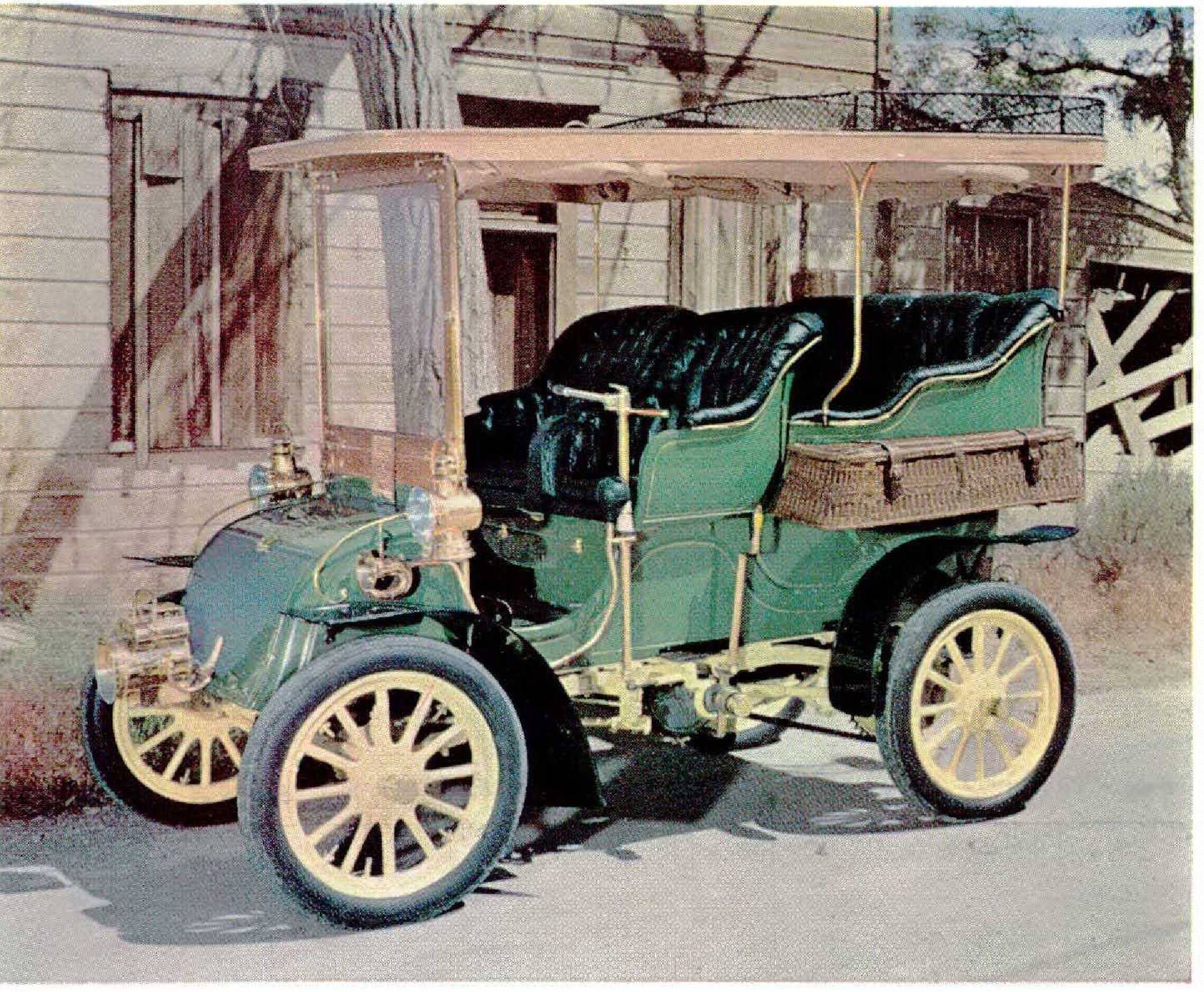
1. Tiller-steered and air-cooled, the 1904 Knox “Waterless” shown in figure 1 cost $2400. The cooling system was strange, but it worked: long iron pins were welded to the outer cylinder walls, porcupine fashion, much increasing the heat-dissipating surface.
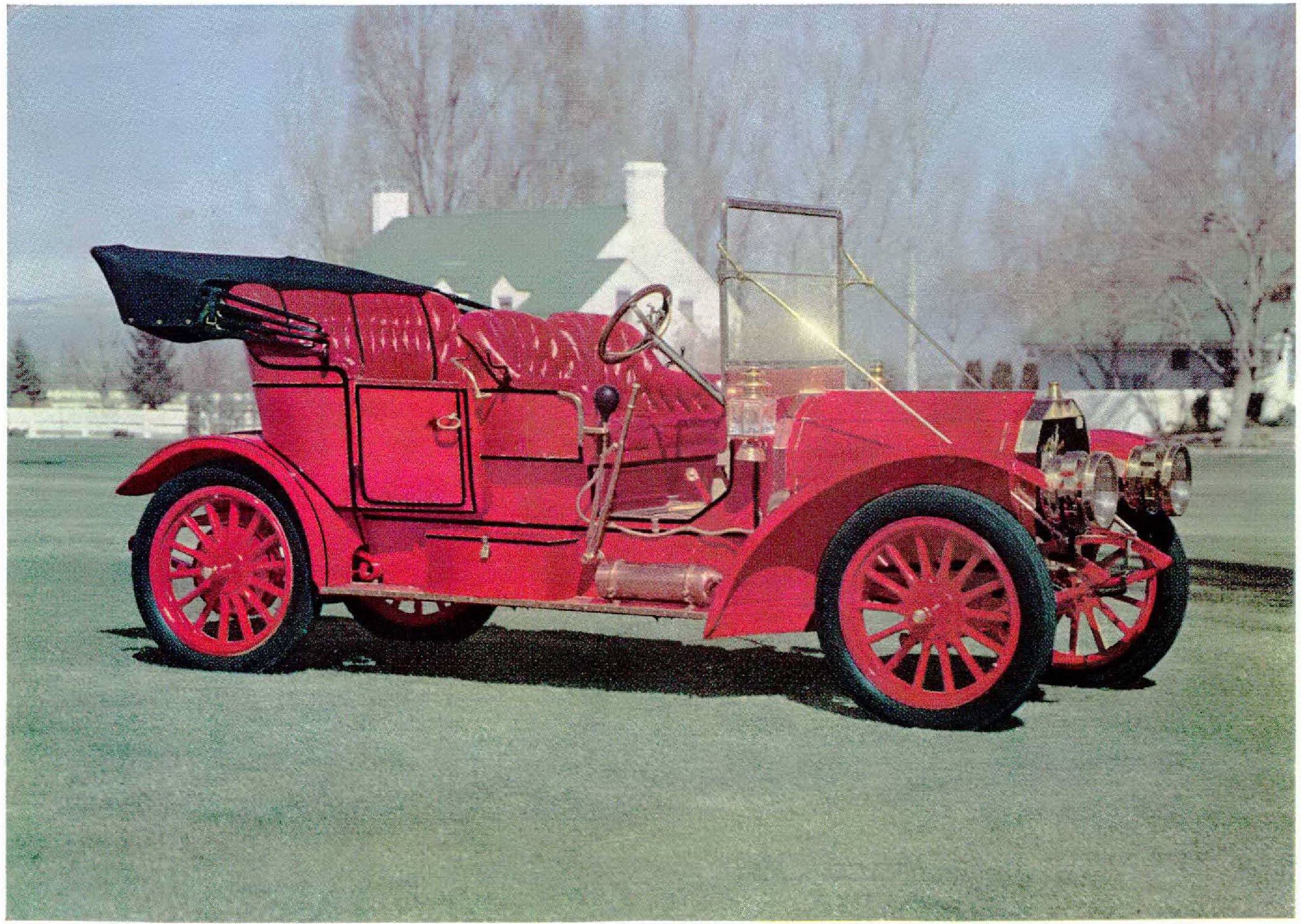
2. The Welch is a rarity among American motorcars, notable historically as one of the early corporate ingredients that combined and made up General Motors. The Welch engine, years ahead of its time, had hemispherically shaped combustion chambers, an overhead camshaft, and inclined valves, all of which are still regarded as required features of a highperformance engine. The Welch had a control peculiarity: there was a clutch for each of the three speeds, governed by three levers, and two braking systems, with a separate pedal for each. The example shown in figure 2 was made in the Pontiac, Michigan, factory in 1909, and was called a Close-Coupled Touring Car.
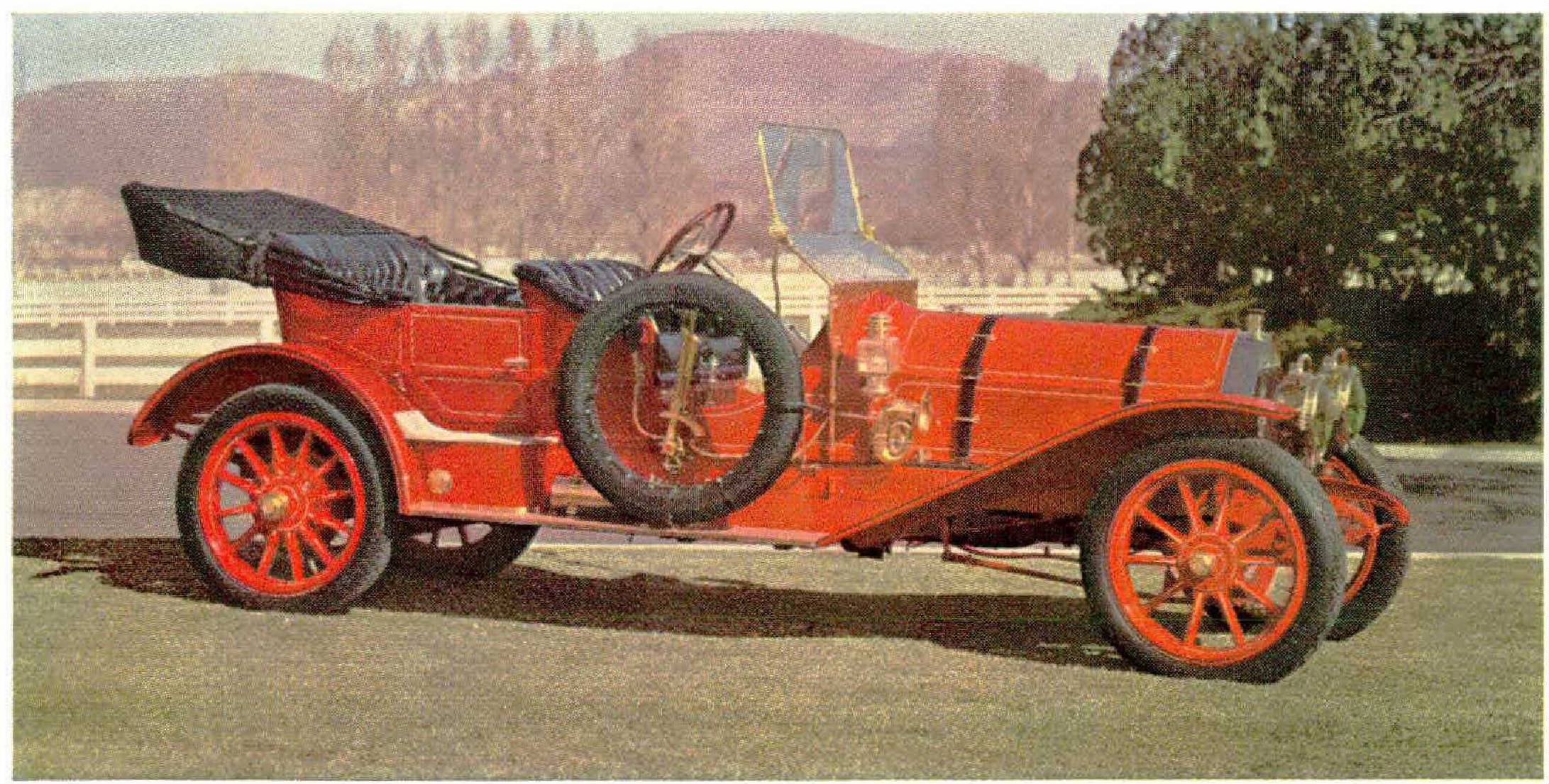
3. The handsome carriage in figure 3 is a 1909 Thomas, the Model K 6-70 “Flyabout,” which was built by the E. R. Thomas Motor Company of Buffalo, New York, in 1909 and retailed for $6000. In 1909 the Thomas was a famous make, a Thomas “Flyer" having won the New York-to-Paris Race the year before. This enterprise lasted from February to July, and the contestants traveled the long way: across the continent to the Pacific Coast, by steamer to Siberia, and thence to Paris. The winning car still survives and is presently in process of restoration in William Hurrah’s facility in Reno. The driver, George Schuster, was Harrah’s guest last summer and drove the car again.
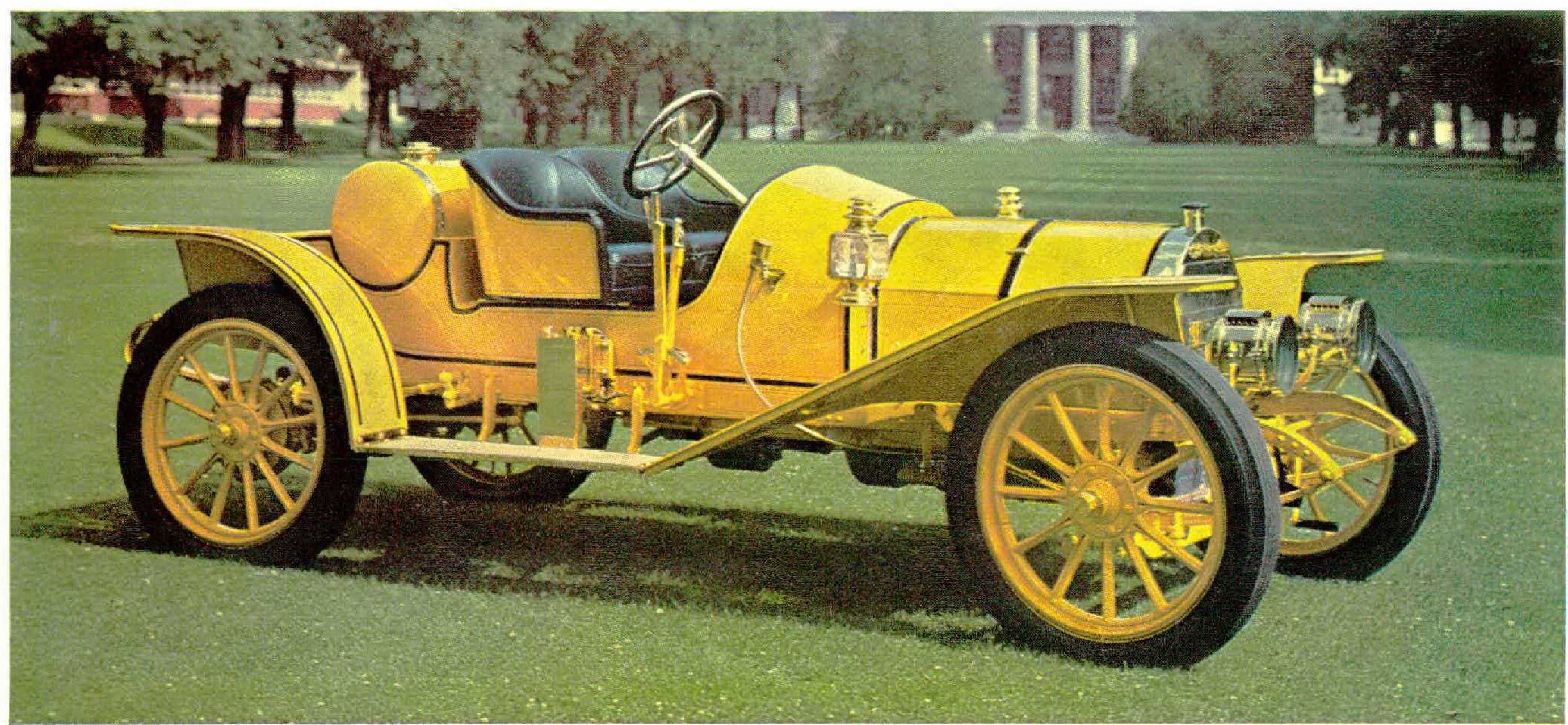
4. The most valuable automobile in the world today, calculated on the ratio of its present value to its original cost, is the T-head Mercer Raceabout, priced at $2500 in 1911-1913 and negotiable by phone today, sight unseen, for upwards of $15,000. This is an immediate ancestor of the Raceabout, and it was designated the Model C Speedster (figure 4).
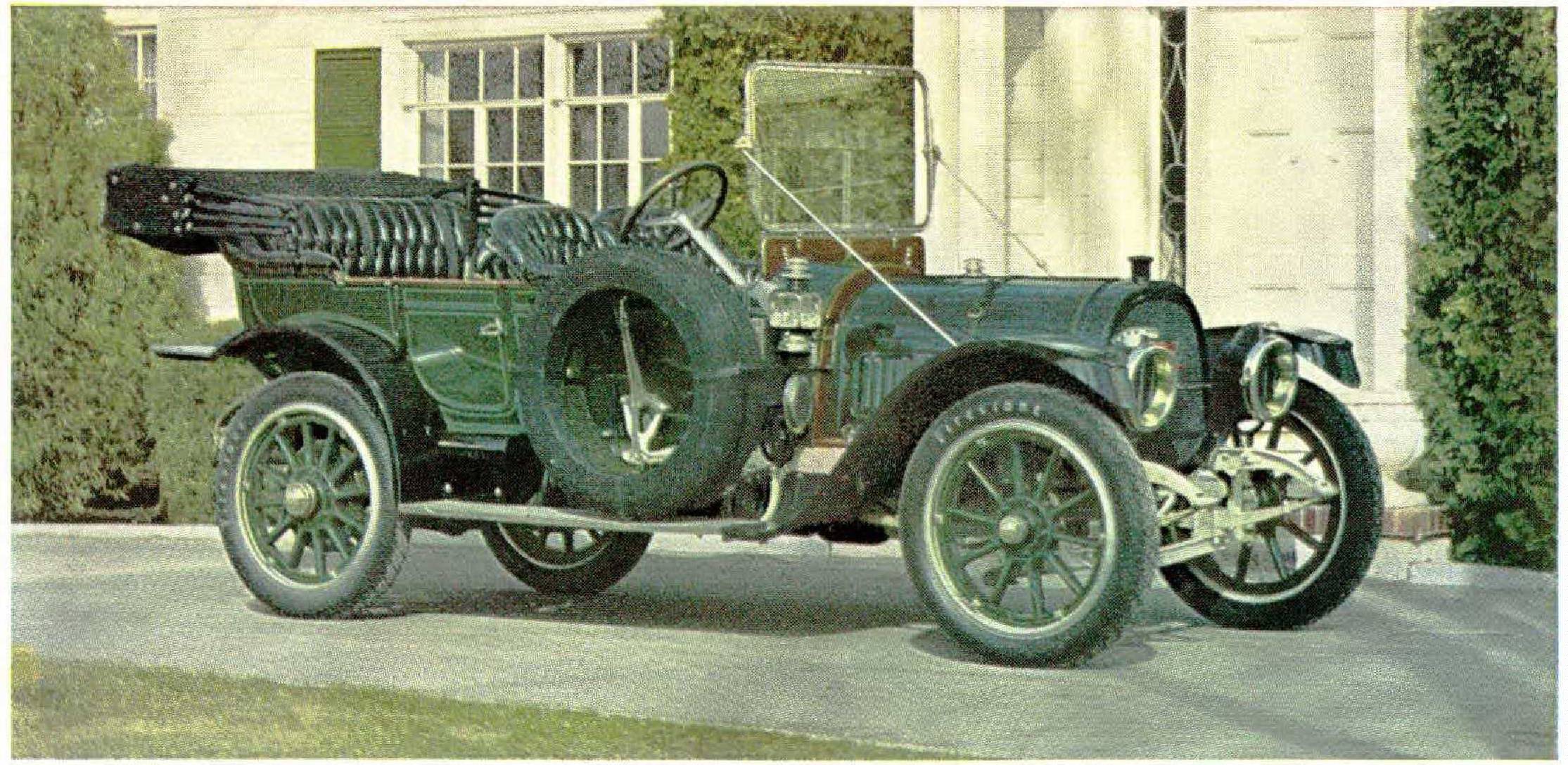
5. Intended for the wealthy, and priced accordingly — $3250 in 1912 for the touring car — the Pope-Hartford was built in Connecticut (figure 5). Not uncommonly, the owner of a car of this excellence bought two bodies with it, an open one for summer, a closed one for winter. The body in disuse was conveniently stored by hoisting it to the ceiling of the automobilehouse.
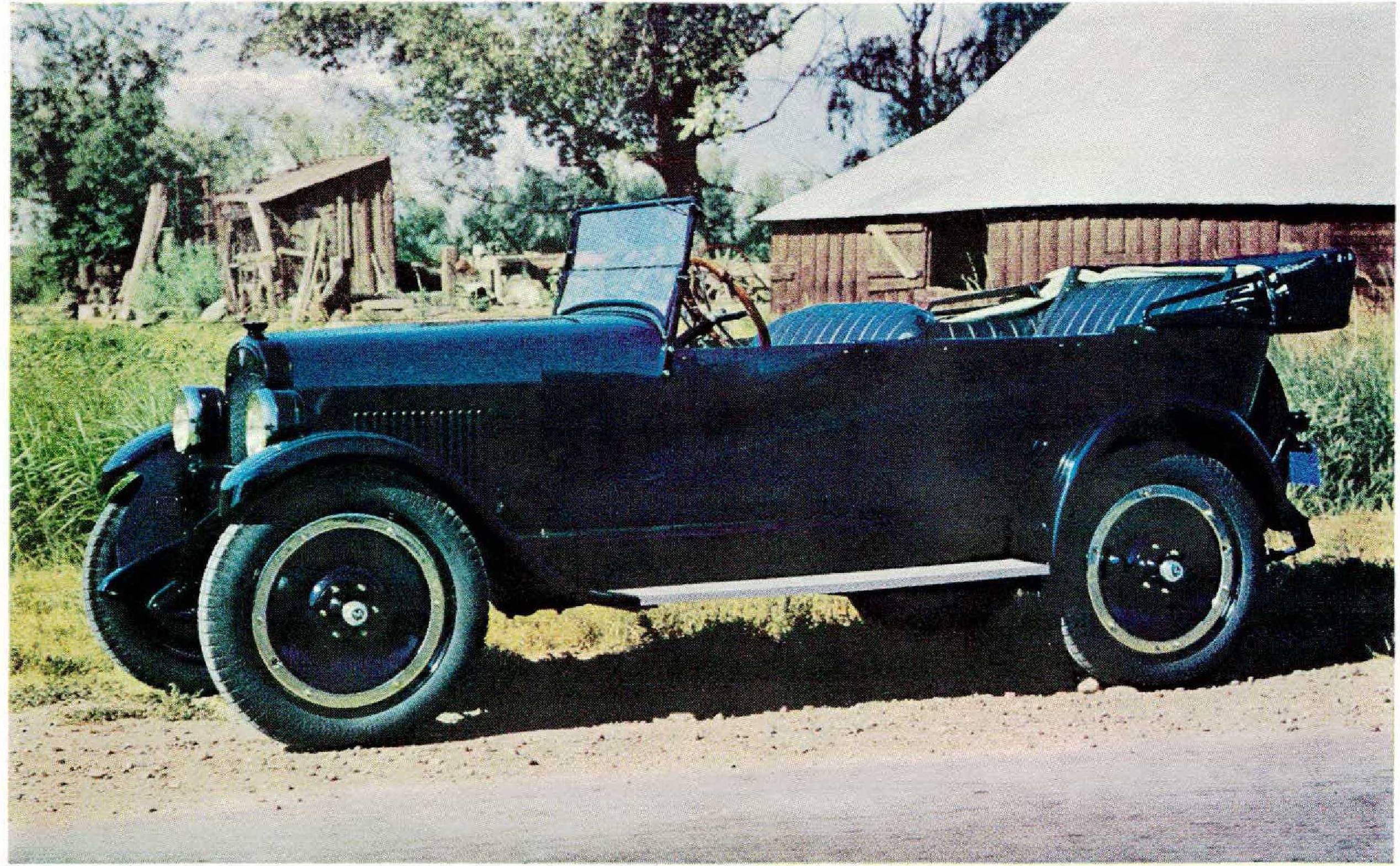
6. Maxwell was a formidable name in the early history of the American automobile. The original company was founded in 1903 by Jonathan Dixon Maxwell and Benjamin Briscoe, and was one of the 130odd companies Briscoe later formed into the giant United States Motor Corporation. In 1921 Walter Chrysler took the Maxwell over, and the make vanished as an entity in 1936, becoming the Plymouth. The blue touring car shown in figure 6 is a 1923 Model 25 touring car.
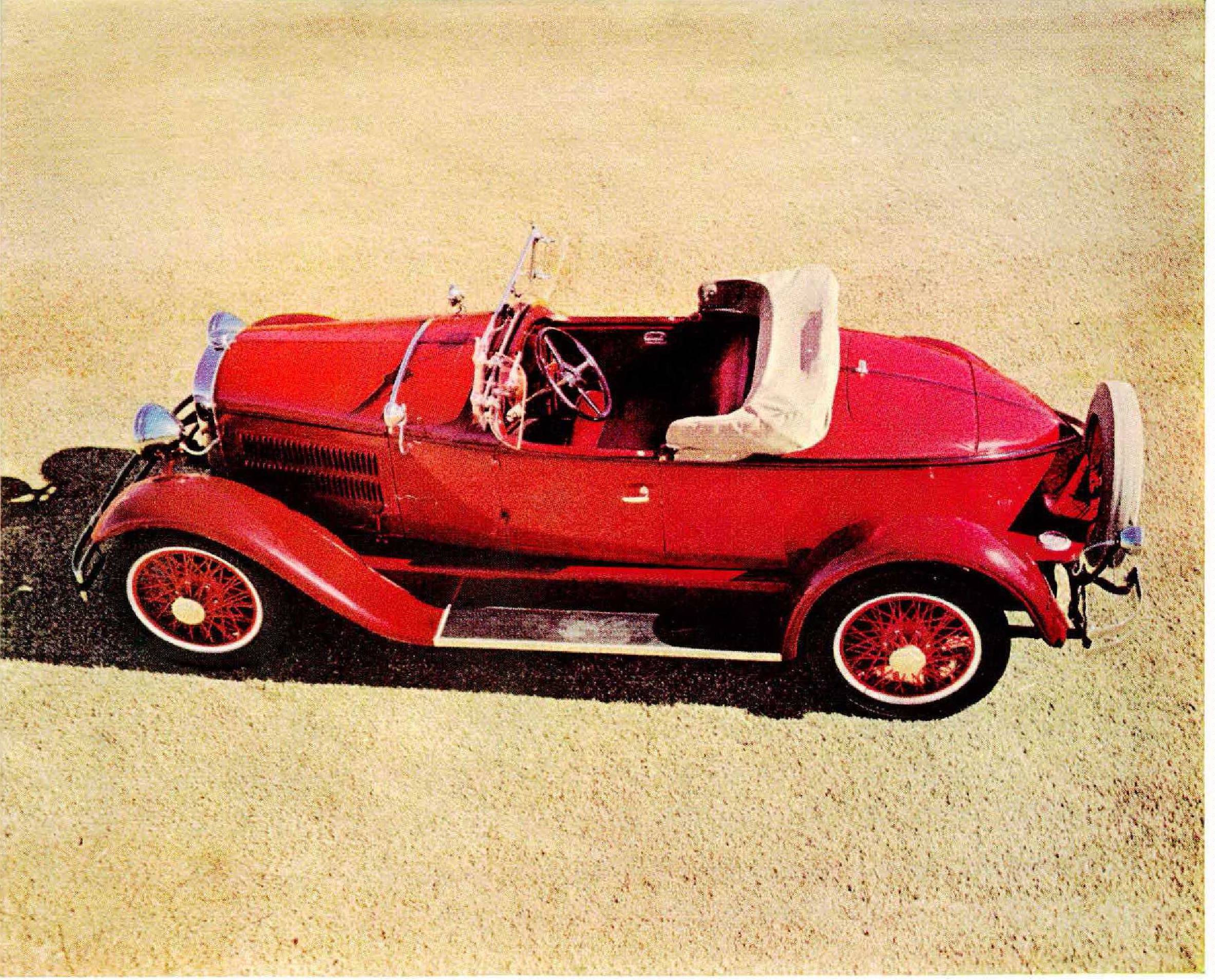
7. The “boat-tail” body is out of vogue now, more’s the pity. It was at its best in long-wheelbase cars like the Auburn and the Duesenberg, but it lent a pleasing and cheeky air to such as the Super Six Speedabout Essex, vintage 1929 (figure 7). Not a factory-made body, this one was done by the carriage-making firm of Biddle & Smart. Essex, a division of Hudson, was viable from 1917 to 1939.
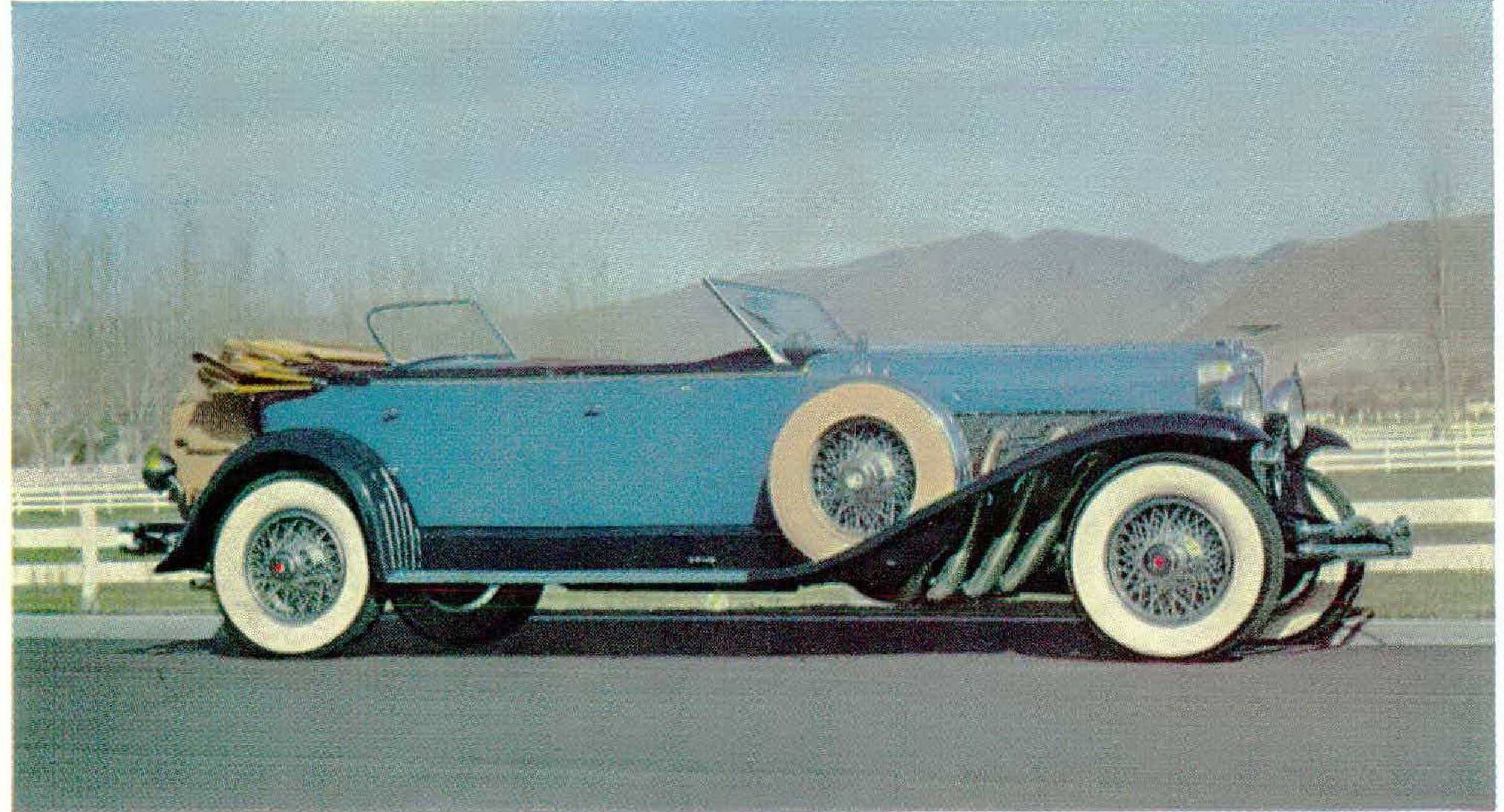
8. The Duesenberg is the American automobile. It was made in Indianapolis, Indiana, by August and Frederick Duesenberg, and it was made to a simple ideal — that it should be the best automobile in the world. In its day it very nearly was. The Duesenberg was designed as a gentleman’s carriage on the most majestic scale. The price range was from $14,750 to about $25,000, and some 470 cars were produced, the last in 1937. The great “J” and “SJ” models—the Harrah car shown in figure 8 is a “J” — produced 265 to 320 horsepower and would run well over 125 miles an hour, even burdened with the heaviest of sedan or limousine bodies.
In 1935 a Duesenberg weighing 4800 pounds set a world record by running twenty-four hours at an average speed of 135, stops included. It ran for a single hour at an average of 152! Duesenberg limousines and town cars were elegant, and two-seater roadsters and coupes were striking, particularly on the long-chassis models, but the double-cowl phaeton is most sought after today. It is rarely that one comes on the market at all, and more rarely still is it priced under $10,000.
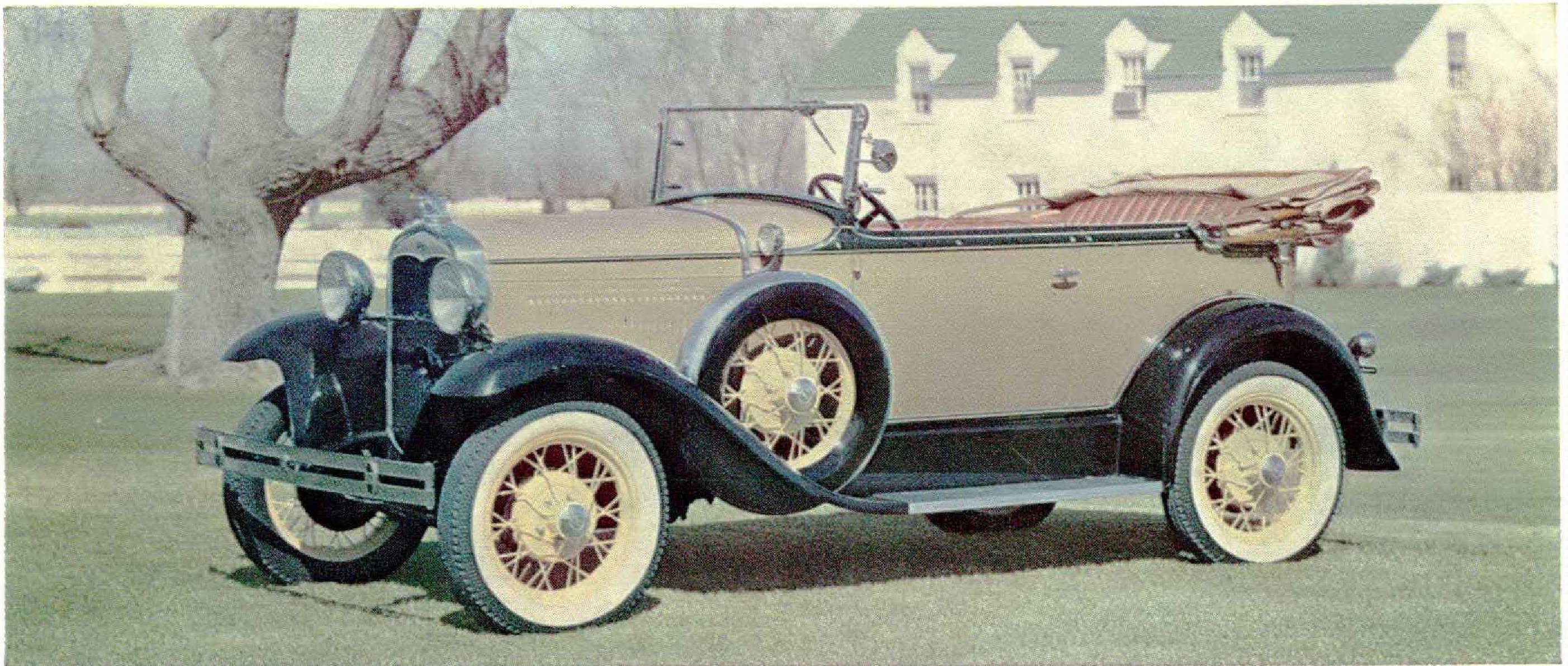
9. In 1931, $580 would buy the Model A Ford deluxe phaeton, body by Briggs, which is shown in figure 9. The measure of its excellence is the beauty of its line in the eye of the beholder today, a third of a century after it left Detroit. The Model A, successor to the sainted Model T, is one of the milestones of automobilism.
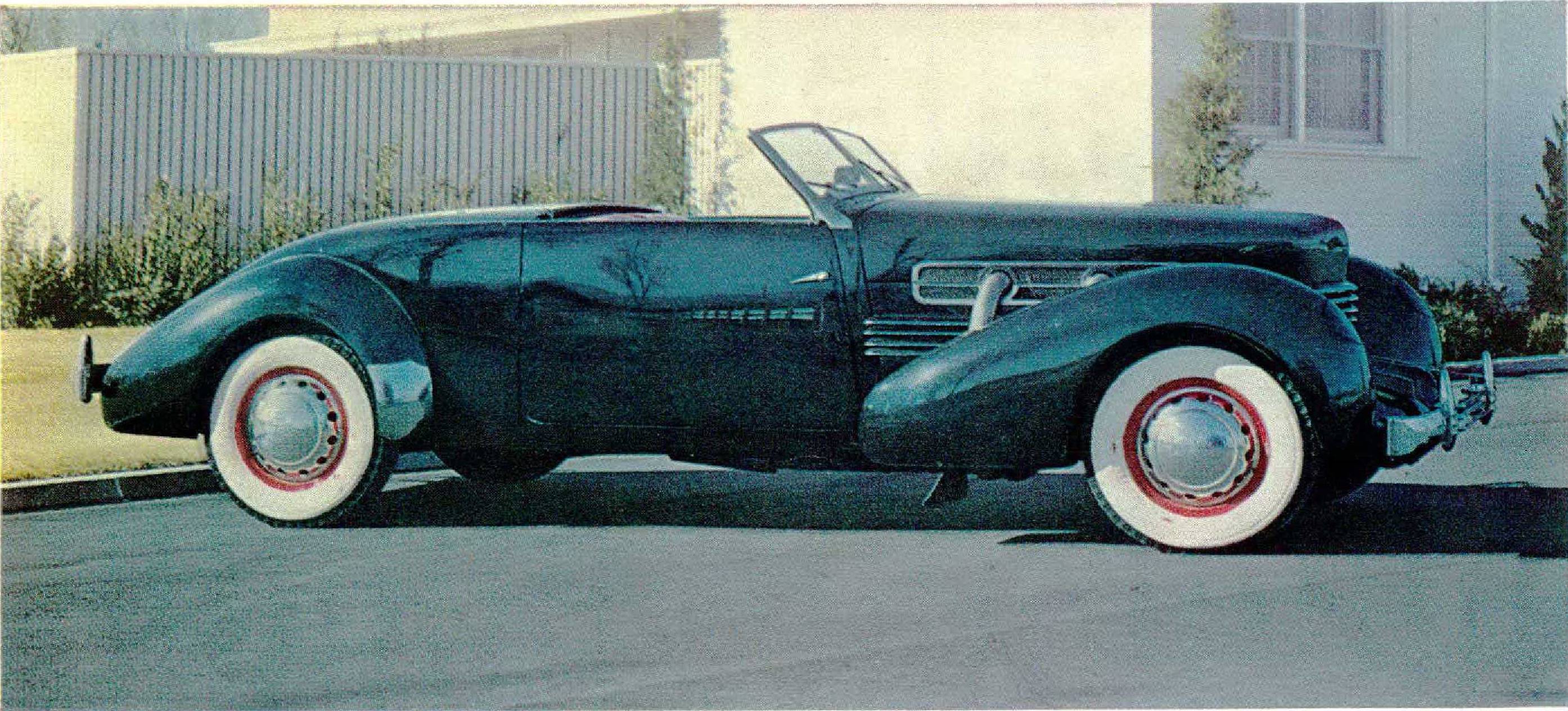
10. The design of the Model 810 Cord (figure 10), by Gordon Buehrig, is one of the happiest ever laid down in the United States. It was full of startling innovations: no running boards, disappearing headlights, concealed door hinges. Drive was to the front wheels, allowing a completely flat floor. Popular acceptance of the car was prompt and enthusiastic. The Cord’s impact was so strong that today, nearly thirty years after its first appearance, a serious effort to produce a Cord replica, an identical body carrying a modern engine, is well under way. The car shown here is a 1937 variant of the 810, the Model 812, which had a 170 horsepower supercharged eight-cylinder engine.