Lay Lobotomy--Go Slow
JOHN H. SLATE is a New York lawyer and author who believes that the shotgun may not, in every case, be the answer to melancholy.
BY JOHN H. SLATE
Over the past several years, in many conversations and writings, I have repeatedly decried the growing excesses of impromptu medicine. Yet it has recently been brought to my attention that these warnings have gone unheeded, that I have, so to speak, simply been wasting my sweetness on the deserted air.
Late in the forenoon of October — , 19 — , a despondent pensioner, whom I shall call Major E—— C—— (Irish Rifles, ret.), deliberately discharged a firearm through the roof of his own mouth. By some incalculable chance the projectile detached the cervical cortex from the cortical cervix, incised the glans glandularii (the gland of glands), and emerged briskly through the top of the skull.
Although a regime of this sort is ordinarily fatal, in this case the actual clinical effects approximated those of a prefrontal lobotomy, the neurosurgical procedure found so useful in the relief of melancholia, or espiritu dejectu.
Today Major E——C—— (Swiss Rifles, ret.) is hale and hearty. Doubtless we should all join in congratulating him on this account. However, I, for one, cannot do so. For the success of the colonel’s technique has, regrettably, inflamed the extremists among the advocates of Home Surgery. Thus, in Suture Self! (Congo Press), “Dr.” Sawyer Headoff has written: “Sterile fields? Micrometric control? Paf!! Just whang away and hope for the best.”
In main part the Home Surgery movement rests on an emotional appeal to the pioneer way of life. It is emphasized that our forebears rarely summoned professional aid, whether the point at issue was a problem in catering or the more troublesome Indian attacks and earthquakes. This may be granted, at least in principle. Yet a careful reading of the early chronicles also suggests that if more expeditious means of communication had been at hand, few forebears exposed to these inconveniences would have scrupled to send out for assistance. In actual fact, the word Help! itself is known to be of Anglo-Saxon origin.
Be that as it may, it is hoped that one more word of caution about the practical limitations of random surgery will not be considered out of place.
Surgery is commonly (and rightly) regarded as the primary domain of the professional. Although the barber’s chair was the original seat of surgical learning, the tonsorial factor is no longer crucial even in the simplest appendectomy. Nor is this due entirely to the inconvenience of sitting up during the operation. Rather, the technological displacement of the barber reflects the forces of specialization rooted in the industrial revolution as well as in the preceding and succeeding periods.
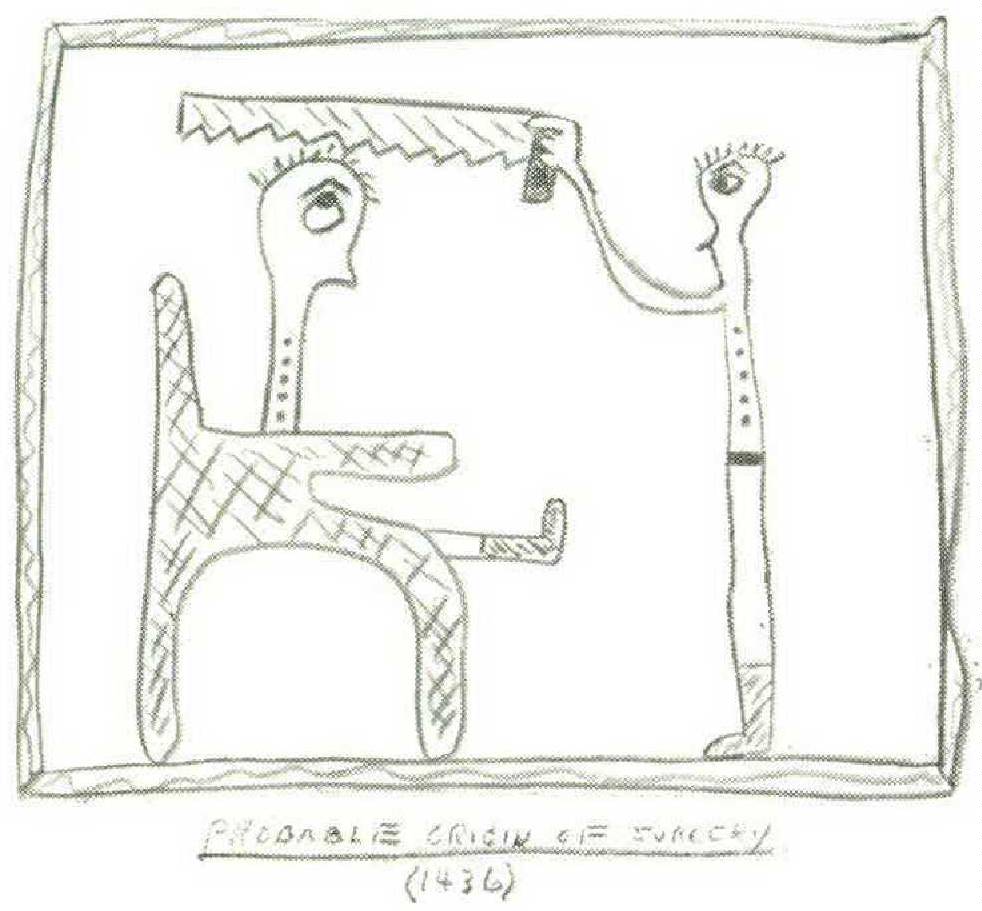
Divisive as these forces may be, we must learn to live with them. For if contemporary barbers are maladroit at surgery, it is at least equally true that a modish haircut is not to be obtained at the hands of the surgeons.
In undertaking any orthopedic work on the head, it is therefore essential to make a rigorous distinction between the inside and the outside of the skull as the locus operandi. Yet the partisans of lay lobotomy evidently find it convenient to ignore this important point, and continue to lay about them with rather more zeal than finesse. Suffice it to say that unbridled enthusiasm, however sincere, is a poor substitute for the precise control that is advisable in this most delicate of operations.
Although it cannot be gainsaid that Commander E—— C—— (ret.)’s method was crowned with success, this cannot be recommended for general application. Apart from the expense of securing a hunting license, there is the matter of noise. Unless the shooting were done in a soundproofed room, an unfavorable public impression would unquestionably result. While a silencer can be fitted to the gun, these devices often leave an unpleasantly oily aftertaste. It would also be necessary to carry out this procedure bareheaded, unless the patient was reconciled to the loss of his hat. However, these aspects of the matter involve merely architectural, ballistic, or sartorial considerations, as the case may be.
From the neurological standpoint, it is felt that gratuitous interference with the central nervous system, at least on any very large scale, is inadvisable. Certainly the human brain should not be molested simply (in George Leigh-Mallory’s celebrated phrase) because it is there. As a minimum, calculations should be made of muzzle velocity and the optimum angle of attack determined by test shots with volunteer subjects. It is unfortunate that the Captain neglected to make any notes on these technical but nonetheless important details. Although one is understandably reluctant to expose another to obloquy, one cannot help observing that this was hardly in the best military tradition.
Despite the groundswell of public opinion favoring a relaxation of surgical standards, it thus appears that some restraint is needed against the use of slapdash methods in specialties that are beyond the capacity of the untrained. Yet the energetic amateur need not stand idly by, for he can usefully be assigned to the simpler cases, relieving the licensed practitioner for concentration on the advanced problems.
In much the same way, the younger mathematicians are permitted to carry out operations involving only the lower numbers, reserving the manipulation of those above 1385 (as well as all long division) to the better qualified. In ancient Egypt, too, it was the lower orders who built the bottoms of the Pyramids, and it was not until this had been done that Cheops and the other top brass took a hand.
While some attrition would doubtless result from the implementation of this “scheme" in surgery, there is no reason to suppose that it would greatly exceed the highway death toll. In any case, the risk will have to be faced. For a policy that both encourages and interdicts the increasingly popular popular movement in this important field plainly cannot be sustained. Surely the collapse of the Greater East Asia Co-prosperity Sphere has already laid bare the folly of the doctrine that everything which is not prohibited is compulsory.
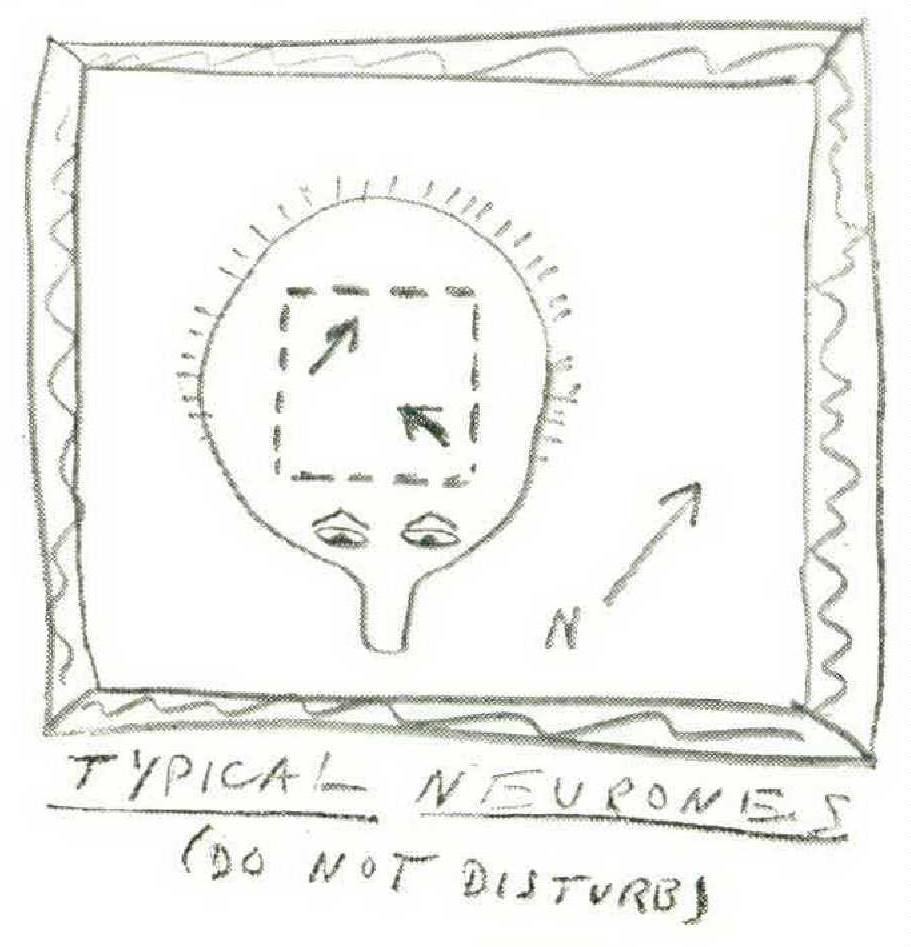
Although it is still early days, it seems clear that since Nature abhors going up without coming down, the rise of lay lobotomy must be succeeded by its fall. Indeed, this should be a source of the liveliest satisfaction. For the unchecked rise of anything would ultimately result in its disappearance from view.