What’s Bugging the Students
NO ONE, except perhaps a few college administrators, mourns the passing of “the silent generation.” But it must be said in its favor that at least one knew what the American university students of the 1950s were silent about, and why. They were conformist for plain, indeed, obvious and traditional, conformist reasons. We may have been distressed and vexed by this conformism; we were not mystified by it; whereas we are very much mystified by the nonconformism of the students of the sixties.
Many of the same middle-aged critics who so fervently and eloquently condemned the silent generation are now considerably upset and puzzled at the way students are “misbehaving” these days. One wanted the young to be idealistic, perhaps even somewhat radical, possibly even a bit militant — but not like this! It used to be said that the revolution devours its children. It now appears that these children have devoured this revolution.
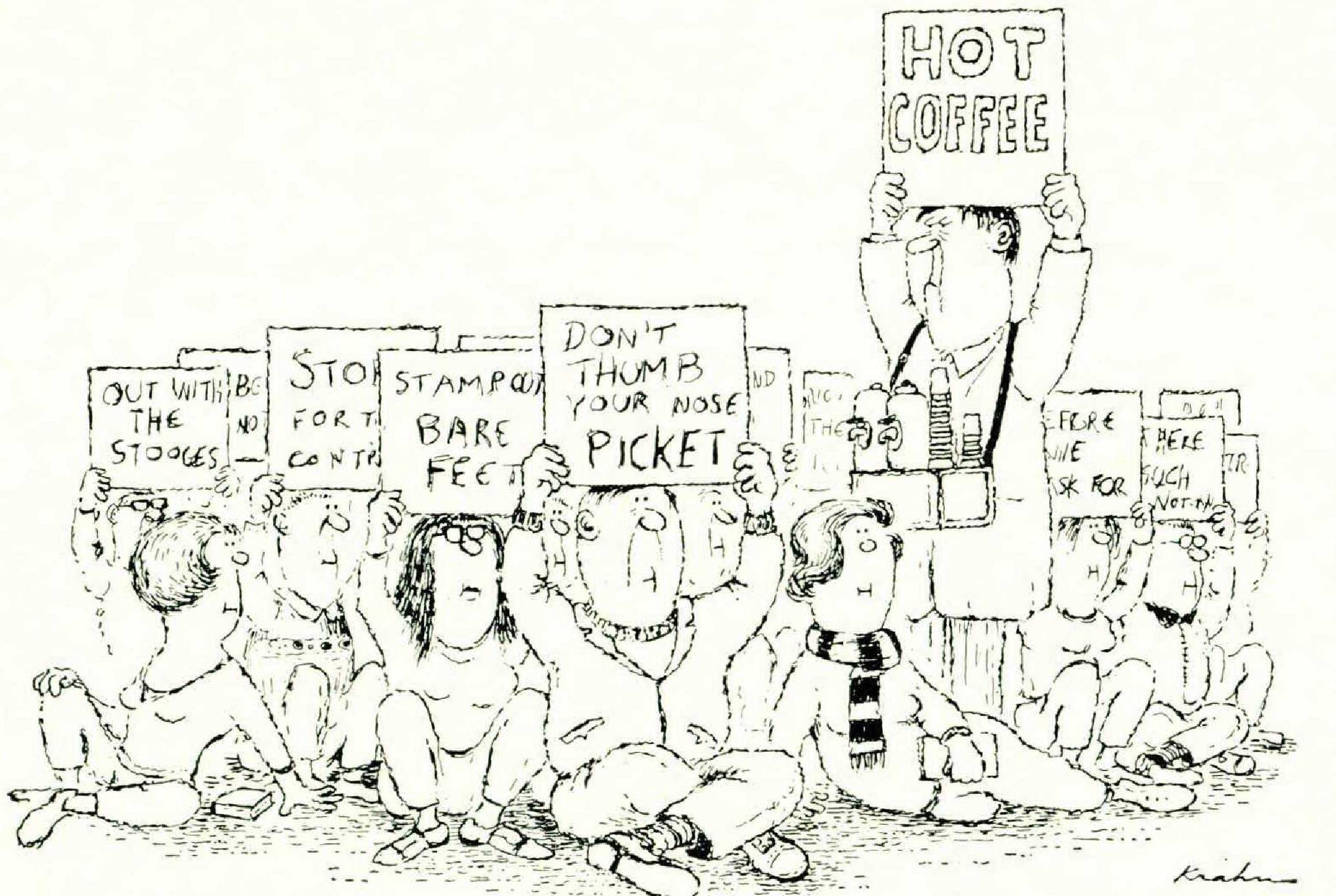
What is it all about? One thing is fairly clear: the teach-ins, the sit-ins, the lay-downs, the mass picketing, and all the rest are not merely about Vietnam, or civil rights, or the size of classes at Berkeley, or the recognition of Red China. They are about these issues surely, and most sincerely. But there is, transparently, a passion behind the protests that refuses to be satisfied by the various topics which incite it. This passion reaches far beyond politics, as we ordinarily understand that term. Anyone who believes the turbulence will subside once we reach a settlement in Vietnam is in for a rude surprise. Similarly, anyone who thinks of present-day campus radicalism as a kind of overzealous political liberalism, whose extremism derives from nothing more than youthful high spirits, is deceiving himself. What we are witnessing is an event in American politics, but not of it.
Indeed, one of the most striking features of the new radicalism on the campus is that it is, in one sense, so apolitical. It is a strange experience to see a radical mood in search of a radical program; it is usually very much the other way around. These young American radicals are in the historically unique position of not being able to demand a single piece of legislation from their government — their “platform” is literally without one legislative plank. Their passion for “freedom now” coexists with a remarkable indifference to everything the United States government is doing, or might do, in this direction.
If one read every campus leaflet published these past two years and attended every campus or offcampus demonstration, and knew only what one learned from these sources, one would hardly be aware that the Johnson Administration had enacted in the area of civil rights the most far-reaching reforms in a century of legislative history. There has been no campus meeting to celebrate the passage of the Civil Rights Act or the Voting Rights Act. There has not even been any meeting criticizing these laws for “not going far enough.” It’s as if nothing had happened — or, to put it more precisely, as if whatever happens in Washington has nothing to do with the world the students live and act in.
The same sort of thing is to be seen with regard to the war on poverty, a topic upon which students will declaim passionately and with unquestionable sincerity. But it seems that their passion is so pure, their sensibility so fine, that these would be violated by a consideration of anything so vulgar as how to get more money into poor people’s pockets. The recent increase in social security and the medicare bill made their way through Congress without the benefit of so much as a benevolent nod from the campuses. Whenever I have mentioned this legislation in conversation, I have received an icy stare of incomprehension and disdain, as if I were some kind of political idiot who actually believed what he read in the New York Times.
Even in the single area where one would most expect specific and tangible proposals of reform, the organization of the multiversity, these have not made their appearance. For an entire year the students of the University of California at Berkeley have given dramatic evidence of dissatisfaction with their university experience — and does anyone know specifically what they would like, by way of improvement? The university officials certainly don’t know, nor do the regents, nor do the faculty. Some outsiders think they know. Berkeley is too large, they say, too anonymous; there is no possibility of a face-to-face community of scholars, young and old. This is true enough. But the Riverside branch of this same university is a small liberal arts college, with great intimacy and comfort, and for the past decade it has had much difficulty in attracting enough students. They all want to go to Berkeley, and the reason, they will explain, is: “That is where the action is.”
The denunciations of the multiversity suspiciously resemble the way New Yorkers excoriate “megalopolis” — having come there in the first place, and determinedly remaining there, for no other reason than that New York is a megalopolis. All Americans will always insist that they adore small towns and detest great cities, but the movement of population from towns to cities remains strangely unaffected. And Berkeley, even today, has far more student applications than it can handle; one might even say, especially today, for I understand that the number of applications has, in fact, slightly increased.
No, the upsurge of left-wing sentiment and left-wing opinion on the American campus today is not the sort of thing progressive parents and educators had in mind ten years ago when they benevolently urged students to become “socially committed” and “more idealistic.” They naïvely wished them to have intelligent discussions of Vietnam, not to hurl insults and epithets at Averell Harriman (as happened at Cornell), or tear up their draft cards, or laud the Viet Cong. They wished them to be urbane and tolerant about sex, not to carry placards with dirty words, or demand the sale of contraceptives in the college bookstore. They wished them to be concerned for civic and social equality for the Negro, not to denounce “white America” as a pious fraud, whose “integration” did not differ essentially from South Africa’s apartheid, or express sympathy with a mindless (if occasionally eloquent) black nationalism. They wished — they wished, in short, that their children be just like them, only a wee bit bolder and more enlightened. Instead, these children are making it very clear that being just like their parents, progressive or not, is the fate they wish most desperately to avoid.
And this, I think, is the crux of the matter. The new student radicalism is so fundamentally at odds with our conventional political categories because it is, above all, an existentialist revolt. The term is unfortunately chic, and ambiguous, too. But in this context it has a fairly definite meaning: the students are in rebellion, not so much because things are bad for them, or for others, but because things are what they are for them and for others.
Clues to the meaning of this rebellion may be found in two phrases that now appear ever more commonly in the left-wing campus vocabulary. The first is “organized America.” The second is “participatory democracy.”
“Organized America” is, quite simply, America, and not, as one might think, some transient bureaucratic excrescence on the body of America. As a matter of fact, today’s students are immensely skillful in coping with bureaucracies and their paper work. They fill out forms and applications with a briskness and competence that startle the middleaged observer. (I would guess that no one over the age of forty could properly fill out a college application form unless he received guidance from some kindly youngster.) What bugs the students is not these trivia but the society they emanate from — the affluent society, welfare state and all. The liberalism (and the radicalism, too) of the 1930s and 1940s has borne its fruit, and it tastes bitter to the children, setting their teeth on edge. That is why American students, amidst reasonably general prosperity and under a liberal Administration that is expanding the welfare state more aggressively and successfully than anyone had thought possible, feel more “alienated” than ever before. So many college students “go left” for the same reason that so many high school students “go delinquent.” They are bored. They see their lives laid out neatly before them; they see themselves moving ahead sedately and more or less inexorably in their professional careers; they know that with a college degree even “failure” in their careers will represent no harsh punishment; they know “it’s all laid on” — and they react against this bourgeois utopia their parents so ardently strove for.
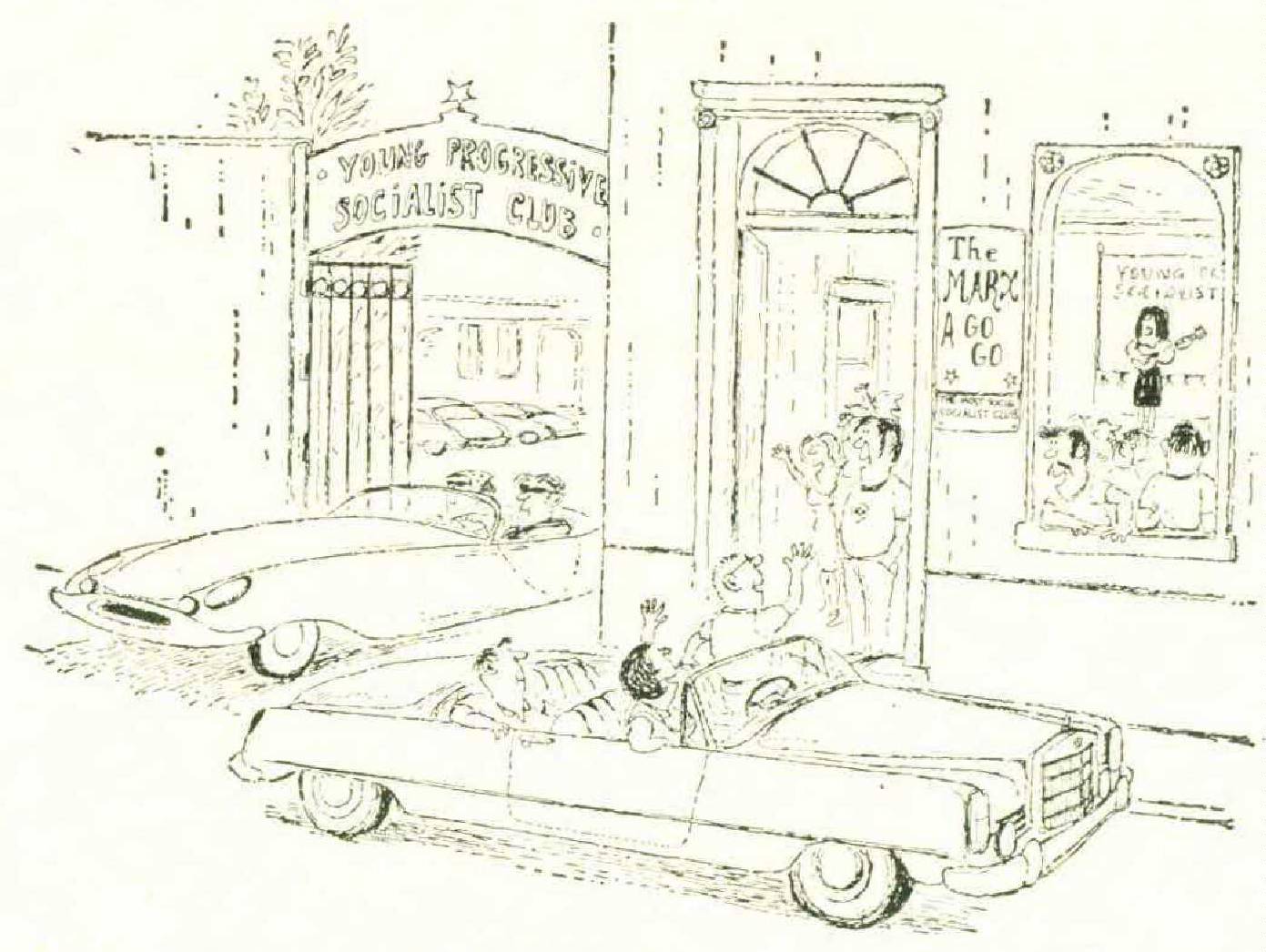
One of the unforeseen consequences of the welfare state is that it leaves so little room for personal idealism; another is that it mutes the challenge to self-definition. All this is but another way of saying that it satisfies the anxieties of the middle-aged while stifling the creative energies of the young. Practically every college student these days understands what is meant by an “identity crisis”: it is one of the cliches of the sixties. It is not, perhaps, too much to say that mass picketing on the campus is one of the last, convulsive twitches of a slowly expiring American individualism.
American youth, however, has had one grand idealistic experience: the civil rights movement. This has been the formative experience for the activists of the 1960s; it is this movement that gave them a sense of personal power and personal purpose; and it is the civil rights movement which instructed them in the tactics of civil disobedience that are now resorted to at the drop of a hat. Unfortunately, the civil rights movement has had one great drawback: so far from being a proper “dissenting” movement, it has behind it the President, Congress, the courts, the laws of the land, and a majority of public opinion. This fact helps explain why the younger militants have constantly pushed the movement toward “extremes” — for example, demanding utter, complete, and immediate equality of condition for the Negro, as against mere equality of opportunity.
Such equality of condition is what “freedom now” has come to mean. And since this demand cannot be fulfilled without repealing three centuries of history, and since even Lyndon Johnson hasn’t figured out a way to do this, there is some satisfaction in such a maneuver. The trouble is that the students do not know how to fulfill this demand either, and are even running out of extremist slogans; which is why so many of them are receptive to the idea of switching their attention to Vietnam, where they can be more splendidly, less ambiguously, in “the opposition.”
A second theme of student radicalism today, and a polar twin to the concept of “organized America,” is the idea of “participatory democracy.” This is a vague notion, but a dynamic one. It expresses a profound hostility toward, and proposes an alternative to, everything that is impersonal, manipulative, “organized” in the American political process. Indeed, many of these students simply dismiss American democracy as a sham, a game played by the “power structure” for its own amusement and in its own interests. True democracy, they insist, can only mean direct democracy, where the people’s will is expressed and legislated by the people themselves rather than by elected representatives, most of whom achieve office by deceit and retain office through the substantial support offered them by the vested interests.
One is reminded by this of nothing so much as the Russian Narodniki (“populists,” our textbooks call them) of the end of the nineteenth century. They, too, were largely middle-class students who selflessly turned their backs on the careers the Gzarist bureaucracy offered them. They, too, “returned to the people,” leaving the fleshpots of Petrograd for the villages of the interior, much as our students leave their comfortable homes in New York or Chicago for Southern ghettos and slums. And they, too, were hostile to the nascent liberal institutions of their day, seeing political salvation only in a transformed and redeemed people rather than in improvements in any kind of system of representative government. It is also interesting to recall that, though they were as individuals the gentlest and most humane of their time, they nevertheless believed in the justice and efficacy of terrorism against the status quo and assassination against its spokesmen.
The analogy is, of course, very superficial: the United States today is not Czarist Russia of yesterday. But it is nevertheless illuminating, because it helps reveal the inner logic of the idea of “participatory democracy,” a logic which proceeds from the most exemplary democratic premises to the most illiberal conclusions. Though few students these days learn it in their social studies course, the Founding Fathers of the American republic were exceedingly familiar with the idea of “participatory democracy"; as a matter of fact, this was what the word “democracy” usually meant prior to 1789. They rejected “participatory democracy” (they called it “direct democracy”) in favor of “representative government” for two reasons. First, they didn’t see how it could work in so large and complex a nation, as against a small city-state. Second, and more important, they thought it inconsistent with the idea of free government — that is, a government that respected the liberties of the individual. For participatory democracy requires that all people be fit to govern; and this in turn requires that all people be made fit to govern, by rigid and uniform educational training, constant public indoctrination, close supervision of private morals and beliefs, and so forth. No legislator can be as free as a private citizen, and to make all the people legislators is willy-nilly to abolish the category of private citizen altogether.
This, of course, is exactly what the Communists do, after their own fashion. They claim to exemplify a truer, more “direct,” more “participatory,” more “popular” democracy than is to be found in the representative institutions of the bourgeois West. The claim has a certain plausibility, in that regimes established by mass movements and mass revolutions certainly “involve the people” more than does any merely elected government. The semblance of “involvement” is perpetuated, as we know, through the mass organizations of the Communist state, and the fact that it is done under compulsion, and becomes more of a farce with every passing Communist year, is one of the inner contradictions both of the Communist system and of the myth of direct democracy itself.
These contradictions our left-wing students are not entirely unaware of. Though many of them are, to one degree or another, either pro-Communist or belligerently “neutralist,” theirs is a very qualified and unconventional version of this attitude; which is why conventional anti-Communist propaganda tends to pass them by. They are, for instance, extraordinarily uninterested in the Soviet Union, and they become ever less interested to the degree that the Soviet Union liberalizes its regime — that is to say, to the extent that the Soviet Union becomes merely another “organized” system of rule.
What they seek is a pure and self-perpetuating popular revolution, not a “planned economy” or anything like that. And this is why they are so attracted to Castro’s Cuba and Mao’s China, countries where the popular revolution has not yet become “bourgeoisified.” As for mass terror in Cuba and China — well, this actually may be taken as a kind of testimony to the ardor and authenticity of the regime’s revolutionary fervor. Our radical students, like other radical students before them, find it possible to be genuinely heartsick at the injustices and brutalities of American society, while blandly approving of injustice and brutality committed elsewhere in the name of “the revolution.”
Like other radical student generations before them, they are going to discover one day that their revolution, too, has been betrayed, that “organized society” is what revolutions establish as well as destroy. One hopes they will not be made too miserable by their disillusionment. One also hopes, it must be added, that they won’t make us too miserable before that day arrives.