Newark: Negroes Move Toward Power
“I’ll be the city’s first black mayor, and I’ll take office by 1970,” said City Councilman Irvine Turner, one of the many Negroes rising in political power as Newark gropes to solve civil rights problems in ways that avoid the destruction of Walts in Los Angeles or the smoldering tension of Chicago's South Side. John O'Shea, a news reporter for Newark's station WJRZ, tells here about a city in racial transition.
Newark:
by JOHN O’SHEA
NEWARK is often called the smallest major city in the United States. Its corporate boundaries within New Jersey enclose only twenty-four square miles, five of which are leased by the Port of New York Authority for Newark Airport and Port Newark. Three square miles are an as yet undeveloped swamp known as the Meadowlands. Within the remaining sixteen square miles are jammed the factories, services, and housing of Newark, and nearly half a million people, 25,000 per square mile, one of the highest densities in the nation.
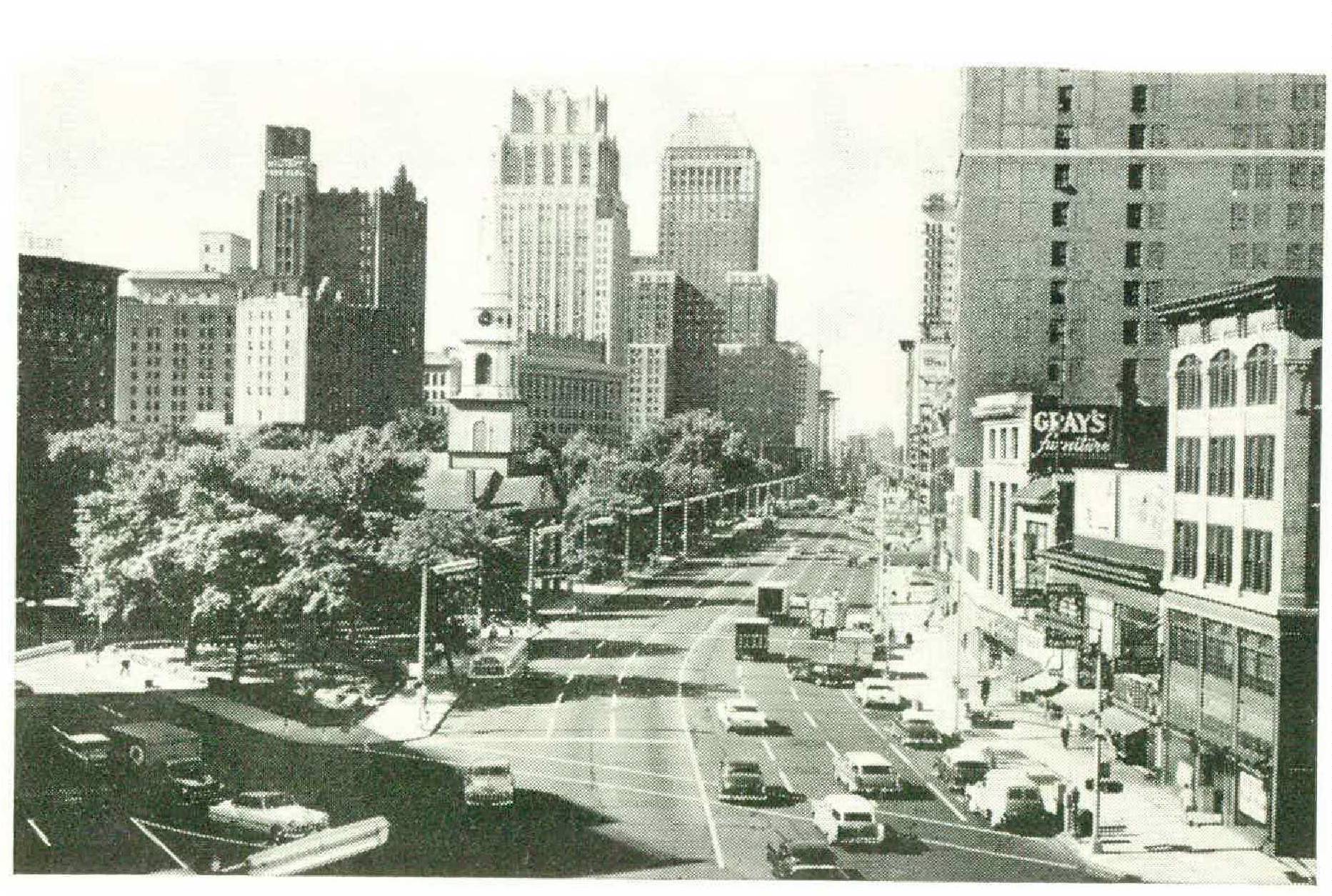
Yet physically, Newark is an airy, spacious city, with an impressive number of broad streets and avenues, many restful and inviting parks, a firstrate museum, and several residential neighborhoods where the houses and the apartment buildings are showplaces, unrivaled in good taste and costliness by any similar construction in the country. Business and commercial activities are compactly centered in a core city area of about a mile and a half square which is distinguished by shining modern office buildings, handsome banks and hotels, and fashionable department stores and restaurants. Dominating the business sector is the severe utilitarian skyscraper of the Prudential Insurance Company, the city’s largest employer. It is this Newark, this prospering industrial, commercial, and transportation center, that is best known to Americans.
But there is another Newark: a vast sprawl of Negro slums and poverty, a festering center of disease, vice, perversion, injustice, and crime. And this other Newark begins virtually at the boundaries of the brisk, modernistic business district, surrounding and encroaching on it, making of the district a kind of island of white middle-class self-sufficiency in a threatening sea of black misery. In an inexorable process the black tide is eroding the fringes of the city’s few remaining predominantly white residential neighborhoods.
These two Newarks share the same corporate city area, but they are strangers to each other, and it often appears that the white business and residential communities prefer things that way. Only a tiny and exceptional minority of Negroes have ever crossed the line into the white business community. The Negro Newark contains within myriad stinking, crumbling slum tenements one of the largest Negro populations of any major city north of the Mason-Dixon line. In 1960 the U.S. Census Bureau estimated that of Newark’s 405,220 residents, between 145,000 and 150,000, or just under 40 percent, were Negroes. In the last four years the city’s Negro population has increased beyond all anticipation, and current working estimates by police officials, welfare workers, churchmen, school officials, and civil rights leaders place the total of Negro residents at more than 202,000 and possibly as high as 205,000, or close to 55 percent. More than 90 percent of these Negro Newarkers are inmigrants from the rural South. The majority are semiliterate, unskilled, and lacking in the basic job training and work habits necessary to survive in the fiercely competitive industrial urban North.
As a direct consequence of this Negro in-migration, Newark is now struggling with recurring and seemingly insoluble crises in housing, in employment, in crime, and in public welfare expenditures. And because Negroes will be the numerically dominant ethnic group in about ten years, barring the unlikely prospect of an abrupt reversal of current trends, Negroes contain in their isolated, poverty-stricken masses the potential for a political revolution that could profoundly affect city, state, and national politics. Newark, the state’s wealthiest and most influential city, is now in transition from white to Negro political control. It will be the first city in the nation to fall under Negro domination, and it will become the stage on which the drama of Negro urban self-government is played.
Newark’s rapidly expanding Negro population is listening to fierce and convincing new voices whose messages would have sounded incredible a decade ago not only to whites but to Negroes themselves. These appeals urge racial pride, denounce economic injustice and discrimination, and emphasize that the Negro must use politics, the traditional path taken by the other American minorities, to gain representation and to share in the good things in American life.
Negro interests are mostly championed by established civil rights groups such as the National Association for the Advancement of Colored People, the Congress of Racial Equality, the Americans for Democratic Action, and the Negro-American Labor Council. Several hundred Negro ministers in several hundred shabby churches, some of them mere abandoned stores, now emphasize religious orthodoxy less than social philosophy and civil rights. The exhortations are often couched in the shrill and superstitious language of Negro mysticism, but the sermons are not falling on deaf ears.
The Congress of Racial Equality and the Americans for Democratic Action point out that of twentyfive major cities canvassed in an interim report of the U.S. Census Bureau in April, 1962, only Baltimore, Philadelphia, Detroit, and Washington vie with Newark in volume of voting-age Negro population. The Census report showed that Negroes accounted for about 17 percent of the voting-age population in the reported cities. These civil rights groups and reliable sources in city and county government and in Democratic organizations estimate that Negroes have provided at least 30 percent of the total vote cast in Newark in recent years. Civil rights leaders firmly believe they delivered the state to President Kennedy in 1960, when Kennedy achieved a 22,000-vote plurality. Although this seems unlikely, most officials do concede that if all Negroes in Newark registered and voted, they would overnight equal the now dominant Italian-American ethnic voting bloc.
THE election in 1962 of Newark’s present mayor, Hugh J. Addonizio, a Democrat, was proof of the strength of applied Negro political power. Addonizio was swept into office on a wave of ethnic and racial enthusiasm. He triumphed resoundingly over Leo Carlin, the ex-Teamsters’ Union official who had the solid support of the business community. But since taking office, Addonizio has been crushed between two opposing and implacable forces: Negro insistence that conditions be improved, and the demands of tax-paying white property owners that taxes be held down or reduced. The conflict has all but paralyzed initiative and achievement in Addonizio’s administration. Spending, however, especially for public welfare and capital improvements, has gone on, and Addonizio’s reign has been marked by the largest budget and the highest tax rate in Newark’s history.
During Addonizio’s seven terms as a congressman his civil rights voting record had been flawless. He had helped put through Congress federal housing laws which underwrote the one-hundred-milliondollar expenditure for public housing projects in Newark. His mayoralty campaign oratory rang with the benevolent social theology of the liberal Democrat. And he entered city hall as the favorite son of the prospering Italian-American community.
It is the irony of Addonizio’s political fate that despite his liberal record and his campaign promises of social justice, he became the first Newark mayor to have to use massive police power and psychological repression against civil rights demonstrators. This occurred in the summer of 1963 when Newark was wracked by civil disobedience and picket-line violence. The year-old Addonizio administration was shaken by a determined job integration drive spearheaded by the Newark-Essex chapter of the Congress of Racial Equality. Now, after more than three years in office, Addonizio has been unable to generate enthusiasm among either Negroes or whites for any unified, cooperative, and purely local program of action against the city’s racial problems.
Addonizio’s most inspired and daring act of political initiative was his declaration during the summer of 1964 of an all-out war on poverty and ignorance. The Addonizio antipoverty war plans were announced following a hastily convened meeting with Negro leaders on July 27, 1964, when city officials feared that a street rally in memory of a Negro boy shot by a white policeman in New York’s Harlem would turn into a race riot. The Addonizio administration exerted all the power and influence it had with the Negro community, and instead of a racial outbreak such as those that devastated Harlem, Brooklyn, Jersey City, Elizabeth, and Paterson, the rally was turned into a rather apathetic voter-registration meeting. A violent thunderstorm with a deluging rain helped reduce any potential riot fever. Only one hundred and fifty Negroes attended the meeting, but the twenty-four hours preceding it were summed up tersely by Dominick Spina, Newark’s ruthlessly honest, hard-bitten police director: “The fear in this city is like nothing I’ve ever seen before. My office has had five hundred phone calls from merchants and residents fearing violence and destruction.”
Within hours after the meeting, Newark became one of the first cities in the nation to apply for funds under the federal antipoverty program. Newark is now a pilot project city in the nation’s pioneering war on want and deprivation. To date, more than $8 million has been allocated to Newark under the Economic Opportunity program. But already the program has been marred by suspicion and bitterness in a fight for control between local interests and “non-Newarkers” who fill controlling positions.
It is estimated that between $55 million and $60 million worth of construction projects are now under way in Newark. Several hundred millions of dollars more will be spent in private, in federally financed, and in government construction within the next decade. Yet few of the city’s jobless Negroes have benefited — or are expected to benefit — directly from the thousands of highpaying construction jobs produced by this heavy spending for city renovation. This is because of rigid construction-union control of apprenticeship programs and of journeyman performance standards, as well as the paucity of construction skills within the Negro community. Civil rights leaders now write off the job integration drive of 1963 as a dismal failure in terms of actual jobs acquired. They believe the drive did achieve a moral victory, enhancing Negro pride in being Negro without encouraging arrogance or supremacist tendencies.
In the summer of 1964, much of the dynamism and activism generated by the job integration drive of 1963 was reawakened and diverted to what Negroes in Newark — and the Northeast — viewed as their prime moral and political objective: the defeat of Republican presidential candidate Barry Goldwater. The only serious job integration effort this year, a drive to integrate construction unions at the Rutgers Law School expansion project, quickly went from picket-line demonstrations to negotiation, eventually coming to rest before the State Civil Rights Division.
THE voter registration drive of 1964, the activity in the current gubernatorial election campaign, and other manifestations of Negro voting strength come as revivifying but not completely welcome relief to the Newark and Essex Democratic organizations. This is because the Negroes can speedily become an internal balance-of-power voting bloc and can be competitors for eventual control of the party. Though prosperous Negroes tend to follow their white contemporaries in flight to the suburbs, very few ever become Republicans. Most have nominal voting status as Democrats, but only a select few are admitted to the highest party councils.
And Negroes who do move closer to the power centers of the Democratic Party in Newark and Essex counties find themselves in an often quarrelsome, tension-ridden house. Long-smoldering and badly concealed animosity characterize the relationship between Mayor Addonizio and Essex County Democratic chief Dennis Carey, a strong-willed, ironfisted, old-school politician who cherishes a bitter hostility toward Addonizio for the mayor’s attempts to take over the county organization. The Addonizio-Carey feud is essentially a conflict of Italian-American versus Irish-American political ambition and power. Sources close to the mayor say he is ambitious to become governor and that he must control his county to win the nomination. The Irish-Americans are on the decline in the city, while Italian-Americans are on the ascendancy. A sure index of Italian-American power occurs every Columbus Day when the parade for the Italian hero is nearly twice as large and flamboyant as the St. Patrick’s Day parade ever was.
But both Addonizio and Carey are alert to the danger of seduction of once dependably Democratic Italian-American voters by the Republican Party. There has been an unmistakable trend toward such defection, both because the Republicans are tempting Italian-Americans with the “right” candidates and because of some resistance to what ItalianAmericans see as overidentification of the Democratic Party with Negro social progress and civil rights. The property-owning, tax-paying ItalianAmerican is the backbone of the Democratic Partyin Newark and in much of Essex County. Thus Democratic leaders like Carey and Addonizio are faced with a political and moral dilemma of the first magnitude.
While Carey and Addonizio find common ground on few matters, they are united in hostility to George Richardson of Newark, a maverick Democrat who was New Jersey’s lone Negro assemblyman from 1962 to 1963. The thirty-seven-year-old Richardson was denied renomination, bucked the machine, and ran independently under the banner of the New Frontier Democrats. Richardson was defeated, but he did register some 10,000 protest votes, and by splitting Negro Democrats away from the party, he contributed to the election disaster that befell Essex County Democrats in 1963.
In July, 1964, Richardson withdrew as an independent candidate for the U.S. Senate and pledged his New Frontier Democrats to the defeat of Barry Goldwater and the election of President Johnson. In announcing his temporary truce with the regular Democrats, Richardson said that President Johnson had given his assurance that Negroes would receive more recognition in state and national politics. Addonizio and Carey cold-shouldered Richardson’s peace overtures, apparently believing that he had nowhere else to go anyway.
Richardson returned to politics last summer, again as a candidate for state senator, heading the ticket of the United Committee for Greater Negro Representation in this month’s election. A second state senate post is also sought by a Negro — thirtyfive-year-old Kenrick Stephenson of Montclair, an electronics engineer. Richardson is still Newark’s most unpredictable Negro politician, though he has a rival in William Clark, who entered the gubernatorial primaries last June as an independent Democrat and got some 20,000 votes. Clark achieved notoriety a few years ago by sending his teen-aged daughter to the Soviet Union to get her high school education.
ACTUALLY, most of Newark’s influential Negroes rose to prominence not through the professions, business, or the ministry but through politics, public service, and lately the civil rights movement. But the Negro leadership that has emerged breaks into two extremes: soft and pliable, the “ins,”or radical and inexperienced, the “outs.” The career of Irvine Turner, Newark’s only Negro city councilman, seems to combine the elements of reasonableness and hard-line radicalism and probably best demonstrates his people’s progress toward status and political control. Turner is the most powerful Negro in the slum-infested central ward. At fortynine he is a fanatical Democrat and a devout Orthodox Jew whose parents were converts to Judaism. He is prominent in the NAACP and an “organization Negro,” which is to say that his words and his actions hew close to the prevailing Democratic Party line.
Turner, who controls about 17,000 votes, practices a personal, bread-and-butter kind of politics in the classic tradition of the American ward boss of the nineteenth century. He boasts that he feeds more Negroes every week than the Newark welfare department. This is an exaggeration by a politician whose oratory is often a mixture of malapropisms wrenched from both Old and New Testaments and the worst platitudes of the small-town booster and civic-uplift promoter. But he does feed many poor people. Each morning the lines of supplicants queue outside his High Street home, and few are turned away without something, even if only a promise. Turner also controls dozens of patronage jobs paying thousands of dollars annually.
Turner is a curious and contradictory mixture of ruthlessly practical politician and social visionary. Commenting on President Johnson’s landslide election victory and the crushing defeat suffered by Republicans in New Jersey, an exultant Turner confessed himself “overwhelmingly satisfied” with the Negro voter turnout in Newark and in suburban Essex County. “But this is just the beginning,” he said. “You’re going to see a hell of a lot of Negroes around here. They’ll overrun city hall. Already in this election we had a thirty percent better Negro voter turnout than in 1960. And mark my words, no white man will be elected in this town without my support. Whoever we Negroes say, will be mayor.”
But in the same breath he complained about the black nationalist orientation of the civil rights movement. “Since the civil rights bill was passed, everything now is black, black, black. . . . They’ve gone completely mad. Don’t they know that a man’s ability comes first, his race next?”
Turner’s facial expression varies between drowsy gravity and resigned suffering. He often slouches, but he never relaxes. Every topic he touches is transformed by his fevered imagination, his hopes, and his fears. He is the author and promoter of several improbable schemes for rescuing Newark’s taxpayers from an annually rising tax burden. One such idea is to borrow $250 million in federal money to underwrite a tax moratorium. Another is for a 70 percent reduction in Newark’s tax rate from its present $66 per thousand to $20 per thousand. Still another plan is to take Newark Airport away from the Port Authority, close the airport, and offer its huge acreage to industry to create more jobs.
In the summer of 1964, during the racial flareups in Paterson, Elizabeth, and Jersey City, Turner distributed a throwaway in Newark’s Negro sections exhorting all Negroes to be peaceable and law-abiding. The leaflet was interesting in two respects: it contained one of Turner’s first open references to President Johnson as “The Great White Father,” and it indicated that Turner tends to see himself as a sacrificial, Christ-like figure. In his message inside, he swore his dedication to the welfare of all Negroes in Newark. Then he added: “When you suffer, I suffer. When you bleed, I bleed. When you hurt, I hurt. When you have nowhere to rest your weary head you can turn to me, for I am always there.” He exhorted them to refrain from rioting for his sake and for the sake of “The Great White Father.” Turner believes Johnson to be “the finest man who ever promulgated residence in the White House.”
At the time of rising racial tension, Turner told a New York City newspaper columnist: “Regardless of how the storm may rise or the wind blow or how this ship may rock, I have confidence in every Negro in Newark. I am responsible for this ward and anyone who starts a riot will have to answer to me.”
Nothing disturbs Turner’s composure as much as the subject of slum lords and slum rents. These evils animate his face as no other topic can. The black eyes flash with animosity and energy, the drawling voice drops to a hiss of anger and frustration as he says: “I will have a rent strike. Last winter I wanted all Negro people who were the victims of slum lords to bring rats to city hall. You ever see a central ward rat? They’re the biggest, juiciest, most vicious stinkers you ever saw. My rent strike fell through. Too many people would have been hurt. But we’re going to have rent control here soon or I’ll know why. The rats are still around. They are harder to scare than the slum lords. But we’re going to have action here soon.”
Turner insists that a $151 million annual numbers racket operates in Newark, and he favors a legalized lottery and off-track betting to finance better education. “We could get forty percent of our revenue this way,” he said. “If it’s legal to gamble in churches — bingo and the like — why isn’t it legal to tax syndicated bookies?”
IN VIVID contrast to the voluble, dynamic, and extravagant pronouncements of Irvine Turner is the precise, analytical, matter-of-fact outlook of the Reverend Horace Sharper, pastor of the Abyssinian Baptist Church in Newark. Sharper is a militant Negro leader who plays a dual role as spiritual adviser and moral gadfly to white and Negro communities alike. His advice and reproofs are often couched in a fine irony that falls just short of cynicism.
“In this city the Irish, the Jews, and the Italians are not sympathetic toward the Negro. There is little love and respect here. In politics they buy the Negro, and he does their dirty work with his own people.”
Reverend Sharper admitted that he is discouraged by Newark’s high crime rate but charged that there is “plenty of police brutality in Newark which reinforces criminal activity in a vicious cycle.” Reverend Sharper explains the political developments of the last decade in Newark in terms of a kind of political and ethnic Darwinism. “The Negro was frustrated by Mayor Leo Carlin. The Italians wanted Carlin’s power. Addonizio promised anything and everything to get in, and once he got in he forgot the Negro.”
The depth of the power vacuum in Newark’s Negro community may be gauged by the fifty-yearold Reverend Sharper’s own career. He graduated from the School of Religion at Howard University in Washington, D.C., and moved to Newark about five years ago. He became an activist in the civil rights movement, picketed during the 1963 job integration drive, and became an officer in several leading civil rights associations. His Abyssinian Baptist Church is a converted ancient synagogue situated near a complex of towering public housing projects. The church parishioners enjoy a thriving social life centered around the church, in whose spotless interior wood paneling, windows, and pews are polished to a high gloss.
In the front yard of the church any day of the week a battered pickup truck can be seen, groaning under a cargo of used clothing and furniture. “We send that stuff to Nigeria . . . to be used by refugees from Angola,” Reverend Sharper explained. “We send food and clothing through the United Nations. We have a racial and cultural identity with our suffering brethren.”
Another powerful Negro, Clarence Coggins, comes from neighboring Jersey City. He is head of the Labor-Negro Vanguard, a socialistically oriented group dedicated to fighting slum lords and joblessness. At the July, 1964, rally, which caused so much needless fear and trepidation, Coggins urged Negroes to register. “Don’t let anyone tell you we want education or jobs,” he cried. “We want political power so we will have our share of the control of the city of Newark. We are fifty percent of the population here and are entitled to fifty percent of the wealth. That’s what we call democracy. To get our share we must take political power. Someday we’re going to elect a black mayor.”
The speech clearly brought to mind the often repeated assertion of Councilman Turner: “I’ll be the city’s first black mayor, and I’ll take office by 1970.” Most Newarkers, especially at city hall, no longer dismiss this kind of talk as mere braggadocio.