Traveler's Choice
BY CHARLES W. MORTON
One sees little in the United States of the Conducted Tour as it is practiced in Europe. In this country, the American’s vacation travel is usually an extension of the love affair with his automobile which he carries on throughout the rest of the year. His schedule calls for spending the most possible time in the car itself, checking briskly out of his motel around 8 A.M., snatching the standardized Interstate Highway version of the breakfast he eats at home, and setting forth on another 475-mile day, leaving just enough time at its end to give the glorious vehicle a rubdown and good-night pat before sitting down to Interstate Highway Dinner No. 3 (pot roast and noodles) or No. 4 (Salisbury steak and baked potato), preceded by a sumptuous jumbo shrimp cocktail (three huge, defrosted, and genuinely deflavored shrimp with a dab of chili sauce). This is a self-conducted tour, each for himself, even though the same people — or at any rate what look like the very same people — turn up at the next motel every night. This is purely an I’ve-been-there tour, undertaking to cover the most miles through the most regions in the shortest possible time.
The conducted tour, on the other hand, supplies the maximum of cultural detail for a given investment of time. It is like the eight-course dinner in which the drinking water counts as one course, the salt and pepper as another, and so on. It reminds one of the forty-two-piece bedroom set once analyzed by, I believe, Dr. Rockwell which reckoned the casters for the bed as twelve of the forty-two pieces in the following breakdown: four frames for casters, four wheels for same, four axles for the wheels.
So, on the conducted tour, if the only entrance to some historic place is through a certain gate, the gate is duly listed, with a paragraph all to itself, as one of the attractions of the stop, and the conductor of the tour convokes his charges and points it out to them. There it is, and let there be no niggling questions later on about whether or not they had seen it or skipped it. The gate that we promised you, ladies and gentlemen — mark it well. A similar tendency is to be noted in the literature of the cruise ships, where the very existence of a principal street, or the lighthouse passed at the harbor’s entrance on the way in, received special mention, even though the passengers could not help seeing both phenomena, freefor-nothing, under their own steam in any sort of visit to the port, conducted or not.
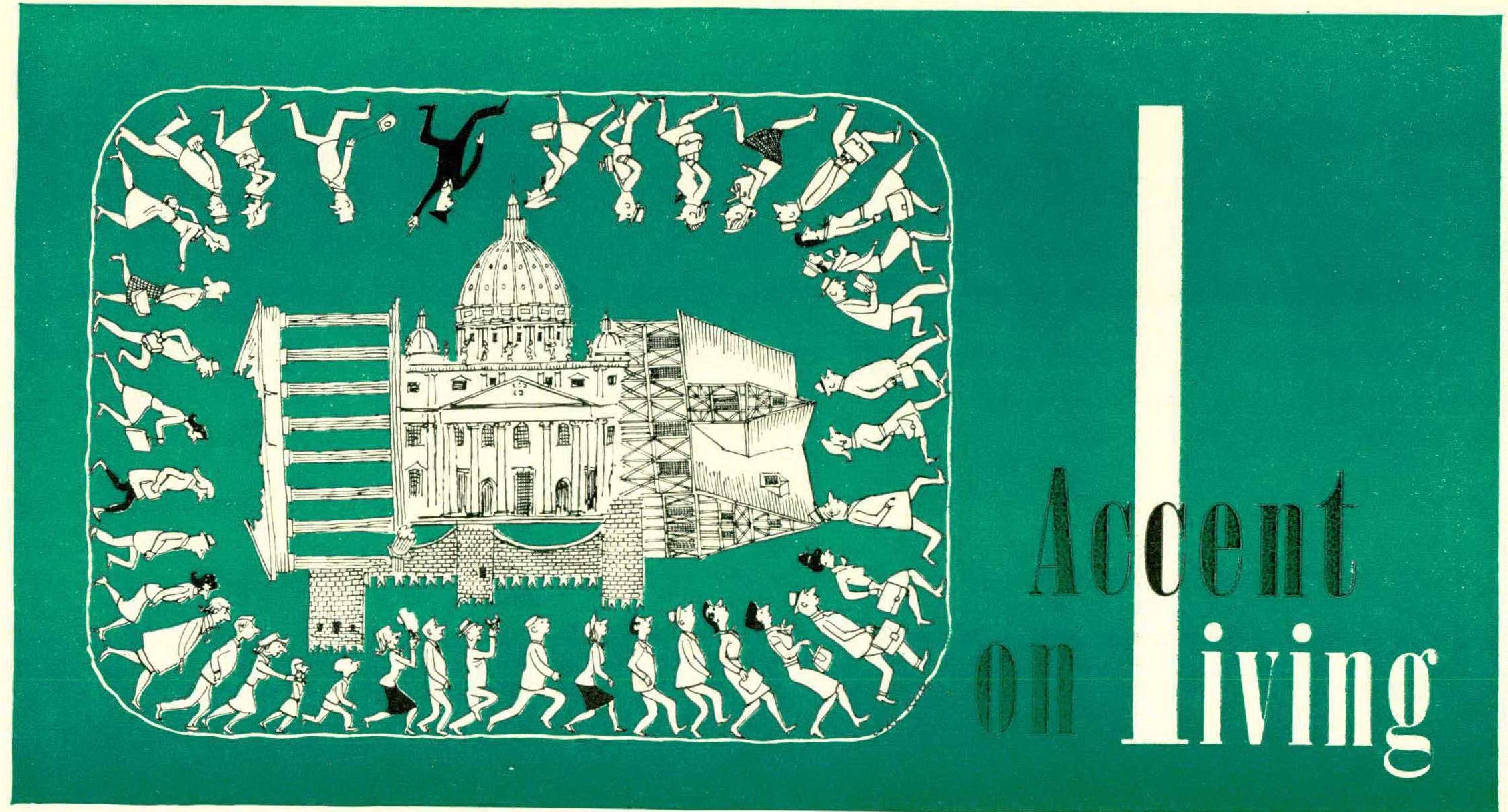
Sympathies of any onlooker are bound to be centered not so much on the tourists as on the conductor or director or chief tutor of the conducted tour as he is seen, for instance, in St. George’s Chapel at Windsor of a summer Sunday. The crush here is about equal to that on a New York rush-hour subway platform. At times the flow of sightseers through the aisles reaches a dead stop, parents become separated from children, husbands from wives.
In these circumstances, the tour director must bring together his pupils anew and examine for them in some foreign tongue such as Flemish, Italian, or German, decorously and in low tones as is fitting in a house of worship, the history of the place and the nuances of British character. His first great problem is how to attract their attention, noiselessly and without blowing a whistle; he does this by a frantic pantomime and by raising and lowering on the end of a stick a sign bearing his own name or perhaps the nationality of the tour. He is just about to identify, sotto voce, the banner bearing the arms of Sir Winston Churchill when the conductor of a different tour shoulders his way through the crowd, raising and lowering his sign. Meanwhile, all sorts of self-conducting tourists, speaking still other languages, start bucking their way out of it all.
I have only a few words of advice for the traveler who will decide for himself where he wants to go and how to get there: he should bear in mind that the fact that a port is duty-free does not necessarily mean low prices, and he should never travel without his own supply of his own liquor and his own flyswatter.