Vertical Drinking in the Soviet Union
HANNAH LEES,author of many light articles, lives with her physician husband in Philadelphia.
The weather was balmy in southerly Kiev and Yalta when we were in the Soviet Union last summer, so my husband and I looked for a sidewalk café where we could sit with a beer or vermouth as in France, Germany, or Italy and watch the world go by. It got very frustrating, for we kept sighting clutches of bright umbrellas in the distance and coming up to tables full of animated people, only to find everyone eating ice cream, delicious ice cream with a variety of delicious sauces, but ice cream is not really very conducive to peoplewatching.
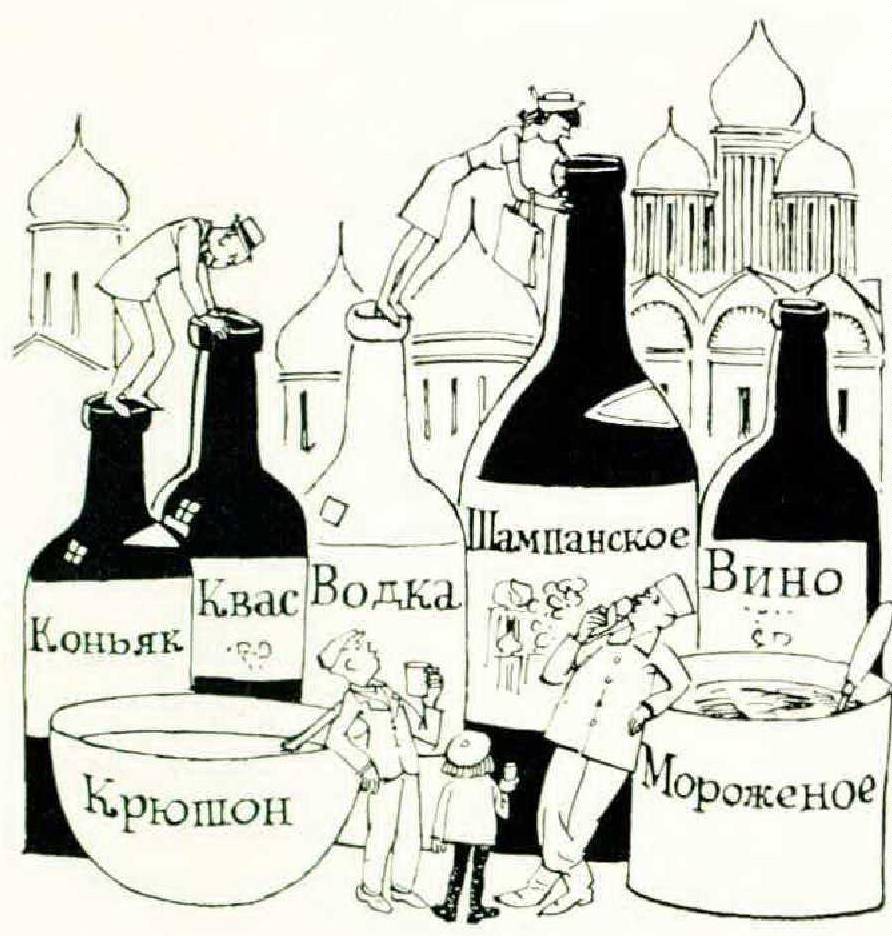
This is not to imply that the Russians are antiliquor. They simply do their drinking standing up, it turned out. On every other street corner you see barrels turned on their sides and mounted on wheels, with a long line of men standing waiting their turn. Some of these barrels dispense beer. Others dispense a slightly alcoholic drink called kvass, made of fermented brown bread and molasses and, I’m afraid, tasting it. Little corner stand-up booths, like our orange juice and ice cream stands, dispense wine by the glass both in the big cities and at the seashore. These quick drinks — beer, kvass, and wine — are all cheap, around 15 kopeks a glass, and a kopek is just a little more than a penny. But there is absolutely no other place where you can pay more to sit down to a drink than in the big tourist hotels, which I’ll come to.
At Yalta, that big Black Sea summer resort, liquor stores also sell drinks by the glass. At one store bottled liquor was available at a counter in the back. Wine, vodka, and brandy — called cognac by every English-speaking Russian we talked to, though I doubt it — were dispensed from a bar on the left. And on the right, behind a highly varnished counter, was a hardworking milk shake machine. A Soviet milk shake, however, has the following ingredients: eighty-five carefully weighed grams of ice cream, three ounces of wine, quite as carefully measured, and one ounce of brandy. Electrically whipped together, it is probably as close to nectar as a milk shake will ever be, though I, in my stuffy American way, felt it was rather strong nectar for all the small children I watched drinking it with their mothers.
GUM, that big department store in Moscow right across from the Kremlin, also dispenses drink from little antiseptic-looking stands scattered among its arcades, and the drink it dispenses is champagne. Anytime the store is open you can buy a small glass of champagne for 40 kopeks (about 44 cents) and a large glass for 75 kopeks (83 cents). We watched laborers in coveralls and mothers with children standing drinking champagne at eleven in the morning, which turns out not to be a bad time at all for champagne.
There is a good deal of drinking, too, between the acts at the opera and ballet. At the Palace of the Congresses (the only really beautiful new building in Moscow, right inside the Kremlin, and used for ballet or opera when the Congresses are not in session), there is a huge glittering refectory on the top floor, reached by a series of four high-speed escalators. The place, which holds 6000, was jammed the night we were there; and the minute the curtain went down for intermission, all 6000 got to their feet and surged into the lobby toward those escalators. At least half of them managed to get aboard and were carried at breakneck speed up to the refectory, where they partook of caviar sandwiches, sturgeon sandwiches, cakes, beer, champagne, “cognac,”and, especially, a rosy drink in a fancy stemmed glass called krushon. Krushon, no connection with Khrushchev, means something to do with fruit and is in fact a wine punch full of various cut-up fruits. The religiously proletarian Russians were lined up by the hundreds to buy it at a ruble ($1.11) a glass.
As for the bars in the tourist hotels, we never found one with any resemblance whatever to the luxuriously cushioned, seductively lighted ones we are used to here at home. The one attached to our first-class hotel in Yalta, for instance, was on the second floor, with an outside entrance that looked like a fire escape. It had pink stucco walls and oilcloth tables and reminded me of the café in Bus Stop. At five in the afternoon it was almost empty. There was a French family at one table dividing two bottles of beer among the five of them. There were two or three Russian couples and families eating yogurt and meringues and cream-filled buns. And there was us. We ordered a “cognac" apiece (50 kopeks); then after a while we both ordered a beer as a chaser, but we were the only ones there living it up even that much.
Yalta is in the center of the Ukranian wine-growing district and has a cellar where for a ruble and a half ($1.65) you can take part in a wine-tasting ceremony at stated times during the day. For your ruble and a half you may sit at one of two long tables in a chair made out of a varnished barrel and taste ten different wines. You start with the driest and cheapest (alcohol 17 percent, sugar 4 percent) and end with the sweetest and most expensive (alcohol 14 percent, sugar 22 percent). Ten glasses of wine for a ruble and a half sounds like quite a bargain, and is, except that first you have to listen to a grim lady commissar give a twenty-minute lecture in Russian on the fine art of winemaking (an Indian sitting next to me interpreted slightly), after which the ten glasses of wine are brought around in such rapid succession that life becomes a series of toss-offs, and you stagger out feeling as if you had been guzzling maple syrup.
Drinking is slightly more what we might call civilized in the bigger cities such as Kiev and Moscow. We found the bar of our hotel in Kiev, again on the second floor, fairly full of people, most of whom seemed to be Russian. Every table was occupied, and knowing it was quite customary for strangers to sit down together, we chose a handsome blond couple with the idea that not knowing each other’s language we wouldn’t bother each other. In a moment of wild optimism I suggested to my husband that he try asking for a vodka martini. The young man at the table seemed much interested, and when the barmaid looked blank, he laughed.
“She doesn’t understand,”he said; “better try something else.” It turned out he was studying to be an interpreter. So much for their privacy and ours, but we had a good time. The young man, however, made a terrible face when we asked for vodka.
“You like it?” he asked.
We said we found it smooth as cream, which we did. But tastes do vary. He and his girl were drinking something that looked like a whiskey sour with a black olive in the bottom. Minding my tourist manners, I did not make a face.
The only really civilized drinking — using as a measure of civilization the relaxation and gaiety that go with the alcohol — was in the hotel dining rooms. There, from eight thirty to eleven thirty, a band usually plays and plays with spirit, and everyone — Russian, French, Belgian, Scandinavian, and American — dances. Between dances they drink champagne, vodka with beer, or (far more chic) “cognac.”
There is said to be a great deal of drunkenness in Russia, but the only drunks we recognized as such in our two weeks there were three men in the dining room of our hotel in Kiev who loudly applauded my husband and me when we came off the dance floor after an animated dance. They got up and bowed and clapped and beamed, and I was so flattered I didn’t recognize their condition until it was pointed out to me.