Efficiency in Its Country of Origin
A professor of English literature at the University of Massachusetts, ALEX PAGE has recently returned from a sabbatical, which he spent mostly in Germany.

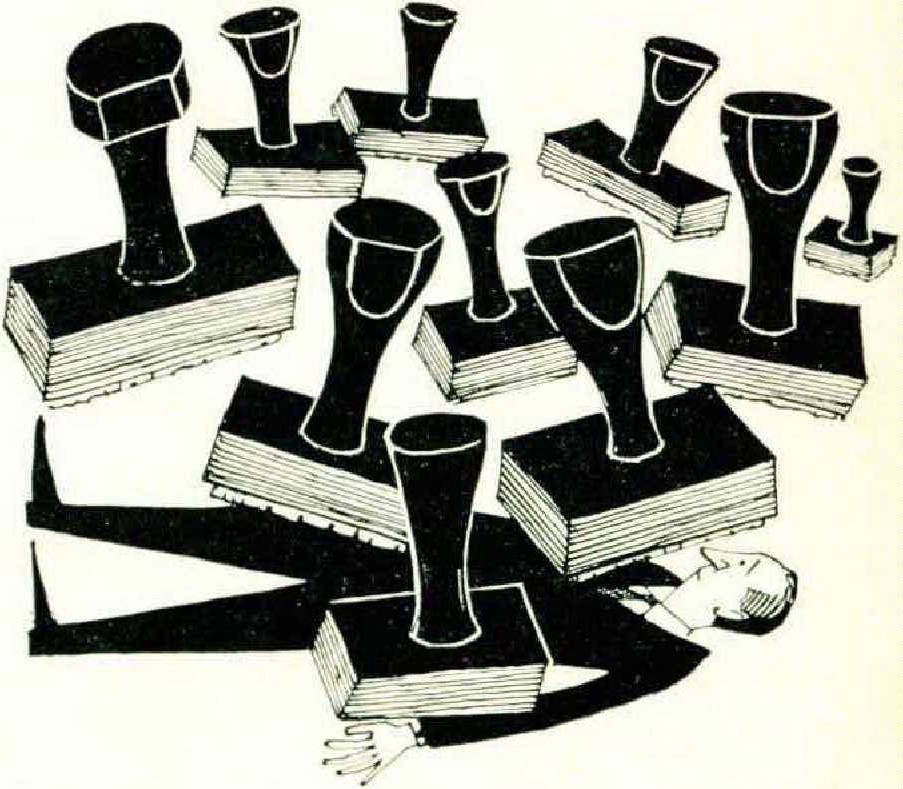
Something strange happened when I went to get my suit from a dry-cleaning establishment in Munich. I handed the lady my ticket; she got the suit and accepted the money. Then with a quick, automatic movement she rubberstamped the ticket and threw it in the wastebasket. Like that.
“Why stamp it” — it seemed reasonable at the time to ask — “if you’re going to throw it away?”
“That is the rule.”
Since I was slow to take that in, she relented and gave me what was to her a perfectly natural explanation. “Anyway, we keep a copy.”
Well, I won’t be caught on the wrong side of an argument about efficiency. It stands among our finer virtues. I had yet to discover that in Germany efficiency is the crowned head of them all. Nor does the head that wears this crown ever lie uneasy.
As soon as my wife and I had found ourselves an apartment, I went to a store to get a nameplate made. Armed with foreknowledge, I had the exact size of the thing down to the ultimate millimeter. The storekeeper and I discussed the type of letter, the size, the spacing between, the color of the plastic, the blackness of the black ink that would announce my presence to the citizens of Munich — everything. It would take a week. When I returned at the appointed day and hour, the man pounced on me: “We made a mistake. [Ein Fehler is an ugly, nasty word in German.] You didn’t say whether you want square corners or you want round corners.”
“Why, it doesn’t really matter,” I assured him. “I’ll take it either way.”
“No, no. Because of the mistake, it is not here. It is still in the workshop. The workmen must know. You must decide.”
So I decided on rounded corners — I was in that sort of mood — not too rounded, just a little bit, say a radius of one millimeter, no more. The information was duly recorded in triplicate, and I was told to return in yet another week.
The nameplate was there, all right. The corners were square. I didn’t feel I ought to make too much of that part of it. For it read, “Page.”
Now I will tell about the Staatsbibliothek. Not knowing the intricacies of time and motion study, I can only give a step-by-step account of getting a book to read in the library (to take one out involves several applications by me, by my landlord, by my supervisor, a waiting period, a trial period, plus all that follows):
First you go to the catalogue room. I never went without having to wait in line, because the trays of card files are not removable, and you mustn’t crowd.
Assuming you find a listing of the book you want, you make out a slip (in effect, a sizable questionnaire), drop it in a box, and return in a day. Or better, two.
The book, if it’s available, will await you in the reading room. You can’t go in unless you check your coat. That part is free, but there is always a long line. Several attendants that you now pass make sure you really have checked your coat.
At the far end of the reading room you are told the book is not there, an altogether likely turn of events. What now? Well, if there is any further information you desire, the librarian intimates, the Ausleihamt is the place. That means the lending department.
You reclaim your slip, retrace your steps, rejoin the line for your coat. Then you walk downstairs to the proper office and search out the proper official. He is, in a manner of speaking, expecting you.
He will explain to you that the book is not in. Now you know for sure. Then he will calculate for you that you can have it in sixtyseven days. And he says you will be notified.
And you actually are, say in sixty-two days. I am compelled to concede that the system works. There are many pleasant diversions Munich offers to the waiting reader, much to be seen, much to be done, possibly even books to be purchased at the numerous bookstores. The Universitätsbibliothek has, naturally, a different system. Its catalogue room is in a building five good blocks from where you go to collect the book. But they call you Herr Professor whether the book is in or out, and that in itself does something for you. Your disinclination to cavil gains momentum.
I evolved a theory that German libraries and banks are both plugged into a Platonic heaven of pure organizational form — the Geist is unmistakably the same. After we got our nameplate working, we joined a nice friendly neighborhood bank. I could tell because it had a luxuriant Christmas tree way back in October. Now, take a simple operation like withdrawing some of your own, personally deposited money.
First off, you confront the teller with your problem verbally. He makes out the check, but only after you have established your identity to his 100 percent satisfaction. You sign. He disappears. If he seems to be gone a long time, it’s for two reasons: (a) he double-checks your signature, and (b) he activates the bookkeeping machines right then and there — all this to take a putative bounciness out of your check.
Supposing he returns with an alles in Ordnung; does it mean you have your money? It does not. You are at best halfway. He hands you a numbered octagonal disk (the corners ever so slightly rounded) for further negotiations with the cashier. The cashier handles the cash end of it, while the teller, I daresay, never gets near the actual goods. You wait until your number is called, then present yourself right smartly, and if, but only if, the cashier’s lines of intelligence confirm that everything in this transaction is strictly bona fide, he will, without a second’s delay, hand you your money. You are now your own man. It’s time for lunch.
Depositing money, on the other hand, is a very quick, one-step affair. I don’t know why, but it is. Another detail worth mentioning: every teller has a lovely sculptured, opaque glass door in front of his window which he can close at will, and does —sometimes just as you are next in line. Boosts his efficiency, all right. Despite all the coming and going and moving around, a reverential hush pervaded my bank. Herr Bankdirektor is a very grand title; it may even beat Herr Professor. Though I addressed all the tellers by the former, it didn’t seem to affect the flow of traffic either way.
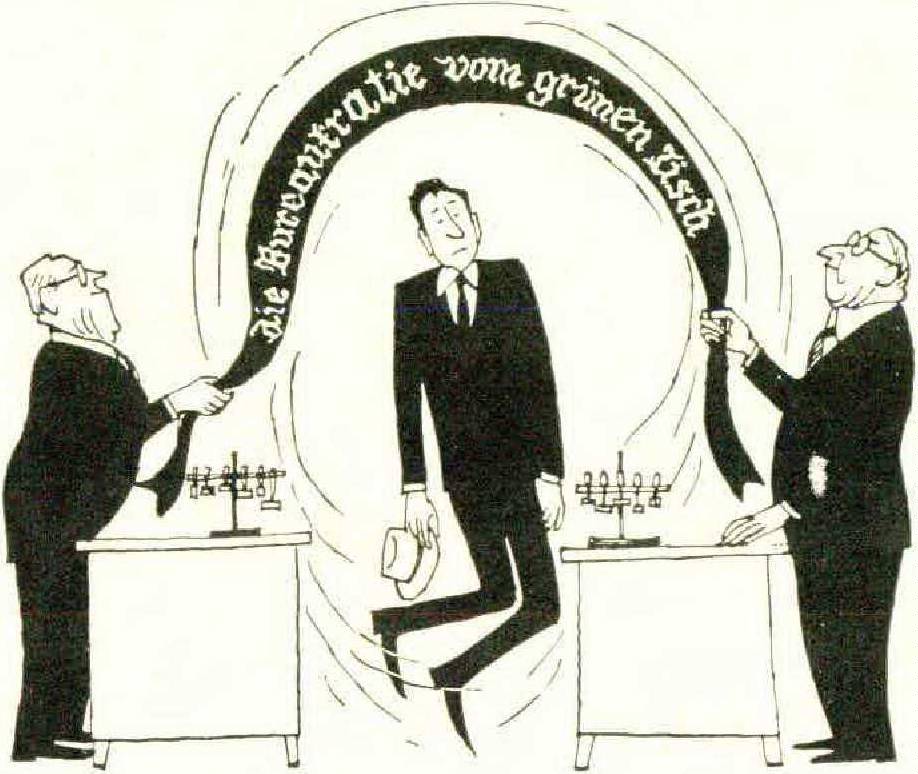
My contention is that one must get the hang of it, but the system does work. I will go further and maintain that even when it doesn’t work, there is something about it that does. This is what I mean. I took my shirts to a laundry and asked them not to use starch. When I returned, all shirts were — what else? — brittle to the touch with starch.
“They are starched,” I said.
The lady looked, and looked at the slip, and said: “I wrote ‘No Starch.’ ”
“Yes,” I said, “but they’re starched.”
“I wrote ‘No Starch.’ ”
“But they are starched.”
“They are starched, but I wrote ‘No Starch.’ ”
We each knew the other had scored a point. And we knew we’d have to leave it at that.
The week before we left Munich, our neighbor, who also occupied the ground floor of the apartment house, experienced fatherhood. When he returned from the hospital, he was in such a state of ecstasy that he put a lighted cigarette in his coat pocket, drank his new offspring a final toast (far-famed Munich beer!), and went to sleep. All that is speculation; no doubt the truth is on file somewhere. At any rate, people saw the smoke and called the fire department. Things began to happen at once. His windows were broken into, the door was smashed, one fireman carried out a chandelier, and four of them tried to do the same to father. He objected, but their mission was official.
Now fire hoses appeared through windows and door. The smoke became steam, and a brooklet made its babbling way into the basement. I knew because I had ventured into the hallway. There was something very reassuring about so much energy at work. I felt protected. By way of telling me that all was under control, one fireman waved me off with the nozzle of his hose in staccato action. I didn’t mind; as I say, I did feel basically protected. Now I felt wet too.
But I couldn’t take my eyes off one astonishing element in this dynamic tableau. Squeezed into the elevator was a large fireman, a gloved hand on the elevator buttons. The elevator disappeared out of sight and returned, stopped for the merest second to catch its breath, went up again and down, up and down. The fireman looked a trifle put upon, but his jaws were set in a rapture of duty. Down he came, and up he went. Was it to keep the elevator from bolting? Or in the hope it wouldn’t notice a thing? Had the man been bad and was he being disciplined? Or was he to divert the bystanders so that more serious work could move apace? Keep an escape hatch open? Wet or no, my wife, myself, and our little boy watched, hypnotized. The elevator was still on the move when we went back to sleep. It still moves in my Munich memories. There must have been a reason. There must.