Solo in Wyoming
Born in Omaha, Nebraska, and eager to sample the best, Charles W. Morton, with the approval of his parents, headed East for Ids schooling. When that proved disappointing, he tried his hand at tractor driving and card playing in Wyoming. Mr. Morton is associate editor of the ATLANTIC.
by Charles W. Morton
I WAS trying one day not long ago to give a lift to a boy who was having great trouble in translating Latin. “I hate this sort of thing,” he said. “It’s really nothing but memory work. But in geometry and some of these other subjects, you have a chance to use your mind and do some reasoning.”
For his own purposes his complaint was sound enough, but he may have hit upon, at the same time, the reason for my own fondness for Latin, and to a lesser extent Greek, and my general unease in mathematics. Memory work in great blocks — poems, proclamations, chunks of Shakespeare —had been loaded on us all the way through the eighth grade. I can still rattle off lines from a history textbook on the Ordinance of 1787, though I retain nothing else of it but the mere words: “Hardly had Congress provided for the sale of the land than a number of Revolutionary soldiers formed the Ohio Land Company,” and so on.
My first encounter with Latin gave me one of the most unhappy fortnights of my youth. I entered Central High School in Omaha a few weeks late, with the result that the rest of the class in elementary Latin were engaged in exercises entirely unintelligible to me. I stuck it out for a time, but the others seemed so assured while I was so mystified that I decided to try some tutoring. A frail old scholar from Creighton, a Catholic school and college — Mr. Kenney — came to our house, and together we sailed into the endings of the first declension. We had not been at it for more than a half hour before I realized that each of the five different endings had a precise meaning of its own. All one needed was to learn the five cases and the paltry terminology concerning them, and the first declension was there and ready, in working order. I tutored for a week, just to make sure of things, and I began to enjoy the subject immensely. Our high school Latin teacher was a tiny birdlike woman, swarthy, with sparkling dark eyes, graying hair, Mrs. Bessie J. Snyder. It was impossible not to learn Latin and like it, under her tutelage.
So much is made nowadays of education and the terrible plight of all who lack one that I can scarcely believe, as I look back on it, the easygoing attitude taken by my parents and myself toward my own. It may well be that the course I followed — or perhaps did not follow — was disappointing to them, but not even my most unexpected starts and stops ever brought from them the least hint of disapproval. I cannot recall that either my father or mother ever reproved me over any issue of importance, no matter how discouraging my decisions might have seemed to them; neither can I think of any want that I ever made known to them that was not amiably gratified. I was, for my part, a reasonably dutiful son, not given to asking for the impossible, and intensely fond of my parents, and out of this warm family relationship there grew, I suppose, another easygoing assumption that I would eventually enter and carry on my father’s hardware business. I certainly grew up in that assumption, just as I always assumed that I would inevitably go to Williams College.
A year of Omaha High School was more than enough for me. Other than the wonderful Mrs. Snyder, the teachers I had were, I thought, a sour lot. Perhaps I was getting too old to go along with more women teachers. At any rate, we all agreed that I should enter some preparatory school in the East.
The selection of a school for me was as offhand as anything of this sort could be. I had been reading the Owen Johnson stories about Lawrenceville in the Saturday Evening Post; it sounded like an entertaining place, and I believe some arrangements were made in the spring of 1913 for me to go there in the fall. But early in the summer, my mother met a personable young man in Williamstown, Karl Wells, who proved to be a master in a small school established some sixteen years earlier, the Morristown School in Morristown, New Jersey. His case for the small school of 100 or so boys was persuasive, and since I cared not at all which school 1 attended, so long as it was not a military school, my father deposited me at Morristown that September, after several splendid days with him at the Waldorf in New York.
I KNEW no more about the real composition of a community like Morristown than I did of Omaha. At the time it seemed to me excitingly elegant, and so it was in many ways, providing glimpses of a style of living I had not seen before anywhere: a five-gaited hunter, single-footing it along the road in long strides at what looked to be about 25 mph, the rider a bony-faced exercise man, seeming to sit without motion on the small saddle; some young people in a chain-drive Simplex, a hugely rumbling car with a small “close-coupled” body by Holbrook, the bows of its top (snugly folded down) of varnished light wood; some elaborate estates, such as Mrs. H. Mck. Twombley’s at nearby Convent, and the fantastic hilltop house with its stables, garages, and eighteen-hole golf course from which Otto Kahn was proposing to crash the highly stratified society of this self-satisfied suburb; many interesting houses; and always the sense of nearness to the much greater attractions of New York.
The boys at the school were a mixture of all sorts. The place was so small that everyone knew everyone else and all about one another. Reticence was not possible, and we probed each other’s lives and minds with inexorable candor. There were six forms and about fifteen boys to a form — bright, dull, amusing, lazy, dirty, or dandified. Some were there simply to relieve their parents from thinking about them; others were expected to come home weekends and bring friends with them. There were two or three from California and one from Texas, but for the most part they came from New York and New Jersey.
The founders and proprietors of the school were a triumvirate of Harvard ‘88 graduates: Francis Call Woodman, headmaster; Arthur Pierce Butler, vice-headmaster; and Thomas Quincy Browne, treasurer. Their scheme of a school was, I believe, sound and would have been a great success had they been drawing on families less precariously situated than the banker-broker types of the onthe-way-up commuters. As it all turned out, the Depression very nearly did the school in, and left it on a five-day-week basis, which necessarily restricted attendance to boys who could go home each weekend. In its earlier days, it was a conventional, strict, tightly controlled boarding school with a sprinkling of day boys from Morristown. The staff was good, and the Latin and Greek teacher, James A. Reeves, was, along with Mrs. Snyder of Omaha, the best and most stimulating within my experience. Most remarkable, as I look back on it, was the school’s success in enabling boys so sluggish and indifferent as to seem ineducable to pass the College Board examinations and enter the college of their choice.
Reeves went on to a considerable career after leaving the school, notably as the tutoring genius of Manter Hall in Cambridge. I was charmed to meet him in 1930 in Cambridge, when he confided to me an extraordinary statistic: it was just before Harvard had set up a tutorial system of its own, but the fact was, he said, that of some 4000 to 4500 undergraduates at Harvard, with its endowment of nine figures, close to a third in the previous year had recourse to Manter Hall, where the endowment consisted of two or three people like Jimmy Reeves and a few blackboards and bits of chalk, in rented premises. On the publish-orperish proposition, I doubt that Jimmy Reeves ever published anything. He was a crammer second to none, but I think he was in the much larger sense a great teacher. His Latin and Greek gave me an abiding liking for words and language and a comfortable sense of having something to tie to amid the vague and often muddled choices in English grammar. That, I suspect, is why I so admired Latin in any case: a truly precise language, few idioms, and a clean-cut rule for everything; learn the rules, follow them, and no trouble can befall you. I liked Greek the less, insofar as it seemed to me less precise and therefore somewhat sloppier. I realize that this makes me sound like an altogether conventional sort of person who thinks everything ought to be done according to what the book says, and I am somewhat shocked to find that this is probably true.
Morristown School was full of penalties for tardiness and other small offenses, for which “marks” were meted out — five, ten, twenty, as the gravity of the case required. The marks, each calling for one walk around the school’s cinder track, were read out after luncheon, when the entire school and staff gathered in the main study hall for dismissal, and a boy had to walk off his marks before engaging in sports for the afternoon. Every moment of our day was prescribed and supervised, and even study, after classes were dismissed for the day, had to be carried on in the schoolroom — from five to six in the afternoon and from seven thirty to nine, five days a week.
The school was especially strict about what we wore. Going without a necktie would have been unthinkable; for dinner the requirement was a dark suit, white shirt, and starched collar, which really necessitated a complete change from daytime wear. We tried to save time on the shirt change by folding inside the button-down collar of the white shirt most of us wore by day and buttoning over it a stiff collar that had been carried in a pocket. But this process left the buttons of the vanished button-down collar exposed, and the scrutineer-master at the dining room door would send back to change any boy disclosed to be wearing a “double-decker.” Some boys went so far as to cut off the telltale buttons, but one really saved needless quarreling with the authorities by wearing a neckband shirt at night and reserving transgressions for more substantial purposes.
I am reminded of these exactions when I contemplate the school and college dress of today, not so greatly unlike the beatniks’. Granting that a dirty sweater, dirty slacks, and dirty shoes are inexpensive, convenient, and perhaps even comfortable for a young person who asserts he is not in the least interested in them anyhow, and whose ideas might be more significant than his appearance leads one to expect — granting all this, I am bound to wonder what becomes of these same people in later life, once the priceless insouciance of youth is gone. What is so embarrassing as the aging Boy Wonder, the superannuated Peter Pan, or the beatnik at fifty?
I went to Morristown for three years. At some point in my second year, one of our better athletes, a boy named James T. Swan from Passaic, mentioned to me a scheme that had been flowering in his mind. I liked him immensely for his maturity and his ready sense of mirth, and the scheme was a dazzler. It was no more than a matter of simple reasoning, beginning with the fact that there were several new boys in the school so dull and awkward and generally unprepossessing that, it seemed plain to us, they must have been a source of great worry to their parents. Perhaps some previous school experience for these boys had failed to pay off, and this, we felt, might have given the parents certain doubts, even distrust, of what the school authorities in general might report and recommend about their son. Would not these parents be glad to subscribe to a more intimate and disinterested report on the boy, not from the headmaster but from schoolmates in more direct day-to-day touch with the problem? Sports? Social relationships? Studies? Personality? For a weekly report for the rest of the school year the fee would be $100.
We picked the three richest and least promising of the new boys and drew up identical letters for their parents, laying out our own qualifications in no modest terms. We were staggered to receive, by what must have been return mail, in each case a check for $100: great idea, much interest, would look forward, etc. We turned to and began scrutinizing our subjects. All school grades were posted each week, and these were easily summarized, and I am sure it was no surprise to the parents that the grades were dismally low. Sports were of course seasonal, but these afforded us a paragraph or two on physical coordination, sportsmanship, and such. Since all sports were more or less compulsory, it was impossible not to have subject matter in this category for the taking.
Our reports went along breezily for a month or more. We even talked with the three boys and asked them idle questions. But what was soon troublesome was the fact that we were making the reports too conscientiously; it was becoming a frightful grind, especially since none of the boys showed any sign of improvement. We decided by the end of six weeks to call it off, and with some assistance from home, to refund the subscription fees in full, which we did with postal money orders. I know there was no collusion at any stage of this episode, for we kept it a dark secret, but all three of the parents, again by return mail, sent back the money orders, endorsed to us, and said that they had received their money’s worth.
Swan and I felt we were well out of it all, but on becoming a bit pressed in the following year, we tried it again. This time the very first parent we approached took it for what it might well have looked to be — a form of extortion — and complained to the headmaster. The latter was ready to talk expulsion and to regard our offense as monstrous, but our account of the previous year’s satisfied parents, of whom he had not heard, and our incontrovertible statement that we felt sorry for the boy and thought he needed help took a good deal of the starch out of his moralizing. The matter was dropped on our agreement to sin no more.
THE school was a curious set of crosscurrents: a genuine, casual democracy and frankness among the boys, backed by preachments to that effect from the staff, and an inevitable tinge of sycophancy and lip-smacking in any mention by the authorities of the great or near-great among parents or boys, past or present, who had any connection with the school. We were allowed to draw fifty cents a week from the school bank as spending money, and we were formally instructed that money was far down the list of priorities toward which we should be striving. It was indeed the period of ostentatious wealth, and to spend a weekend at the home of one or another of our plutocrats was to sample a world of sumptuous novelty.
There was one boy who lived not far from the school who was picked up each Saturday by a chauffeur in a vast Alco 6-cylinder touring car, a model distinctive for the white band edging the top of its body-sides and a very good car of the time. I went home with him one Saturday, and after luncheon — served by a butler and two footmen, the latter in brown tailcoats with silver buttons — his mother handed him money and told us that we could go to the theater in New York and dine that night at the family’s apartment in Carlton House at — unforgettable number — 22 East Forty-seventh Street. Her brother-in-law’s valet would provide tickets and accompany us to the theater: Chin-Chin with Montgomery and Stone.
The chauffeur drove us to Manhattan Transfer in Newark, and by mid-afternoon we were at Carlton House in a lovely apartment: a pink bedroom, a blue one, and a living room where we would have dinner later on from the Ritz kitchen. What to do meanwhile.
“I’d like to go through the Tombs,” said my host. “My father knows the district attorney, and I’ll call up and see what he can do for us.” The Ritz switchboard put the call through in no time, and whoever came on at the other end must have assented most hospitably, for my host, whom I will call G — , said we should be off immediately. It seemed to me an excellent way to spend the rest of the afternoon.
G— asked the doorman to signal a cab for us and to pay the cab for taking us to the Tombs and to tip the driver and charge it all to the family’s account. His mother had given him fifty dollars, he said, but there was certainly no use in spending his money on what could just as well be charged.
We walked up the steps of the grim old graystone building a few minutes later. A handful of men and women stood just outside the heavily barred doorway, apparently being denied admission. I was astonished, but G — took it as no less than our due when a guard inside, very much on the lookout for us, asked our names and opened the barred door with a flourish. He would show us the place, he said, and answer any questions.
I remember the Tombs mainly for the servility of the guard toward G — and myself and his rudeness to the prisoners, whom he identified for us, well within their hearing: “Now this one here’s an ordinary thief,” as we stood at the barred cell door. “Here’s a murderer, this nigger,” he explained at the next. “We keep him by himself or with another nigger. We never put a white man in with a nigger.” The prisoners, without exception, ignored the guard and ourselves, even though they might have wondered what business of ours their troubles could be. I recall a great stack of loaves of bread, the dirty appearance of the whole place, and its smelly airlessness.
G — gave the guard grandly a dollar when he unlocked the big door for us to leave. The doorman at Carlton House once again paid off the taxi on our return. For dinner that night I ordered my customary spree-dish, spaghetti with tomato sauce, and a Clover Club cocktail, which impressed even my host, man about town though he was. It was delicious, the first I had ever tasted. I did not disabuse G — of his impression that I rarely sat down to dinner without one.
Chin-Chin, which I saw a half-dozen times again during its long run at the Globe, was a rosy dream full of gay little chorus numbers, bright comedy, and a couple of songs whose words and music are still indelibly in my mind, “Ragtime Temple Bells” and “Chinese Honeymoon,” this last a comic duet for the two principals. G—’s uncle’s valet proved to be a Frenchman named Levasseur, who sat in the balcony while we had orchestra seats, accompanying us after the show to the Hudson Tubes at Thirty-third Street and putting us on the train at Hoboken. Everything at G—’s house was quiet when we got there after walking from the Lackawanna station. We were driven back to school in the afternoon after another elaborately presented luncheon, this time with G — ‘s parents and two or three guests, who paid no attention to us.
As I look back at how we felt about the eight or ten real plutocrats in the school, I believe most of the boys had a sense of curiosity about where and how their families lived, but no great yearning to do likewise. The one material outlay that we all genuinely envied was the succession of stunning automobiles in which the little Kahn boy, in Form I, was delivered and picked up at the school each day: various Rolls-Royces, one a sports touring car with an aluminum hood and a thick panel of glass built into the body between the hood and the windshield; a Lancia or two; and a small imported car with much brass trim, either a Renault or a Fiat with the inverted-U radiator style, I forget which, and it could just as well have been both. The Kahn chauffeurs were all foreigners, and in the winter they wore fur hats that matched the fur collars and cuffs of their livery greatcoats.
I GAME out well enough in the College Board examinations, but I was short a credit in geometry, and I entered the class of 1920 at Williams with a “condition” in that subject in the fail of 1916. I still do not know what I expected college to be or what I would derive from it, beyond an interval of good company before eventually going to work. There was no specific objective of learning or achievement in my mind, and the idea that a college degree was in any way a credential that might be of use to me never entered my head.
A half dozen of my new classmates quickly proved very pleasant company, and our major concern was how we would fare when after a period of formal “rushing” by the fraternities, which took in the great majority of undergraduates, the final invitations went out to the freshman class in November. There was no one house where I felt at all certain of an acceptance, and I persisted in a vaguely reassuring expectation that something suitable would turn up. But as the weeks of rushing began, and I was dined and scrutinized at one house after another, at no time did it seem to me that I was really getting anywhere with any of them. Hoping, nevertheless, right to the bitter end — an empty mailbox while those of my friends were stuffed with bids — I found myself totally rejected. I would not even be seeing my friends at meals, for only the nonfraternity men ate at the Commons.
My haste was such that I did not even trouble to resign. I packed a bag, left a note asking my cousin to pack my trunk and ship it to me by express, and took the Century at Albany that evening, homeward bound. For the first time in my life I had tested my standing with my fellows and been found ruinously wanting, and that was that. It simply could not be explained away or made more palatable: I was a flop.
So ignominious and speedy a withdrawal from college must have surprised and disappointed my parents, but never a hint of any such reaction came from either of them. I went to work at the hardware store, my father brightened my life considerably by trading in our old 1913 Chalmers “36” on the marvelous new Stutz, and I plugged along until the summer, when we drove east once again. That fall I decided to have a try at the University of Chicago, where I was admitted as a student taking correspondence courses while tutoring and working off my condition in geometry, but living in an undergraduate dormitory, Hitchcock Hall. I even became pledged to a fraternity, and all was going along smoothly enough until I brought home two or three friends for a long Washington’s Birthday weekend. At this point I was overwhelmed by one of the viral infections, and I was seriously ill for a month. Again I withdrew from college.
It happened that James Morton & Son Company was supplying the hardware for a ranch house that an Omaha contractor was building on a vast property at Pitchfork, Wyoming, amounting to some 240,000 acres and shipping several trainloads of Herefords to market each year. It appeared that I could have a small job there as a tractor driver, for some 4000 acres of the bottomland along the valley of the Graybull River were under cultivation, and I decided to take it on. It was the first for me of what were to be several adventures in Wyoming, a region that has never ceased to fascinate me. I can no longer tolerate the high altitudes of the Rockies, and 1 am out of touch with developments there, but the ranch hands and small landowners of those days were certainly the most formidable and the most entertaining people I have ever met. I believe almost any one of them, given a rifle and an ax, could have fashioned a way of life for himself and lived off the country indefinitely.
To reach Pitchfork one took at Billings the branch-line train to the end of the railroad at Cody, and went from there by a light horse-drawn stage to Meeteetse, a little cow town some forty miles to the southeast, with a log hotel, the Weller House, where two and three guests to a room was the practice; a barbershop where a wood-burning stove heated water for the only bathtub in town available to the public (Bath: 50¢); a Chinese short-order restaurant, which was the only really bad Chinese restaurant I have ever experienced; a large general store, a couple of saloons, and a livery stable. One of the saloons, operated by two brothers, Bob and Jack Fenton, was great fun, and I spent many of the final days of my stay in Wyoming playing solo there, from nine thirty in the morning to closing time toward midnight. Rickety board sidewalks and a few cow ponies sleeping at the hitching rails completed the Meeteetse scene.
PITCHFORK was some twenty-five miles or more beyond Meetectse, reached by what was called the Sunshine Stage, a light two-horse wagon which also carried the mail, fortunately for the passenger, since the driver was provided an excellent lunch, by his contract with the Post Office Department, at a small ranch en route, and the passenger fared equally well at a cost of fifty cents. The Pitchfork brand, a design of three short prongs with a stubby handle, was famous all over the West, but Pitchfork itself, although shown on some maps, was no more than a ranch house and postal address, with a large barn and vast corrals of peeled logs.
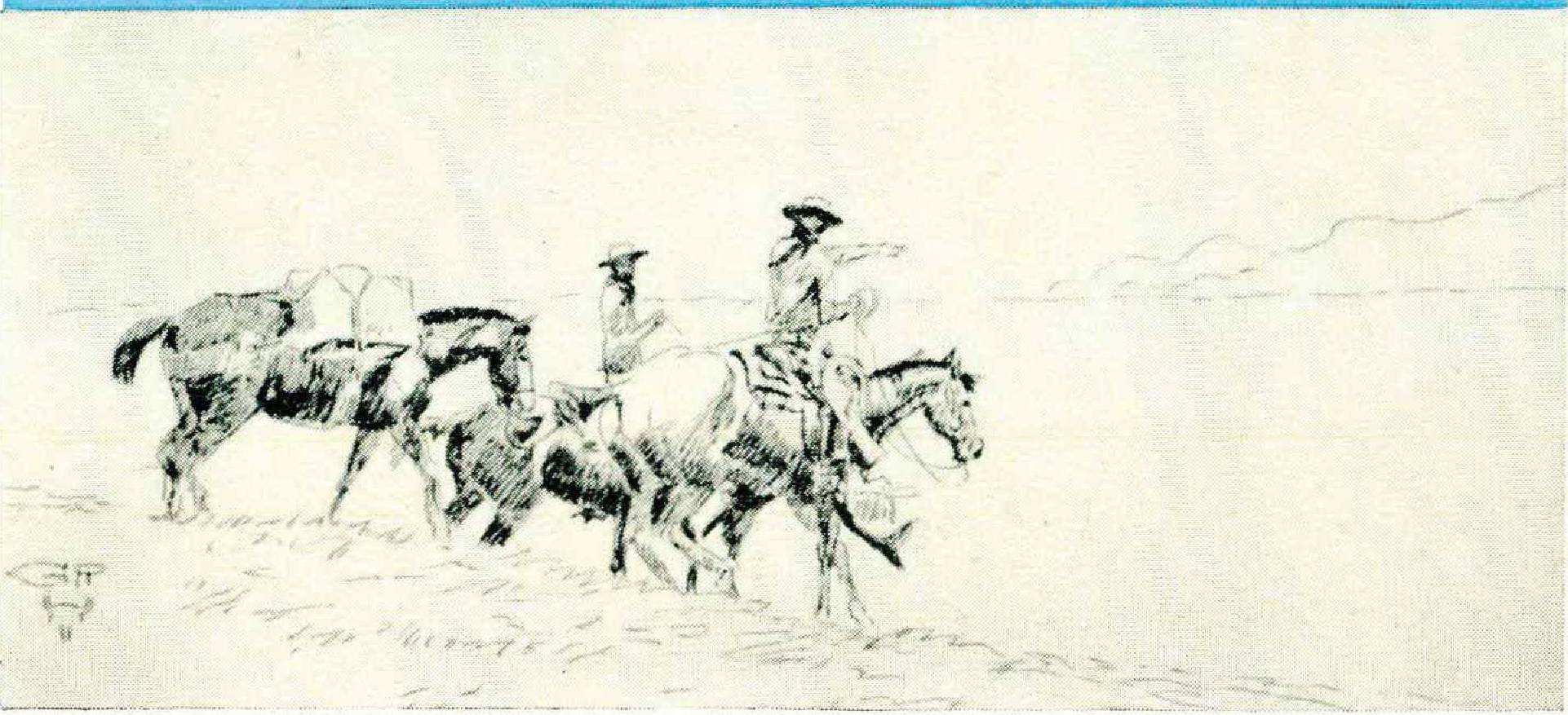
Four ranches made up the Pitchfork complex: the Pitchfork; the Z-Bar-T, nine miles up the river from Pitchfork, another cattle outfit where the new house was going up and where I would be working; the 91, a horse ranch that was said to be doing a brisk business with the army; and the TL, a sheep ranch that I never did get around to seeing. The scene as a whole was the broad, gently rolling brown bottomlands of the Graybull valley, surrounded by rough and lofty snow-covered mountains. A pattern of haystacks, each protected by barbed wire, dotted the valley, and the main work of the cowboys from day to day was forking out hay to the Herefords, who were broken up into small groups and divided among many stacks, when the snow cover was too heavy for grazing. The weather was always spectacular, but even in early April the sun in the high altitudes was hot enough to keep the range fairly open, although the occasional blizzard might look like the end of the world. A dozen or more hands worked on the Z-T, some married and living with their families and others living in the bunkhouse, a rather too small room with six or seven beds and bunks, adjoining a dining room and kitchen.
There was no plumbing of any sort in the bunkhouse, but I believe the kitchen held a hot-water tank heated from a spacious coal or wood range. Soft coal was abundant and mined almost locally in that part of Wyoming. The washing water for the ranch hands was no more than a large bucket on top of the pothellied stove, with a dipper and a tin basin, and one emptied the basin out the door after using it. Just outside the bunkhouse, an icy little brook called Rose Creek tumbled down the hill, and one could get fresh water from a pump. I preferred the pump to the tin basin, but it was a fast turn on a chilly morning. The outdoor privy for the hands was a commodious multipassenger unit in a shed off the barn. The house at the Pitchfork ranch was adobe or plaster and rather picturesque, but the Z-T bunkhouse was nondescript — a one-story clapboard building.
I set up in the bunkhouse the folding canvas cot that I had brought along, but a couple of nights there were enough. It was customary for the last man to turn in to cram the large pothellied stove that heated the place with all the wood it could hold and then to make sure that the windows and door were tightly closed. A half hour later the stove was cherry red, the room temperature impossibly high, and the whole place was echoing with thunderous snores. I shifted to a small wall tent of my own on a gentle slope outside, where I managed to keep dry and fairly warm in a tight lamb’s-wool sleeping bag and many layers of blankets.
The Z-T used various tractors, including a huge J. I. Case steamer, but 1 found myself on one of two small Cleveland Caterpillars, of early design, in a tandem hitch pulling eighteen-foot doublediscs, harrows, drills, and a manure spreader of discouraging voraciousness. It was shocking, after an hour of prying and heaving at the layers of the manure stack in loading the spreader, to find the whole cargo kicked off over the stern in what seemed hardly more than seconds. The old ranch hand in charge of our rig, with whom I was working, was named Wagner, and Old Wag could outfork me by an embarrassing margin, and he could swear more impressively, as he did at the frequent breakdowns of our Caterpillars, than anyone else on the place —• longer, harder, and with more real conviction, so menacingly that one almost expected the misbegotten machine to heal itself and resume pulling. We used the Caterpillars for all sorts of tasks, and my first job with them was as part of the tandem hitch when we went to work on a long low log barn that was sagging heavily from one end toward the other. We hitched on to the ridgepole and pulled the structure into plumb, at which point log props were applied to the other end to keep it that way. I don’t believe this whole job took more than a half hour.
One of the Caterpillars was powered by a Buda engine, and this would quickly overheat and boil away its water every two or three circuits of the field. The other had a better engine, but both tractors suffered from a ghastly need of frequent greasing, and both were prone to rupture their tracks and necessitate the most arduous repairs, on the spot and then and there.
To make any repairs to the wheels it was necessary to dig a sizable hole, take out a pin from the track, and lower the ends of the track into the hole, thus getting direct access to the wheel. The ranch maintained a machine shop and plenty of spare parts for all the machinery, and a blacksmith whom I came to know very well, a tall, wiry Texan with faded blue eyes and thick strawcolored hair and mustache, by the name of James Jefferson Knight. Along with the cook, an exarmy mess sergeant in the Philippine war and the finest cook imaginable for such a crew as the ravenous hands of the Z-T, he was perhaps the toughest man on the place — sunny and amiable on the job, but a rapid and morose souse once inside a Meeteetse saloon.
The incessant repairs and lugging water in a tengallon milk can from the river with Old Wag made a day’s work with the tractors fairly heavy going. The cultivated acreage was four or five miles up the river from the bunkhouse, and our transport was a Model T, with the back scat removed and a platform at the rear where our gasoline and miscellaneous gear were carried. The route was cross-country, without any road, and almost any morning on the way to our rig we would start up an antelope from the river; it would come flying up the slope, across our bows at perhaps 200 yards distance, and vanish over the hill in a matter of seconds, certainly the fastest animal at full throttle I have ever seen and seeming almost not to need to touch the ground.
When unencumbered by a tow, a small Caterpillar was a furiously rough ride, veering and yawing at the slightest inattention by the driver, for a touch on the steering wheel would brake sharply on one track while leaving the other free, and on either hard-over position the machine could turn in its own length. Pulling a big load it was much more stable, but as the driver of the rear tractor in the tandem, I lived in a cloud of dust almost regardless of where the wind was coming from, getting the full output from the tractor ahead or from the machinery we were pulling behind. The massive white cloud formations, forever changing against the background of the blindingly blue mountain sky, were always worth watching as we roared along at a slow walking pace, with the unmuffled exhaust blasting away only a few feet from the driver’s car. Every so often a shadow would cross our course, and looking up, I could see an eagle cruising the valley. I saw no other game on the Z-T, although the mountains were full of it. The Graybull was fished not at all except by the blacksmith, who would cut himself a willow rod, turn up a few “devil scratchers” from under the rocks along the bottom, and bring in a fine string of big trout after an hour or two of effort.
THE high point of the day, socially, came for me after supper of an evening, when one of the foursome of solo players into which I had been admitted would look us over and remark, with an air of jovial inspiration, “Deal the cards, you sons of bitches, and I’ll frog without looking.” This was, in bunkhouse parlance, the Invitation to the Waltz, a frog being the lowest bid in solo and not really a very hazardous offer. But it always got a game going in the bunkhouse, and we played there almost every night. Solo is such a fast upand-down sort of game that it is not easy to fix a satisfactory stake for it, especially if the players are hard up, as we were. Unless one gives the chips a precise money definition, the pastime version of solo is to start each of the four players with 110 chips, and the first to go broke pays a flat sum to the other three. A solo hand can be played very quickly indeed, and if one considers that the bidder of heart solo — the highest bid—could win as much as eighteen dollars on a single hand at five cents a point, played out in a minute or less, even a penny game can reach interesting dimensions.
The ordinary all-day saloon game was on the basis that the first to lose his stack of 110 chips would buy a round of drinks for the others. There were really no saloon bums in Meeteetse, and it was good manners to include the kibitzers when the players stepped up to the bar, for they were kibitzers only because they lacked numbers to make up a game of their own, and they would treat in their turn like everyone else. A great virtue of solo is that it can be played by either three or four players without any change in its values, since in the four-handed game the dealer lays off. I believe it stems from the German game called skat. I have never found it in the East, but the plain fact is that any game favored by such gamblers as the stock hands of Wyoming is worth a try. I marvel, looking back, at how hard they worked for their small wages and how gaily they risked their all. My own ratings would be, approximately, the best game for two, pinochle; for three or four, solo; for four, hearts; for five or six, straight draw poker or five-card stud.
Solo is easier to play than to explicate, but for anyone interested in cards, here is the game:
A hand of solo is played by three players; if there are four, the dealer lays off after dealing. It is a bidding game in which the declarer becomes opposed by the other two, playing as partners. The objective of the declarer is to gain “count” rather than to win tricks, the count being similar to the count in pinochle (ace-11, ten-spot10, K-4, Q.-3. J-2, for a total of 120). The declarer is paid by each of his two opponents for any count above the break-even point of 60, and he pays each of his two opponents the amount by which he fails to take in 60. As in pinochle, the ten-spot is next to the ace in value in the play as well as in the count.
Solo is played with the six-spot low, the twos, threes, fours, and fives being removed at the beginning of play. The first round of the deal is three cards at a time to each of the three players, and a “widow,” or “kitty,” of three facedown in the center of the table. Four at a time to each of the three players are dealt in two more rounds, and the dealer’s duties are completed, leaving each player with eleven cards in hand and three, facedown (of course the entire deal is facedown), in the center of the table.
There are only three bids in solo: a frog, the lowest, in which hearts are automatically trumps and the bidder, if he becomes the declarer, is allowed to take the widow into his hand and put facedown in front of him, before play begins, any three cards from the total of fourteen that he is holding, and these belong in his eventual count; a solo, in which clubs, diamonds, or spades may be the trump, according to the declarer’s later announcement, and which overcalls a frog; and a heart solo, which makes hearts trumps and overcalls all other bids and which, if bid initially, ends the bidding then and there. In all solos, including a heart solo, the widow becomes the property of the declarer, but it remains facedown on the table, undisclosed, throughout the play. Any count it contains belongs to the declarer, but it cannot be turned over until the hand is played out.
The payoff rates on the three bids are on a frog, one for one; on a solo, two for one; on a heart solo, three for one.
Examples, if the declarer happens to take in a total count of 72: on a frog he would win 12 points from each of the two opponents; on a solo, 24 points from each; on a heart solo, 36 points.
Similarly, if he happened to fail to make 60 and took in, for instance, only 45, he would pay each of the two opponents 15 points on a frog, 30 on a solo, and 45 on a heart solo.
It should be emphasized that there are indeed only three possible bids, a frog, a solo, and a heart solo. All suits have the same value, so that the first player to bid a solo can be overcalled only by a player bidding a heart solo. The trump which the player has selected for his solo in clubs, diamonds, or spades is not identified until the bidding is complete, at which point a player will remark to the declarer, “You bid a solo. Put a handle to it,” and the declarer announces the trump.
There are very few rules indeed governing the play. The opening bid is from the player to the left of the dealer, and the opening lead is from the player to the left of the declarer. A player must follow suit, and if unable to do so, must play a trump, regardless of how the trick stands at that point.
The Fenton brothers, a highly picturesque pair, were genial hosts to the two or three solo tables that were more or less constantly in use when we were in Meeteetse on an outing. The older Fenton was dressed as no one else in the vicinity was dressed, a cloth cap and a cardigan sweater setting him apart from all others. His brother had a long, ragged mustache, wore a shapeless and battered old felt hat, a vest and never a coat, and kept a much used towel tucked into his waistband. He was extremely polite to me, and whenever he served me a drink, he would whip out the dirty towel and polish the glasses with it before setting them down on the bar. (A drink was two ounces of Yellowstone whiskey accompanied by a small beer chaser.) Both Fentons wore neckband shirts, with a brass collar button and no collar. The biggest night at their place, or for that matter in Meeteetse, while I was there was when Dr. Dorrance, the multimillionaire owner of Campbell’s Soup, was passing through with a large pack outfit on a spring bear hunt and decreed that everything for everybody at both saloons for the afternoon and evening would be on him, a gala which must still keep his memory green.
GETTING the twenty-five miles to Meeteetse from the Z-T was a problem. Anyone with a truck or car would offer a ride, but there were long periods, often several days at a time, when no one at all went over the tortuous road through the sagebrush and the countless prairie-dog villages. The only dependable method was to start walking and hope for a lift, but I walked it several times with never a sight of a ride. By about the halfway point the chattering and scurrying of the prairie dogs became a great irritant. The legend was that they could duck into their burrows too quickly even for a rifle shot, although I doubt this, but I never saw a dead one. They were not scavengers, but I was assured that no one but an “Injun” would eat one.
The blacksmith was usually my companion on a Meeteetse outing. Aside from his extraordinary skill at his forge, I remember him for his brownpaper Bull Durham cigarettes, which he twisted into a durable shape without licking the paper, and for his boast that he could tell time by consulting a two-foot carpenter’s rule that he carried. I had many a chance to check him on this last, and I have no way of explaining his success. He would unfold the rule and bring down his thumb at some random point on it, meditate a moment, and then announce, within ten or fifteen minutes of exactness, the time of day. The figure where his thumb had come down had nothing that I could see to do with what he announced as the time. He was oddly mystical in his purported disclosure of his method, which went as follows and no further:
“Now there’s twelve inches in a foot, ain’t there?”
“Correct.”
“And it’s twelve hours around the clock?” “Right.”
“And there’s twenty-four inches in two feet?” “Right.”
“And there’s twenty-four hours in a day?”
“Yes.”
“Well, there you are!”
The blacksmith’s brown-paper cigarettes remind me that no one in Wyoming smoked “tailormades,” which were regarded with suspicion no matter what brand and were usually called “pimpsticks.” Bull Durham was the universal smoke, with Duke’s Mixture a poor second. I was the object of some curiosity by an old stockman in the Fentons’ one day when I produced a package of pimp-sticks and lighted one. The old man looked at me with amazement and finally, unable to resist the opportunity, said to me, “Say — let me just try one of them things.”
A few years later, on a long and enchanting motorcycle trip with my wife through France, we stopped at a pump outside a hotel in Chateaubriant. The porter was wearing a long apron of striped ticking and a visored cap, and I took him for a Frenchman. But he noticed a Bull Durham tag hanging from my breast pocket and disclosed himself as an American from California. He had gone AWOL at the end of World War I and been stranded in his porter’s job ever since. He asked me if I would give him the half-empty sack of Bull, but I dug into the locker and produced a couple of full sacks for him which had a profound emotional effect on him. “I save up for a ticket home,” he said, “but just as I get almost enough to buy it I blow it all on getting drunk. But I’m gonna start saving again right now.” He looked over his shoulder and lowered his voice. “These frogs,” he said, “are mean when you have to work for them.”
THE walk to Meeteetse was such a nuisance that I decided to buy a horse, and the foreman of the Pitchfork, a pleasant and much respected man named Cassidy, said he had just the right animal, an eight-year-old sorrel mare who had been running free on the range for the past year. The mare, I learned, would be brought in with a hundred or more other horses at the weekend, she would be mine for forty dollars, and he would lend me a saddle and bridle to use while I tried her out.
Her arrival at the corral of the Pitchfork one noon was part of a magnificent demonstration of professionalism by Cassidy and his men. Cassidy was the only man on the place who wore anything fancy in the way of chaps. His were gray leather, with a decorative motif in silver studs, emphasizing the three-pronged fork of the Pitchfork brand. I do not know where he got them, but the catalogues of the Miles City Saddle Company were the favorite reading matter in the bunkhouse of the Z-T, and one could find warrant in them for spending into the thousands on an equestrian outfit. Most of the style of the cowboys and hands was functional and without ornament. Cassidy in his handsome chaps and riding a powerful big horse that carried his bulk like a feather was an impressive sight.
A truck gave me a lift to Pitchfork. Cassidy and two or three of his hands were taking their ease on the top rail of the corral fence. Several branding irons were keeping hot in a small wood fire. There were many colts in the herd, he said, who had spent their first year without ever seeing a man, and he thought they would all be coming along any minute now. He pointed across the flat where, two or three miles distant, one could see dust. “There they are,” he said.
The dust, approaching at an amazing pace, disclosed a great mass of horses, running hard, guided and urged on by three or four riders, waving their hats and heading the whole thundering, breathless advance into the wide fan-shaped fencing that would funnel it into a lane leading to the corral. The horses were scarcely slowed by the lane, and the first arrivals burst into the big enclosure on the dead run, keeping at it in a counter-clockwise circling that was soon slowed by their sheer numbers. To me it was a scene of wild confusion, but Cassidy and his men could identify an astonishingly large number of the horses, some by name, others by their previous ownership, or for some distinctive habit or accomplishment. They all identified the sorrel mare readily enough, and one of the hands, at what seemed to me the risk of his life, took his coiled rope and dropped down into the milling mass. His throw was so effortless that he seemed to move no more than his wrist, but his twitch on the rope brought the mare down, tripped by his noose on a foreleg, and he had a bridle on her in a jiffy. She was slick and very frisky, and I rode her back to the Z-T with much self-esteem. I unsaddled her in the barn, led her to a pasture, and turned her loose. This was a mistake. It was like stalking a wild animal on foot to get her into a corner and put a bridle on her the next time out.
1 will not dwell on the trials I endured from this horse. She was mean and never mean the same way twice. She would tolerate two automobiles and bolt from the third, the same with mailboxes or even a stone beside the road. At times she would stop and eye a telephone pole with such trembling, ears-cocked, ears-back panic that even I began to think the pole was doing something to scare her; if not at that moment, perhaps it had on some previous occasion. At that instant, after seeming Lo compose herself, she would bolt again. She very nearly threw me when the sleeve of my slicker, neatly tied on behind me, came adrift and touched her flank, to which her reaction was one of bucking and sunfishing. If I left her at a hitching rack, she would lean back and pull until she broke the reins. It was suicidal to light a cigarette while riding her in the dark. My worst moment with her came when we put up suddenly from the road just in front of us an eagle or a hawk which had been enjoying a dust bath. She went through her entire repertoire.
Cassidy obligingly took her off my hands. He decided that she was locoed, suffering from nervous instability caused by eating locoweed. In season, the weed produces an attractive little flower, and one of a cowboy’s duties is to keep the stock from grazing on it, for it affects cattle as well as horses.
THERE were many odd characters at the Z-T: a Swiss chore boy who lavished all his spare time and money on an ill-matched team and a buggy of which he was very proud, in the manner of a large property owner; an Old Swede, Andy, perhaps eighty years old, who kept all his belongings, including a kerosene table lamp and china shade, in a tin trunk with a curved top and who could take a spading fork and prepare the ground for a huge kitchen garden in one long day of nonstop work; Doc, the self-styled veterinarian, forever fending off ribaldries about the mortality and strange symptoms his treatments were causing among the cattle; a cowboy known only as Big Red, soft-voiced, polite, and by far the biggest man in the whole countryside; a remarkably disheveled man named Brown, who lived with his two or three children in a sheep wagon, in which they would come back for supplies at long intervals from his job of keeping the barbed-wire fences in repair; John Sayles, the foreman, who could have stepped comfortably into a role in High Noon or Shane, who knew the scores of verses of “The Chisholm Trail” and many other marvelous songs. The most amusing man in this assortment was a teamster, whose name I have lost, who arrived one spring evening as we were all sitting on the steps of the bunkhouse after supper. He was riding a large, dispirited horse and was followed by a white pack mule carrying his bedroll and effects. He dismounted, opened the gate to the yard, and found himself defied by the mule, which balked and refused to be led or dragged or booted through the gate.
No greetings had been exchanged, but finally a voice from the steps broke the silence. “That’s a fine big horse you’ve got there, friend,” said the voice. “Whyn’t you put a rope on the critter and haul him in?”
The stranger continued struggling with the mule, which relaxed suddenly and came ambling into the yard. “I would’a,” the stranger called back to the group on the steps, “but the tree of that old saddle’s a mite weak.”
The next morning at breakfast, while the men were already tucking away their gargantuan portions of wheat cakes, potatoes, and ham and bacon from the ranch’s smokehouse, the cook was standing in his kitchen doorway when the stranger appeared. “Hello,” remarked the cook to no one in particular, “here’s the mule man again!”
Such a start could have blighted the affairs of some men, but the mule man was no novice at settling in, and he was enough of a prima donna to take such a crack as almost a compliment, much as Henry Ford might have indulged those who joked about his Tin Lizzie. He was so full of talk and tall stories of his adventures that he quickly made himself at home. He was, incidentally, the only man I met in Wyoming who still wore a revolver at all times, a .38 double-action Smith & Wesson, from which most of the bluing had long been worn away, and he was fond of exhibiting an almost illegible permit to carry the gun issued in some small town in Montana many years earlier: a certificate, if you please, of his respectability and status in the community.
The mule man was a tireless solo player and the first after supper each evening to take the big plug-tobacco tin with the basketlike handles and sort out a deck from the mixture of greasy cards it contained. I do not remember that anyone ever put a new deck into circulation at the Z-T, and since such a player as the mule man smoked a cob pipe and chewed tobacco as he played, the cards all showed the effects of much fingering over months and years. His stories were bizarre; one was a description of a mysterious pestilence which littered the banks of some river in the Northwest with millions, said he, of dead salmon. “And sir,” the story concluded, with the mule man assuming the air of one who could not expect such untraveled folk as ourselves to believe him, “there warn’t a dog nor a coy-o-tee for miles around as had a hair on his body for eatin’ ‘em!”
By far the most spectacular man on the Z-T was the cook, Red Carlin, a powerful-looking figure of middle height, a brick-red complexion, sparse ginger hair, bloodshot eyes, and a saturnine view of all authority. Like hi.s small bedroom and the kitchen, his attire was always immaculate: a chef’s white hat, a white shirt and trousers, several layers of aprons, and white sneakers as spotlessly clean as everything else he wore. He would replace immediately any garment that became the least bit stained. His pies were of absolutely classic delicacy, and I believe he would have been welcomed as a great cook anywhere in the world. He was very kind to me and invited me into the kitchen for coffee and a piece of pie or cake whenever I was in the vicinity between meals, which was all too rarely.
Red disappeared for a day or two on drinking sprees in Meeteetse every few weeks, but he was too good a cook to lie fired for such lapses, iff is ultimate departure came when he brought back to the ranch from one of these outings a stocky little chap who looked not unlike Red himself, an unemployed teamster whom he introduced to us as Shorty Towle. Alcohol was forbidden on the ranch, but Red and Shorty, as a nonworking guest, continued to hit it up in great style, and after a few days it was decreed by the proprietors that Shorty would have to go.
Red’s response to this order, which came while he was turning a great outlay of steaks on his grill for our noon dinner, was to leave the whole meal to go up in smoke, telephone to Meeteese for an automobile to pick him up, pack his suitcase, and, in his unfamiliar “store clothes,” sit on the steps with Shorty awaiting their ride to town. His successor, who arrived a few days later, after an interval of what seemed to us semi-starvation, was hopelessly incompetent and as dirty as Red had been scrupulous. It was August, and I had been there almost five months. I decided to go home.
In Meeteetse I found that Red was lodged somewhere nearby and spending most of his time in the poker game, based in a log cabin at the edge of the village, a public-private sort of game where almost anyone was welcome to sit in. The game was straight draw poker or five-card stud, table stakes and everything in cash, and it worried me to find Red so heavily involved in it when I dropped in at the cabin one night. Pots of a couple of hundred dollars were commonplace. It was quite beyond my resources, and I was superstitious enough — and still am in gambling matters—to be worried too lest my presence somehow affect Red’s luck adversely, for he seemed to be losing considerable money on fairly good cards. I slipped out without attracting his attention and decided to restrict myself to the small-time solo game at the Fentons’.
THE final week of my sojourn in Meeteetse brought me a casual meeting with Shorty Towle one day at the Fentons’. He had gone to work hauling coal and supplies to an oil drilling rig some fifteen miles back into the hills, and he invited me to throw in with him in the sheep wagon in which he was camped on the bank of Wood River, a couple of miles south of town. It gave my whole stay in Wyoming a marvelously pleasant windup.
The routine was simple, but Shorty’s four-horse hitch — young, aggressive, and unpredictable animals that he called affectionately “my ponies” — made our daily travels exciting enough. At the end of each afternoon, Shorty would take on a ton or so of soft coal in his heavy freight wagon by pulling up under the hopper of a Meeteetse dealer, only two or three minutes and no work being needed for this process. He next picked up the day’s supplies at the general store and a pint of whiskey at the Fentons’ for himself, and we were back at his camp by twilight. The horses were corralled at a bend in the stream, where they could drink at will, a vertical cliff forming about half of the enclosure, and a crude fence of logs and wire the rest. They were fed hay and grain, and it was unsafe to get near the rear of any one of them, for they would kick furiously at anything or nothing. Harnessing them of a morning was an exercise in delicate slow motion, as if we were handling unstable explosives.
Shorty’s standard of housekeeping in the sheep wagon was as severe as Red’s in his kitchen. Everything was scrubbed and in perfect order. He was a good cook, and we lived very well, largely by his practice of helping himself to any part of the oil driller’s supplies that he fancied. The drillers were highly paid, only the best of everything would suffice for them, and we prospered accordingly. Shorty’s best specialty was a baking-powder bread which, cooked in a frying pan on top of the stove, came out as a single, light, skillet-sized biscuit. “Sheepman’s loaf,” Shorty said it was called, and it went very well with eggs and ham and bacon. The wagon contained an astonishing number of cupboards and drawers and a double bunk, crosswise, at its front end.
As a last act before putting out the lantern and turning in of an evening, Shorty put the pint of whiskey to his lips and let the equivalent of three or four big drinks trickle down his gullet in the fashion of a Spaniard getting under a jet from a wineskin: he was the only man I ever saw who could take on whiskey like that, without swallowing. In the morning, on getting out of his blankets and before firing up the stove, he tipped up the bottle again for most of what remained. The liquor seemed to affect him not at all, beyond bringing from him a sigh of satisfaction.
Our route to the oil derrick was altogether crosscountry, with no road at all but the faint track made here and there by the wagon itself on previous trips. The freight wagons had brakes of a sort, an iron shoe that could be made to press against the broad metal rims of the back wheels, activated by a cross member terminating on one end in a socket into which a wooden pole was driven. From the upper end of the pole a stout rope went to the driver’s seat, sometimes to a pedal, more often to a cleat, hanging loosely and ready for him to haul on by hand; the longer the pole, the greater the leverage and pressure on the brakes. Cross-country driving with a relatively light load like ours for four horses is easy enough on the level or uphill, but some of the dry gulches we crossed were so steep that much braking was needed to keep the wagon from over-running the horses. At one slope in particular it was all Shorty could do to hold them back from bolting. One of his “ponies” had dropped dead here some weeks earlier, he explained, and he had dragged the carcass down the gulch a few rods, where its bones were already beginning to whiten. “They get a whiff of it along about here,” he said, “and they don’t like it a-tall.”
The biggest freight wagon I saw in the West was the beer wagon, which came over the road from Cody to Meeteetse every month or so, a high-sided mountain wagon, piled to the sky with cases of beer from a Billings brewery; it had huge wheels, a lofty brake pole, and a broad seat, where the driver and one or two companions, beer bottles in hand, enjoyed the pleasures of a trip that must have taken at least two full days at a slow walking pace. One could imagine the wagon lurching and creaking over the stones of the river crossings, its ten or a dozen horses scrambling for a footing, and all Meeteetse turned out for its approach. With such an audience the driver became the stylist: it seemed almost without attention on his part, save for a ceremonial crack of the whip, that he turned the long hitch around and brought the wagon to a triumphant stop, the traces settling into the dust, at precisely the door of the Fentons’ saloon.
I never learned how the drilling came out, but a lot of wildcatting in the vicinity paid off in later years. The rig that Shorty was supplying was a study in loneliness, with no sign of other human existence to be seen in any direction. The drill and its steam engine were clanking and chuffing in all vigor when we got there, but it looked to me like a very long shot; the little pile of coal that we augmented so slightly seemed a trifling resource for powering so ambitious a venture. The silence when the drilling stopped for the dinner hour was overwhelming.
Dinner with the dozen or more drillers was superb. The men lived in a well-kept bunkhouse and took their meals in the cookhouse, presided over by a middle-aged woman and her beautiful daughter, perhaps twenty, and it was plain both were treated as the absolute authorities having the unquestionable last word over everyone else on the premises. Their cooking alone could have warranted such a status; their dinners might have come from the kitchen of a rich Iowa farm at threshing time; but they were remarkable personalities into the bargain: warmhearted, gay, zealous, and amiably in complete control of their work and their environment. The hospitality of the whole establishment to such outsiders as Shorty and myself was a tonic to be felt all the way back to Meeteetse, as our empty wagon rattled over the hummocks of buffalo grass. I can only hope that both women went on to marry wildcatters who struck it rich.
My worries about Red Carlin’s poker playing were needless, I found a year later, when I went through Cody with a friend from Indiana, at the beginning of a pack trip into the Shoshone Mountains. We dropped in at the Cody Café for breakfast, and there was Red, the proprietor, once again in his white aprons, giving me a comradely greeting. He had just about cleaned out the Meeteetse poker players, I learned, and had bought the café with part of his winnings.
Two years after that, in the second year of our marriage, my wife and I were in Cody on our way to the wilds. It was her first experience of Wyoming, and I was eager to have her see Red Carlin, whose saga I had told her, so we began the day, after stepping out of a stuffy Pullman into the chill of the early morning, at the Cody Café.
Red was not there. I asked the waitress about him. She was the type who seemed always to have one hand at her hip and the other patting her back hair, and she looked at me superciliously. “Ain’t you heard?” she asked.
“No, not at all. Heard what?”
“He ain’t here anymore. He’s dead.”
Her manner was so portentous that I could not help asking how it had happened.
“He married one of the waitresses, and he killed her with a butcher knife,” the waitress said. “And he hung himself in the jail at Fort Collins.” I did not learn what had brought Red to Fort Collins, and I may be mistaken about the location, but that is what I thought the waitress said. At any rate, Red was dead by his own hand, and the customers of the Cody Cafe were the poorer for his passing.