Who Goes to Prison: Caste and Careerism in Crime
Most of the people who commit crimes which could send them to prison do not go, says Mr. Jackson, a Brooklynborn Junior Fellow at Harvard, who is studying imerican folklore and penology. For two years he has been visiting prisons to interview inmates and law enforcement officials.
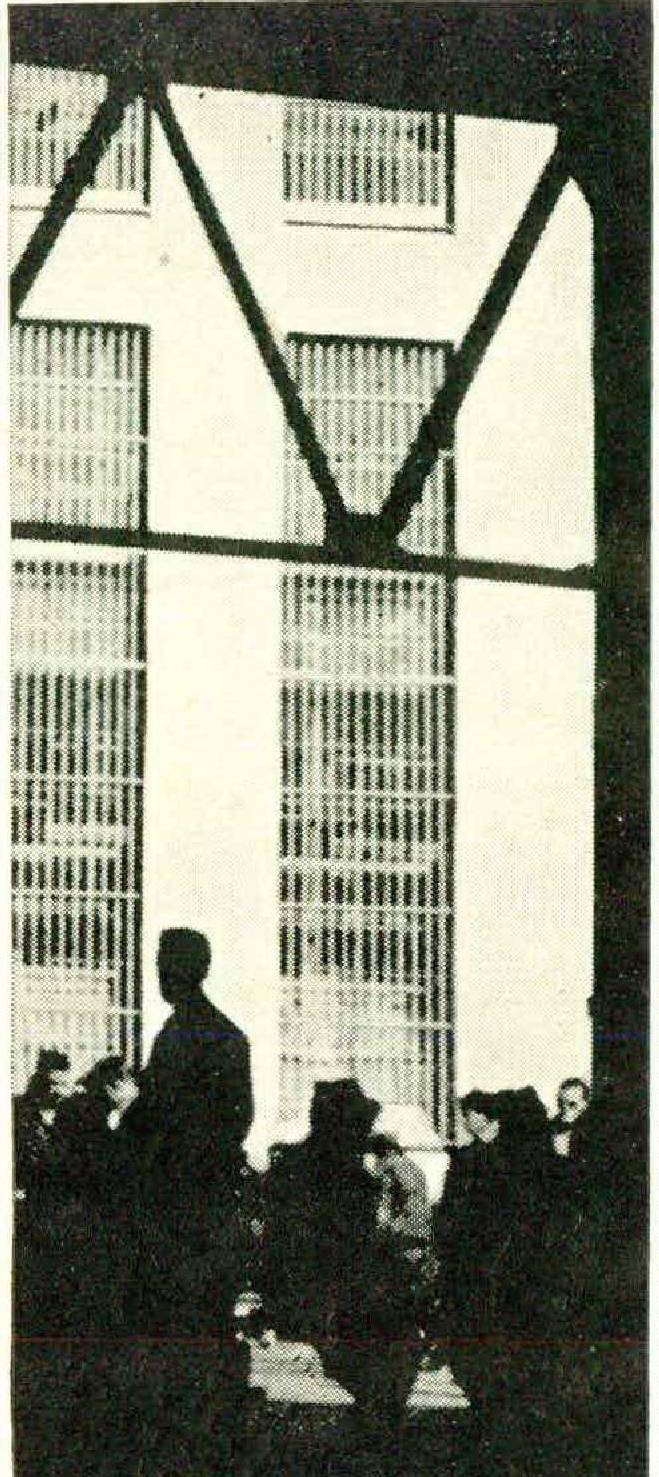
UNLESS you have led an abnormally isolated adulthood, the chances are excellent that you know many people who have at one time or another committed an act, or consorted with someone who was committing an act, for which they might have been sent to prison. We do not consider most of these people, or ourselves, criminals; the act is one thing, the criminality of it quite something else. Homicide, for example, is in our law not a crime; murder only is proscribed. The difference between the two is the intention, or to be more accurate, society’s decision about the nature of that intention.
Most prisons are organized nominally to handle the personalities who fit the public’s image of the Criminal — that nefarious deviant who supplies such fine copy for scandal sheets and television scriptwriters—but only rarely do prison staffs have an opportunity to deal with that sort of offender. Largely, a state prison is populated by people who are not too bright; impulse criminals (whose offending act reflects not a life pattern but a set of extreme circumstances — most murderers are in this category); chronic convicts (a large group of men who stay out for short periods only because they don’t know how to get along anywhere but in prison, and who seem to spend their criminal hours out of prison seeking not profit so much as prestigious reincarceration); some habitual offenders (those who can’t manage to stay out of trouble but who still base their value systems in the world outside); and a very small number of professionals who had a run of bad luck or a moment of carelessness.
The men who become prisoners are the most obvious criminals: clumsy, stupid, impulsive, hungup. Some have gotten what they deserve, some are oversentenced, some belong in mental institutions, some shouldn’t be in any institution.
Most of the people who commit crimes which could send them to prison do not go. Consider, for example, the large number of criminals who go unpunished simply because the general public insists on cooperating with them. Call girls, bookies, loan sharks, abortionists, and bootleggers know quite well that their customers are as anxious to keep their activities from the attention of the police as they are themselves, that even if an arrest does occur, most honest citizens will do whatever they can to avoid involvement. Like the distributors of narcotics, these offenders are protected by members of the society against which they supposedly offend, by otherwise honest men and women who would no more think of turning them over to the police than of admitting they had visited an abortionist or consorted with a whore or blown a week’s pay on a bum tip and had to borrow at an exorbitant rate to pay the bookie.
Other crimes go unreported, and there is no way to document their number. No one knows how many public officials take graft in any single year, but surely there are many more than those who make the headlines. Many business firms will not prosecute shoplifters, embezzlers, or pilferers, because they believe the damage to their reputation will be more costly than the satisfaction that might result from a conviction. Many rapes, for exactly the same reason, go unreported: victims think there will be no apprehension or conviction of the criminal and they will suffer embarrassment in addition to their humiliation (not without some cause: there were convictions of adults on the original charge in only 16.7 percent of the rapes reported to the police in 1963).
The late Edwin H. Sutherland, a well-known criminologist, devoted considerable study to what he termed “white-collar crime”—offenses committed in the course of their business activities by persons in relatively high positions. Among these offenders are persons who file fraudulent tax reports, businessmen who misrepresent the facts in a transaction, and lawyers who resort to illegal methods in order to secure acquittals for their clients.
In collaboration with Donald R. Cressey, Professor Sutherland once wrote that “crime is found in most occupations and is very prevalent. The people of the business world are probably more criminalistic in this sense than are the people of the slums. The crimes of the slums are direct physical actions— a blow, a physical grasping and carrying away of the property of others. The victim identifies the criminal definitely or indefinitely as a particular individual or group of individuals. The crimes of the business world, on the other hand, are indirect, devious, anonymous, and impersonal. A vague resentment against the entire system may be felt, but when particular individuals cannot be identified, the antagonism is futile. The perpetrators thus do not feel the resentment of their victims and the criminal practices continue and spread.”
The deliberate and intelligent offenders—the professional killer, the high-level narcotics distributor, the fraudulent corporation executive, the thoughtful burglar, the physician salting away money which ought to be paid to the IRS —go to prison so rarely they hardly affect the statistics. And when they do go, they do not stay very long. Prison population reflects only that part of the criminal world that isn’t smart, rich, dishonest, or lucky enough to stay out of jail. To this point, the Honorable Charles E. Wyzanski, Jr., Chief Judge, U.S. District Court, Massachusetts, remarked recently, “Unfortunately the whole system is one in which the hydra heads are plucked and not the trunk.”
WHERE the rich and professional obtain competent and expensive legal aid, the poor, despite recent Supreme Court decisions regarding procedure and representation (Gideon, Escobedo, Douglas, Pointer, and so on), are at an appalling disadvantage. Even if they are innocent, they cannot afford to hire a top-notch lawyer; a court-appointed attorney may take a sincere interest in their case, but it is more likely he will not. The poor defendant cannot put up bail, and regardless of the facts of the case, the man not out on bail is more likely to be convicted than the man who enters the courtroom through the front door. If there is a delay between his arrest, trial, and acquittal, he finds himself saddled with debts accumulated during the period, and perhaps lie has lost his job. The bail system, observed Ronald Goldfarb in the New Republic, “plays into the hands of the organized criminal while it discriminates against the poor one or the one who commits an isolated criminal act; it is a vehicle for discrimination; it can and does subvert the judicial process; and it is frequently applied improperly as a form of punishment.” The accused without money for bail “is punished before he is tried, and whether or not the ultimate verdict is guilty or not guilty. The defendant is also handicapped in assisting his defense. His chance of obtaining acquittal is lessened.” The great success of the Vera Foundation’s Manhattan Bail Project, arranging for many defendants to be released on their own recognizance, has clearly shown, in the words of Herbert J. Sturz, the project’s director, “that verified information about a defendant is a more reliable criterion upon which to base release than ability to buy a bail bond.”
One particularly repugnant illustration of the kind of inequity fostered by our bail system occurred in New York last April. On a tip, it was claimed, police arrested on a narcotics charge a woman who had a bottle of pills in her purse. Because she did not have the $25 bail money, she spent twenty days in the house of detention. The woman could not get the police to telephone the physician who had issued the prescription found with the pills; the police, apparently, were too busy to bother. Five days after her arrest the police laboratory verified her story: chemical analysis revealed that the pills were for her thyroid condition. But it was another fifteen days before anyone bothered to unlock the door to her cell. Would the police have dared act in so cavalier a fashion with anyone they thought had any power or influence at all? Nobodies don’t count; no one cares about them: they don’t file lawsuits.
The amateur gets arrested first. The man who does in his wife or an acquaintance is easily apprehended and convicted, but the professional killer, who has little or no connection with his victim and no apparent motive, is hard to find. None of the gunmen responsible for Boston’s 30 gangland slayings in the last twenty months has been convicted; there were only 17 convictions resulting from 926 known gangland slayings in Chicago in the period 1919 to 1957. In a 1964 FBI sampling of 2951 murders in 1658 cities, it was found that of the 2162 persons formally charged, only 984 were found guilty as charged, 431 were found guilty of a lesser charge, 175 were referred to juvenile court, and 572 were acquitted or dismissed. Even if every one of the juvenile suspects was found guilty, the conviction rate would still be under 50 percent. And that tells us nothing about the many murders that arc undetected.
LIKE the Boy Scout, the professional goes prepared. Preparedness, more than anything else, is enough to distinguish him from the merely habitual offender, who can commit crimes well enough but isn’t sufficiently adaptable to handle the occasional problems that may occur in their wake. Some professionals consider the possibility of imprisonment much the same way an investor considers the possibility of a bad turn in the market:
“We got together and talked it over and decided that to get the amount of money we wanted in the shortest time, that crime was the way to get it. Now crime, we feel, is just like any other business. In other words, there’s setbacks in crime and there’s deficits. Just as if you run a business, there’s always a chance it might burn down or you might go bankrupt or your employe might embezzle every dime you’ve got without the insurance to cover it. It’s the same with crime. Of course the penalty for going bankrupt in crime is much stiffer than — but at the same time your material gain is much greater than — in a regular business.”
But most professionals do carry insurance. One Texas thief always let his lawyer know where he was working and kept him on a regular retainer:
“We were giving him 8500 every two weeks. This $500 was to make any bonds. Fees — that was all extra. The $500 was for him to get there and keep us from getting killed. Now they have a law that they can’t whip a confession out of you, they won’t accept it in court anymore. It has to be given with counsel present. Well, son, when they got confessions in the past it didn’t make any difference how they got them: they were good.”
The amateur and clumsy thief gets to prison so frequently not only because he doesn’t know how to steal well but also because he doesn’t know how to handle a decent “score” when he does happen to hit. An inmate of Indiana State Prison told with scorn the story of another inmate who had been one of three men on a smoothly executed $30,000 payroll holdup:
“This guy had changed suits once a week, normally on the weekend like any other working joe. He had a car leaning sideways. But then he started walking into the crap tables, playing $500, saying, ‘Let ‘em roll.’ He’d throw craps and say, ‘Hell, there’s plenty more where that come from.’ Changing suits two and three times a day. Throwing parties. . . So the minute the pop comes he’s offered a ten flat [a sentence having a maximum of ten years]. I think it was for two or three thousand dollars. He couldn’t afford it. His buddies could hand the detectives a few dollars and let ‘em water it down a little and they came up with a ten flat. He had enough nerve to say, ‘Some dirty rotten sonofabitch must of ratted us out!’ I said, ‘Man, you sick!' Now he got a ten-totwenty-five and his buddies got a ten flat apiece because they had a little money to pay off.”
THE professional finds his referents, his values, in the outside world. For some, the incentive is purely acquisitive: they want things or the status things seem to represent. Other values are subsumed in the quest, sometimes quite consciously. “In my walk of life,” one killer told me, “you’ve got to use a certain amount of cold calculation, at times animal cunning, and brute force to survive. And in doing so, you leave a certain amount of your feelings buried deep and you keep them that way. . . . I’m not interested in being tough. Every act I have committed to an extent has been made on the basis of the buck. ‘Cause I’ve learned that . . . the buck is what makes you an American citizen as well as a person [that] can [be] respected. A broke man is like a dead man. No one wants to hear what he got to say, ‘cause what the hell, he must not be of any value if he’s not using it for his own benefit. ... I see no sense in walking around with my collar turned up and talking out the side of my mouth. That’s backwards. I want to look like anything except what I actually have lived the life of being.”
Once one has met a number of professionals in situations in which rapport may be established, one discovers they are frequently middle-class in background and quite articulate. These are two qualifications that open the standard channels of economic advancement in the noncriminal world. Many of the pros are agile enough to make as much money legally. And they often know it. One said to me, only half-joking, “I bet you wonder why a bright clean-cut kid like me from a good family turned to crime.” I said I had indeed wondered about that. “I like the life,” he said, meaning the romantic business of spending big, carrying an automatic in a special shoulder holster, moving in two worlds at once. For others, the money is sometimes secondary to a feeling about the criminal act that is almost sexual. The following statement was made by a Southwestern burglar highly respected by his colleagues:
“Now after I get inside, all my fear more or less is gone. And you concentrate on the safe, and you can look at it and — of course you always know what kind of safe it is before you make your entrance and everything. You go in, you got your tools and everything, and you can estimate what’s in the safe. If it’s a place that has delivery trucks, you can figure $500 per truck for every truck they got and they’ll have that much in the safe. I mean that’s the average for any kind of business whether it be a beer truck or a dry cleaning place. But still in all, that jewel might be the one. It just might be the guy that’s beating the income tax, or it might be the guy that’s booking all the big football payoff or layoff or something. And there’s no charge in the world, man, like when you see that smoke. . . . For instance, if you’re punching it and you hear that pin hit the back of the safe: clinggg! You know you’re home free. Or if you’re peeling it you see that smoke come out — whenever you pop that door and see the smoke you know that you’ve cracked the rivets and it’s all yours. And when you see that safe door open, it is a charge. I think the most safes I ever made was six of them in one night. But that was four of them in one building — you just go from safe to safe. But, man, it never became less. You know, it’s not like screwing. The first time it’s pretty wild, then each time it tapers off; you get part of the same drive, you know, the same action, but it’s not like the first. A safe’s not like that. Each time it’s more so because you figure the odds are more in your favor of it being the big score.”
SINCE the professionals are the most articulate and agile members of the criminal population, it is not surprising to find that on the rare occasions when they have to do some time, they rise quickly to positions of power in the prison society. Even though they are few in number, their influence is often extensive. In Texas, the professional is called a “character,” and one of them explained at some length just what the qualifications were and how one’s status in the world outside affected one’s inmate career:
“Crimewise you have a differentiation. First of all, you’ve got your rapos and you’ve got your women beaters and your women killers and your incests and all of these crimes against another person that is more or less unprotected. Now those people are looked way down on. Because we know that they will do it to my wife or your wife or our children just like they’ll do it to anybody else. And don’t ever forget one thing: characters think a lot of their families; that’s about the only thing they have. They’re the people that, whenever we get in jail, well, they’re the ones that send us money to have something to smoke and so forth, and they’re the only ones that you can depend on. And actually they really know what a family means, more than anyone else who probably never had to call on their family. They’re pretty conscious about their families. Now, you got your intelligents. Some pretty intelligent people in the penitentiary that arc not characters but foulups. A lot of your chcckwriters, lot of ‘em are college graduates. They’re not a ‘rum’; you can’t consider them a idiot or a rum, and you can’t consider them a character. So they’re just some of the people, just part of the people that make up the population of the prison system. They don’t have any definite place in a prison system.
“Your real characters are ones that go out and use the underworld as a means of livelihood and go about it in a professional way, in a professional manner. ... I think that a character is somebody that makes his living completely outside the law but yet has some principle about it. And you’d be surprised at the difference in the way the police treat us. . . . Hell, they talk as much character talk as you and I can. They get their point over and you can get your point over to them. ‘Course, sometimes it don’t do you too much good. . . .
“The penitentiary officials, they recognize this. They recognize the class distinctions, and they operate accordingly. Now you take all the key positions in the prison, they’re either given to the intelligent person I was talking about — like the checkwriter or somebody like that, that gets off in a storm — or they’re given to the characters. Now if it’s handling other convicts, if it’s down to where you’re gonna tell another convict what to do and dictate his policies to him, they always get a character to do that. . . . It’s on your record. They know that I’m a character. I’ve never been taken into the captain’s office and asked to cop out [inform] on somebody. He knows I’m not gonna do it. And he respects me enough not to even ask me. So he and I, we get along fine. . . . The penitentiary knows that there’s characters and there’s idiots and there’s rums. And your characters will always be running the penitentiary. They can’t hire enough guards.
“Down here, one a these rums, one a these idiots, he’s not gonna get in my face. Because he knows that he can’t survive and do it; he knows I’m gonna hurt him.... A character is a professional thief, whereas the rest of them are on-again-off-again, hooligan-mulligan, you know, they’re just not professional. I guess we frown on them as much as a doctor would a chiropractor.”
This statement offers more than a sample of professional pride. The “rums,” the chronic convicts, are frowned upon by the characters for the same reason they are frowned upon by the police: they are failures. They cannot make it in the free world, and the great gap that separates them from successful criminals is carried over into the prison milieu. Dr. David Haughey, former director of psychological research, Massachusetts Department of Correction, said recently that very few successful criminals come to prison, but “those who are taken into the training system and are found to be wanting — they don’t profit from their training and are fired or let go in some sense — turn to crime on their own. They tend to be unsuccessful there, too. And it is very frequently these kinds of individuals who come to prison — and come again. Because failure is characteristic of almost every area in which they have tried to perform. They have been failures in school, they have been failures at work if they attempted it. . . . These men are failure types, even in crime.”
Ironically enough, it is in prison where the failure type or rum may find the only place he can settle in some comfort. Harvard psychiatrist Norman Zinberg has compared the attitude of the chronic convict with the attitude found among many career military men: both “bitch” about the way of life, the regulations, the officials; both eventually get out, spend a short and tumultuous period at large, then find their way back to the ranks. In inmate parlance, they are “doing life on the installment plan.”
A characteristic solipsism about activity outside prison develops when an inmate tries to avoid admitting to himself that he needs prison. One lifer in Texas told me he had been convicted on circumstantial evidence. I asked for details, and he said, “There was a gunfight of three, four plainclothesmen and myself. I wasn’t committing any crime — though I was on escape from here. I was armed. There’s where I was violating the law. But I wasn’t committing any crime, I wasn’t trying to commit any crime. I was attending to my own business, but the situation developed to such an extent where there was a gunfight. ... A chief of detectives was killed.” Notice that the facts regarding his actual killing of a policeman are set in passive and impersonal terms. That he was at the time of the gunfight a wanted man, escaped from prison, where he had been serving a life sentence for murder, and was blazing away with a huger automatic and a .38 caliber revolver doesn’t seem to matter very much.
His story is a classic “bum-rap” tale. Except for the professionals and the impulse criminals, it is hard to find inmates who do feel there was adequate cause for their incarceration. Some insist they were railroaded, some that they were tried on the wrong charge, some that they were given an unfair sentence. Some are right, most are not. The outstanding example of the genre in my experience was offered by one triple-murderer who in all sincerity told me he had been “bumrapped,” not because he hadn’t killed those people — he admitted that freely — but because there were at least four procedural errors in the course of his trial.
The cry of “bum rap” is particularly important to the chronic convict who often faces parole with mixed feelings. He is anxious to get out, to find a woman, walk down the street, wear a different color outfit; but he knows he won’t make it out there because “they” won’t let him.
He has to get back inside without letting it appear, to his colleagues or himself, that he wants to come back. One man was released, stole a bright red Jeep, parked in front of a finance company office, held up the finance company, drove down the block and parked in front of the nearest tavern, went inside and set his pistol and the finance company’s money box on the bar in full sight of everyone, ordered drinks for the house —• and complained about his bad luck when the police walked in a few minutes later. The type is not uncommon. He’ll come back screaming, but no matter what gets in his way, he will come back: it’s home.
MOST of the persistent offenders come from the lower economic levels, and one of the most wasteful and unnecessary sequences of crimes connected with poverty is that resulting from narcotics addiction. Poverty does not cause addiction, just as it doesn’t cause any other kind of crime. But the two occur together so frequently that we cannot ignore their intimacy: addiction is largely a lower-class disease. And since it is a disease that is handled by a police agency rather than a medical one, the infected tend to be at the same disadvantage before the law that the unempowered always are.
The Federal Bureau of Narcotics has long had its say about narcotics legislation, and the punitive controls now operative are a national scandal. Many observers feel those controls do little to stop addiction, but no one knows for sure the statistical methods used by the bureau are so unreliable that it is impossible to determine the changes in the addict population effected by the various repressive laws.
A considerable number of responsible students are convinced that the repressive laws do more to increase the spread of crime than stop it. Isidor Chein, professor of psychology at N.Y.U., said recently that “the worst consequences, by far, of addiction are entirely a result of our public policy with regard to addiction.” At best one can say that the bureau has failed slowly; at worst, that its attitudes have contributed more to the maintenance of the criminal population than any legal blunder since Prohibition. By law, the American addict is a criminal, although alcoholics, who are far more numerous, far more dangerous, and far less healthy, are quietly tolerated. The addict’s greatest problem, other than the fact of his addiction, is getting money to buy drugs. He robs, connives, panders, swindles — anything to get money for that shot. He is a frequent visitor to court and prison; he is easily arrested, easily convicted, easily readdicted when he gets out. He is usually broke. When arrested he is dependent on a courtappointed attorney; he tends to have a poor arrest record, and is likely to go to jail.
The kinds of inequity still latent in our system are perhaps best illustrated by a pair of narcotics trials held a few years ago. One involved an addict, Gilbert Mora Zaragoza, the other the highest-ranking narcotics distributor yet sent to prison, Vito Genovese.
Zaragoza — high-school dropout, epileptic, low IQ, junkie — was the first person convicted under section 107 of the 1956 Narcotics Control Act, which permits sentences as severe as execution or life without parole for adults convicted of selling narcotics to minors. Zaragoza had no previous convictions for peddling, and the minor to whom he sold the narcotics was an old friend who had been set up by the Bureau of Narcotics. Nevertheless, Judge William C. Mathes sentenced him to life without parole.
I asked George H. Gaffney, Acting Commissioner of Narcotics, about this apparently callous entrapment. “The only comment I can make on the conviction of Gilbert Zaragoza,” Gaffney wrote, “is that he was afforded a proper trial before a jury in United States District Court and was found guilty upon competent evidence. The method of obtaining evidence by making purchases of narcotics from a person with the requisite predisposition to engage in such activity has been approved many times by various Circuit Courts of Appeals and by the United States Supreme Court.” Then God help us all.
Zaragoza’s sentence is all the more obscene when we note that Genovese, convicted in 1959 for narcotics conspiracy, was sentenced to fifteen years in prison and ordered to pay a $20,000 fine. With good behavior, Genovese need serve only eight years. The retail take for heroin sales in this country is estimated at $300 million a year, and one doubts that Genovese was forced into poverty by the assessment.
Even if it were not true that the poor and stupid are shortchanged in the police station and courthouse, they surely are after they get to prison. Parole boards are generally composed of reasonable, honest, well-meaning men, and when an inmate comes before them, they consider with as much fairness as they can muster his past record, his conduct while in prison, the likelihood of his success outside. What determines the likelihood of success? The man’s economic situation, his associates, his place of habitation. The offender with money or connections can easily demonstrate that he will be able to get along without difficulty; so can most professional criminals. The noncriminal impulse offender and the professional tend to serve time quietly in prison; they’re smart enough to stay out of trouble. But the offender whose social and intellectual inadequacies were responsible for his getting into trouble in the first place — where will he go and what will he do?
The answers are obvious: back to the same street, the old crowd, the old routine. It is not surprising that he doesn’t find early release. No wonder that he spends a long time behind bars. No wonder, but no fairer. We can understand why the poor go to jail more frequently than the affluent, why the smart spend less time behind bars than the stupid, but we should understand also that this same set of conditions makes the failures more antisocial, more bitter.
David Haughey commented on the effect of this: “From the inside, this certainly is part of what leads the average inmate to feel that he is the victim of a corrupt society, and that everyone on the outside is just as corrupt as he is. It’s just that they have more things going for them — friends, money, influence, power. And when you don’t have power, then you serve time.”
That inside view is, unfortunately, the correct one.