Last Stop Before the Carbarn
McAndless, the hero of this new story by Ralph Maloney, got to be World’s Best Bartender not through mere shake-and-stir skill, but because he was something of the autocrat at the barstool. With Mr. Maloney’s talented hand to limn him, McAndless keeps his aplomb right up to Ihe Last Nightcap.
A Story by RALPH MALONEY
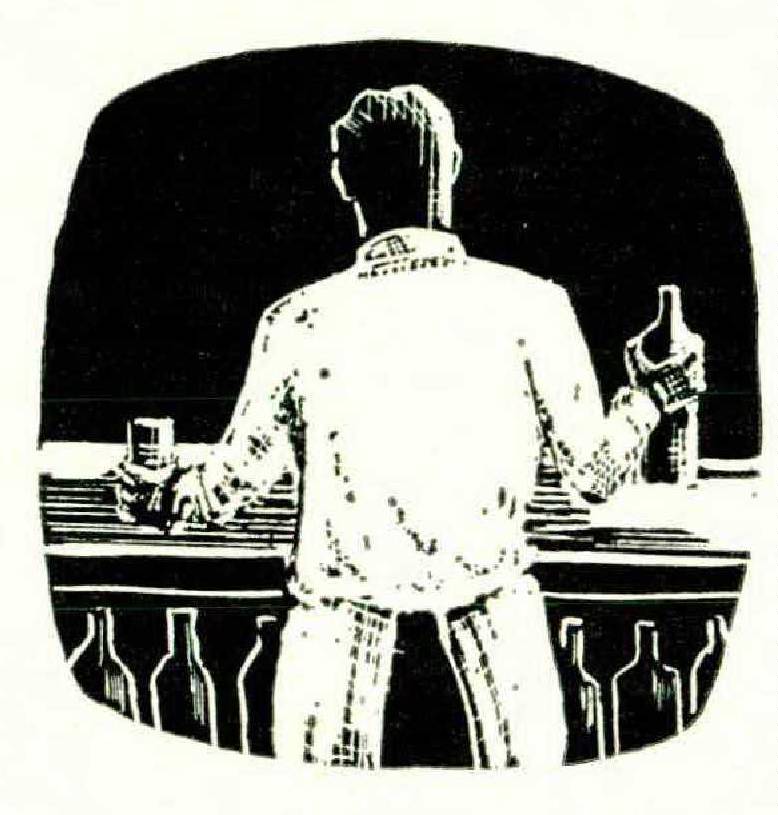
IF HE were ever seriously and politely asked who was the best bartender in the world, good manners and truthfulness would require McAndless to say that he was. There is every chance he would be right. Certainly he looked like the best bartender in the world: a handsome man and big, strongly made, with a dozen geniality wrinkles at the corner of each eye and vigorously curling white hair tamed to the sides of his head. His wrists, under the precisely twice-turned-up cuffs of his shirt, were thick as a shapely girl’s calf, yet his hands at work were nimble rather than brutish. In the daily sudden rush of cocktail hour, he moved with the speed and sureness and agility of a much smaller man, filling the orders of four cocktail waitresses and twenty or so bar customers easily and promptly. When the first frantic round of rush-hour drinks was delivered and business slowed to a more normal pace, McAndless turned from the service bar with a slight but unmistakable strut. It was hard work, requiring unusual stamina, coordination, and memory, and he did it better than anybody he had ever seen anywhere.
Mechanical skill was the least of the McAndless’ qualifications for World’s Best Bartender. Any servant can be taught to measure and shake and stir and pour, and with practice will get pretty fast at it. But servants don’t make good bartenders — or better, no good bartender is a servant. McAndless, in fact, was an autocrat. When he stepped behind a bar, he was absolutely in charge of the premises. He controlled the junior bartenders and the level of conversation, the chef and the jukebox, the waiters and the deportment of the women present.
Behind this arrogant facade beat an arrogant heart that was as much a hazard of McAndless’ occupation as sore feet. Not because he saw people at their worst and despised them for it. That’s folklore. McAndless’ arrogance was a reflection of his positive sense of his own worth. And his sense of his own worth had been shored up at every turn in life since he committed himself to tending bar. He made more money than his customers. As a bartender, for a host of cultural reasons, he was very attractive to women. He had a tremendous range of acquaintance and was well liked. For thirty-five years he had lived the good life — pint of whiskey, two-pound steak, dollar cigar. Nothing there to teach humility.
When Kuhn, Loeb cut his salary from sixteen to eleven dollars a week in 1931, McAndless took night work as a waiter on West Fourteenth Street to make ends meet. The restaurant closed every evening at ten and reopened as a speakeasy at midnight with McAndless, the biggest of the waiters, behind the bar. He worked till dawn every day, then went to Kuhn, Loeb and tried to make sense on the telephone. He did not make sense, but that wasn’t why they fired him. They fired him when he asked for vacation time, on the altogether sound premise that anybody with vacation money in 1931 was a thief. All at once, McAndless did not have a respectable job with a future paying eleven dollars a week. He had what was, in point of fact, criminal employment of unknown future paying eighty dollars a week. The difference in the money compelled McAndless to commit himself halfway to a life behind a bar.
He remained only halfway committed until one night, when perhaps he had just turned old enough to wonder what good might come of all this cheering and laughter, he was visited by three of his Kuhn, Loeb contemporaries. It was near dawn on Sunday, and the three of them had whizzed away a week’s salary on a quarrelsome and joyless payday drunk. They spoke so bitterly of their world and one another and the speaks they had visited that night that McAndless bought them several rounds of drinks to dispel the horrid sense of loss and futility these men generated. He spent more on them in an hour than any of them had made that week. Before they left, the Kuhn, Loeb clerks watched a girl whose father owned Sullivan County sweep the floor and clean the ashtrays so McAndless could take her home right away. (Porters did that work, not McAndless, but the girl attacked things with such impossible vigor that he decided it was wisest to let her tire herself some before they went upstairs or anywhere.) As he let the clerks out the door, McAndless could see hostility rising from their shoulders like waves of heat from a beach. They would have families and large homes one day when he had nothing, if only out of spite and if they had to kill themselves to do it. McAndless locked the door behind them and turned to watch a very rich girl washing his dishes. While he had been mulling his status and future, the world had committed him to tending bar. He shrugged and accepted the commitment. A minority of one is a madman.
ON THE night of Repeal, McAndless sat on the bench before an upright piano next to a girl who played, without skill, a woefully pretty ballad called “The House Is Haunted.” McAndless sang, then and always the least of his vices, and the girl played, until the midnight sirens heralding the end of Prohibition drowned them out. Everybody kissed everybody else, and McAndless kissed a telegram from the newly formed Liquor Authority of the State of New York. Until issuance of license, the telegram authorized Michael McAndless, doing business as The 38 Club, to sell whiskey, wine, and beer at retail for on-premises consumption at 120 West 38th Street, N.Y.C.
That was the first of several saloons McAndless had a piece of over the next thirty years. It did well from the day they opened the door. McAndless sold his share to the first solvent bidder because his partners’ money was gun money, which entails, sooner or later, trouble. He drifted north and east with the growth of the city, nursing his stake, his bankroll, as partner or manager or trusted employee. Jails are full of trusted employees, but McAndless was careful, and the bankroll grew. In 1942 he sold his interest in a bar (his fourth? his fifth?) that was getting rich on sailors to buy his way into the Navy. For twelve years after the war, he had a small, dark saloon on East Sixtyfourth Street that was jammed every night with grown men and women spending incredible money. It was the golden age of the saloon in New York that ended in the mid-fifties when adults abdicated, surrendering the city to children from the suburbs and similar six-dollar trash. In 1957, at the top of the market, McAndless sold out.
For all the family he had in the world, a sister, he bought a small apartment building, handed her outright deed, and walked off as though he had buried her in style, his commitment ended. For a year he did almost nothing but go to the movies. It was an exciting year. Having spent his adult life in the saloon business, he had simply missed out on movies. But a year of movies was enough, and McAndless started looking for a new bar. He was fifty years old, and far from being ready to retire, he was warming up for the next fifty and more if they’d give it to him.
He found a spare, clean, no-nonsense Irish bar on Lexington in the sixties, and bought it for little cash down and very-long-term notes. He had no illusions about recapturing the trade that had done so well by him after the war. Those were class people, and class people didn’t live in the city anymore. He wanted adult men with moderate money who were willing to pay and pay well for an enormous drink in good company in a clean, sane place with good talk and no juke noise. It took McAndless four years of twelve hours a day, six days a week, to accept, to believe, that there was no room in New York for a clean, sane saloon. He broke even when he sold the place because he had worked it himself and worked it hard. He even turned a small profit, for he learned two things that he might otherwise never have realized. First, the rules for success, as stated, are far from complete. You can work and save and use your head and know your business and still fail. With minor exceptions, only artists and soldiers have to learn that. Second, he had &emdash ;apparently and suddenly and sadly — become an antique. What pleased him didn’t interest the rest of the world. He didn’t know what people wanted.
So he took a year off for more movies and the touring of bars, then bought a place on Second Avenue that had Everything. It was well decorated and equipped, surrounded by towering office and apartment buildings, a short walk from Grand Central and a block from the UN. Couldn’t miss.
But he learned again that things had changed. Everybody commuted. There were no men left in the city after six. Just boys who couldn’t afford to leave town and tourists and what McAndless called “nances.” The place couldn’t miss, and it missed, badly. McAndless learned again and sadly that he was an antique, but this time the lesson cost him a lot of money. He had a sharp pencil, and every morning he made the same reckoning: the saloon was costing him four hundred dollars a week. Before he put the place on the market to recoup what money he could — and give that to A.T.&T. — he was approached by two young bartenders from nearby saloons that were doing well. Gambling on their youth, McAndless made them partners and gave them thirty days to make the saloon break even.
Whatever the boys set in motion, it was not a saloon. It looked to McAndless like Rosie-theLitvak’s waiting parlor before the MP’s shut her down. There were girls at the bar of a type that McAndless would never permit in a saloon of his, although years ago many of his best friends had been hookers. And once in a while two men who seemed as masculine as leather or a punch in the mouth would meet in the bar and go off! together. Whatever the boys set in motion, saloon or not, it was a business and it made money, and McAndless let them alone.
He visited the bar less and less often. The place had taken on a strong and corrupt odor. Sweat is one thing, and it smells bad, but nothing gets made or destroyed without that smell. The smell that made McAndless’ head literally try to recoil from his nose was compounded of deodorant, which he did not use, tobacco, which he no longer used, and the absolutely inexplicable smell of cheap gin, perfumed gin, half-pint gin that he had not seen, never mind tasted, for three decades. The smell kept him awake at night and woke him in the morning. McAndless decided to do his nose a favor and get out of town for a while. He made a generous and airtight agreement with the boys. It was more generous than they expected and far more binding than they knew, so both parties were joyous and scaled the agreement with many, many drinks.
IF IT does not smell good at the beach, it doesn’t smell good anywhere. McAndless drove to the only seaside resort he knew anything about — Islip, Long Island — and took a room at the inn. “The Inn at Islip,” as the owner, Mr. Bowker, insisted it be called, was a rambling complex of old white buildings perched on the dunes just above the high-water mark. There was a genteel air to the place; authority here was feminine. A piano precisely as out of tune as the pianos impoverished ladies give lessons on could be heard playing “Serenade” as McAndless checked in. The main sitting room was snowy with doilies, and there was even a crocheted something separating the rabbitears antenna from the aluminum top of the television set. The place smelled as though some old fusspot threw all the windows open three times a day to let the sea air sweep through. There was no smell of tobacco or whiskey; just salt air and the down-cellar odor of mildew.
It was not yet the resort season when McAndless checked in. It was the ninth of May, and they charged him eighteen dollars a day for a spare cell of a room and three meals. That seemed a little steep to McAndless, but he had money in the bank, and the beach was worth it. The water was too cold even for wading, but because of the cold the surf was unlittered and so white you couldn’t look at it for long. You could see almost through the waves as they humped up a hundred feet offshore. The beach was hot and empty by day, and at night McAndless slept curled under two blankets.
The manager of the inn was a big white-haired Britisher twenty years McAndless’ senior with a dramatically deep tan. His name was Ed Grant, and he insisted that at McAndless’ age he had been the same size but had shrunk. They walked miles on the beach together every morning, talking of the hotel and bar businesses, the British and American navies, and a shared enthusiasm, Winston Churchill. People who passed them on the beach could be depended upon to stop at a polite distance and wonder at the two big white-maned gentlemen. Old movie stars? Retired admirals? Jewel thieves?
At any rate, they came to know one another well and to enjoy each other’s company, and as the month wore on, Grant said he might be able to arrange a room for McAndless for the season, but not for less than thirty-five dollars a day.
“Must be some room,” McAndless said.
“Not quite the room you have now, I’m afraid,” Grant said. They were standing on a slat-board path before the main building of the inn, having finished their morning hike. Grant put one foot into the sand next to the path and watched it disappear. He looked uneasy but pleased. “We do quite well in the summer. Same people every year. Well-to-do. Gentlemen, almost all of them, with their wives —”
“I’m not broke by any means,” McAndless said, “and a good reason I’m not broke is that I don’t pay thirty-five dollars a day to stay in resort hotels in season — however pleasant the management might be.”
“Well. Yes. Can’t say I blame you.” Grant pointed from his hip at a tacked-on afterthought wing of the main building that was the inn’s bar, and for want of a better word, cocktail lounge. “You have to admit that’s one of the handsomest little bars you’ve ever seen in your life —”
“Oh, no you don’t.”
“Our guests are a marvelous class of people, wonderful to deal with and very generous. The bartender here has his own cottage in the rear —”
“Come on. I have a place in the city.”
“I know you do. And you hate it. It stinks. You told me so yourself.” Under the shade of one hand, Grant looked right through McAndless’ skull and clear to Lisbon.
McAndless’ eyes wavered, and he dropped them to inspect his nails. He was abruptly seized with lust for the little jewel of a bar, and with something akin to nostalgia for the days when he worked regularly with men and women of class and money. “Ah, no,” he said at length. “The man who owns the place is an overbearing, contrary little fascist. You told me so yourself —”
“I did not!”
“And I’ve been on my own since Repeal. You can’t expect a man like me to take advice, never mind orders. I’m just as used to having my own way as your friend Bowker. There’s bound to be a clash.”
Grant had a characteristic deep chuckle which he delivered off the bridge of his nose, like a baritone warming up. “Hm-hm! And what if I’m the buffer?” He patted his generous belly. “Enough here to buffer anything. Well. Think it over. Drop by if you have a minute.” He stomped down the path to the porch and around the porch, as though he were put out with McAndless for hesitating and would be infuriated if McAndless refused. First-rate con man, McAndless thought, smiling after him. The old devil had the touch.
With one hand on the plate glass of the window to make a cup of shade to see through, McAndless looked, perhaps for the twentieth time, at the bar. The chairs were wicker and deep, the tables round and thick and close to the floor. From the front windows you could probably see the surf; certainly from behind the bar you could see out to sea for miles. A jewel. And really, seriously, what the hell else did he have to do for the summer?
THE establishment and maintenance of a superior bar facility were what McAndless’ working life was all about. He shorted the house a mixed case of scotch and rye on the initial inventory and bribed hotel workmen to scrub and paint for him. When the first guests of the season arrived, he promised the economic moon to the ablest and most mature of the undergraduates who waited tables, and got himself a splendid barboy. Every morning at eleven thirty he emptied half the Coke out of a bottle, filled it with whiskey, and delivered it to the salad chef. In return, the salad chef provided the bar with colossal trays of hors d’oeuvres. For cold beer with her lunch, the housekeeper supplied the bar with fresh linen and flowers every day.
The guests were everything McAndless had expected, and more. He had expected they would be rich, and with rooms suddenly fifty dollars a day, he wasn’t disappointed. If there was one characteristic McAndless found cheering, even endearing, in people, it was the possession of money in reasonable quantity. The more, the extra, the plus he hadn’t anticipated was that these people were not only gentlemen and ladies, they were people on an expensive holiday, smilingly determined to be pleasant and to be treated pleasantly. Many of them, indeed, wanted to be amusing and amused, certainly their right at those prices, and several succeeded. From the very beginning, it was such a pleasant job that McAndless often said it was a shame to take money for it. But he did. At the end of the first two weeks he was showered with envelopes by departing guests. The envelopes were full of tens and twenties, and one had a fifty-dollar bill in it. He and his barboy, Willie, pooled all tips and split down the middle. McAndless almost laughed aloud in pleasure watching Willie count his tips. It was so much money the boy didn’t want to carry it loose in his pocket. He went to his room and got his wallet, tucked the money in neatly, and installed the wallet on his hip, patting it often the rest of the day.
When the first group of guests left, McAndless literally, actually, honestly felt sad. It was his first experience with a resort bar, where people you have become attached to are suddenly no longer around. But then a new group of guests, just as rich and nice, replaced those who had left him, and McAndless transferred his attachment to them.
There were incidents, of course, initiated by the women who ran the other departments of the inn. In years past, apparently, the man who ran the bar had been the first berry-cheeked wet-head to come in off the street, and McAndless was certainly not that. He was, at the kindest estimate, an overbearing man, although he was cheerful about it. The women came to hate him not as a challenge to their established eminence but as one hates the Goodyear balloon — there, out of reach, its name emblazoned, unconcerned. The housekeeper reported that McAndless had given whiskey to the maintenance men to polish his bar before opening. There was outrage in the front office, and Ed Grant, as buffer, went to speak to McAndless. “Where did the whiskey come from?” Grant asked by way of rebuke.
“I shorted the house a case on the initial inventory,” McAndless explained blandly. “It was cheaper than paying overtime.”
“Probably was,” Grant said, at a loss, as we all are, to deal with reasonableness. “Join me in a scotch.”
By way of celebration of the tips, McAndless closed the bar early one night, and he and Willie took a handful of guests on a tour of local jazz joints and discothèques and colored bars. Grant was at the door of the bar when McAndless opened up in the morning. “No need to take money elsewhere, is there?” he began.
“I looked for you but you were already in bed,” McAndless said, opening the door. “What the hell, Ed. It was my money, Willie’s and mine, that got spent.” McAndless smiled openly, even tolerantly, as only a marvelously secure man can smile, and Grant shelved the lecture he had been sent to deliver. It had involved words like “fraternizing,” and “guests” said in the sense of “betters,” and in the face of that smile his speech became unutterable. He also shelved, in large part, his role as buffer. It was too much to ask of him, at his age, to bridge the gap between the outraged unreason of the front office and the sweet reasonableness of the bar, particularly when he knew perfectly well they were both wrong.
Bowker came into the bar every evening at cocktail hour for one drink, sometimes two, with his guests. In the language of the trade, Bowker owned the store, and McAndless served him promptly and well. That was the extent of their contact. Then the loss of Willie was felt or imagined to be felt by the woman who ran the dining room, and she went to Bowker in tears, lacking a whip. In curiosity more than anything else — in the past the barboy had been the least competent of the waiters — Bowker visited the bar one day in the middle of the afternoon. Neither he nor McAndless knew quite how to behave. Bowker stepped across the threshold of the bar as though the floor might give way under him: McAndless approached him with big hands gingerly outspread, as if to catch a tumbling vase. When it was established that he wanted neither to drink nor complain, Bowker asked Willie if he really liked working in the bar.
“Yes, sir. I like it fine,” the boy said. He looked staunch and loyal. He had a great deal of money on his hip.
“In other years our . . . older boys all wanted to work in the dining room. We’ve always had trouble getting a good young man to take this job.” Bowker smiled in a way that said, We are all friends here, encouraging Willie to speak. He was confused to the point of suspicion that a good waiter would want a job that for twenty years had been the burial ground for his annual error.
“I like it here fine, sir,” Willie said. Some of McAndless had rubbed off on him, and he added, brightly, “Nice of you to ask.”
“All right,” Bowker sighed, in a tone that usually prefaces “It’s your funeral,” and he left. McAndless considered the incident, if he considered it at all, as closed. It wasn’t in him to understand that he had witnessed a vigorous protest from a timid man.
The encounter didn’t produce a beginning of comprehension between McAndless and Bowker, but it did lower or break the barriers to communication. When Willie was assigned by mimeograph to some nut-house early-morning color guard, McAndless spent only twenty minutes looking for Ed Grant before carrying his protest directly to Bowker.
“Why shouldn’t an American boy want to raise his flag?” Bowker demanded.
“Because he works till midnight, sometimes two in the morning.”
“That’s not very patriotic, I must say.”
“Oh, let’s find a patriotic waiter,” McAndless said, not laughing and looking like a man who was not laughing. “They can get to bed by eleven.” And McAndless left, considering that incident closed, too, because the arrogant and the timid have as much in common as the rich and the poor.
But these incidents were isolated and rare and not the ordinary course of events. In the main, it was McAndless’ pleasure to tend bar at the inn. He rose early and swam and hiked the beaches — generally alone, since Grant seemed very busy now. He played golf twice, dutifully and without skill, because the men at the bar talked about the course continually. The food at the inn was so good it was startling, and McAndless ate selectively and enormously. There was even a Mrs. Goyette, a husbandless woman of, say, forty-five, who had not simply taken a fancy to McAndless but was altogether smitten with him. She was a graying blonde who wore bulky pastel sweaters, lots of bangles, and tight slacks. She rented a house nearby, was not a guest at the inn, but took her meals there, in order, she explained, “not to have a lot of servants snooping around all the time.” McAndless got that message readily enough, but she mooned so at him that he declined her unstated invitation. It would be cloying, and in McAndless’ present atmosphere — salt water, sun, sand, hard work, marvelous people — he would not be cloyed.
July Fourth and Labor Day are two weekends that can make or break the season for resorts. If the forecast is for rain on the Fourth, it can mean the resort operator can’t afford Florida in the winter. If the forecast is for rain on Labor Day, too, it can mean the end of the business. It doesn’t much matter whether it ultimately rains or not. The forecast keeps people and their lovely money in the city. The television and newspapers agreed on the Friday before the Fourth that the weekend would be deluged. Bowker digested this information, fired a second cook, pronounced the glassware in the dining room untouchable, asked a guest at the buffet if he really thought he could eat that incredible plateful of food, and in general behaved like a resort operator before a rainy Fourth. On a shortcut through the bar, on his way to make trouble at the front desk, Bowker saw McAndless out of the corner of his eye and stopped, his face bulging with words and anger and fright. “Where’s your jacket?” he demanded in the presence of several customers.
“I don’t work in a jacket,” McAndless said mildly, gentling Bowker because there were people at the bar. He smiled affably, reasonably, because he saw he dealt with a frightened man somehow backed to the wall, and nothing bites like a cornered fox.
“Willie doesn’t seem to mind wearing a jacket.”
“Willie is the barboy. I’m the bartender.” It was in no way a boast. McAndless was stating what was to him an important fact.
“We’ll see.” Bowker said senselessly, furiously, and stormed off. He was followed out by a lovely ripple of woman’s laughter that made it very easy to keep moving.
McAndless’ shirts were white, broadcloth, tailored, monogrammed. button-down, flap-pocket, lightly starched prides. They were handsome and expensive and had a decidedly formal air. Even the twice-turned-back cuffs had elegance. He did not simply fold them back but ironed them in place every morning. When Saturday turned out to be exactly as rainy as forecast, Bowker came into the bar before lunch. He walked rapidly to the door, on the attack, but ran out of courage on the threshold, probably because McAndless was alone in the room. “Didn’t the jackets arrive?” he said, with what can only be called asperity.
“These shirts cost me twenty dollars apiece, or damned near,”McAndless said. He had been counting his bankroll and stood with large batches of bills in either hand. “I don’t see the sense in covering them with dollar jackets from a laundry truck.” He went on counting.
Bowker hated Communists because there aren’t any, he was that timid, but the sight of all that money in McAndless’ hands infuriated him. (The bartender has so much money it takes all morning to count it, and I’m losing thousands because of that goddamned rain.) “If you’re going to work in my bar you’re going to dress appropriately,” he announced; then his eyes went big at his own temerity.
“I’m dressed appropriately,” McAndless said, pocketing the money, putting it out of sight, aware the money had touched the man off. He tried to smile, but something set his stomach to churning wildly full seconds before he knew what was happening in his head. “Your bar?” he said, and “Your bar!” he hollered.
“We’ll see,” Bowker called, leaving fast. “We’ll see whose bar this is!”
MCANDLESS knew whose bar it was. After ten minutes of banging things and muttering, he went to the front office to find Grant and tell him to get another man in a hurry. Grant had just left, and nobody seemed to know where he had gone. McAndless was furious with himself for letting Bowker bait him out of his jewel of a bar; and then, of course, he was depressed. He wanted very much to be left alone in his depression, but he had set in motion an unparalleled little saloon, and by three o’clock that rainy Saturday afternoon the bar and the tables near the bar were full. You were childish about that jacket, proud of your expensive shirts, vain of your old man’s figure. One of the men arrived with a ukulele and everybody sang “rain” songs, of which there is an astonishing number. You refused to wear a coal that said “I am the bartender.” One of the couples, not young people but probably unaccustomed to alcohol in the afternoon, left holding hands, and everybody clapped. You took the bartender’s tips fast enough. Why couldn’t you wear his jacket? He had left a message asking Ed Grant to come and see him as soon as possible, but Grant didn’t appear that afternoon, nor did he come by in the evening. Yes, I know whose bar it is, but I hope they are very careful how they ask me to leave it.
By way of lifting his spirits. McAndless drank along with his customers. At eight o’clock he was sitting on the beer cooler behind the bar, watching Willie trying to work the bar, booming instructions, and roaring with laughter. The guests joined in, ordering drinks Willie had never heard of, then changing their minds. Willie took it all with marvelous grace. At eleven, McAndless threw everybody out, and with a spandy new quart of scotch in his fist, stomped off to his cottage.
It rained Sunday, too. McAndless needed badly an hour of hot sun, a swim, a hike on the beach. Instead, he got company. Pretty, faithful old horny hound dog Goyette was at the door when he opened the bar. He made her a drink and went about the business of “setting up.” He had filled the ice bins when he saw two figures walking up from the beach in the thick mist, very slowly, sopping and reluctant. McAndless stood up straight and dried his hands. “Oh-oh,” he said.
“What is it, Mike?” Mrs. Goyette cried, clearly ready to hurl her frail body into the sea to spare her man. McAndless walked rapidly out from behind the bar to the outer door and waited for the boys to come to him. They were his managers, his partners in the city saloon. Roland, the leader, stopped outside the door. “I suppose you’re wondering what we’re doing here, Mike,” he said.
McAndless turned his back on bad news. “Come in,” he said. “Shut the door. Sit down. Dry off.”He went behind the bar and busied himself with cherries and olives and lemon peels. He spilled the peels into the ice and threw everything else in after them. “All right. Let me hear it.”
“Fact is, we had a raid,” Doug, the younger one, said.
“A raid.”
“Not exactly a raid,” Roland said. “Is it all right to talk?” He nodded at Mrs. Goyette.
McAndless overlooked this politeness entirely. “OK, you didn’t have a raid. What did you have?”
“Couple of girls picked up two businessmen. They were vice squad.”
“That could mean my license. You’re tellin’ me I might have to start all over at sixty, sixty-five.” The boys said nothing. McAndless filled an oldfashioned glass with whiskey and drank it off. “Doug,” he ordered, “get back here and set this bar up. Roland, come over here and sit. Tell me what I got left.”
The first look at a cut is the worst. After that it is just so much blood on your sneakers. McAndless learned there would be a fine, at the least, and probably a big one. A hearing was set before the State Liquor Authority early in September, They could continue to do business until the hearing, but that meant a policeman on the premises and on the payroll twelve hours a day. And a sign in the window warning passersby that the joint had been raided.
“A cop? A sign in the window? Forget it,” McAndless said.
“Well, yeah, Mike,” Roland said, “I can’t say I blame you, but me and Doug, we gotta make a living —”
“Make a living someplace else. Work a couple of weeks somewhere. Lock the joint up till I come back, because I’m coming back with customers you wouldn’t believe. I got a stack ol cards this thick. Grown-ups! Adults with money! All of them looking for a decent saloon in New York, and I’m going to give it to them. Go back to the city.
Lock the joint, and leave it locked till you hear from me. Now get lost.”
The boys left without a word. Certainly they were cowed by McAndless, and naturally they had very little to say in their own defense. But mostly they did not speak because everything they knew about the saloon business told them that McAndless was crazy. There was no trade for a grown-up bar in New York, although old-timers talked about it always. They trudged off down the slat-board path toward the sea, their narrow, bent backs reading clearly Crime Does Not Pay.
LATE that afternoon the mist burned off and the color of everything became impossibly true and Ed Grant entered the empty bar with a handsome young Greek at his side. McAndless recognized the Greek at once. He was a West Side hotel bartender, and McAndless at first sight felt for him the contempt of the physician for the quack. “This is Miko,” Grant said. “He’ll be working with you.” The eyes that had once seen right through McAndless’ skull and clear to Lisbon were Little Orphan Annie saucers.
“Where were you yesterday when I was trying to quit?”
“I wish you’d show him around, show him the storeroom —”
“Funny thing, I need the job now. My city saloon is in trouble.”
Water bubbled into the Little Orphan Annie eyes. “— introduce him to the guests, and of course to Willie — ”
“All right, Ed. I’ll take care of it. Forget it.”
“Thank you,” Grant said. He walked to the door and stopped as though some comment were expected of him and he could think of none to make. “I’m not eligible for social security,” he said finally, angrily, and he walked off, looking seventy-seven easy.
“Willie,” McAndless called to the boy dozing in a deep chair. “This is Miko. He’s the new bartender. Show him around —”
Looking impossibly staunch and with his youth sticking out all over him, Willie said, “They fire you, I’m quitting.”
“Talk about it tomorrow,” McAndless said, pleased. “Show him around.” He smiled that he could command that response from a young man, hoping the gift would never go away.
Although it had been a long time between victories, McAndless took the new defeats hard. He no longer healed very well. He stood on a sun deck above the beach and the surf, wondering at the sharp colors the burned-off mists had left, and learned a host of old lessons: you can’t get anywhere without sticking your neck out, but if you stick your neck out, almost anybody can chop your head off; there is no fidelity, only humanity; things have no allegiance, an automobile you love will go faster for the man who steals it. Lessons he had learned long ago and so well that he had been several times a rich man. Perfect, he thought. Perfect. Even the tide is low.
Far to McAndless’ right an old Ford pulled into the parking lot, and so many people got out of it, it was like the circus but funnier. Six men and six women, all carrying beer cans, got out of the car and walked to the beach, making tremendous noise. McAndless had a curious feeling, close to déjà vu, and he pursued it, hunted it down, and he remembered Boston, where he had buried a wandering brother. He had left the funeral parlor at twilight, and there were no cabs around. A trolley came by and he got aboard, thinking to take it to the nearest wide place in the road where there might be taxis. He fell asleep on the trolley and was wakened by the conductor, who shook him gently and insistently from all possible distance — sure McAndless was drunk, and afraid of him. “This is the last stop,” the conductor said. “After this it’s the carbarn.” The door of the trolley was open, and McAndless stepped out into the cold night. He stood on the curb newly wakened, disarranged by grief, and lost, watching the trolley car go away. Suicide time. Down the street were the lights of a small bar, and he walked to it, hoping to telephone for a taxi.
All of the men at the bar listened in when McAndless told the bartender he was lost and wanted a taxi. At once, and for no reason he could think of to this day, half of the men offered him a lift to anywhere he wanted to go. They got to pushing and shouting over the right to drive McAndless around Boston. Confused, not at all sure his leg wasn’t being pulled, McAndless ordered a round of drinks for the bar. Somebody bought him a solitary drink in return, and he bought another round for the bar.
A party ensued which McAndless remembered in detail — although he had gotten quite drunk —now, ten years later. The people in the party were for the most part Irish males, restricted in their pursuit of hilarity only by the absence of money, and McAndless had money, plenty of it. When the bar closed, a dozen of them, drinks in hand, had climbed into one car and driven off. McAndless slept eighteen hours in the back bedroom of a wooden tenement and woke up cured of his brother’s death.
MCANDLESS put on a jacket. He went to his cottage and put on his best linen jacket. When he got to the bar he chose a corner barstool he had always thought would be a grand place to sit as a customer. He ordered a scotch, and he and the Greek had a brief professional talk about prices and which whiskey to push and related pedestrian matters of bar management. I hat out of the way, McAndless told Miko to put all cocktail business on a tab and give it to him after dinner. As the guests arrived and learned their drinks were being paid for, they asked out of courtesy why McAndless was leaving. He explained that his business in the city forced him to leave the inn, which was in part the truth and certainly more pleasant than telling them he had been fired. Again out of courtesy, he was asked what had gone wrong with his restaurant in the city, and McAndless told a story that was only here and there factual about the boys, the hookers, the fags, the vice squad. He told the story with every comic device at his command to mounting laughter, and at the end, laughter and delighted applause. The party was on.
Mrs. Goyette arrived and sat next to McAndless at the bar, and was suddenly very attractive to him. It wasn’t the scotch in him, nor did she become attractive in the way Burmese do if you are in Burma long enough, but she had stopped pushing, pressing, soliciting. She had McAndless for the evening and knew it, so she relaxed, eased herself, permitted her intelligence and humor to come through, and was in consequence something of a belle.
The men at the bar were different from the men McAndless had met in God-knows-where, just outside of Boston, in that they had money, too. Soon several men were buying drinks for separate clusters of talking people, and the party gained size and momentum. As he was shocking and amusing the group around him with another story from the shadow world of saloon life, McAndless recognized something in the faces of the men. They were the men who had sweated out eleven dollars a week in 1931 while he lived the good life. And now it was their turn. They had homes and families and money and no fear of the future. And he had what he had. He closed down hard on that section of his mind. There was no bitterness there, but there wasn’t a hell of a lot of joy, either. He concentrated on telling his story, on amusing his guests.
All at once it was nine o’clock, the bar was still half-full of people, and the dining room was closed. McAndless gave Willie ten dollars to give to the salad chef in return for twenty hamburgers for the bar. Willie and the salad man responded with trays of roast beef and ham and turkey sandwiches, and the salad man made McAndless take back his ten. The party almost fizzled on the food, but McAndless restored the party spirit by pocketing all of the bar tabs before a Greek in panic.
They went, four carfuls of them, to a local jazz joint, where McAndless sang several ordinary songs of his youth which were now folk classics. Later at a discothèque one of the professional dancers took an unlikely shine to McAndless. She had long blond hair, a deep bosom untrammeled in a loose sweater, and skintight pants. She taught McAndless a couple of primitive steps and hurled herself into lunatic action before him. McAndless joined her until his legs quit. Back at the table, he plumped down in his chair laughing and exhausted. Mrs. Goyette, speaking as sweetly as only a jealous woman can, suggested they all go back to her place and have a swim in the pool.
Mrs. Goyette’s summer house was so senselessly large and so evidently expensive that McAndless decided in drunken cunning that it was time he got married after all. There was a bar with more whiskey on it than some saloons can boast, and two of the men made drinks for everybody on the grounds that McAndless had been waiting on them long enough. The women crowded around McAndless, batting their eyes and asking long-forgotten questions they were once told would “draw men out.” He was the first bartender some of them had ever really talked to. His life seemed irregular, unpredictable, insecure, even daring — everything their lives weren’t. And anyway, he was a big masculine thing and fun to flirt with. Understanding most of the reasons for his momentary celebrity, McAndless enjoyed it hugely nonetheless, and hoped he would never see the day it stopped.
At four in the morning, the women began to look slick and ugly and one man was snoring in an armchair. By common consent the party broke up. The men put on their coats and the women smoothed their dresses and they all woke the sleeping man and headed for the door. Emily (formerly Mrs. Goyette) caught McAndless’ sleeve where no one could see and tugged it briefly but urgently. “I thought I’d stick around for a drink, if it’s all right with you,” McAndless said, so she wouldn’t have to ask.
“Fine. I haven’t had a chance to talk to you all night,” Emily said, and went to the door, calling airy good-nights to her guests.
There was a minor accident in the driveway and glass tinkled as one of the cars backed into another, but finally all four cars got under way sensibly enough, everybody yelling good-night. In the headlights of the backing and turning cars, McAndless saw the pool. It was curiously shaped and surrounded by a patio and looked chill and forbidding. Perhaps because a swim might add some flavor to his forthcoming, inevitable encounter with Emily, or perhaps because the pool looked so forbidding and had to be challenged and overcome — either way for reasons having to do with pride — McAndless announced, “I’m going for a swim.”
“A swim? At this hour? Don’t be silly. Come in and have a drink.” She said this last in tones of the sweetest invitation. McAndless felt no matching urgency — felt, indeed, anesthetized from the waist down — and decided a swim was imperative.
“You go fix us drinks.” he said. He had his coat and tie off and was unbuttoning his shirt. “Bring them to the pool. All of a sudden I’ve just gotta go swimming.”
Emily left with a sigh that said she would go along with him now and domesticate him in good time. McAndless undressed at the pool, folding his clothes neatly, as was his nature, and piling them on a chair. He flexed his great shoulders without vanity and slapped his flat belly, hard. Naked at the edge of the pool, he did not in the least want to dive into the forbidding water. But he’d look like a fool if he got dressed and walked back to the house. And who knows, maybe the plunge would wake his jewelry up. “Get in and get out,” he said aloud to the night. “No backing out now.”
He dove. It was the shallow end of the pool, and he bumped the bottom roughly. The water was beyond-belief cold, and the shock of entry drove the air out of his lungs. He surfaced and began a controlled breaststroke to the far end of the pool, which seemed now a long way off. He suffered a sharp pain along his left side and turned on his back to float, saying aloud through clenched teeth, “Don’t be trite. Show a little imagination.” Then somebody hit him in the left rib cage with the peen end of a ball peen hammer as big as the World’s Fair. His knees jerked right to his nipples and stayed locked there. He rolled on his side and began to sink, knowing all the while that he had to unclench his body or drown. He got his right arm moving and propelled himself toward the nearest rim of the pool. With an effort of strength and will he could not quite himself believe, he unclenched his body and forced it to the pool’s rim and rolled it out of the water, onto the stones of the patio. He heard a woman screaming and heard glass breaking, but he kept moving on all fours to the chair that held his clothes. Even though somebody was helping him, he had a terrible time getting his shirt on because his body was wet. He got his arms through the sleeves, and still on his knees was trying to make the buttons work when that goddamned hammer hit him in the chest again and getting his shirt on didn’t matter anymore.