The Great Mail Crisis of Norfolk, Illinois
JORDAN CRITTENDEN is a graduate of Kansas University now living in Laguna Beach, California. His first novel, BALLOONS ARE AVAILABLE, will be published this month by Atheneum.
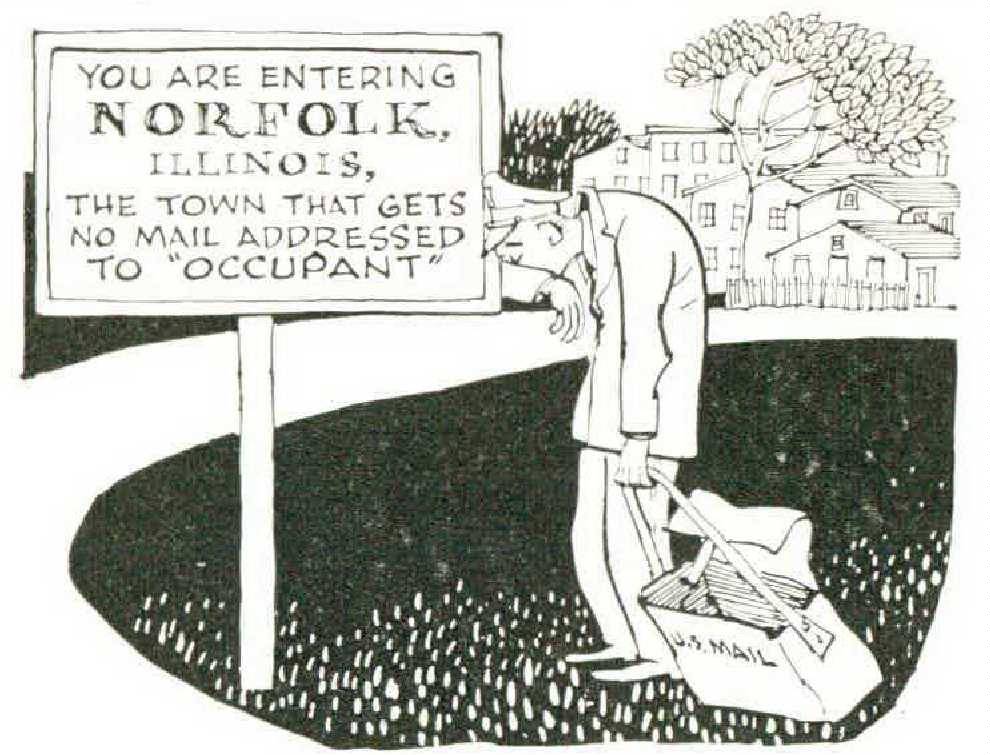
The people of Norfolk, Illinois, were never especially fond of receiving mail addressed to “occupant,” even though it might tell how to order custom-made draperies at below factory prices, or contain a coupon good for seven cents off on a kitchen item that wiped clean with a damp cloth. No one thought such mail was important. But then last year the entire community of 20,000 was deprived of its rightful quota of such mail. The repercussions have not yet died away.
Harold Lockehart, the postmaster of Norfolk, sensed something was amiss when he returned from a coffee break on August 2, 1965, and found three mailmen playing keep away with a bottle of mucilage. “Let’s cut this out and get that mail delivered,” Mr. Lockehart said.
“We already did,” said one of them. “Hey, you and Fred try to get it away from me and Arthur.”
The next day was worse. All the mailmen were through by nine o’clock in the morning. One mailman, who was new on the job and anxious to prove himself, collected all the mail that hadn’t yet been taken from the mailboxes and delivered it again.
By the fourth day Harold Lockehart knew it was serious. He checked with the sorters, who worked in the back of the post office. “Something’s fouled up,” they said. “We’re getting some first-class mail, which is nice, but no occupant mail.”
Mr. Lockehart went to the train station and questioned the man in charge of unloading the mailbags. “Are you tampering with the natural ebb and flow of occupant mail?” he said.
“Do I look like that sort to you?”
“Frankly, yes. Especially around the mouth.”
The man quit and took a job selling new and used cars. Still there was no occupant mail. “I don’t like it,” Mr. Lockehart said to his wife. “The men are getting restless.”
The first of the trouble began the following week. Mr. Walter Ott, who had been a mailman for over thirty years, was caught throwing rocks at a duck in the city zoo. He admitted to authorities that he knew it was wrong, but said there didn’t seem to be anything else to do.
On August 25, Mr. Lockehart called an emergency meeting of Norfolk’s civic leaders. “For one thing,” he told them, “an awful lot of mailmen will be out of work.”
“How many do you presently employ?” said one of the civic leaders.
“Twenty-six.”
“And if the current dearth of occupant mail persists, how many will you actually need?”
“Well, if my little boy lets me borrow his wagon, I think I can do it all myself,” Mr. Lockehart said.
The civic leaders formed a factfinding committee to interview the residents and try to determine what had halted the occupant mail influx. The committee was formed over protests that the matter was the responsibility of the federal government. Later that week there were pickets marching in front of the post office. Some unpleasantness occurred when a passerby began haranguing a mother of four who was carrying a placard that read: “Keep Occupant Mail Out of Vietnam.”
Meanwhile, the fact-finding committee discovered a startling apathy toward occupant mail among the residents of Norfolk. Often, disillusionment was the cause. One housewife said, “A year ago I got a coupon entitling me to an absolutely free nail brush with deluxe nylon bristles and a lifetime polyethylene handle. The whole family was excited when it arrived. We thought maybe things would be different from what they’d been before. But then, only a month later, my husband said to me, ‘Martha, I don’t know what’s wrong with me, but I don’t seem
to care one way or another about the nail brush.'”
Another housewife said she once took advantage of a low, low offer on a vanity shelf for home or office that featured powerful neoprene suction disks. “I should never have taken advantage of that offer,” she said, “because the next thing I knew, the company was in serious financial trouble. I’ve felt awful ever since.”
Evidently, the fact-finding committee concluded, these incidents and others like them had caused the corporations of America to lose faith in Norfolk, Illinois.
A second committee was formed to write various companies and ask them to give the people of Norfolk another chance. One company was urged to saturate the town with samples of its revolutionary new toothpaste. A large record company was urged to mail out announcements of a 50 percent savings on its invaluable collector’s item, which featured the top song stylists of the sixties singing all-time pop favorites. “Just the other day,”the committee wrote, “one of us was saying to another one of us, ‘Wouldn’t it be swell to have Bobby Darin, Connie Francis, Frankie Avalon, and a host of others on a single microgroove 33 LP!’ ” Unfortunately the committee was unable to address its letters to any particular individual within the corporations, and as a result, their pleas were mistaken for ordinary occupant mail and discarded unopened.
At the height of the crisis, a flock of sea gulls arrived from nowhere and settled on and about the post office. Many people called it a good omen, although it did not seem to affect the situation.
That November Harold Lockehart was forced to dismiss the mailmen employed by the Norfolk post office. “I hereby dismiss all twentysix of you,” he said. “Good luck in the new endeavor of your choice.”
They did not even try to find other jobs. They had been idle too long. They no longer seemed themselves. Within a month all of the mailmen had bought motorcycles with their severance pay, and had taken to roaring up and down the small main street of Norfolk, terrorizing shoppers and merchants alike. They continued, out. of esprit de corps, to wear their uniforms, which, with the addition of chrome chains around the waist and leather gloves, looked surprisingly menacing.
The townsfolk are undecided what to do. One faction claims that the problem will solve itself once the local draft board catches up with them. Another faction, however, argues that this attitude is unrealistic since most of the unemployed mailmen are over forty.